April 3: Truly This Man Was the Son of God!
♫ Music:
Mark 15:21–41 (NKJV)
Then they compelled a certain man, Simon a Cyrenian, the father of Alexander and Rufus, as he was coming out of the country and passing by, to bear His cross. And they brought Him to the place Golgotha, which is translated, Place of a Skull. Then they gave Him wine mingled with myrrh to drink, but He did not take it. And when they crucified Him, they divided His garments, casting lots for them to determine what every man should take.
Now it was the third hour, and they crucified Him. And the inscription of His accusation was written above:
THE KING OF THE JEWS.
With Him they also crucified two robbers, one on His right and the other on His left. So the Scripture was fulfilled which says, “And He was numbered with the transgressors.”
And those who passed by blasphemed Him, wagging their heads and saying, “Aha! You who destroy the temple and build it in three days, save Yourself, and come down from the cross!”
Likewise the chief priests also, mocking among themselves with the scribes, said, “He saved others; Himself He cannot save. Let the Christ, the King of Israel, descend now from the cross, that we may see and believe.”
Even those who were crucified with Him reviled Him.
Now when the sixth hour had come, there was darkness over the whole land until the ninth hour. And at the ninth hour Jesus cried out with a loud voice, saying, “Eloi, Eloi, lama sabachthani?” which is translated, “My God, My God, why have You forsaken Me?”
Some of those who stood by, when they heard that, said, “Look, He is calling for Elijah!” Then someone ran and filled a sponge full of sour wine, put it on a reed, and offered it to Him to drink, saying, “Let Him alone; let us see if Elijah will come to take Him down.”
And Jesus cried out with a loud voice, and breathed His last.
Then the veil of the temple was torn in two from top to bottom. So when the centurion, who stood opposite Him, saw that He cried out like this and breathed His last, he said, “Truly this Man was the Son of God!”
There were also women looking on from afar, among whom were Mary Magdalene, Mary the mother of James the Less and of Joses, and Salome, who also followed Him and ministered to Him when He was in Galilee, and many other women who came up with Him to Jerusalem.
Poetry
from “Darkness”
by Lord Byron
I had a dream, which was not all a dream.
The bright sun was extinguish'd, and the stars
Did wander darkling in the eternal space,
Rayless, and pathless, and the icy earth
Swung blind and blackening in the moonless air;
Morn came and went—and came, and brought no day,
And men forgot their passions in the dread
Of this their desolation; and all hearts
Were chill'd into a selfish prayer for light:
And they did live by watchfires—and the thrones,
The palaces of crowned kings—the huts,
The habitations of all things which dwell,
Were burnt for beacons; cities were consum'd,
And men were gather'd round their blazing homes
To look once more into each other's face;
Happy were those who dwelt within the eye
Of the volcanos, and their mountain-torch:
A fearful hope was all the world contain'd;
Forests were set on fire—but hour by hour
They fell and faded—and the crackling trunks
Extinguish'd with a crash—and all was black.
The Long, Dark Coronation of the Son of God
One year during Holy Week, a student shared in class that Good Friday, in his Norwegian tradition, was known as “Long Friday,” so called because of the extended fasting and reflection offered in honor of Christ’s sacrificial death. Similarly, when the Gospels narrate the final days of Jesus’ life, time slows down to a crawl. Mark gives an extended account of events leading up to Jesus’ final moments. This was a Long Friday indeed.
After he is flogged, Jesus carries his cross until he can’t. Simon gets him to Golgotha. Jesus declines the offer of wine with myrrh, facing every moment with none of his senses dulled. The day only grows darker as the soldiers nail Jesus to the cross and then take bets on who gets his clothing. They affix a sign above the cross to publicize his “crime,” and then the mocking begins. First it comes from those passing by; the public has rejected him. Next it comes from the chief priests and scribes. Finally, he is mocked by the criminals on either side. This scene is marked by rejection all around.
Have you ever felt all alone? Jesus, here, is all alone.
The bright sun was extinguish’d, and the stars did wander darkling in the eternal space, rayless, and pathless. Lord Byron’s words mirror the bleakness of this moment. In the dark of noonday, Jesus is anguished, “My God, my God, why have you forsaken me?” There is no answer. Jesus cries out once more. He takes his final breath.
“Truly this Man was the Son of God!” This first human response to Jesus’ death that Mark records is remarkable. First, it is uttered by a Roman centurion, someone who would be expected to ascribe this title to a Caesar. Instead, he deliberately recognizes Jesus’ divine sonship. Second, as a gentile, he represents the reality that all people—Jew and gentile—are invited to recognize Jesus as Lord. Finally, consider what induces this centurion’s declaration. Mark tells us it was when he saw that Jesus “cried out like this and breathed His last” that he knew. It wasn’t after Jesus was raised from the dead. No, it was within the depth of darkness, at the height of suffering, at the moment of his death. This is when the centurion recognizes Jesus.
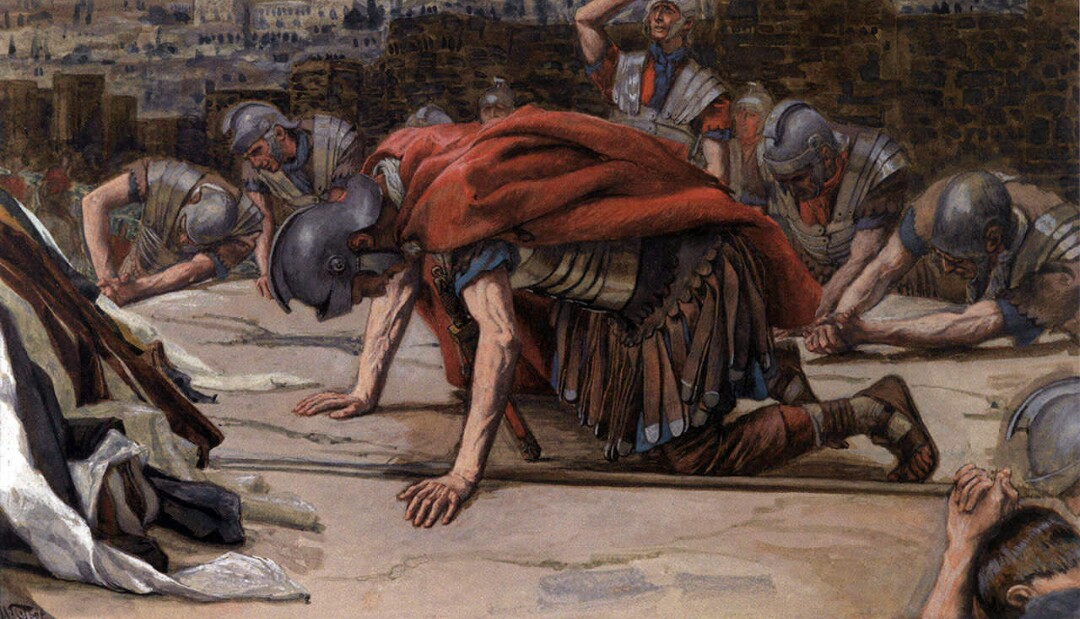
Tissot’s painting suggests that this revelation was profound enough to bring the centurion to his knees. Understandably, this man probably oversaw Jesus’ entire execution—he was complicit. In confronting who Jesus is—or was—his legs won’t hold him up any longer.
Our world is replete with evil, hatred, and injustice. Where can we find God when we suffer, when we feel abandoned in the dark? On that Long Friday He was on the cross, absorbing the wounds inflicted upon him by soldiers and passersby alike, absorbing the sins of the world, committed by them, and by us.
On this Good Friday let’s consider how the cross was Jesus’ coronation. The soldiers mocked him, but he truly was the “King of the Jews,” as the placard read. Jesus embodies the centurion’s confession that remains true today: Truly this man is the Son of God!
Prayer
Almighty God, we pray you graciously to behold this your family, for whom our Lord Jesus Christ was willing to be betrayed, and given into the hands of sinners, and to suffer death upon the cross; who now lives and reigns with you and the Holy Spirit, one God, for ever and ever. Amen.
—Book of Common Prayer
Dr. Jeannine Hanger
Associate Professor, Talbot
Talbot School of Theology
Biola University
For more information about the artwork, music, and poetry selected for this day, we have provided resources under the “About” tab located next to the “Devotional” tab near the top of the page.
About the Artwork
The Confession of the Centurion
James Tissot
1886–1894
Opaque watercolor over graphite on gray wove paper
16.4 x 27.6 cm
Brooklyn Museum of Art
New York, New York
Public Domain
Artist James Tissot paints one of the centurions bowing down at the foot of the cross. Being no stranger to crucifixions, the centurion recognized that Jesus was different. The moment Jesus died, there was a series of phenomenal events that took place, including darkness that came over the whole land, the curtain of the temple being torn in two, an earthquake that shook the land, and deceased saints being raised from the dead (Matthew 27:51–53). When the centurion saw how Jesus died, he—along with others who were present—were filled with fear and recognized this was no ordinary death and this was no ordinary man. It is remarkable that the centurion recognized that the things Jesus said were true, and He was who He claimed to be––“Truly this Man was the Son of God!”
About the Artist
James Tissot (1836–1902) was a French painter and illustrator. He was a successful painter of fashionable, modern scenes and society life in Paris before moving to London in 1871. A friend and mentor of the impressionist painter Edgar Degas, Tissot also painted scenes and figures from the Bible. In 1885, Tissot had a revival of his Catholic faith, which led him to spend the rest of his life making paintings about biblical events. Moving away from impressionism and postimpressionism, Tissot returned to traditional, representational styles and narratives in his watercolors. To assist in his completion of biblical illustrations, Tissot traveled to the Middle East to make studies of the landscape and people. His series of 365 gouache illustrations showing the life of Christ were shown to critical acclaim and enthusiastic audiences in Paris, London, and New York, before being bought by the Brooklyn Museum in 1900. Tissot spent the last years of his life working on a series of paintings of subjects from the Old Testament, which he unfortunately never completed.
About the Music
“Truly He Was the Son of God” from the album Hymns of Compassion
Instrumental
About the Composers/Performers
Oyvind Kristiansen is a Norwegian pianist, organist, arranger, music programmer, and composer of original music. His work has focused these last years on improvisational and contemplative piano performing, composing of liturgical music, and creation of emotive and rhythmic soundscapes for different kinds of productions. His affection for the hymns of his childhood has been the most important influence on his musical career. And a lifetime appreciation for and working with electronic music has definitely made an impact and brought contrasting flavors to his music. His most important work has come to life through his collaboration with record company Kirkelig Kulturverksted and the arts-oriented church Kulturkirken Jakob in Oslo, Norway.
Jonas Kilmork Vemoy (b. 1986) is a Norwegian jazz musician (trumpet) and composer, member of Maridalen Jazz Trio, and is also known for his collaborations on a number of bands and album releases.
About the Poetry and Poet
Lord Byron (George Gordon Byron, sixth Baron Byron; 1788–1824) was an English Romantic poet and one of the most influential figures in early nineteenth‑century British literature. He is regarded as one of the greatest British poets, known for his expressive and often autobiographical verse. His major works include the long narrative poems Childe Harold’s Pilgrimage and Don Juan, as well as shorter lyrics such as those in Hebrew Melodies. Educated at Trinity College, Cambridge, Byron traveled extensively in Europe and spent much of his later life in Italy. His poetry is celebrated for its innovation, emotional intensity, and satirical edge, and he remains a central figure of the Romantic movement.