April 2: Christ Before Pilate
♫ Music:
Mark 15:1–20 (NKJV)
Immediately, in the morning, the chief priests held a consultation with the elders and scribes and the whole council; and they bound Jesus, led Him away, and delivered Him to Pilate. Then Pilate asked Him, “Are You the King of the Jews?”
He answered and said to him, “It is as you say.”
And the chief priests accused Him of many things, but He answered nothing. Then Pilate asked Him again, saying, “Do You answer nothing? See how many things they testify against You!” But Jesus still answered nothing, so that Pilate marveled.
Now at the feast he was accustomed to releasing one prisoner to them, whomever they requested. And there was one named Barabbas, who was chained with his fellow rebels; they had committed murder in the rebellion. Then the multitude, crying aloud, began to ask him to do just as he had always done for them. But Pilate answered them, saying, “Do you want me to release to you the King of the Jews?” For he knew that the chief priests had handed Him over because of envy.
But the chief priests stirred up the crowd, so that he should rather release Barabbas to them. Pilate answered and said to them again, “What then do you want me to do with Him whom you call the King of the Jews?”
So they cried out again, “Crucify Him!”
Then Pilate said to them, “Why, what evil has He done?”
But they cried out all the more, “Crucify Him!”
So Pilate, wanting to gratify the crowd, released Barabbas to them; and he delivered Jesus, after he had scourged Him, to be crucified.
Then the soldiers led Him away into the hall called Praetorium, and they called together the whole garrison. And they clothed Him with purple; and they twisted a crown of thorns, put it on His head, and began to salute Him, “Hail, King of the Jews!” Then they struck Him on the head with a reed and spat on Him; and bowing the knee, they worshiped Him. And when they had mocked Him, they took the purple off Him, put His own clothes on Him, and led Him out to crucify Him.
Poetry
“To Put this World Down Like a Bundle”
by Emily Dickinson
To put this World down, like a Bundle—
And walk steady, away,
Requires Energy—possibly Agony—
'Tis the Scarlet way
Trodden with straight renunciation
By the Son of God—
Later, his faint Confederates
Justify the Road—
Flavors of that old Crucifixion—
Filaments of Bloom, Pontius Pilate sowed—
Strong Clusters, from Barabbas' Tomb—
Sacrament, Saints partook before us—
Patent, every drop,
With the Brand of the Gentile Drinker
Who indorsed the Cup—
Christ Before Pilate
“I believe in . . . Jesus Christ, his only Son, our Lord,
who was conceived by the Holy Spirit,
born of the Virgin Mary,
suffered under Pontius Pilate,
was crucified, died and was buried . . .” (from The Apostles’ Creed)
In the Church’s historic creeds—most notably the Apostles’ Creed and the Nicene Creed—Pontius Pilate gets air time.
Pilate, of course, factors significantly in our gospel narratives. Pilate who, despite recognizing Jesus’ innocence, ultimately exercises his ultimate governmental authority in the region as he sentences Jesus to death.
In his powerful sermon in Acts 2, Peter claims that Jesus was killed by “the hands of lawless men” (Acts 2:23, ESV). Although Acts does not name Pilate explicitly, Peter’s language allows no one involved to escape moral responsibility. Both Pilate and the religious leaders were, according to Peter, lawless.
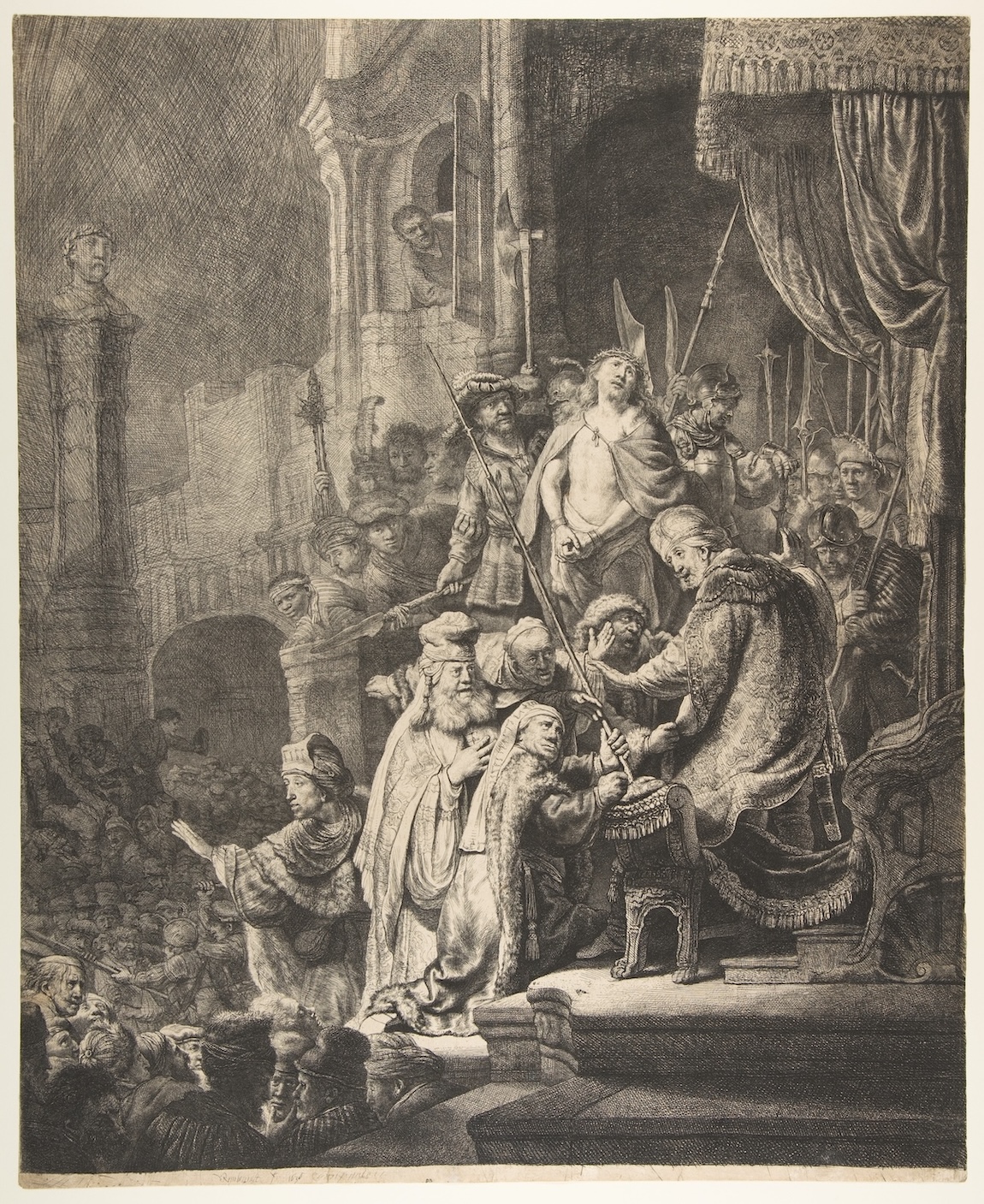
Rembrandt’s etching, Christ Before Pilate, depicts a busy scene, with Pilate seeming to attempt to calm people down as he sorts out the details of Jesus’ case. In the original sketch, there is a tall pillar to the left with a large bust of Caesar looking down upon the scene as though preparing to cast judgment on Jesus. Rembrandt portrays Jesus with his gaze turned away and upward, suggesting that his eyes are focused, not on the tragic drama unfolding all around him, and not on the face of Caesar, but away and upward toward the heavens.
In Mark’s account, Pilate asks Jesus if he is “the King of the Jews.” Jesus’ response is simple: “It is as you say” (Mark 15:12). Beyond that, Jesus says nothing more. The calm composure suggested in Jesus’ expression in Rembrandt’s work might suggest that Jesus is fully aware that his “kingdom is not of this world” (John 18:36). This is something about which Jesus’ accusers know nothing, and they continue to push Pilate until it appears that evil and death have prevailed. Or so it seems.
The power in this scene does not come from those who hold political and religious power. It comes from Jesus himself, who knows who he is and where he was going (John 13:3). Yes, earthly powers will kill Jesus, and he knows what is coming. But his sights are set above and beyond all the posturing and lying and pacifying that play out all around him. His sights are set on his Father’s intention to reconcile the world to himself (2 Cor. 5:19).
In our time we can be overwhelmed with the powers that surround us, that look down upon us in judgment. But when our lives are grounded and centered in Jesus, our sights move above and beyond it all as we trust our heavenly Father to bring his ultimate intentions to bear upon the earth. We may live in earthly kingdoms, but our true Kingdom is not of this world. It is the kingdom where Jesus, and not Caesar, is Lord.
Prayer
O God, you are our refuge and strength, a very present help in trouble.
Therefore we will not fear though the earth give way,
though the mountains be moved into the heart of the sea,
though its waters roar and foam,
though the mountains tremble at its swelling.
So, I will be still, and know that you are God. Amen.
(adapted from Psalm 46)
Michael McNichols, D.Min.
Author
For more information about the artwork, music, and poetry selected for this day, we have provided resources under the “About” tab located next to the “Devotional” tab near the top of the page.
About the Artwork
Christ Before Pilate
Rembrandt van Rijn
Etching on paper
Metropolitan Museum of Art
New York, New York
Public Domain
This print exemplifies several popular depictions of the passion of Christ into one overwhelming scene. Here artist Rembrandt van Rijn combined the presentation of Christ to the people by Pontius Pilate and the mocking of Christ by the people of Jerusalem into a deeply moving etching. Although surrounded by the Pharisees, soldiers, and a motley crowd of onlookers, Christ appears disengaged as He looks to the heavens, His hands clasped in prayer.
About the Artist
Rembrandt Harmenszoon van Rijn (1606–1669) was a Dutch draftsman, painter, and printmaker. He is generally considered one of the greatest visual artists in the history of art and the most important in Dutch art history. Unlike most Dutch masters of the seventeenth century, Rembrandt created works that depict a wide range of style and subject matter, from portraits and self-portraits to landscapes, genre scenes, allegorical and historical scenes, and biblical and mythological themes. His contributions to art came in a period of great wealth and cultural achievement that historians call the “Dutch Golden Age.” Having achieved youthful success as a portrait painter, Rembrandt’s later years were marked by personal tragedy and financial hardships. Rembrandt’s portraits of his contemporaries, self-portraits, and illustrations of scenes from the Bible are regarded as his greatest creative triumphs. His self-portraits form a unique and intimate autobiography, in which the artist surveyed himself without vanity and with the utmost sincerity. Rembrandt’s foremost contribution to the history of printmaking was his transformation of the etching process from a relatively new reproductive technique into a true art form. Because of his empathy for the human condition, he has been called one of the greatest storytellers in the history of art, possessing an exceptional ability to render people in their various moods and dramatic guises. Rembrandt is also known as a painter of light and as an artist who favored an uncompromising realism.
About the Music
“The Crowd and Pilate” from the album He is Jesus Christ
To teach us, he tried to tell us how to live our lives.
Some people followed, some foolish people swallowed up his lies.
How can he lead us? Is this the prophet we have waited for?
He is so simple and all the leaders seem to mock his voice.
We’ve seen him heal us.
We’ve seen him open up the beggar’s eyes.
The lame have walked. The deaf man heard.
We saw a dead man rise when he called out his name.
He is a liar. He is a sinner. He speaks blasphemy.
He is just a man, a charlatan at best.
He cannot read.
He must not be the man he claims to be.
Then that day, Jesus from Caiaphas went to the hall of judgement.
And it was early.
Then Pilate entered into the judgement hall again.
And called Jesus and said unto him - Art thou the king of the Jews?
Jesus answered him - sayest thou this thing of thyself or did others tell it thee of me?
Pilate answered - Am I a Jew? Thine own nation and the chief priests have delivered thee unto me.
What has thou done?
Jesus answered - My kingdom is not of this world. If my kingdom were of this world, then would my servants fight, that I should not be delivered unto the Jews.
And now is my kingdom not from hence.
Pilate therefore said unto him - Art thou a king then?
Jesus answered - Thou sayest that I am a king. To this end was I born. And for this cause came I into the world that I should bear witness to the truth. Everyone that is of the truth, heareth my voice.
Pilate sayeth unto him - What is truth?
I find in this man no fault at all, this man you brought unto me. Will ye therefore that I release him unto you? What wrong has he done?
(The chorus shouts a cacophonous response)
Crucify him! Crucify him! Crucify him!
Composer
Rob Gardner (b. 1977) is an American composer known for his oratorios. One of his most widely performed works is his oratorio Lamb of God, about the death and resurrection of Jesus Christ. It was recorded by the London Symphony Orchestra at Air Studios in London in 2010. He graduated from Brigham Young University with a B.S. in business management and later did graduate study in the University of Southern California's Scoring for Motion Pictures and Television program. Among the oratorios by Gardner are He is Jesus Christ and Lamb of God. He composed and conducted the production of the YouTube video Manger of Bethlehem. He also has composed the musicals Blackbeard and The Price of Freedom with Mckane Davis. Gardner is also a cofounder and president of the nonprofit organization Spire Music.
Performers
Spirit Song Choir and The London Symphony Orchestra
Spirit Song Choir is an independent, ecumenical community choir. Spirit Song is dedicated to sharing sacred and other inspirational choral music through concerts, community events, prayer and worship services, sing-alongs, and Spirit Song Radio. They have a dedicated outreach to their friends in senior living communities. This volunteer organization brings together singers, instrumentalists, and dancers with a wide range of musical and life experiences.
The London Symphony Orchestra (LSO), founded in 1904, is the oldest of London’s symphony orchestras. As a self-governing body, the orchestra selects the conductors with whom it works. At some stages in its history, it has dispensed with a principal conductor and worked only with guests. Among the conductors with whom it is most associated are Pierre Monteux, André Previn, Claudio Abbado, Sir Colin Davis, and Valery Gergiev. Since 1982, the LSO has been based in the Barbican Centre in the City of London. The LSO claims to be the world’s most recorded orchestra; it has made gramophone recordings since 1912 and has played on more than two hundred soundtrack recordings for the cinema. It is probably best known for recording John Williams’s score for the Star Wars movies. This film and its sequels attracted a new group of admirers and consolidated the period of film music activity for the orchestra, which continues unabated to this day. The LSO also recorded other Williams film scores including Superman, Harry Potter, and Raiders of the Lost Ark.
About the Poetry and Poet
Emily Dickinson (1830–1886) was an American poet widely regarded as one of the most important figures in American literature. Born in Amherst, Massachusetts, she lived much of her life in relative seclusion, writing nearly 1,800 poems that explore themes of death, immortality, nature, and the inner life. Dickinson’s innovative use of syntax, punctuation, and meter, along with her concise and intensely personal style, has had a lasting influence on modern poetry. Although only a handful of her poems were published during her lifetime, her work was posthumously collected and brought widespread acclaim, establishing her as a central figure in the American literary canon.
About the Devotion Writer
Michael McNichols (DMin) is an author and former pastor. He served for fifteen years at Fuller Theological Seminary as an administrator and Affiliate Assistant Professor of Intercultural Studies.