April 4: Jesus Is Buried in Joseph’s Tomb
♫ Music:
Mark 15:42–47 (NKJV)
Now when evening had come, because it was the Preparation Day, that is, the day before the Sabbath, Joseph of Arimathea, a prominent council member, who was himself waiting for the kingdom of God, coming and taking courage, went in to Pilate and asked for the body of Jesus. Pilate marveled that He was already dead; and summoning the centurion, he asked him if He had been dead for some time. So when he found out from the centurion, he granted the body to Joseph. Then he bought fine linen, took Him down, and wrapped Him in the linen. And he laid Him in a tomb which had been hewn out of the rock, and rolled a stone against the door of the tomb. And Mary Magdalene and Mary the mother of Joses observed where He was laid.
Poetry
“The Eighth Elegy”
By Rainer Maria Rilke
Translated from the German by Alfred Corn
Dedicated to Rudolf Kassner
With all of their eyes, animals behold
openness. Only our seeing is
retrospective, set like traps around them,
an obstacle that blocks the path to freedom.
What does exist outside we come to know
from their faces alone; in fact, we make
even young children turn and take a backward
look at fixed concepts, not at the openness
deep in those mammal features. Free of death.
That, only we see; the unhindered animal
keeps its decline and sunset ever behind it,
with God before; and, if it walks, goes forward
in timelessness, like springs that well and flow.
Yet we don’t, not even for a single day,
have pure space before us, a place where flowers
forever bloom. It’s always the real world,
never a Nowhere void of negation, a pure
Unsurveillance that can be inhaled,
forever known and thus not craved. As children
we lose ourselves to this in silence, until
abruptly shaken. Or someone dying is it,
and, near death, does not see death but stares
beyond it, his gaze perhaps large as the mammals’.
And lovers, if their partner didn’t block
the view, could then draw near and be astonished . . .
As if by someone’s oversight, space opens
behind the partner. Since neither can get beyond
the other, each of them turns back into World.
Forever focused on Creation, we see it
as only a mirroring of untrammeled regions
that we have darkened. Or an animal,
voiceless and calm, looks up and then straight through us.
Our fate consists of this: to be against,
nothing else but that, and always against.
Were consciousness like ours present in
the animal whose firm tread moves toward us
following its own guidance—, we’d be torn
along its wayward path. Its inner self, though,
is limitless, ungrasped, with no regard
for its positioning, pure, like its clear gaze.
And where we see a future, it sees All,
itself within that All, forever healed.
And yet inside the warm and watchful mammal
the weight and pain of sorrow also dwells.
For it fastens on him too, a thing that often
overpowers us,—the recognition
that what one strives so hard for was perhaps
at one time closer, truer, an alliance
endlessly tender. Here, all is detachment.
There, all was breath. And after the first home,
the next seems like mere travesty and bluster.
O blessedness accorded the small creature
still living in the vessel where it was born.
Joy of the mayfly that leaps up inside
even when mating. The vessel’s everything.
Observe the songbird’s hindered confidence:
its hatching almost taught it to know both,
as though it were the soul of an Etruscan
whose mortal flesh an opened space received,
with his own reclining likeness as its lid.
And how it baffles those poor creatures born
from wombs, yet meant to fly. As though alarmed
at themselves they flitter through the air, much like
a crack going through a cup. So the bat’s path
splits through the evening sky’s porcelain.
And we, observers, relentless, everywhere,
intent on objects, never looking outside them!
They overfill us. We arrange them. They break up.
Once more we arrange. We ourselves are broken.
Then who has wheeled us backwards, so that we,
no matter the action, always seem to have
the stance of those about to depart? Like someone
on the final hill, which one more time shows him
his entire valley, who turns, pauses, lingers—,
and so we live, constantly saying farewell.
Lament in Silence
Here, on this Saturday, there is deepening gloom in a season of lament––betrayal, false accusation, scourging and flogging… agony on a Roman execution machine…then: silence. Christ has committed his spirit to the Father in final submission. Friends are left with his limp, lifeless body, and lovingly lower him in the cold light of profound dereliction.
My God, you have abandoned me.
The friends have questions, but these must wait. Today is a day of lowering, anointing, wrapping his body again, but this time there are no stars leading. No angel voices. No cattle lowing or wise men bowing. No shepherds in awe. This time he appears powerless yet again, swaddled not for the manger but the grave.
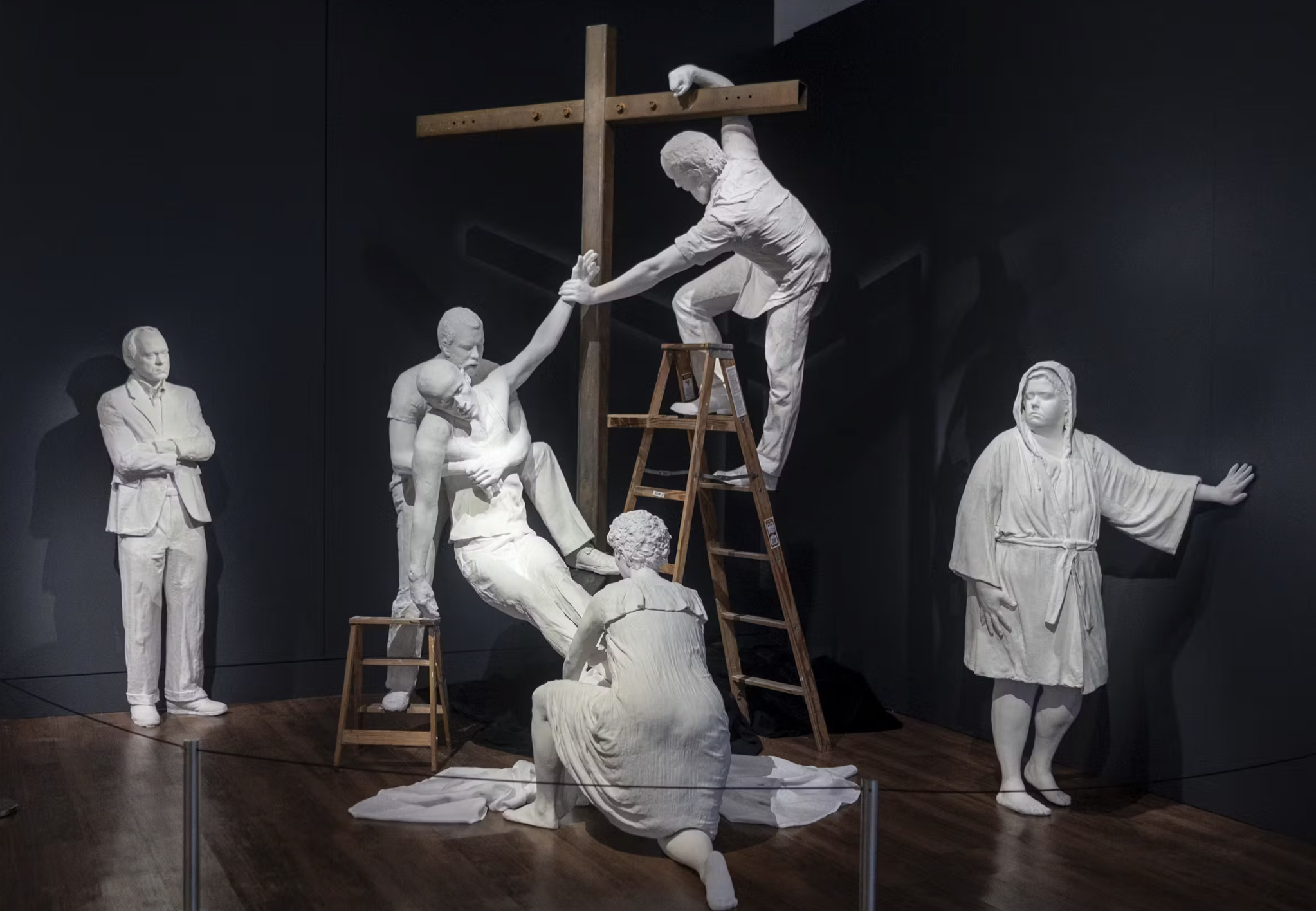
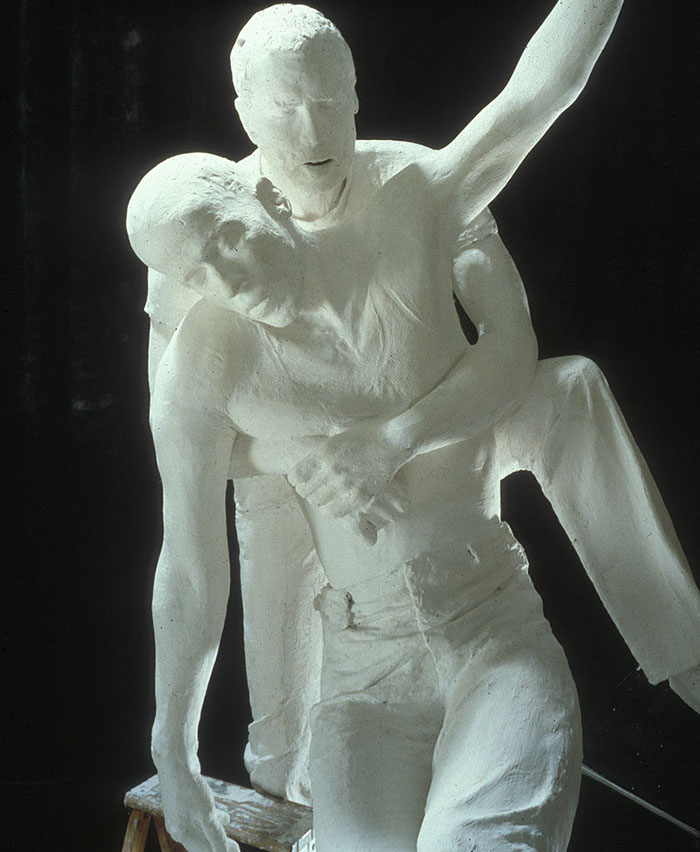
Theodore Prescott’s magisterial sculptural installation captures lament in palpable silence. Cast in plaster from the bodies of Prescott’s colleagues at Messiah University in the mid 1980s, these figures are completed in the same technique as a death mask. Painstakingly crafted from a multitude of fragile molds directly formed on his friend’s bodies, this ambitious tableau is then assembled in a life-like array––creating a breathtaking enactment of the saddest moment in human history. God came to us, for us, yet we betrayed, denied, and killed him.
Prescott’s sculpture is full of contemplative quiet despite the implied violence. This is one of the central paradoxes of great art––holding opposites in creative tension. Darkness defining the edges of light. Figures both strange and familiar. They might be the traditional characters in the story but might also be us—stationed at the foot of this portable killing device made from common steel, adjustable for anybody it can torture.
The artist conveys a poignancy that goes to the heart of our human dilemma: how can we recover from our own sin, our complicity with evil, our failure to live up to our own understandings of truth and right action? And yet this stunning sculpture also communicates deep compassion and forgiveness. Prescott has arranged the figures just right––creating a fitting theodrama that unfolds slowly as we gaze from person to person in the deepening gloom. It’s a scene depicted endlessly in European sacred art and Prescott casts it in modern artistic dialogue with the likes of George Segal––whose plaster figure tableaus were a fixture of American contemporary art in the last century.
Prescott’s deft use of a contemporary artistic idiom, combined with an ancient Christian theme, powerfully communicates a complex emotional landscape needed to revivify sacred art tradition. He also offers us an opportunity to go with Magdalene and John, Nicodemus and Mary to take care of Jesus’s body in intimate embrace amidst our grief. Prescott invites us to journey closer. Feel the sorrow. Enter the silence awaiting us on that holiest of Saturdays.
Rilke’s poem “The Eighth Elegy” (from the Duino Elegies) evokes consciousness of death as our perennial posture in the world: “we live our lives, forever taking leave – contrasting humans with the beasts who have death behind them, fleeing always in survival instinct. We turn to face it. Christ’s death on the Cross inaugurates the promise of a new covenant for life eternal. But on this Holiest of Saturdays we wait with Rilke, who has given voice to our sadness and loss –– yet also evinces a living hope.
Prayer
Our Father in heaven, You know our struggle. You know our sufferings and our burdens. Our painful path is not distant from You but is always present to Your heart of love. And yet we enter into desperation at times (even these times) wondering where You are. Why is my brother not healed? Why is my best friend’s mental and emotional health plummeting into a dark, downward spiral? We will yet praise You, for Your lovingkindness and grace are sufficient as You have declared, and Your power is made perfect in weakness. And we are weak and foolish creatures. You have told us to cry out, to seek Your face, to wear you out with our pleading. We boldly ask (at Your own encouragement), “Will not the God of Righteousness do rightly?”
Bruce Herman
Artist
For more information about the artwork, music, and poetry selected for this day, we have provided resources under the “About” tab located next to the “Devotional” tab near the top of the page.
About the Artwork
Descent from the Cross (two views)
Theodore Prescott
1985–87
Cast hydrocal, steel, wood, fiberglass, neon
Cloth figure life-size
Cross 10 ft.
Installation at the Museum of the Bible
Washington, D.C.
Permission granted from the artist
In his original conception of the piece entitled Descent from the Cross, sculptor Theodore Prescott says, “I wasn’t trying to make a historical recreation of the scene. Instead, I wondered, what would it look like if, in my day, people condemned to death were crucified?” That question informed Prescott’s decision to have the figures in modern clothing —T-shirts, pants, a sundress, and even a suit. It also motivated his decision to ask those near to him to serve as models. Six of his Messiah University colleagues spent several grueling hours permitting Prescott to make plaster casts of them. Prescott used those casts to create six life-size figures of Jesus; Mary, His mother; Joseph of Arimathea; two witnesses; and one other character . These figures surround a towering, adjustable metal cross. Over the next twenty-five years, many churches and colleges displayed Prescott’s work, drawing viewers from around the region. Eventually, though, Prescott sensed the piece had run its course and retired it, packing it away into storage. But, to his surprise and delight, it didn’t remain there. In 2025, two decades after Descent from the Cross had last been exhibited, the Museum of the Bible in Washington, D.C., contacted Prescott about using the piece in an exhibit of collected pieces all focusing on that moment of Christ’s descent. So, Prescott; his wife, Catherine, also a gifted artist and former Messiah University professor; and others began the laborious restoration process. As they worked, Prescott noticed that the piece took on new life. “In seeking to simply clean it up, we transformed the piece,” he says. “The material had originally been more textured and duller — it’s smoother and brighter now than it was. It has a bit of a different spirit.”
About the Artist
Theodore (Ted) Prescott is a sculptor and writer who lives near Harrisburg, Pennsylvania. He chaired the art program at Messiah College in Grantham, Pennsylvania, and retired as a Distinguished Professor of Art. His articles on art have appeared in several publications, including American Arts Quarterly, Image Journal, and The New Criterion. Prescott’s sculpture is characterized by an interest in material substances and their poetic and associative nature. He is versatile in the use of traditional sculptural materials like stone, wood, and metals, but also employs unconventional materials like coal, honey, and salt. The forms of his work are derived from modern and contemporary sculpture, but his subject matter is often drawn from the Christian tradition. He has completed several commissions and has work both in private and public collections. He and his wife Catherine live in an old farmhouse in rural Pennsylvania and love having their grandchildren visit.
About the Music
“Good Friday Lamentations” from Middle Eastern Orthodox Chant
Ancient Christian hymn sung for generations by Middle Eastern Christians.
Sung in Arabic, English translation:
O my Life and my Christ;
and the armies of the angels were sore amazed,
as they sang the praise of Thy submissive love.
How, O Life, canst Thou die?
Or abide in a grave?
For Thou dost destroy the kingdom of death, O Lord,
and Thou raisest up the dead of Hades’ realm.
Now we magnify Thee,
O Lord Jesus, our King;
and we venerate Thy Passion and Burial,
whereby from corruption’s bowels are we redeemed.
Thou Who didst establish
the earth’s bounds dost now dwell
in a small grave, O my Jesus, Thou King of all,
Who dost call the dead to leave their graves and rise.
O my dear Christ Jesus,
King and Ruler of all,
Why to them that dwell in Hades didst Thou descend?
Was it not to set the race of mortals free?
Lo, the Sov’reign Ruler
of creation is dead
and is buried in a tomb never used before,
He that emptied all the graves of all their dead.
In a grave they laid Thee,
O my Life and my Christ.
Yet, behold now by Thy death, death is stricken down,
and Thou pourest forth life’s streams for all the world.
Thou, O Christ, wast numbered
with men of evil deeds
as one evil, and didst also deliver us
from the ancient schemer’s evil works and deeds.
About the Performer
Ribale Wehbe (b. 1999) is a Lebanese singer. She began her musical journey at the age of eight as a soloist with the Sem Choir, where she remains an active member. She holds a degree in music education and musicology from Antonine University in Lebanon and a diploma in Byzantine music from the School of Byzantine Music in Athens, Greece. Throughout her career, she has performed in Romania, Greece, Russia, Austria, Armenia, and Belgium, collaborating with renowned Byzantine musicians. In 2024, she toured Romania and continued to perform in the largest concert halls, including Sala Palatului in Bucharest and Pallas Theatre in Athens. In 2025, she continued to captivate audiences with her exceptional performances.
About the Poetry and Poet
Rainer Maria Rilke (1875–1926) was a Bohemian-born poet and novelist widely regarded as one of the most significant German-language poets of the early twentieth century. His work is known for its lyrical intensity, spiritual depth, and exploration of themes such as love, solitude, art, and the search for meaning. Among his most influential works are Duino Elegies, Sonnets to Orpheus, and Letters to a Young Poet. Rilke’s poetry reflects a lifelong engagement with philosophy, mysticism, and the inner life, and his innovative use of language had a lasting impact on modern poetry.
About the Devotion Writer
Bruce Herman (b. 1953) is an American artist, writer, curator, and educator. Herman lives with his best friend Meg. They’ve lived on the same street for thirty-five years and share their woodland home with their daughter Sarah, her husband Peter, and grandson Tristan—along with two dogs, two barn cats, a horse named Willow, and assorted wildlife. Herman is a painter, writer, and public speaker who taught studio art for forty years and recently retired from Gordon College, where he continues to curate exhibitions. His art has been shown in more than one hundred fifty exhibitions—nationally in a dozen US cities, including New York, Boston, Washington, Chicago, and Los Angeles, and internationally in Canada, Italy, England, Japan, Hong Kong, and Israel. Bruce’s artwork is featured in many public and private art collections, including Hammer Museum, Los Angeles; Cincinnati Museum of Fine Arts; De Cordova Museum, Boston; Cape Ann Museum; the Vatican Museums in Rome; and in many colleges and universities throughout the US and Canada. His art and his words are widely published in books, journals, popular magazines, newspapers, and online art features.