March 12: The Transfiguration: A Glimpse of Christ's Glory
♫ Music:
Mark 9:1-13 (NKJV)
And He said to them, “Assuredly, I say to you that there are some standing here who will not taste death till they see the kingdom of God present with power.”
Now after six days Jesus took Peter, James, and John, and led them up on a high mountain apart by themselves; and He was transfigured before them. His clothes became shining, exceedingly white, like snow, such as no launderer on earth can whiten them. And Elijah appeared to them with Moses, and they were talking with Jesus. Then Peter answered and said to Jesus, “Rabbi, it is good for us to be here; and let us make three tabernacles: one for You, one for Moses, and one for Elijah”— because he did not know what to say, for they were greatly afraid.
And a cloud came and overshadowed them; and a voice came out of the cloud, saying, “This is My beloved Son. Hear Him!” Suddenly, when they had looked around, they saw no one anymore, but only Jesus with themselves.
Now as they came down from the mountain, He commanded them that they should tell no one the things they had seen, till the Son of Man had risen from the dead. So they kept this word to themselves, questioning what the rising from the dead meant.
And they asked Him, saying, “Why do the scribes say that Elijah must come first?”
Then He answered and told them, “Indeed, Elijah is coming first and restores all things. And how is it written concerning the Son of Man, that He must suffer many things and be treated with contempt? But I say to you that Elijah has also come, and they did to him whatever they wished, as it is written of him.”
Poetry
from “Transfiguration”
by Mark Jarman
1.
They were talking to him about resurrection, about law,
about the suffering ahead.
They were talking as if to remind him who he was and
who they were. He was not
Like his three friends watching a little way off, not like
the crowd
At the foot of the hill. A gray-green thunderhead massed
from the sea
And God spoke from it and said he was his. They were
talking
About how the body, broken or burned, could live again,
remade.
Only the fiery text of the thunderhead could explain it.
And they were talking
About pain and the need for judgement and how he would
make himself
A law of pain, both its spirit and its letter in his own flesh,
and then break it,
That is, transcend it. His clothes flared like magnesium,
as they talked.
7.
I want to believe that he talked back to them, his radiant
companions,
And I want to believe he said too much was being asked
and too much promised.
I want to believe that that was why he shone in the eyes
of his friends,
The witnesses looking on, because he spoke for them,
because he loved them
And was embarrassed to learn how he and they were
going to suffer.
I want to believe he resisted at that moment, when he
appeared glorified,
Because he could not reconcile the contradictions
and suspected
That love had a finite span and was merely the comfort
of the lost.
I know he must have acceded to his duty, but I want
to believe
He was transfigured by resistance, as he listened,
and they talked.
The Transfiguration: A Glimpse of Christ's Glory
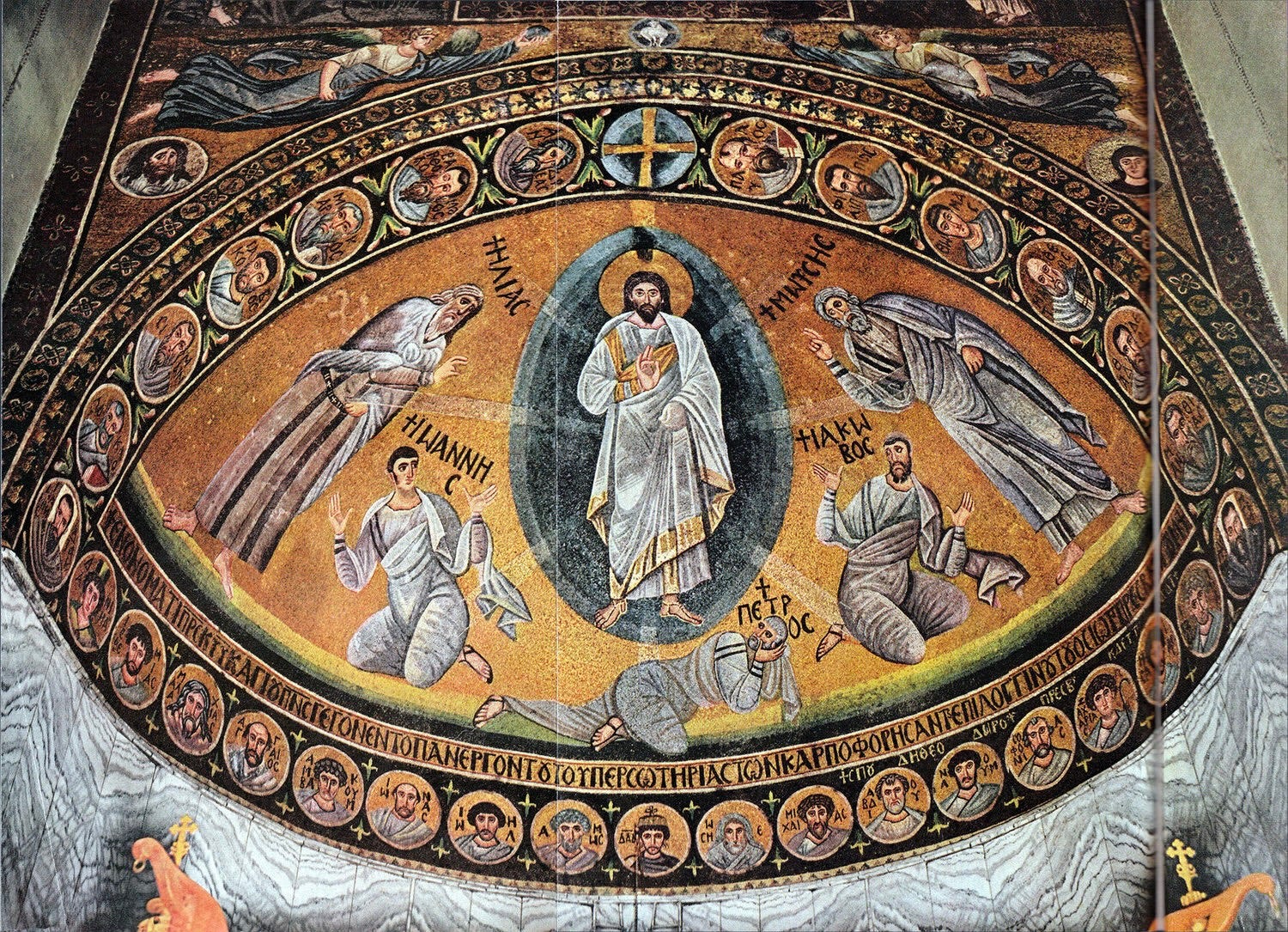
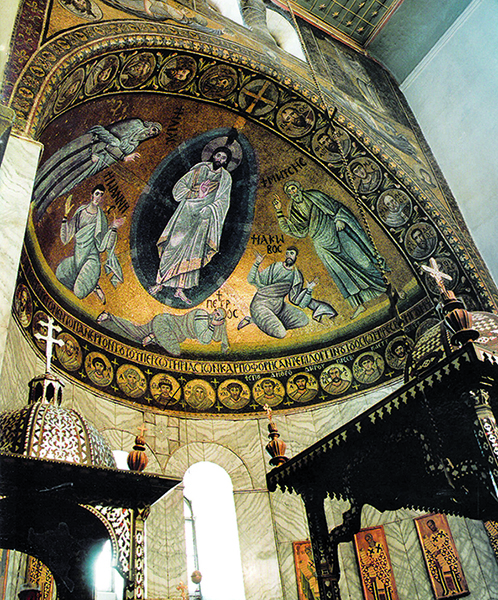
The art we’re offered today is a pair of photographs depicting the beautiful space of St. Catherine’s basilica. Those icon mosaics have been painstakingly designed and arranged in the lofty vault of the church. Even the apparently blank space of the marble beneath it has been carefully rendered. The alternating veins of light and dark stone that look like wings can only be made by carefully cutting thin layers from the same piece of stone and then book-matching them to achieve the symmetry of their appearance. It’s the laborious work of skilled hands guided by inspired imagination.
Did you notice that these photos come right after the passage where Peter announces they should build three tabernacles and that idea goes nowhere fast? Kind of a funny pairing, right?
Peter’s astonished anxiety pushes him in the direction of clumsy hospitality. We’re told he “didn’t know what to say” because he was so afraid. We can all say and think ridiculous things when we’re afraid. When the glory of God shines into my life, I often feel compelled to do something, and these things are often silly or ridiculous. Peter is rescued from the embarrassment of making the tabernacles by the voice of the Father: “This is my beloved Son. Hear him.” The Father instructs the stunned disciples with a perhaps stranger command: their response to the glory of Jesus and the Father’s love for him ought to be their undivided attention.
But to give this undivided attention is actually quite difficult. In his contemplation of the Sabbath, Abraham Heschel proposes that Peter’s nervous tendency typifies a broader human condition: “Shrinking, therefore, from facing time, we escape for shelter to things of space. The intentions we are unable to carry out we deposit in space…The higher goal of spiritual living is not to amass a wealth of information, but to face sacred moments.”
Facing the sacred is, of course, precisely the point of St. Catherine’s basilica: one’s eyes are drawn up to Christ, and only his eyes look back at us. To look left or right is to behold saints occupied with gazing upon the Lord. Their focus should train our own. Jarman’s poem engages a similar difficulty; facing the sacred and refusing to turn away to distractions or labor “Only the fiery text of the thunderhead could explain it. / And they were talking…His clothes flared like magnesium / as they talked.”
In the transfiguration, we see two groups of people have very different responses to facing the sacred, and this only for a moment. As astonishing as the brilliant light is—and the voice of the Father, and the appearances of Moses and Elijah—the whole event is “suddenly” over; a memory that the disciples aren’t allowed to share until after the Resurrection. The Transfiguration, like the Sabbath, means to train our hearts and our eyes to face—and delight in—sacred moments. For a day is coming when the moments will cease. We will face the sacred itself for all eternity. How will it be then for you and I when we arrive? Will we be able to stand still? Or will we become uncomfortable and grow desperate for something to do.
Prayer
Oh Lord of light, instruct my heart with joy and peace in your presence so that I may learn to cherish what is sacred here and now in this mortal life. Teach me to cherish these glimpses so that I may, with your aid, become fit to abide always with You when these moments become unbroken eternity in the world that is to come.
Dr. Phillip Aijian
Adjunct Professor
Torrey Honors College
Biola University
For more information about the artwork, music, and poetry selected for this day, we have provided resources under the “About” tab located next to the “Devotional” tab near the top of the page.
About the Artwork
Transfiguration of Christ (2 views)
Anonymous artists
Sixth century
Mosaic
Eastern Apse of the Great Basilica
St. Catherine’s Monastery
Sinai, Egypt
Public Domain
The transfiguration of Jesus is an event described in the New Testament where Jesus is transfigured and becomes radiant in glory upon Mount Tabor. Many Christian traditions, including the Eastern Orthodox, Catholic, Lutheran, and Anglican churches, commemorate the event in the Feast of the Transfiguration, a major festival. In Christian teachings, the transfiguration is a pivotal moment, and the setting on the mountain is presented as the point where human nature meets God: the meeting place of the temporal and the eternal, with Jesus, as both true man and true God, serving as the connecting point, acting as the bridge between heaven and earth. The iconography of the transfiguration continued to develop over time and this depiction of the event is a sixth-century symbolic representation, a well-known depiction at Saint Catherine's Monastery on Mount Sinai in Egypt.
About the Artist
Anonymous artisans
About the Music | 1
“Morning Chant for the Feast of Transfiguration” from Orthodox Christian Chants
Glory to the Father, and to the Son, and to the Holy Spirit,
Christ took Peter, James, and John up into a high mountain apart,
And was transfigured before them.
His face shone as the sun and His raiment became white as light,
There appeared Moses and Elijah, talking with Him.
A bright cloud overshadowed them.
And behold, a voice out of the cloud saying:
This is my beloved son in whom I am well pleased:
Hear ye Him.
About the Composer | Traditional Eastern Orthodox Chant
About the Performer
Father Apostolos Hill serves the community of Holy Trinity Greek Orthodox Cathedral in Phoenix, Arizona, as the senior pastor. Prior to his ordination, he was a chanter at various parishes as well as a teacher of Byzantine chant. His recordings of Byzantine chant “Gates of Repentance,” “Hymns of Paradise,” and “Cycles of Grace: Hymn from the Great Feasts” have been well received in Byzantine chant circles and are bestsellers.
About the Music | 2
“Transfigure Us, O Lord” from the album Lenten Journey: The Stories and Scripture of Lent in Song
Transfigure us, O Lord.Transfigure us, O Lord.
Break the chains that bind us:
Speak your healing word.
And where you lead, we’ll follow.
Transfigure us, O Lord.
Down from heights of glory,
Into the depth below.
The love of God self-emptied.
The love of God to show.
You light the path before us,
The way that we must go.
Transfigure us, O Lord.
Transfigure us, O Lord.
Break the chains that bind us:
Speak your healing word.
And where you lead, we’ll follow.
Transfigure us, O Lord.
Light for those in darkness,
The hungry have their fill.
Glad tidings for the humble.
The healing of all ills.
In these we glimpse your glory,
God’s promises fulfilled.
Transfigure us, O Lord.
Transfigure us, O Lord.
Break the chains that bind us:
Speak your healing word.
And where you lead, we’ll follow.
Transfigure us, O Lord.
To the Holy City Jerusalem you go.
Your face set toward the ending.
The cross to be your throne.
Shall we journey with you,
And share your pascal road.
Transfigure us, O Lord.
Transfigure us, O Lord.
Break the chains that bind us:
Speak your healing word.
And where you lead, we’ll follow.
Transfigure us, O Lord.
Transfigure us, O Lord.
Transfigure us, O Lord.
Break the chains that bind us:
Speak your healing word.
And where you lead, we’ll follow.
Transfigure us, O Lord.
About the Composer/Performer
Bob Hurd has served as a teacher, composer, and liturgist in various pastoral and academic settings, including Loyola Marymount University in Los Angeles; the Franciscan School of Theology in Berkeley; St. Patrick’s Seminary in Menlo Park, California; Santa Clara University; and most recently, Seattle University’s School of Theology and Ministry. Hurd is also known as an early pioneer of bilingual and multilingual music, with compositions like “Pan de Vida” and “Misa de las Américas.” In 2005, he received the Faithful Servant Award from the Southwest Liturgical Conference, and in 2010, he was named NPM’s Pastoral Musician of the Year. Bob’s most recent book, Compassionate Christ, Compassionate People (2019), reflects his years of teaching, writing, composing, and serving as a pastoral musician.
About the Poetry and Poet
Mark F. Jarman (b. 1952) is an American poet and critic often identified with the New Narrative branch of New Formalism. He was coeditor with Robert McDowell of The Reaper throughout the 1980s. Centennial Professor of English, Emeritus, at Vanderbilt University, he is the author of eleven books of poetry, three books of essays, and a book of essays coauthored with Robert McDowell. He coedited the anthology Rebel Angels: 25 Poets of the New Formalism with David Mason. Jarman's awards for poetry include a Joseph Henry Jackson Award, three grants from the NEA, and a fellowship from the John Simon Guggenheim Foundation. His book The Black Riviera won the 1991 Poets' Prize. Questions for Ecclesiastes was a finalist for the 1997 National Book Critics Circle Award in poetry and won the 1998 Lenore Marshall Poetry Prize from the Academy of American Poets and The Nation magazine. Bone Fires: New and Selected Poems won the 2013 Balcones Prize.