March 11: Christ's Startling Challenge: Take Up Your Cross
♫ Music:
Mark 8:34-38 (NKJV)
When He had called the people to Himself, with His disciples also, He said to them, “Whoever desires to come after Me, let him deny himself, and take up his cross, and follow Me. For whoever desires to save his life will lose it, but whoever loses his life for My sake and the gospel’s will save it. For what will it profit a man if he gains the whole world, and loses his own soul? Or what will a man give in exchange for his soul? For whoever is ashamed of Me and My words in this adulterous and sinful generation, of him the Son of Man also will be ashamed when He comes in the glory of His Father with the holy angels.”
Poetry
“Door in the Mountain”
by Jean Valentine
Never ran this hard through the valley
never ate so many stars
I was carrying a dead deer
tied on to my neck and shoulders
deer legs hanging in front of me
heavy on my chest
People are not wanting
to let me in
Door in the mountain
let me in
Christ's Startling Challenge: Take Up Your Cross
Simon of Cyrene did not ask to struggle up the road to Golgotha with a bloody, backbreaking cross laid across his body. He did not ask to become part of the pageant of cruelty given for the pleasure of the clamoring mob. It seems unlikely he thought Jesus was anyone more than a common criminal. He was a bystander, a passerby. He did not ask to join in Christ’s suffering.
Yet that suffering was still asked of him. And for whatever reason — whether a mortified submission to bullying centurions, or a heartfelt compassion for the weakened Christ — Simon of Cyrene said yes to this unexpected call. He stepped into the road and took up Christ’s cross.
We often talk about Christian callings, about vocation, as if vocation is something God gives us to make us feel happy, special, or important. It is true that any vocation faithfully undertaken will become a gateway to joy and peace. But as Simon of Cyrene treads the difficult road to Calvary behind the battered Christ, his example challenges us to abandon any assumptions we might have that we undertake our vocations for the sake of our own fulfillment.
Recall the following from today’s Scripture passage: “[Jesus] said to them, ‘Whoever desires to come after Me, let him deny himself, and take up his cross, and follow me. For whoever desires to save his life will lose it, but whoever loses his life for My sake and the gospel’s will save it.’”
Jesus is not speaking in vague or abstract terms. With these words Christ calls us to rise each day and love others like He loved us on Good Friday. He calls us to submit to a daily self-emptying. To faithfully respond, we must willingly die to everything we think we know about ourselves, who we are, and what we want so that He might incarnate His love — His suffering, dying, humble, resurrecting, triumphant love — within our selves, souls, and bodies.
There is a paradox here. For the more we give ourselves to become avenues of Christ’s love to the world, the more completely Christ re-creates us into the unique persons we were made to be. My self, sacrificed without reservation or stipulation to be used as God wills, is the only meet offering I can make in response to Christ’s gift of His life on Good Friday. But it is specifically my self — unique, restored, resurrected, made beautiful — that He delights to use to love others.
It is important to remember that we do not have to seek heroic tasks to answer our vocations. We answer them by self-sacrificially loving the people, places, and work God sets before us in our daily lives. Any place, any community, any work faithfully undertaken can become the seat of a Christian vocation. And vocational work undertaken in simple circumstances is no less heroic for its apparent smallness. By assenting to take up our crosses here, now, we undertake no less than the work of Christ’s love as it was modeled for us on Calvary.
Scripture does not tell us what happened to Simon of Cyrene after Good Friday, but tradition teaches that he left that day changed — that he became an early follower of Christ; that his entire household converted to the new faith; and that he and his two sons went on to become Christian missionaries.
Only God knows the horizons our humble self-offerings might reach. We do not have to bother ourselves with worry about the impact our work will have. Our calling is simply to follow Him: to take the next step of faithfulness set before us today, then the next, and the next — just like Simon did, every inch up the road to Golgotha.
Prayer
God, of your goodness give me yourself: You are enough for me, and anything less that I could ask for would not do You full honor. And if I ask anything that is less, I shall always lack something, but in You alone I have everything. Amen.
— Drawn from Julian of Norwich’s Revelations of Divine Love
Alea Peister
Alumna, Torrey Honors College
Biola University
Copywriter for Deloitte Digital
For more information about the artwork, music, and poetry selected for this day, we have provided resources under the “About” tab located next to the “Devotional” tab near the top of the page.
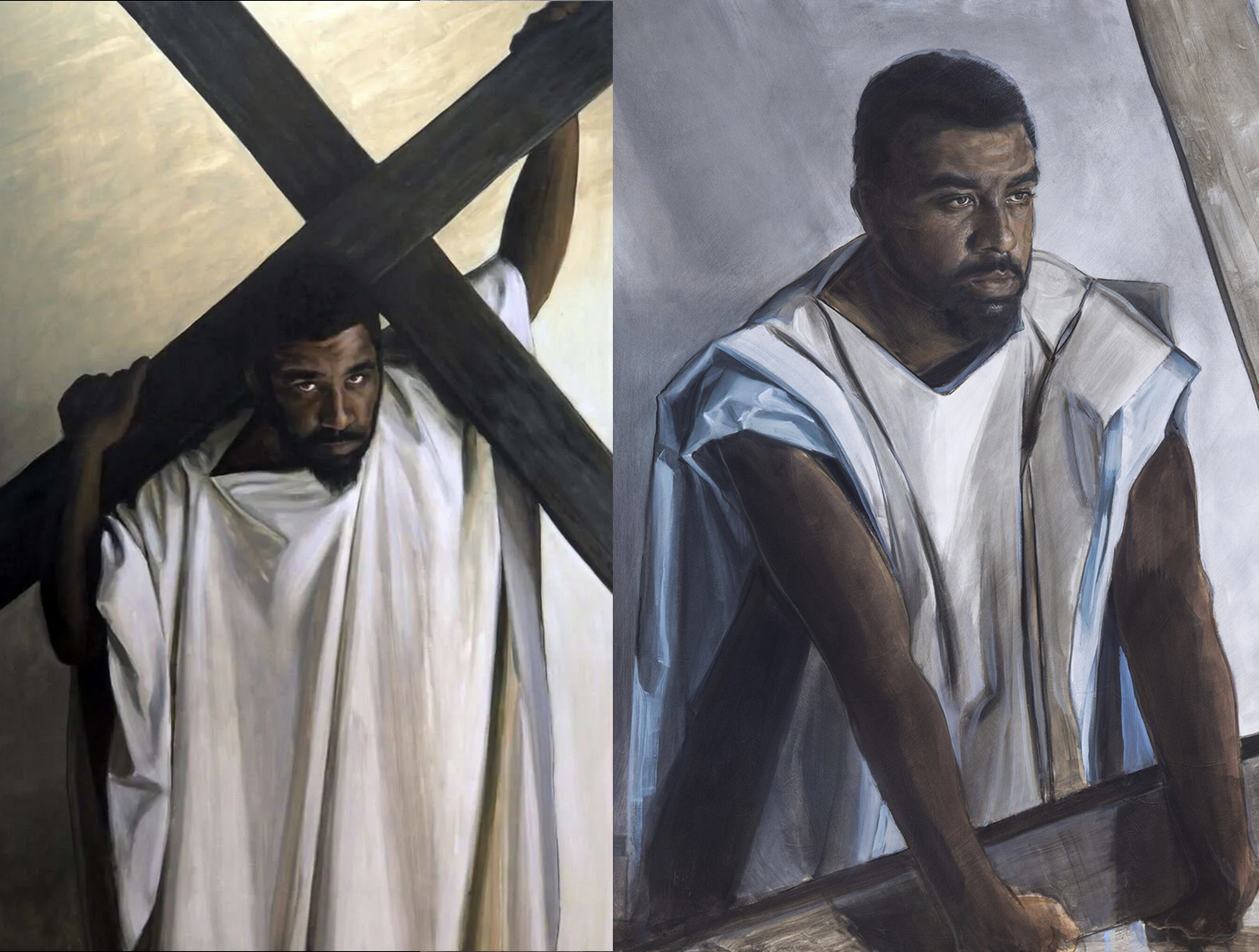
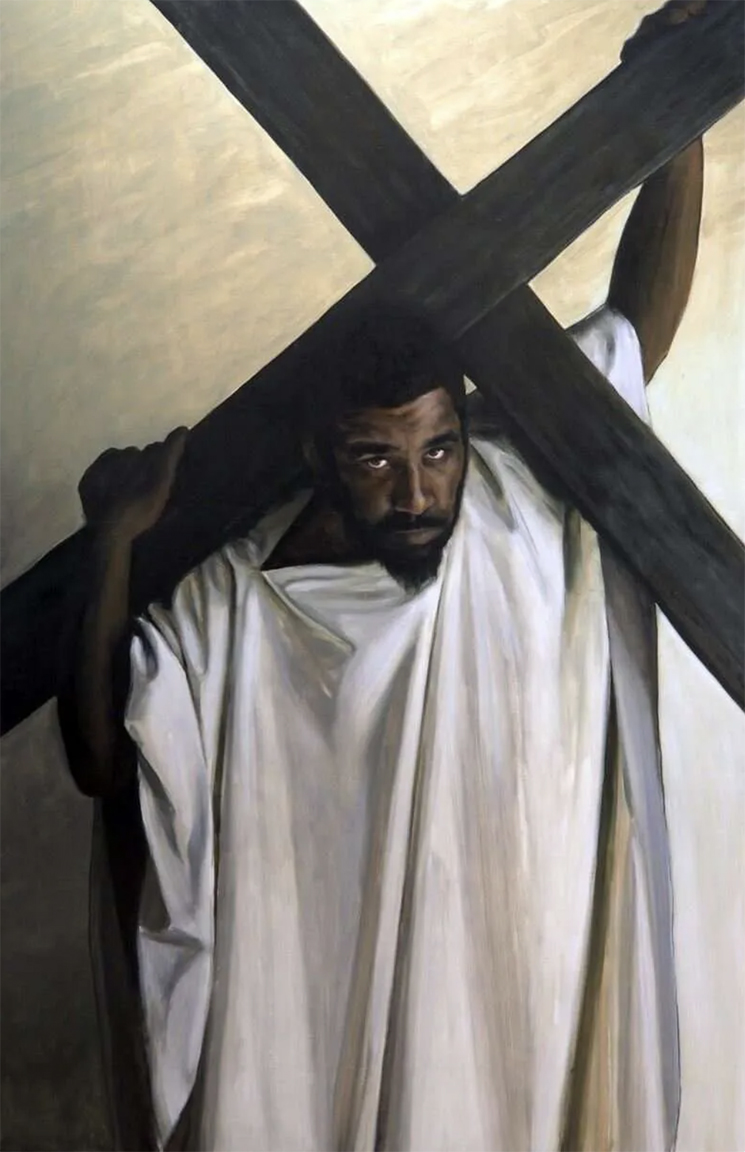
About the Artwork | 1 (L)
Simon of Cyrene—Take Up Your Cross
Egbert Modderman
Oil on canvas
Museum of the Bible
Washington, D.C.
Used with permission of the artist
Photo by Artrevisited
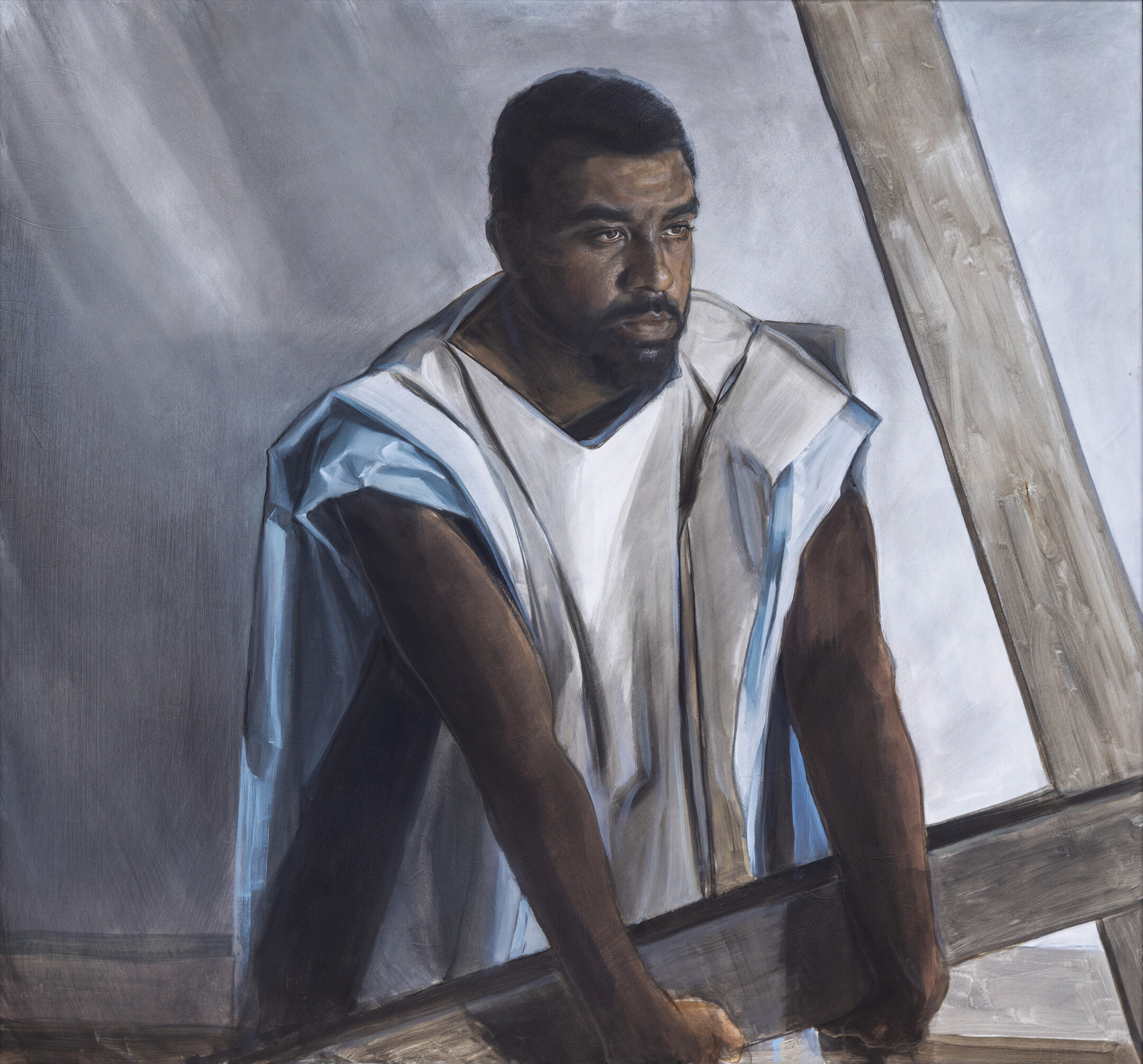
About the Artwork | 2 (R)
Simon of Cyrene—Take Up Your Cross
Egbert Modderman
Oil on canvas
Used with permission of the artist
Photo by Artrevisited
Simon of Cyrene was the man compelled by the Romans to carry the cross of Jesus of Nazareth as Jesus was taken to His crucifixion, according to all three Synoptic Gospels. His place of origin has led many to wonder if he was of African descent and therefore Black. In Matthew 16:24 Jesus says, “If anyone desires to come after Me, let him deny himself, and take up his cross, and follow Me.” Jesus instructs His followers to completely surrender their lives to God and follow Him. This involves denying our own desires, and instead placing God's will and the needs of others at the forefront of our lives by making a daily commitment to live for Jesus, regardless of what that may require.
About the Artist | 1 & 2
Egbert Vincent Modderman (b.1989) is a Dutch painter who mainly focuses on painting life-size biblical scenes. Modderman studied spatial design at the Minerva Academy and the Classical Academy of Painting in Groningen, the Netherlands, and the Florence Academy of Art. After a brief period of portraiture and still lifes, he discovered his true passion—universal themes of meaning and humanity. He not only creates contemporary portraits, such as that of St. Martin, but also works on monumental paintings of the seven works of mercy. Modderman's style is characterized by a dramatic and lifelike depiction of biblical figures, inspired by the great masters Rembrandt van Rijn and Caravaggio. His work is a visual celebration of the beauty of the Christian faith, without being moralistic. In 2020, his dedication to his art was recognized with the prestigious BP Young Artist Award from the National Portrait Gallery in London, England.
About the Music
“Take Up Your Cross” from the album Heart of the Shepherd
Take up your cross,
And follow the way,
The way of Jesus Christ.
His yoke is easy,
His burden light,
Our Resurrection song.
Take up your cross,
And follow the way,
The way of Jesus Christ.
His yoke is easy,
His burden light,
Our Resurrection song.
Whoever seeks to follow Me,
Must deny his very self,
Take up his own cross every day,
And follow in My steps.
Take up your cross,
And follow the way,
The way of Jesus Christ.
His yoke is easy,
His burden light,
Our Resurrection song.
Take up your cross,
And follow the way,
The way of Jesus Christ.
His yoke is easy,
His burden light,
Our Resurrection song.
What can you show,
Who gain the world,
When you lose your soul instead,
Be not ashamed of the Son of Man,
And he’ll raise you from the dead.
Take up your cross,
And follow the way,
The way of Jesus Christ.
His yoke is easy,
His burden light,
Our Resurrection song.
Our Resurrection song.
About the Composer/Performer
John Michael Talbot (b. 1954) is a singer-songwriter, guitarist, author, and founder of a monastic community known as the Brothers and Sisters of Charity. His songs were the first by a Catholic artist to cross well-defined boundaries and gain acceptance by Protestant listeners. Talbot won the Dove Award for Worship Album of the Year for his album Light Eternal with producer and longtime friend, Phil Perkins. He is one of only nine artists to receive the President's Merit Award from the National Academy of Recording Arts and Sciences. In 1988 he was named the No. 1 Christian Artist by Billboard. Today, Talbot is one of the most active monk/ministers alive, traveling over nine months per year throughout the world inspiring and renewing the faith of Christians of all denominations through sacred music, teaching, and motivational speaking.
About the Poetry and Poet
Jean Valentine (1934–2020) was an American poet known for her spare, lyrical style and emotionally resonant work. Over a career spanning several decades, she published numerous poetry collections, including Dream Barker, which won the National Book Award for Poetry in 2004. Valentine’s poems are marked by their brevity, musicality, and attention to inner life, often engaging themes of love, loss, memory, and social justice. She taught for many years at Hunter College in New York City and was widely respected as both a poet and mentor within the literary community.