March 13: Christ Delivers Demon-Possessed Children
♫ Music:
Mark 7:24–30 (NKJV)
From there He arose and went to the region of Tyre and Sidon. And He entered a house and wanted no one to know it, but He could not be hidden. For a woman whose young daughter had an unclean spirit heard about Him, and she came and fell at His feet. The woman was a Greek, a Syro-Phoenician by birth, and she kept asking Him to cast the demon out of her daughter. But Jesus said to her, “Let the children be filled first, for it is not good to take the children’s bread and throw it to the little dogs.”
And she answered and said to Him, “Yes, Lord, yet even the little dogs under the table eat from the children’s crumbs.”
Then He said to her, “For this saying go your way; the demon has gone out of your daughter.”
And when she had come to her house, she found the demon gone out, and her daughter lying on the bed.
Mark 9:14–29 (NKJV)
And when He came to the disciples, He saw a great multitude around them, and scribes disputing with them. Immediately, when they saw Him, all the people were greatly amazed, and running to Him, greeted Him. And He asked the scribes, “What are you discussing with them?”
Then one of the crowd answered and said, “Teacher, I brought You my son, who has a mute spirit. And wherever it seizes him, it throws him down; he foams at the mouth, gnashes his teeth, and becomes rigid. So I spoke to Your disciples, that they should cast it out, but they could not.”
He answered him and said, “O faithless generation, how long shall I be with you? How long shall I bear with you? Bring him to Me.” Then they brought him to Him. And when he saw Him, immediately the spirit convulsed him, and he fell on the ground and wallowed, foaming at the mouth.
So He asked his father, “How long has this been happening to him?”
And he said, “From childhood. And often he has thrown him both into the fire and into the water to destroy him. But if You can do anything, have compassion on us and help us.”
Jesus said to him, “If you can believe, all things are possible to him who believes.”
Immediately the father of the child cried out and said with tears, “Lord, I believe; help my unbelief!”
When Jesus saw that the people came running together, He rebuked the unclean spirit, saying to it, “Deaf and dumb spirit, I command you, come out of him and enter him no more!” Then the spirit cried out, convulsed him greatly, and came out of him. And he became as one dead, so that many said, “He is dead.” But Jesus took him by the hand and lifted him up, and he arose.
And when He had come into the house, His disciples asked Him privately, “Why could we not cast it out?”
So He said to them, “This kind can come out by nothing but prayer and fasting.”
Poetry
“March: St. John the Divine”
From A Memory of the Future (W.W. Norton & Company, 2018)
by Elizabeth Spires
New York
At noon precisely, just as the bells began to ring,
the white peacock in the garden of Saint John the Divine
spread its glorious tail, making a rippling many-splendored
sound, like a sibilant wind rushing through many leaves.
The tips of its feathers, shaped like tiny V’s, reminded me
of doves descending, the promise of a season yet to come.
Three of us watched. A dark-haired woman clapped
at the spectacle, and a Spanish man asked for the name
in my language, then held out his arms and said, I love you.
The peacock turned full circle, then turned again.
It arched its head and cried, cried out, waiting
for an answering cry. But no cry came.
These Lenten weeks are wordless, gray and slow.
One waits for a sign that never comes, and then it does.
While out on Amsterdam, the traffic never slowed,
and strangers on the sidewalk, each alone,
hurried to wherever it was they were going,
not paying attention, just talking on their cell phones.
Christ Delivers Demon-Possessed Children
Several of our esteemed writers passed up on the opportunity to write on these challenging scripture passages. Demon possession is a formidable topic to take on, and Jesus’s words to the Phoenician woman are harsh to our ears, perhaps even difficult to reconcile with the infinite love and compassion we know Christ to have.
Some scholars point out that the word translated as “little dogs” here is one reserved for animals welcomed into the family home—something akin to modern-day pets. Others mention that the region of Tyre and Sidon was specifically seen as a godless, unclean place, almost a Sodom and Gomorrah in the eyes of first century Israelites. Matthew, in his telling of the story, refers to the woman as a Canaanite, historically seen as the embodiment of corruption of God’s plan by the people of Israel. Christ’s words to the woman (shaped for the ears of the disciples) clearly articulate the cultural assumptions both of them would have been very familiar with: the people of Israel did not defile themselves by making contact with the unclean people of this region.
And yet, not only does Jesus walk freely into this land, he performs miracles and later miraculously feeds thousands of the unclean souls as he moves through the region.
After his initial silence toward the woman—then seeming refusal of her request—he upends the social and spiritual order of the day by granting the woman her request, not just ending the suffering of the daughter, but in the process acting out God’s radical dispensation of grace to the Gentiles. The woman becomes almost a living parable of God’s plan to first send his Son to his chosen people, but then push beyond what any first century people would have imagined by extending his welcoming arms to the unclean, to the foreigner, to the enemy. However complex, this story ends in amazing grace.
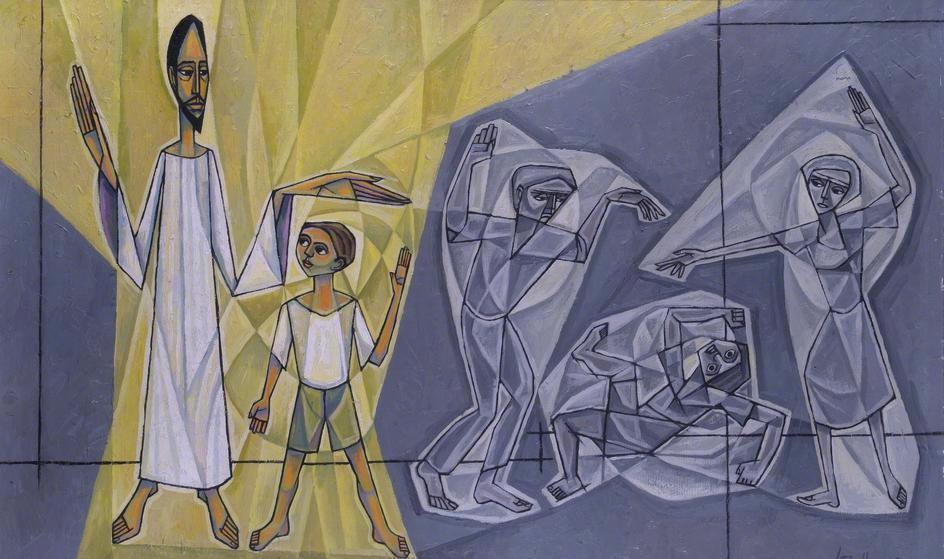
In John Reily’s almost stained-glass-like oil painting, the demon-possessed boy on the right is rendered in agonized geometric distortions. In a manner reminiscent of Picasso’s Guernica, Reily uses cubist conventions to contort the figure to collapse both physical and spiritual anguish into a mass of sharp, angular fragments. The luminous, golden glow surrounding Christ and the healed boy on the left gives visual form to the remarkable outpouring of divine transformation experienced by both children in these passages. “Unclean” as they are, each is suddenly, wonderfully, mercifully renewed.
Even if we have not experienced the anguish of these children, we know what it feels like to be broken, twisted and fragmented in a world that is all of those things. A world that attempts to shape us in its image. The reordering of the world through Christ’s sacrifice re-assembles us in body and spirit. Not yet fully, not yet perfectly, but the invitation and promise is there for all.
For us gentiles, these are reminders of just how incomprehensible Christ’s mission would have been to his disciples, and to those who believed themselves to be outside the covenant promises given to Israel, looking in and longing to be in the healing glow of the Messiah. The requests of these gentiles required a great leap of faith, a desperate longing that required they break through the religious, historical, political and cultural boundaries keeping them from believing they could be part of the chosen. And yet, they find themselves whole, basking in the glow of Christ’s boundless grace and mercy.
Prayer
Lord, give us a small measure of the great faith, a faith that heals even those seen as beyond hope.
Thank you for your amazing grace, and for the mercies you bless us with each morning.
We come to you with wonder and gratitude that you have chosen us to be your children, your people.
May we be forever delighted by your endless, boundless love.
Amen.
Luke Aleckson
Professor, Department of Art
Executive Director, Center for Christianity, Culture & the Arts
Biola University
For more information about the artwork, music, and poetry selected for this day, we have provided resources under the “About” tab located next to the “Devotional” tab near the top of the page.
About the Artwork
The Healing of the Lunatic Boy
John Reilly
1958
Oil on canvas board
66.5 x 106 cm
Methodist Modern Art Collection
The Methodist Church Great Britain
Permission granted by the Methodist Modern Art Collection
https://www.methodist.org.uk
This painting by the English artist John Reilly pictures the healing of a deaf and mute boy by means of driving out an unclean spirit. Reilly places Jesus and the healed boy on the left side and the convulsing boy and his desperate parents on the right side. One of the figures on the right could also be a disciple who tries to heal the boy without success. On the right we see a grey world without light, in which each person is imprisoned in his own bubble. Perhaps one could see it as a world without prayer or faith, in which people attempt to liberate the boy with exorcising gestures. Jesus and the boy stand together, calm and upright in God’s radiant, golden light. Jesus prays and passes on God’s healing blessing to the young boy.
About the Artist
John Reilly (1928–2010) was an English painter, ceramic artist, and potter whose work frequently explored Christian themes. Born in Walton-on-Thames, Surrey, he trained at Kingston-upon-Thames Art College from 1949 to 1952. In 1954 he moved to the Isle of Wight, where he later founded Ventnor Pottery Studio with his wife, potter Elspeth Henderson. Reilly became known for his brightly colored ceramic plaques and tiles as well as his oil paintings, many of which interpreted biblical narratives through stylized forms and expressive color. His work has been exhibited in churches and cathedrals across England and is included in collections such as the Methodist Modern Art Collection.
About the Music | 1
“I Was on the Outside” from the album Song of Mark
I was on the outside, no power and no name,
A woman and a pagan – so they say,
While he was on the inside, with his power and his fame,
And I knew that he was in our town today,
So, I came to where he stayed and knelt before him,
And I begged and cried and pleaded and I prayed.
“Rabbi, please, I beg of you, come heal my child,
Come, make my daughter whole once more,
I believe that God sent you to help me,
So, I look to you that you might answer,
My prayer for the love that I bear.
I ask nothing more from you, but only this,
To make my daughter whole once more.
I believe that your hands have the power to restore her life,
And so I swallow my pride, and ask you inside.
Woman, I have many children, too,
They are sick and they are dying,
They are hungry, they are crying out to me for bread.
So, woman, what would you have me do?
All these children at my table must be fed,
I cannot give to every dog some bread.
I would suffer anything to heal my child,
To make my daughter whole once more,
Even dogs get the crumbs from the table,
Give me anything that you are able,
To give that my daughter might live.
Sister, you have answered true,
The love of God shall not be kept from you.
Oh sister, your cries have touched my soul,
Now go in peace, your daughter is made whole.
I was on the outside, no power and no name,
Yet Jesus turned and heard my plea that day.
He was on the inside,
Yet he heard me all the same,
And we shared the Reign of God upon the way.
About the Composer/Performer
Marty Haugen (b. 1950) is liturgical music composer and workshop presenter. His first job was as a worship leader in a Catholic parish in Minnesota in 1973. He began composing there in response to the poor quality of some of the music he was required to lead. Haugen holds a B.A. degree in psychology from Luther College and an M.A. degree in pastoral studies from the University of St. Thomas in St. Paul, Minnesota. His works include two settings of the liturgy for Lutheran use, "Holden Evening Prayer" and "Now the Feast and Celebration,” and settings of the Catholic Mass, including the Mass of Creation. Haugen has also composed other works, including liturgical settings, choral arrangements, sacred songs, and hymns, including "Gather Us In," "Eye Has Not Seen," "We Are Many Parts,” and "Shepherd Me, O God," as well as psalm settings and paraphrases. Haugen is a performing musician, and has recorded a number of CDs.
About the Music | 2
“Help My Unbelief”
When this heart in my chest feels cold
When these prayers that I pray feel old
When I’m far you still hold me close
All the things I don’t understand
All the questions inside my head
I bring it all to you once again
I believe God
Help my unbelief God
I’m down on my knees God
Free my soul
And break this heart of stone
Oh I believe God
Help my unbelief God
When my eyes can’t see God
Light my way
Give me the faith to say
I believe
Anything can be possible
A little faith is unstoppable
Even the mountains are movable
I believe God
Help my unbelief God
I’m down on my knees God
Free my soul
And break this heart of stone
Oh I believe God
Help my unbelief God
When my eyes can’t see God
Light my way
Give me the faith to say
I believe
I believe
I believe
Yes, I believe
It is well
It is well
It is well
With my soul
It is well
It is well
It is well
With my soul
Lord help me know
It is well
It is well
It is well
With my soul
It is well
It is well
It is well
With my soul
I believe God
Help my unbelief God
I’m down on my knees God
Free my soul
And break this heart of stone
Oh I believe God
Help my unbelief God
When my eyes can’t see God
Light my way
Give me the faith to say
I believe
It is well
It is well
It is well
With my soul
I believe (repeats)
About the Composers
Chris Tomlin, Jason Eskridge, Ben Johnson and KK Johnson
Jason Eskridge is a Nashville-based vocalist and musician originally from Rockwood, Tennessee. A graduate of Tennessee Tech University (B.S., Mechanical Engineering), he transitioned from engineering to pursue music professionally. Eskridge has served as a studio and touring vocalist for artists including Lyle Lovett, Randy Travis, Jonny Lang, Nicole C. Mullen, and TobyMac. He has performed throughout the United States and internationally, and has released original music including a six-song EP. Eskridge’s work reflects a desire to create music that deepens faith, cultivates reflection, and invites listeners to live with greater joy and purpose.
Ben Johnson is a producer, composer, and songwriter based in Los Angeles, CA. He is a founding member of Hatch Music and is known for his work in the Christian and worship genre. Most notably in 2017, he co-wrote and produced back-to-back #1 Billboard hits by Joshua Micah, “Parachute” and “Who Says”. Additionally, Ben has done an extensive amount of music for television and advertising. His work can be heard on networks such as CBS, PBS, CNBC, Animal Planet, Fox Sports, and NBC Sports.
KK Johnson is a Nashville-based artist, engineer, producer, and songwriter. A multi-instrumentalist from an early age, she began performing professionally as a child and later relocated to Nashville, where she developed her production skills using Logic Pro. Johnson has worked with artists including Ty Dolla $ign, Tyler Rich, and Kylie Morgan, and has produced projects across pop and country genres. She is a member of the sibling trio Track45, signed to Stoney Creek Records under BBR Music Group. Johnson has also entered a joint venture with Warner Chappell Music and Amped Entertainment. Her work reflects both technical precision and a commitment to creative excellence.
About the Performer/Composer
Chris Tomlin (b. 1972) is an American contemporary Christian music singer, songwriter, and worship leader from Grand Saline, Texas. He is signed to Capitol Christian Music Group and has become one of the most influential voices in modern worship music, known for songs such as “How Great Is Our God,” “Our God,” “Whom Shall I Fear (God of Angel Armies),” and “Holy Forever.” Tomlin helped shape the Passion Conferences worship movement and has released numerous albums that are sung in churches around the world. His work has earned multiple Dove Awards and a Grammy Award, and his songs are widely used in congregational worship. He is married to Lauren Bricken and they have three daughters.
About the Poetry and Poet
Elizabeth Spires (b. 1952) is an American poet and the author of seven collections of poetry and seven children’s books. She taught for many years at Goucher College in Baltimore, Maryland, where she is professor emerita of English and previously held the Chair for Distinguished Achievement. Her poems have appeared in The New Yorker, Poetry, American Poetry Review, The Paris Review, and numerous other literary magazines and anthologies. Her honors include the Amy Lowell Poetry Travelling Scholarship, a Whiting Award, a Guggenheim Fellowship, the Witter Bynner Prize from the American Academy of Arts and Letters, two Ohioana Book Awards, and the Maryland Author Award from the Maryland Library Association.
About the Devotion Writer
Luke Aleckson is a Professor of Art at Biola University and is currently the Executive Director of the CCCA. He received his M.F.A. from the School of the Art Institute of Chicago in sculpture and a B.S. in art from the University of Northwestern, St. Paul, Minnesota. Past positions have included serving as Department Chair and Professor of Art and Design at the University of Northwestern and the Director of Denler Gallery in St. Paul.