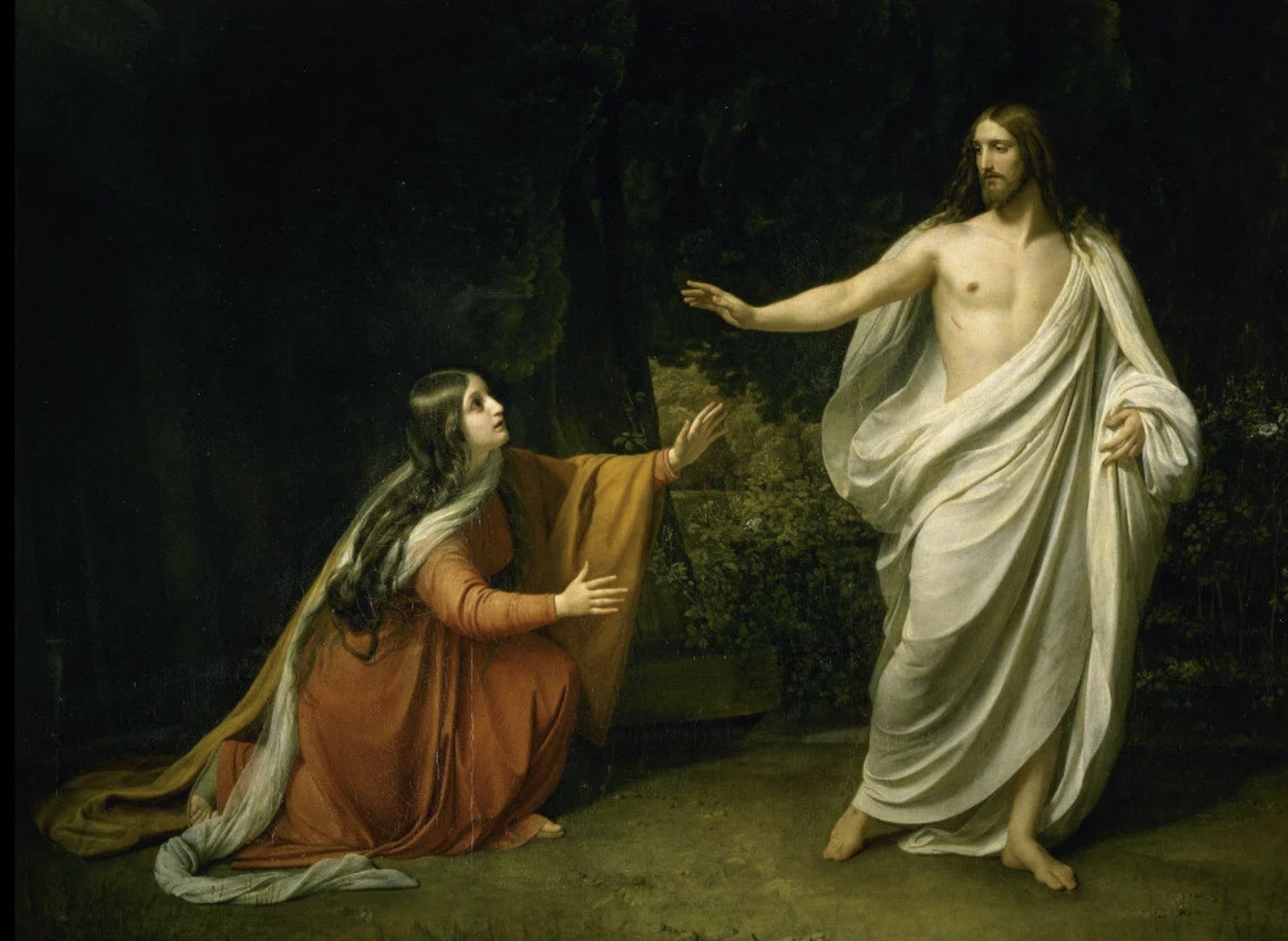
April 7: The Risen Lord Appears to Mary Magdalene
♫ Music:
Mark 16:9–11 (NKJV)
Now when He rose early on the first day of the week, He appeared first to Mary Magdalene, out of whom He had cast seven demons. She went and told those who had been with Him, as they mourned and wept. And when they heard that He was alive and had been seen by her, they did not believe.
Poetry
“Resurrection”
by W.R. Rodgers
The tomb, the tomb, that
Was her core and care, her one sore.
The light had hardly scarleted the dark
Or the first bird sung when Mary came in sight
With eager feet. Grief, like last night’s frost,
Whitened her face and tightened all her tears.
It was there, then, there at the blinding turn
Of the bare future that she met her past.
She only heard his Angel tell her how
The holding stone broke open and gave birth
To her dear Lord, and how his shadow ran
To meet him like a dog.
And as the sun
Burns through the simmering muslins of the mist,
Slowly his darkened voice, that seemed like doubt,
Morninged into noon; the summering bees
Mounted and boiled over in the bell-flowers.
‘Come out of your jail, Mary,’ he said, ‘the doors are open
And joy has its ear cocked for your coming.
Earth now is no place to mope in. So throw away
Your doubt, cast every clout of care,
Hang all your hallelujahs out
This airy day.’
Coming Out of the Tomb
When Jesus rose early on the first day of the week, he appeared first to Mary Magdalene. She went and told those who had been with him, who were mourning and weeping. But when they heard that he was alive and that she had seen him, they did not believe it.
The first witness to the resurrection was not someone prepared for joy. Mary Magdalene came to the tomb carrying grief. She had been faithful in following Jesus, faithful in love, and faithful even in loss. She did not come expecting resurrection. She came because love brought her there.
Mark’s Gospel tells us that Mary is entrusted with news the others cannot yet receive. She goes to the disciples, who are still mourning and weeping, and tells them what she has seen. They do not believe her. Grief has narrowed their vision. Hope feels impossible. Even devoted followers can struggle to receive good news when it disrupts their understanding of how the world works.
One poet imagines this moment as a gentle invitation spoken into sorrow. In “Resurrection,” W. R. Rodgers hears the risen Christ say to Mary, “Come out of your jail… the doors are open.” The image is arresting. Grief can become a kind of cell, familiar and enclosing. Mary’s sorrow is real, but it is no longer the place where she must remain. Jesus does not scold her for her grief. He calls her forward from it.
This calling echoes across Christian worship and song. In the aria “I Know That My Redeemer Liveth,” Handel sets words drawn from Scripture that proclaim, “I know that my Redeemer liveth… For now is Christ risen from the dead.” The music does not deny death or decay. It acknowledges them and then insists, quietly and confidently, that they do not have the final word. Resurrection is not shouted over grief; it rises through it.
The Scripture, poetry, and song remind us that resurrection is not only something we are told to believe. It is something we are invited to step into. Mary steps into it before she fully understands it. The disciples will come to believe later, in their own time. Resurrection does not wait for perfect faith. It moves toward us while we are still mourning.
There may be moments when you, like Mary, carry hope others cannot yet hear. There may be moments when you, like the disciples, find yourself unable to believe good news because grief feels too heavy. In both places, Jesus meets us. He opens doors we did not know were there. He calls us out of the confines that bind us and into life.
The question Mark leaves us with is not whether Christ is risen. He is. The question is whether, in our sorrow or doubt, we are willing to hear his voice and step forward when he calls.
Prayer
Risen Jesus, you come to us while we are still grieving and unsure. Help us hear you when you call. Give us the courage to move toward the life you offer, even when hope feels thin. Amen.
Robin LaBarbera
Professor Emerita
School of Education
Biola University
LaBarbera Learning Solutions
Seal Beach, California
For more information about the artwork, music, and poetry selected for this day, we have provided resources under the “About” tab located next to the “Devotional” tab near the top of the page.
About the Artwork
Christ's Appearance to Mary Magdalene After the Resurrection
Alexander Ivanov
1835
Oil on canvas
242 × 321 cm
Russian Museum
Public Domain
This painting by Russian artist Alexander Ivanov is a two-figure composition in life-size scale, with Mary Magdalene positioned on the left and Jesus Christ on the right. The painting depicts the moment when, according to the gospel narrative, Mary Magdalene recognizes the resurrected Christ. With a gesture of His right hand, Christ stops her impulse to touch Him, saying, "Do not cling to me, for I have not yet ascended to the Father.” The coloring of the canvas is largely based on the contrast between "the bright colors of the Magdalene's dress, shaded by a white coverlet, and the cold whiteness of the drapery enveloping the Savior's torso.”
About the Artist
Alexander Andreyevich Ivanov (1806–1858) was a Russian painter who was born and died in St. Petersburg, though he spent most of his life in Rome. He painted in the neoclassical tradition, but as it was going out of style, support for his work during his life was minimal. In the 1850s he developed a plan for a series of large frescoes to illustrate the Bible. Though the project was never completed, he painted a great many watercolor sketches for the frescoes.
About the Music
“I Know That My Redeemer Liveth” from the album “Handel’s Young Messiah”
Since by one man, came death.By one man also came the resurrection of the dead.
For as in Adam all of us will die.
So, in Christ shall all of us be made alive.
I know that my redeemer liveth
And that he shall stand
At the latter day,
At the latter day,
Upon the earth
I know that my redeemer liveth
And that he shall stand
At the latter day
Upon the earth
Upon the earth
I know that my redeemer liveth
And that he shall stand
At the latter day
Upon the earth
Upon the earth
I know that my redeemer liveth
For now is Christ risen from the dead
The first fruits of them that sleep
Of them that sleep
The first fruits of them that sleep
For now is Christ risen.
For now is Christ risen from the dead
The first fruits of them, them that sleep
I know that my redeemer liveth
And that he shall stand
At the latter day, upon the earth
Upon the earth
Upon the earth
I know that my redeemer liveth
And that he shall stand
At the latter day, upon the earth
Upon the earth
Ah, death, where is your sting
Grave, where is your victory
Thanks be to God who gives us the victory
Through our Lord, Jesus Christ
About the Composer
George Frideric Handel arranged by Don Hart
George Frederic Handel (1685–1759) was a German baroque composer who spent the bulk of his career in London and became well-known for his operas, oratorios, anthems, and organ concertos. He was strongly influenced by the great composers of the Italian baroque and the middle-German polyphonic choral tradition. Musicologist Winton Dean writes that his operas show that "Handel was not only a great composer; he was a dramatic genius of the first order.” Handel’s Messiah was first performed in Dublin, Ireland, in April 1742 and received its London premiere nearly a year later. After an initially modest public reception, the oratorio gained in popularity, eventually becoming one of the best-known and most frequently performed choral works in western music. Handel's Messiah has been described by the early-music scholar Richard Luckett as "a commentary on Jesus Christ's Nativity, Passion, Resurrection, and Ascension," beginning with God's promises as spoken by the prophets and ending with Christ's glorification in heaven. The music for the Messiah was completed in only twenty-four days and Handel wrote the letters SDG—Soli Deo Gloria, “to God alone the glory”—at the end of the manuscript. In many parts of the world, it is accepted practice for the audience to stand when the “Hallelujah Chorus” is performed. The tradition is said to have originated with the first London performance of the Messiah, which was attended by King George II. As the first notes of the triumphant “Hallelujah Chorus” rang out, the king was so moved that he rose to his feet and remained standing until the end of the chorus, initiating a tradition that has lasted well over two centuries. Indeed, the “Hallelujah Chorus” is one of the most awe-inspiring pieces of music ever written.
Don Hart is a composer, arranger, and orchestrator living in Nashville, Tennessee. In addition to his commercial recording endeavors, Don also serves as composer-in-residence with Orchestra Nashville. In addition to composing, Don wrote numerous arrangements for recordings and live performance. Those he worked with include the Kansas City Symphony and Orchestra Nashville, Darrell Scott, Viktor Krauss, Stuart Duncan, Bryan Sutton, Dan Dugmore, Suzy Bogguss, Matraca Berg, Gretchen Peters, Raul Malo, Chris Tomlin, Jim Cosgrove, JJ Heller, Jennie Riddle, Diane di Stasio, and Risa Binder. Don’s instrumental and choral arrangements have been published by a number of companies, including Hal Leonard, Word Entertainment, Shawnee Press, and Lorenz.
About the Performers
Cynthia Clawson and the First Baptist Church Choir of Norfolk Virginia
Narrated by Barry McGuire
Cynthia Clawson (b. 1948), referred to as the “singer’s singer” and called "the most awesome voice in gospel music" by Billboard Magazine, has received a Grammy and five Dove awards for her work as a songwriter, vocal artist, and musician. Her career has spanned over four decades, with twenty-two albums released since 1974. Clawson has performed in many prestigious venues and with preeminent groups, and her work has been featured in a number of films, including A Trip To Bountiful. Cynthia currently resides in Houston, Texas, and is married to lyricist, poet, and playwright Ragan Courtney.
The First Baptist Church Choir of Norfolk, Virginia, has a rich and varied program of worship music, and the choir is an integral part of their services.
Barry McGuire (b. 1935) is an American singer-songwriter primarily known for his 1965 hit "Eve of Destruction.” He was later a singer and songwriter of contemporary Christian music after he became a born-again Christian in 1971. In 1973, he joined the Myrrh label and released the album Seeds. This album contained backing vocals by the family trio that would become known as the 2nd Chapter of Acts. In 1974, McGuire released his second Jesus music album, Lighten Up, which included a remake of "Eve of Destruction.” In the 1980s, after his final album Pilgrim, McGuire left the music industry and settled for a time in New Zealand with his wife, Mari. He wrote music, performed, and hosted the videos for several years for Gospel Light Publishing's vacation Bible school programs. He returned to the United States, where in 2000 he toured with Christian musician John Michael Talbot.
About the Poetry and Poet
W. R. Rodgers (William Robert Rodgers; 1909–1969) was a Northern Irish poet, essayist, broadcaster, and writer best known for his contributions to mid‑twentieth‑century literature. Born in Belfast, he studied English at Queen’s University Belfast and was ordained as a Presbyterian minister before leaving the ministry to work for the BBC in London. Rodgers published significant poetry collections including Awake! and Other Poems (1941) and Europa and the Bull (1952), and his work often reflected the landscapes and tensions of Irish life. In addition to his poetry, he produced influential radio broadcasts on literary figures and held roles as a critic and lecturer. Rodgers’s Collected Poems was published posthumously in 1971. He was elected a life member of the Irish Academy of Letters and served on literary panels in Britain and Northern Ireland. Rodgers died in Los Angeles in 1969.
About the Devotion Writer
Robin LaBarbera is an independent evaluator and writer with a background in education and social work. She is faculty emerita from the School of Education at Biola University. Her work focuses on faith, well-being, and human flourishing, particularly among unhoused neighbors and people who are currently or formerly incarcerated.