April 8: Jesus Walks with Two of His Disciples
♫ Music:
Mark 16:12–13 (NKJV)
After that, He appeared in another form to two of them as they walked and went into the country. And they went and told it to the rest, but they did not believe them either.
Poetry:
“Emmaus”
by Rowan Williams
First the sun, then the shadow,
so that I screw my eyes to see
my friend’s face, and its lines seem
different, and the voice shakes in the hot air.
Out of the rising white dust, feet
tread a shape, and, out of step,
another flat sound, stamped between voice
and ears, dancing in the gaps, and dodging
where words and feet do not fall.
When our eyes meet, I see bewilderment
(like mine); we cannot learn
this rhythm we are asked to walk,
and what we hear is not each other.
Between us is filled up, the silence
is filled up, lines of our hands
and faces pushed into shape
by the solid stranger, and the static
breaks up our waves like dropped stones.
So it is necessary to carry him with us,
cupped between hands and profiles,
so that the table is filled up, and as
the food is set and the first wine splashes,
a solid thumb and finger tear the thunderous
grey bread. Now it is cold, even indoors;
and the light falls sharply on our bones;
the rain breathes out hard, dust blackens,
and our released voices shine with water.
Jesus Walks with Two of His Disciples
When we experience loss, a feeling of untethering can follow. An untethering from the physical world and an untethering from bonds of relationship. In her short book, Notes on Grief, written after the death of her own father, author Chimamanda Ngozi Adichie describes how inappropriate it felt to see the mail still arrive in the mail box—she felt untethered from her physical world because of a rift in her relational world. Despite this disorientation, the world still had the audacity to proceed as if nothing had happened. The physical world and relationships continued. Society still communicated by sending mail that was placed for recipients to collect in a mail box.
Normalcy exists alongside loss and it feels untethering. The new rhythm of life is too syncopated for us to stabilize on our own. Rowan Williams, inspired by T. S. Elliot’s Wasteland, identifies this untethered feeling in today’s poem,
Out of the rising white dust, feet
tread a shape, and, out of step,
another flat sound, stamped between voice
and ears, dancing in the gaps, and dodging
where words and feet do not fall.
In our short passage of scripture today, we read Mark’s description of two seemingly untethered disciples walking in the countryside with the risen Lord Jesus. In true Markian style, it is a short account. Just two sentences. We know from having spent this season of Lent saturated in Mark’s Gospel, that his account is focused on the question of Jesus’ identity. In today’s passage, however, Mark omits all of the identity drama recorded by Luke (Luke 24:13-35). That identity question has been the drum beat of Mark’s entire gospel (Who do people say that I am?, Mark 8:27). He has already answered it for the reader (You are the Christ, Mark 8:29). Instead, Mark focuses on the risen Christ walking and conversing with the two disciples—re-tethering them. The question now becomes: how does one walk in step with Him? In these two verses, Jesus is walking with the two and not just appearing to them
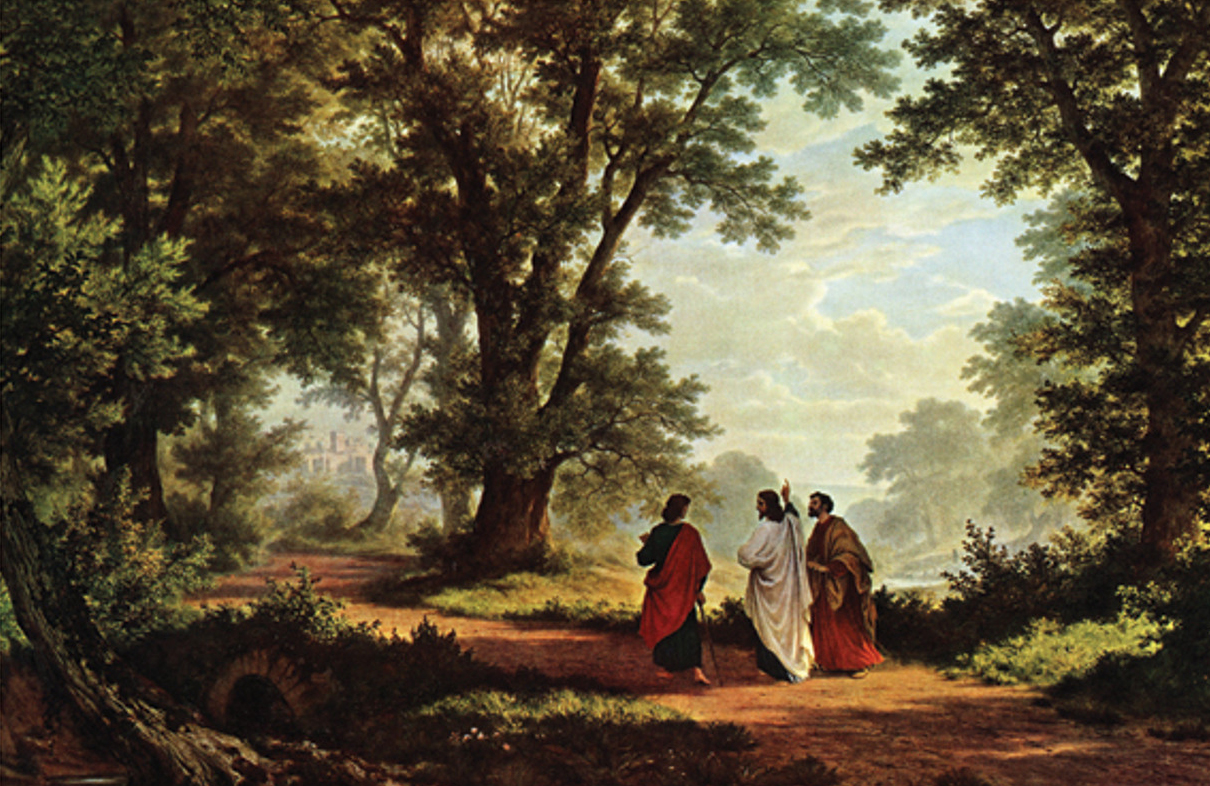
Today’s artwork illustrates that the disciples' focus is not on the path they are treading but is turning this way and that as they learn to walk the syncopated rhythm of this new life. The focus of the painting—the still point—is Jesus Christ gesturing heavenward and providing the structure and stability to counteract their untethering. The one who stilled the raging seas also secures the anxious hearts of his disciples. Rowan Williams again:
Between us is filled up, the silence
is filled up, lines of our hands
and faces pushed into shape
by the solid stranger, and the static
breaks up our waves like dropped stones.
Life and relationship with others only make sense in the context of a walk that is in step with Jesus. He defines us, gives us purpose, and when we struggle to see things clearly or struggle to understand why certain things happen to those we love, he ‘fills up the silence’. His identity and his presence transform and sustain the lives of believers. Acknowledgement of who he is changes everything forever. ‘So’, says Williams,
it is necessary to carry him with us,
cupped between hands and profiles,
so that the table is filled up, and as
the food is set and the first wine splashes,
a solid thumb and finger tear the thunderous
grey bread.
Celebrating Easter is wonderful, and yet we need to be reminded of the truth of resurrection every day as we walk closer and closer to our eternal home. When normalcy and loss coexist as they did for the two disciples in today’s passage, resurrection truth stabilizes, even redeems, the disorientation of that untethered feeling. Listen to today’s music, listen to the determined beat and onward marching rhythm. Listen also for these words Glory, Hallelujah! Shout on, pray on, we're gaining ground. Let us spur one another on to ‘carry him with us’, to eat the bread and drink the cup together and proclaim his death until he comes again (1 Corinthians 11:26).
Walk on, my friends, tethered (to Christ) and singing!
Prayer
Thank you for the gift of your son Jesus Christ. Thank you for our new lives found in and through his death and resurrection. Thank you for the body of Christ and for the presence of the Holy Spirit in our lives. May we learn to identify those who need encouragement, even today. May we remind them of the transforming power of your Son’s identity and presence. In Jesus name,
Amen.
Siân Draycott
Assistant Professor
Torrey Honors
Biola University
For more information about the artwork, music, and poetry selected for this day, we have provided resources under the “About” tab located next to the “Devotional” tab near the top of the page.
About the Artwork
Road to Emmaus
Robert Zund
1877
Oil on canvas
119 x 158 cm
St. Gallen Museum of Art
St. Gallen, Switzerland
Public Domain
Jesus, in one of His post-resurrection appearances, appears to two disciples as they travel along the road to Emmaus. Jesus appears mysteriously to the disillusioned disciples, who tell Him about the events of the past few days. As the two disciples talk about the tragic events that have transpired with the crucifixion of Jesus, their mysterious companion opens their minds to a deeper understanding of the Scriptures. He listens intently to them as the two disciples reveal their shattered hopes and dreams for Jesus, who they had hoped would redeem Israel. The concept of redemption for these disciples and many other Jews meant that a conquering, all-powerful Messiah would lead them to freedom from the Romans. Upon arriving at Emmaus, the disciples welcome their companion to stay and spend the night with them. Jesus remains for dinner and as He takes the bread, gives thanks, and breaks it, they realize their companion is the risen Jesus. It is the message of faith acknowledging that Jesus is the living bread, the risen Messiah.
About the Artist
Robert Zund (1827–1909) was a Swiss landscape painter. Zund's art is distinguished by a special closeness to nature and a highly naturalistic, richly detailed style of painting. In 1852 Zund traveled to Paris where, at the Louvre, he studied the works of the Dutch and French masters of the seventeenth century. His first major work was The Harvest (1860), now in the Kunstmuseum Basel. That same year, he copied works by landscape artists such as Claude Lorrain, Ruisdael, and Paulus Potter in the Gemälde Gallery, Dresden. His passion was mainly for idyllic landscapes around Lucerne, Switzerland.
About the Music
“I Know That My Redeemer Lives - Shout On!” from the album Songs of the Saints Project
I know that my Redeemer lives,
Glory Hallelujah.
What comfort this assurance gives,
Glory Hallelujah.
Shout on, pray on, we’re gaining ground.
Glory Hallelujah.
The dead’s alive, and the lost is found.
Glory Hallelujah.
He lives to crush the fiends of Hell,
Glory Hallelujah.
He lives and doth within me dwell,
Glory Hallelujah.
Shout on, pray on, we’re gaining ground.
Glory Hallelujah.
The dead’s alive, and the lost is found.
Glory Hallelujah.
He lives, He lives who once was dead.
Glory Hallelujah.
He lives my ever living Head.
Glory Hallelujah.
Shout on, pray on, we’re gaining ground.
Glory Hallelujah.
The dead’s alive, and the lost is found.
Glory Hallelujah.
He lives to bless me with His love.
Glory Hallelujah.
He lives to plead for me above.
Glory Hallelujah.
Shout on, pray on, we’re gaining ground.
Glory Hallelujah.
The dead’s alive, and the lost is found.
Glory Hallelujah.
He lives my hungry soul to feed.
Glory Hallelujah.
He lives to help in time of need.
Glory Hallelujah.
Shout on, pray on, we’re gaining ground.
Glory Hallelujah.
The dead’s alive, and the lost is found.
Glory Hallelujah.
He lives, all glory to His name.
Glory Hallelujah.
He lives, my Savior still the same,
Glory Hallelujah.
Shout on, pray on, we’re gaining ground.
Glory Hallelujah.
The dead’s alive, and the lost is found.
Glory Hallelujah.
About the Composer
Lyrics by Samuel Medley and Music is a traditional American folk hymn
Samuel Medley (1738–1799) was an English minister and hymn writer. At fourteen, he was apprenticed to an oilman in the city of London. In 1755, however, he obtained his freedom upon entering the Royal Navy, from which he was discharged after being wounded. From 1762 to 1766, Medley maintained a successful school in Soho, London, and became acquainted with Baptist minister Andrew Gifford, who encouraged him to enter the Baptist ministry. Medley was ordained and in 1772 he began his ministry in Liverpool, where he worked among the seamen of the port. Medley wrote over two hundred thirty hymns. He wrote "I Know That My Redeemer Lives" in 1775, and it was first published in George Whitefield's Psalms and Hymns hymnal the same year.
About the Performer
Joe Stout is the chief musician at Christ Covenant Church as well as board member and director of music at Christ the King Academy in the Pacific Northwest. His passion is music and his desire is to learn and teach others Christian songs that will endure the test of time.
About the Poetry and Poet
Rowan Williams (b. 1950) is a Welsh poet, theologian, and writer who served as the 104th archbishop of Canterbury from 2002 to 2012. Educated at Christ’s College, Cambridge, and Wadham College, Oxford, he held academic positions in theology at both Oxford and Cambridge before his episcopal appointments. Williams has published widely across theology, spirituality, and literature, and his poetry and translations have earned recognition in literary circles; his Collected Poems and other poetic works reflect his engagement with language, faith, and culture. In addition to his literary work, he has written numerous books on theology and Christian thought and served as master of Magdalene College, Cambridge.
About the Devotion Writer
Siân Draycott grew up in Wales and earned a Ph.D. in educational studies from Talbot School of Theology. She is an Assistant professor at the Torrey Honors College, Biola University where she enjoys discussing great books with her students.