April 6: Fear and Amazement Grip the Disciples
♫ Music:
Mark 16:8 (NKJV)
So they went out quickly and fled from the tomb, for they trembled and were amazed. And they said nothing to anyone, for they were afraid.
Poetry:
“Fear”
By Kahlil Gibran
It is said that before entering the sea
a river trembles with fear.
She looks back at the path she has traveled,
from the peaks of the mountains,
the long winding road crossing forests and villages.
And in front of her,
she sees an ocean so vast,
that to enter
there seems nothing more than to disappear forever.
But there is no other way.
The river can not go back.
Nobody can go back.
To go back is impossible in existence.
The river needs to take the risk
of entering the ocean
because only then will fear disappear,
because that's where the river will know
it's not about disappearing into the ocean,
but of becoming the ocean.
Fear, Uncertainty, and Doubt
In some of the earliest manuscripts, Mark’s Gospel ends at 16:8, with the women fleeing the empty tomb in fear and amazement at the angel’s proclamation that Jesus has been raised. In this rush of bewildering events and world-shattering news, Mark’s Gospel closes suddenly—leaving us not with resolution, but with wonder.
We can relate to these disoriented followers of Jesus, when all they thought they knew was inverted, more than once. When we encounter fear, we can taste, see, touch, hear, and smell it; our imagination is a ready amplifier. Thank God for art, which activates our senses.
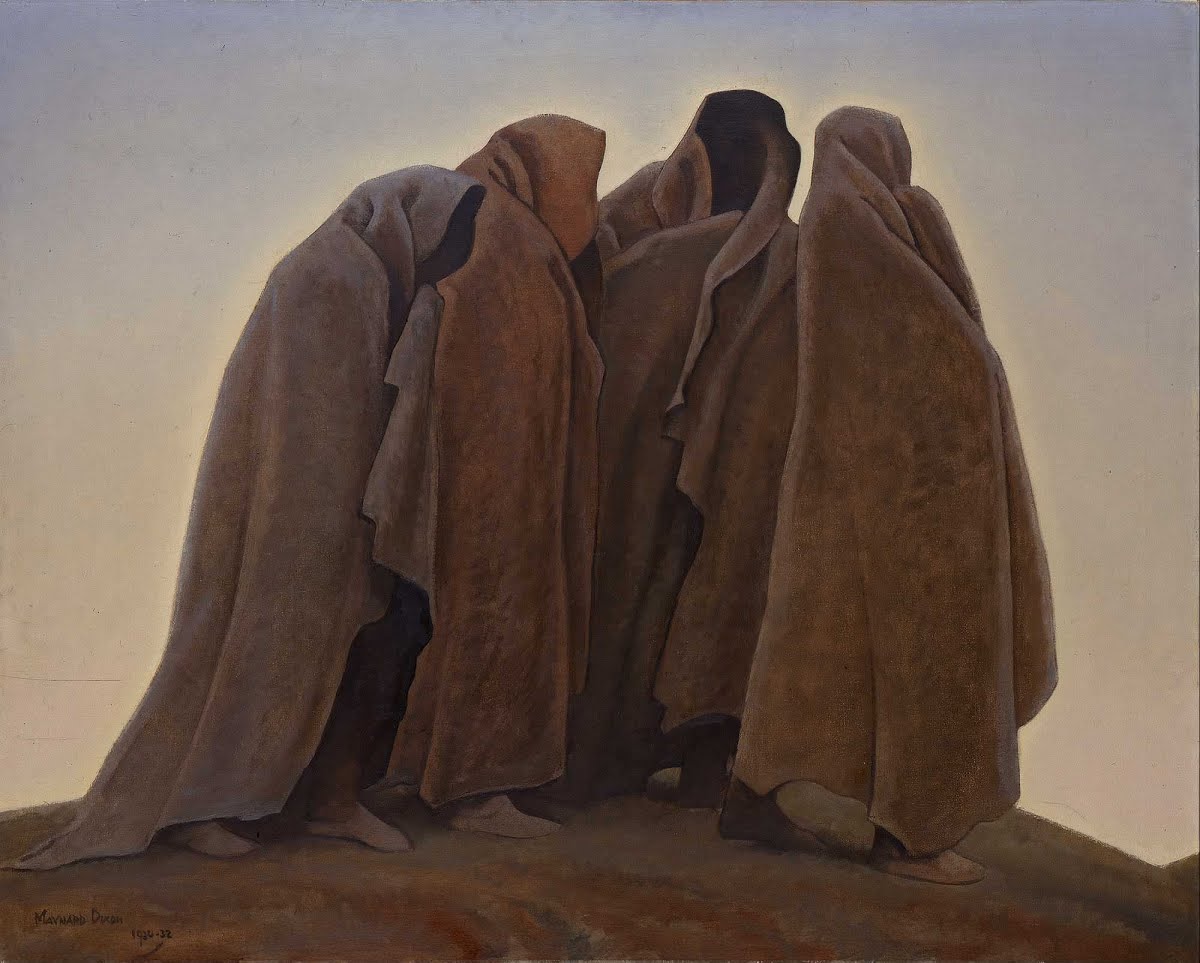
In Maynard Dixon’s “Shapes of Fear” painting (circa 1930s Great Depression and Dust Bowl), we see feet, but huddled human faces are rendered as shadows. Our imagination makes quick work of whispered uncertainty. Earthen colors weave a reminder that we are formed from dust and, because of sin, return to dust—yet never outside God’s sustaining care. What follows?
The biblical promise that God is faithful to make all things new, even as we wait for their full unveiling. Perhaps God is also doing something new now, all the time, revealing a pattern. On God’s earth (as it is in heaven), then and now might be not so very far apart.
The Lebanese poet Kahlil Gibran paints the reluctant encounters of a river, fearful to follow the pull of gravity into the warm, transforming embrace of the ocean.
The disquieting ramifications of Jesus’ resurrection were then, and are today, not intuitively familiar! All our senses are on alert.
The day Jesus’ tomb was discovered empty, and whenever God’s activity is unfamiliar, we may experience fear. Fear appears as early as Genesis 3, whenever those made in God’s image forge different garden paths than God has provided.
Made in God’s image, yes, but we’re easily distracted. Each time we reimagine God’s designs, we create a canvas for ourselves and others to experience fear, as in the painting, or the empty tomb, or the reluctant river.
Bodily death is real for us dusty humans. Resurrection spans beyond our earthen story, so yes, we feel uncertain. Resurrection seems foreign to our human boundaries, so we may doubt. Even Thomas—a firsthand witness—confessed his doubt and was invited to touch the wounds of the risen Christ.
Jesus, and Mark’s storytelling, acknowledge human doubt and meet it with revelation that invites belief.
Alfred Lord Tennyson wrote, “There lives more faith in honest doubt, believe me, than in half the creeds.”
The temptation to reduce the fullness of God to human certainty is an obstacle to faith. Uncertainty can be a welcome, humble companion, in an earthen story created, inhabited, and continually touched by God, still making things new, as the river approaches the ocean.
Theological inquiry, fueled by curiosity, tempered by uncertainty, rooted in love, is a holy path. It’s a beautiful exercise of imagination, reaching beyond the gravity of our limits. We should take heart, when uncertain paths lead us toward deeper faith in Jesus. God’s love and light cannot be foiled.
Prayer
Oh, God, even in our shadows,
you are always creating.
Replenish and sustain our lives,
within this earthbound experience
(which you yourself have tasted),
and far beyond our human life spans.
Break the walls, tear the curtains.
Show off your beautiful habits:
transforming fear into wonder,
uncertainty into discovery,
doubt into faith,
and death into life.
Shape us into vessels for your love.
Amen.
Barry Sherbeck
Freelance photographer, filmmaker, videographer, visual artist, writer, and educator
For more information about the artwork, music, and poetry selected for this day, we have provided resources under the “About” tab located next to the “Devotional” tab near the top of the page.
About the Artwork
Shapes of Fear
Maynard Dixon
1930–32
Oil on canvas
101.5 x 127.3 cm
Smithsonian American Art Museum
Washington, D.C.
Public Domain
The painting Shapes of Fear by American artist Maynard Dixon is an evocative painting that captures a sense of fear, apprehension, and anxiety. The artwork features four cloaked figures huddled together, with their bodies and their faces hidden from view. The cloaks' earthy tones and the figures' anonymity suggest themes of desolation, secrecy, uncertainty, and apprehension. The subdued color palette and minimalistic background focuses the viewer's attention on the abstracted forms and the implied tension between them. The absence of any distinct facial features or identifying traits renders the figures as abstracted universal symbols of an unsettled and uncertain environment. During the painting of this work, Dixon was likely influenced by the social and economic hardships felt during the Great Depression.
About the Artist
Maynard Dixon (1875–1946) was an American artist. He was known for his paintings, and his body of work focused on the American West. Dixon is considered one of the finest artists that dedicated most of their art to the US Southwestern cultures and landscapes at the end of the nineteenth century and the first half of the twentieth century. He was often called "The Last Cowboy in San Francisco." Through his work with the Galerie Beaux Arts, a cooperative gallery in San Francisco, Dixon played a pivotal role ensuring the West Coast supported the work of local, modern artists. He was married for a time to renowned photographer Dorothea Lange, and later to painter Edith Hamlin.
About the Music
“The Pain and Persistence of Doubt” from the album Luke: A World Turned Upside Down
In the light of the dawn,at the dawn of the day,
as the night that seemed endless was done,
In emptiness, in hopelessness,
to care for a corpse, they come.
In the dim morning light,
they thought that they might have
caught a glimpse of a stone rolled away,
In fear, they bowed, not knowing
how they could hear an angel say,
"Why search for the living here among the dead?
Can't you see that He's simply not here?
Why can you not figure out what His words were all about?
When will you let go of the pain and persistence of doubt?"
In heart-pounding hope,
they ran back from the tomb,
to tell the impossible truth.
Did they succumb to delirium and
believe unbelievable news?
Why search for the living here among the dead?
Can't you see that He's simply not here?
Why can you not figure out what His words were all about?
When will you let go of the pain and persistence of doubt?
In our own world and in our own way,
we live like this mystery is not true,
But if we take care and defy the despair,
in our own ears the words might ring true.
Why search for the living here among the dead?
Can't you see that He's simply not here?
Why can you not figure out what His words were all about?
When will you let go of the pain and persistence of doubt?
About the Composer/Performer
In a career that spans over thirty years, Michael Card (b. 1957) has recorded over thirty-one music albums, authored or coauthored over twenty-four books, hosted a radio program, and written for a wide range of magazines. He has penned such favorite songs as “El Shaddai,” “Love Crucified Arose,” and “Immanuel.” He has sold over four million albums and written over nineteen number one hits. Card’s original goal in life was to simply and quietly teach the Bible and proclaim Christ. Although music provided him the opportunity to share insight gained through his extensive scholarly research, he felt limited by having to condense the vast depth and richness of Scripture into three-minute songs. This prompted him to begin to write articles and books on topics that captured his imagination through conversations with Bible teachers, friends, and contemporaries in both Christian music and the academic community, and Card has continued to write to this day. Card travels frequently each year, teaching and sharing his music at Biblical Imagination Conferences, and facilitating the annual Life of Christ Tours to Israel.
About the Poetry and Poet
Kahlil Gibran (1883–1931) was a Lebanese American poet, writer, visual artist, and philosopher best known for his book The Prophet, one of the most widely read works of spiritual literature in the twentieth century. Born in the village of Bsharri in present-day Lebanon, Gibran emigrated with his family to the United States as a child, settling in Boston, where he was exposed to both Western literary traditions and his native Arabic culture. Writing in both Arabic and English, Gibran’s work explores themes of love, faith, suffering, freedom, and the human search for meaning, often blending poetic language with spiritual reflection. In addition to his literary work, Gibran was an accomplished visual artist whose drawings and paintings often accompanied his texts. His influence continues to span literature, theology, and popular spirituality worldwide.
About the Devotion Writer
Barry Sherbeck is a writer, visual artist (photographer, filmmaker), and educator, based in Madison, WI. He lived and traveled internationally almost half his life, and has worked in visual communications for 40 years. He loves being a father, grandfather, and home chef, and deeply appreciates light, water, music, reading, and walking.