March 2: The Power of Jesus to Heal: His Divine Authority and Compassion
♫ Music:
Mark 5:21-43 (NKJV)
Now when Jesus had crossed over again by boat to the other side, a great multitude gathered to Him; and He was by the sea. And behold, one of the rulers of the synagogue came, Jairus by name. And when he saw Him, he fell at His feet and begged Him earnestly, saying, “My little daughter lies at the point of death. Come and lay Your hands on her, that she may be healed, and she will live.” So Jesus went with him, and a great multitude followed Him and thronged Him.
Now a certain woman had a flow of blood for twelve years, and had suffered many things from many physicians. She had spent all that she had and was no better, but rather grew worse. When she heard about Jesus, she came behind Him in the crowd and touched His garment. For she said, “If only I may touch His clothes, I shall be made well.”
Immediately the fountain of her blood was dried up, and she felt in her body that she was healed of the affliction. And Jesus, immediately knowing in Himself that power had gone out of Him, turned around in the crowd and said, “Who touched My clothes?”
But His disciples said to Him, “You see the multitude thronging You, and You say, ‘Who touched Me?’ ”
And He looked around to see her who had done this thing. But the woman, fearing and trembling, knowing what had happened to her, came and fell down before Him and told Him the whole truth. And He said to her, “Daughter, your faith has made you well. Go in peace, and be healed of your affliction.”
While He was still speaking, some came from the ruler of the synagogue’s house who said, “Your daughter is dead. Why trouble the Teacher any further?”
As soon as Jesus heard the word that was spoken, He said to the ruler of the synagogue, “Do not be afraid; only believe.” And He permitted no one to follow Him except Peter, James, and John the brother of James. Then He came to the house of the ruler of the synagogue, and saw a tumult and those who wept and wailed loudly. When He came in, He said to them, “Why make this commotion and weep? The child is not dead, but sleeping.”
And they ridiculed Him. But when He had put them all outside, He took the father and the mother of the child, and those who were with Him, and entered where the child was lying. Then He took the child by the hand, and said to her, “Talitha, cumi,” which is translated, “Little girl, I say to you, arise.” Immediately the girl arose and walked, for she was twelve years of age. And they were overcome with great amazement. But He commanded them strictly that no one should know it, and said that something should be given her to eat.
Poetry
From “The Healing of the Daughter of Jairus”
By Nathaniel Parker Willis
Like a form
Of matchless sculpture in her sleep she lay—
The linen vesture folded on her breast,
And over it her white transparent hands,
The blood still rosy in their tapering nails.
A line of pearl ran through her parted lips,
And in her nostrils, spiritually thin,
The breathing curve was mockingly like life;
And round beneath the faintly tinted skin
Ran the light branches of the azure veins;
And on her cheek the jet lash overlay,
Matching the arches pencill’d on her brow.
Her hair had been unbound, and falling loose
Upon her pillow, hid her small round ears
In curls of glossy blackness, and about
Her polish’d neck, scarce touching it, they hung
Like airy shadows floating as they slept.
’Twas heavenly beautiful. The Saviour raised
Her hand from off her bosom, and spread out
The snowy fingers in his palm, and said,
“Maiden! Arise!”—and suddenly a flush
Shot o’er her forehead, and along her lips
And through her cheek the rallied colour ran;
And the still outline of her graceful form
Stirr’d in the linen vesture; and she clasp’d
The Saviour’s hand, and, fixing her dark eyes
Full on his beaming countenance—AROSE!
The Power of Jesus to Heal: His Divine Authority and Compassion
Do you ever feel like you’re lost in the crowd, unnoticed, anonymous, overlooked? I pray this Mark 5 passage will remind you of how wide and intimate is God’s mercy.
The Gospel writer tells the stories of two people, deep in their need for help. The first story is of a rich man named Jairus who fell at Jesus’ feet, desperate as his twelve-year-old daughter was dying. Then comes the second story, one of a poor woman without a name who fell at Jesus’ feet, desperate because she had been subject to bleeding for twelve years.
Twelve years: this is how long she’d suffered. This is how long the ruler’s daughter had been alive.
This Mark 5 passage is crowded with crowds. Five times the word crowd or multitude is found in this passage, plus the tumult of the crowd outside the house of the synagogue ruler.
Yet Jesus was attentive to the one among the many. After the perpetually bleeding woman touched the hem of Jesus' cloak and was healed, Jesus turned to see who it was. As he looked around, his closest followers didn’t see what Jesus saw, saying to him: “You see the multitude thronging you, and you say, ‘Who touched me?’”
An overlooked line in this story is Jesus’ response to the blindness of his disciples. The Bible says that Jesus kept looking around to see who had touched him, until he found the woman, the woman now healed.
St. Augustine says that flesh presses, but faith touches. This is a story not about pressing flesh but about touching faith. “Daughter, your faith has made you well.” “Jairus, do not be afraid, only believe.”
The contrast between the two faces in the crowd is no coincidence. This, I believe, is God’s way of telling us how wide his mercy is. It stretches from the rich to the poor, from the family man to the lonely woman, from the named to the unnamed. (Though Jesus names the woman “daughter,” the only time he does this in Scripture.) These two stories reflect the spectrum of God’s grace. Who does not fit within this breadth? We all do.
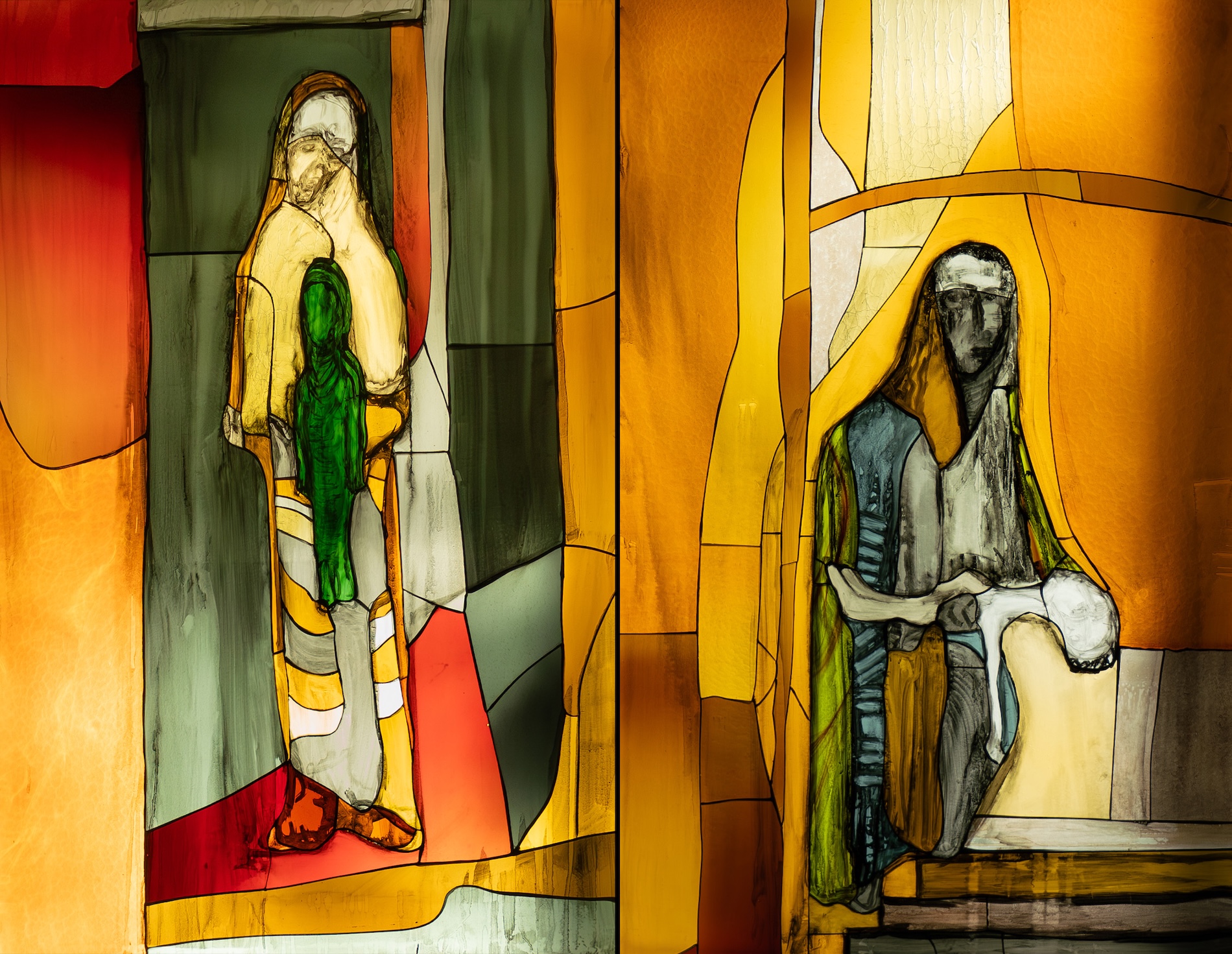
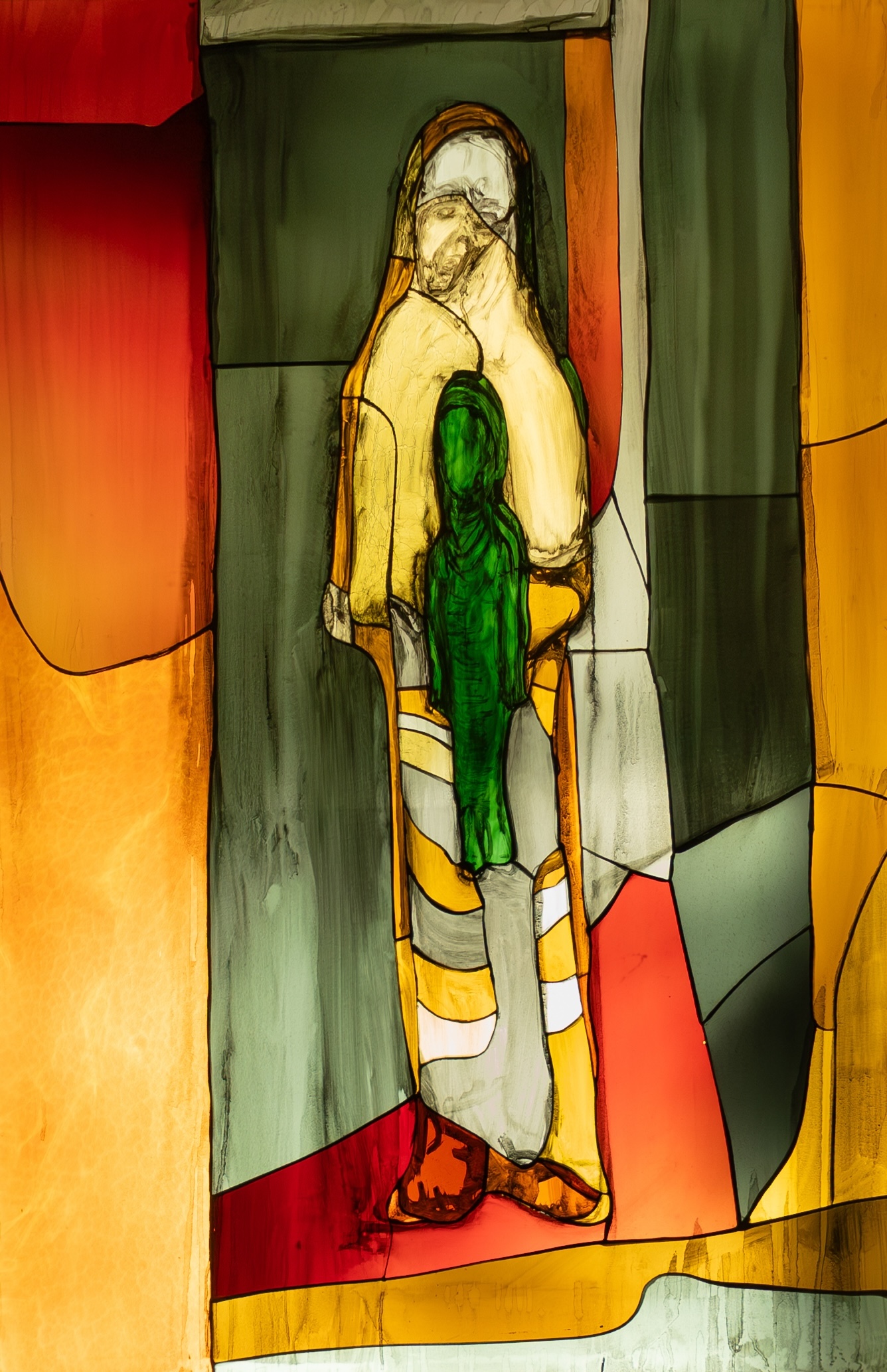
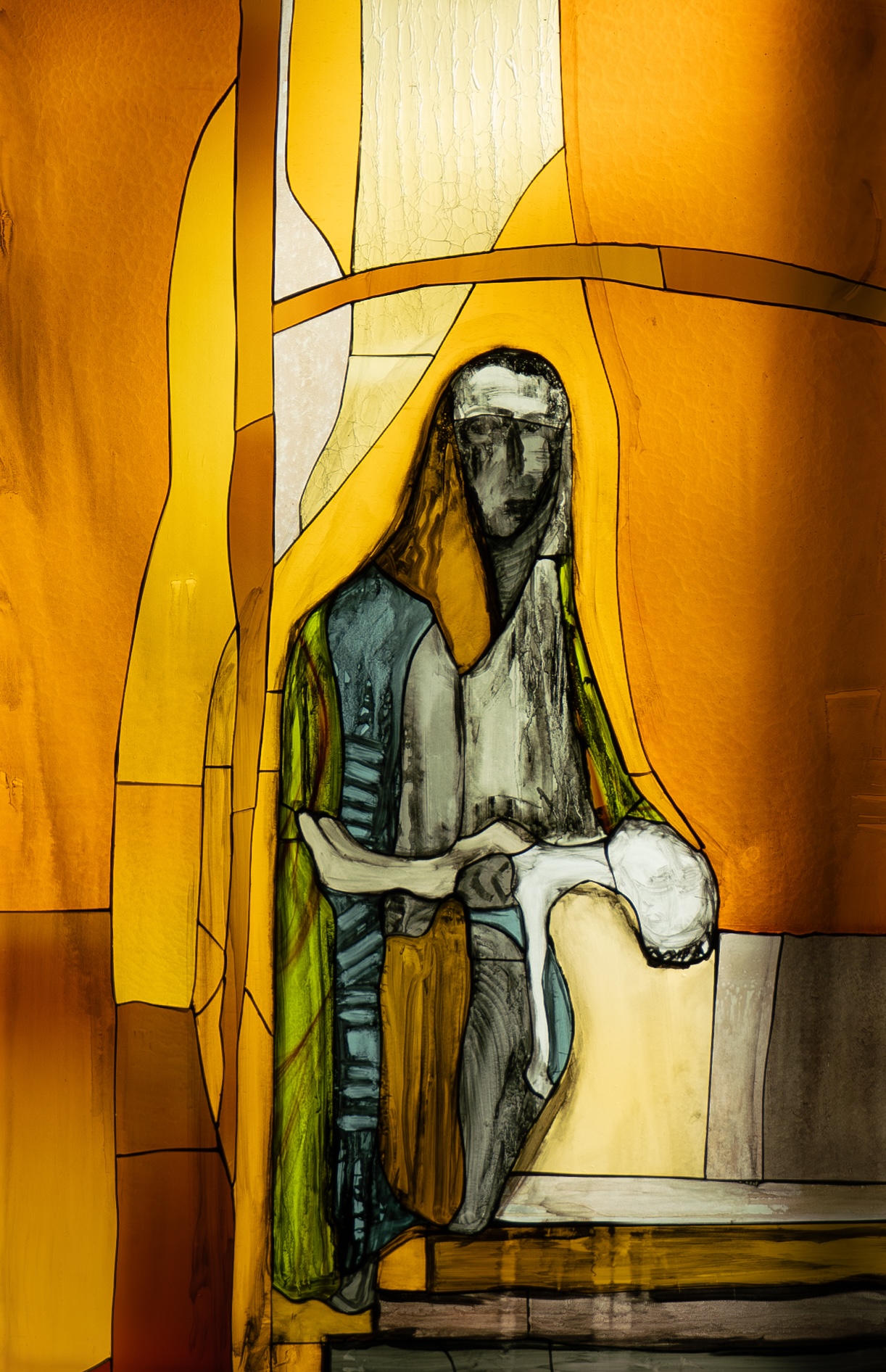
Ultimately, this is a story of God giving resurrecting life to those who come to Christ as their only hope for eternal life. Resurrection: a miracle breaking through to this side of heaven, just as another biblical resurrection, the resurrection of the widow’s son in 1 Kings 17, is depicted in Peter Brandes’ striking stained glass piece from Biola University’s Calvary Chapel.
You are not alone, anonymous, forgotten or overlooked. For we are all noticed and loved by God. We are all like the two sufferers, needing to press through the crowds and to fall at the feet of Jesus, the One who forgives and restores and redeems and gives life. As they came to Jesus, hopeless as they were, the woman’s bleeding stopped, and the man’s dead daughter breathed life again. As the poet Nathaniel Parker Willis puts it,
...she clasp’d
The Saviour’s hand, and, fixing her dark eyes
Full on his beaming countenance—AROSE!
As we come to Christ desperate for his mercy, he sees us, clasping us by the hand, raising us from our deathbeds and giving us new life, now and forevermore.
Prayer
Dear God,
You see us. You know us. You redeem us. You love us. In the midst of the pressing crowd, you know our name, our needs. In response, Lord, we ask that you would give us strength to believe and ears to hear. We pray that if we lift up the eyes of faith, and if we touch but the extreme border of your garment, it will be sufficient for rescuing us from our physical needs and redeeming us from our spiritual brokenness. We pray this in your name, Jesus.
Amen.
—Adapted from St. Augustine’s sermons on the New Testament
Dr. Barry H. Corey
President
Biola University
For more information about the artwork, music, and poetry selected for this day, we have provided resources under the “About” tab located next to the “Devotional” tab near the top of the page.
About the Artwork
Elijah Raises the Widow's Son (Two views)
Peter Brandes
Stained Glass
Calvary Chapel, Biola University
This stained glass window is installed in Calvary Chapel at Biola University. The top two panes to the left of the relief wall depict Elijah’s interactions with a widow and her son (1 Kings 17:17-24). Elijah, a man of God, arrives at the home of the hungry widow and her son. Though famished herself, the widow offers the last meal they have left — but after they have eaten, the widow realizes a miracle has occurred and there is both bread and water left. That night, however, the widow’s son dies. It is at this time that the first resurrection in the Old Testament occurs — Elijah asks God to give the child his life back, and he is raised from the dead. This window has been placed deliberately opposite the window with the Easter morning motif, and in the part of the chapel bearing Maja Lisa Engelhardt’s massive wall with the motif of resurrection.
About the Artist
Peter Brandes (1944 – 2025) was a Danish painter, sculptor, ceramicist, and photographer internationally recognized for his abstract and liturgical art. A self-taught artist, Brandes created significant ecclesiastical works across Europe and the United States, including contributions to Roskilde Cathedral and monumental ceramic installations such as the Roskilde Jars.
In 2018, Brandes and his wife, painter Maja Lisa Engelhardt, were commissioned to reimagine Biola University’s Calvary Chapel. Brandes designed all 32 hand-cut stained-glass windows for the chapel, integrating innovative LED illumination technology to create a space centered on biblical themes of resurrection and new life. Deeply committed to expressing Christian faith through visual art, Brandes leaves a legacy of sacred work that continues to shape worshipping communities worldwide.
About the Music
“Oh! It Is Jesus” from the album Soweto Gospel Choir - Grace
Oh, it is Jesus
Yes, it is Jesus
It’s Jesus in my soul.
For I have touched the hem of his garment.
And his blood has made me whole.
Oh, it is Jesus.
Yes, it is Jesus.
It’s Jesus in my soul.
For I have touched the hem of his garment.
And his blood has made me whole.
Oh, it is Jesus.
Yes, it is Jesus.
It’s Jesus in my soul.
For I have touched the hem of his garment.
And his blood made me whole.
Oh, it is Jesus (Oh).
Yes, it is Jesus (It’s Jesus).
It’s Jesus in my soul (with my soul).
For I have touched (for I have touched) the hem of his garment (Yes, Lord).
And his blood (And his blood) made me whole.
I’ve tried all I could.
Seems like nothing did me any good.
Then I heard Jesus.
He was passing by.
Then I decided to give him a try. Oh.
Oh, it is Jesus (Oh).
Yes, it is Jesus (Yes, it is Jesus).
It’s Jesus in my soul.
For I have touched (for I have touched) the hem of his garment (Yes, my Lord).
And his blood has (made me whole) made me whole.
Oh, it is Jesus.
Yes, it is Jesus (Yes, it is Jesus. Yes, it is Jesus, Lord).
It’s Jesus in my soul (in my soul).
For I have touched (for I have touched) the hem of his garment.
And his blood has made me whole (made me whole).
(And his blood) And his blood has made me whole.
And his blood has made me whole (made me whole, made me whole).
About the Composer
Andraé Edward Crouch (1942–2015) was an American gospel singer, songwriter, arranger, record producer, and pastor. Referred to as "the father of modern gospel music" by contemporary Christian and gospel music professionals, Crouch was known for his compositions "The Blood Will Never Lose Its Power," "My Tribute (To God Be the Glory)," and "Soon and Very Soon." He collaborated on some of his recordings with famous and popular artists such as Stevie Wonder, El DeBarge, Philip Bailey, Chaka Khan, and Sheila E., as well as the vocal group Take 6. Many popular artists have covered his material, including Bob Dylan, Barbara Mandrell, Paul Simon, Elvis Presley, and Little Richard. Crouch was noted for his talent of incorporating contemporary secular music styles into the gospel music he grew up with. His efforts in this area helped pave the way for early American contemporary Christian music during the 1960s and 1970s.
About the Performers
The Soweto Gospel Choir was formed in Soweto, South Africa, by David Mulovhedzi and Beverly Bryer, the group’s two choir directors. The more than thirty-member ensemble blends elements of African gospel, Negro spirituals, reggae, and American popular music. Their albums Blessed and African Spirit won Grammy Awards for Best Traditional World Music Album in 2007 and 2008 respectively. The choir is an ambassador for Nelson Mandela’s 46664 Campaign and has performed at Cape Town, Johannesburg, London, and New York, with many well-known artists. The choir is also an ambassador for the 1Goal Campaign, which is an anti-crime advocate and runs an AIDS orphans foundation, Nkosi’s Haven Vukani.
About the Poetry and Poet
Nathaniel Parker Willis (1806–1867) was an American poet, author, and editor who was one of the most widely read writers of his day. Born in Portland, Maine, and educated at Yale, Willis became known for his sentimental and religious poetry as well as his travel writing and essays. He worked with several prominent publications and helped found The Home Journal (later Town & Country), playing a significant role in shaping American literary culture in the mid-nineteenth century. Though his popularity declined after his death, Willis was an influential literary figure in his lifetime and was acquainted with writers such as Edgar Allan Poe and Henry Wadsworth Longfellow.
About the Devotion Writer
Dr. Barry H. Corey is the eighth president of Biola University. Since assuming the role in 2007, Corey has led Biola into its second century with the launch of an ambitious ten‐year university plan, completing the largest fundraising campaign in Biola’s history by exceeding its $180 million goal, creating four new academic schools and embarking on a major university transformation journey to position Biola to flourish for decades to come. He has done this while honoring the mission of the university and its unique contribution to the landscape of higher education. A native of New England, Corey previously served as dean of the faculty and vice president for education at Gordon‐Conwell Theological Seminary as well as its vice president for development. He received his B.A. in English and biblical studies from Evangel University and his M.A. in American studies and Ph.D. in education from Boston College. As a Fulbright scholar, Barry lived in Bangladesh, where he researched educational programs for children of the landless poor. Corey is the author of the books The Treasurer: A Biography of Herbert Stewart Gray (Westbow, 2025), Make the Most of It: A Guide to Loving Your College Years (Tyndale, 2020), and Love Kindness: Discover the Power of a Forgotten Christian Virtue (Tyndale, 2016), and his writing has been featured in publications like The Washington Post, The National Review, Relevant, and Converge, among others. He currently serves or has recently served on governing boards such as that of Gordon-Conwell Theological Seminary, the Museum of the Bible, the National Association of Independent Colleges and Universities, Christianbook International Outreach, and the Council for Christian Colleges and Universities. He and his wife, Paula, have three children: Anders—who is married to Ashley—Ella, and Samuel.