March 1: Christ's Dominion Over Demons
♫ Music:
Week Three Introduction | March 1–7:
Jesus on the Move: Confronting Demons, Disease, and Death
The gospel of Matthew is known for its substantial Christological discourses. John’s gospel also has extended passages that contain lengthy teachings of the Savior. Interestingly, Mark doesn’t spend much time on dialogue in his gospel. Instead, his fast-paced narrative focuses on Christ’s amazing actions. Every action Jesus performed was done with divine authority and power. This sovereign authority over all things was foundational to His mission and ministry. All who encountered Him knew there was something extraordinary going on—something that transcended the expected, routine ways of operating in the world. Much like the Old Testament prophet Moses, who dominates the pages of the Pentateuch, Christ is presented by Mark as the great lawgiver, prophet, sustainer, and deliverer of the New Testament.
Mark wanted his readers to experience a zealous Christ, a Christ on the go with holy fire in His soul: forgiving sins, healing the sick, casting out demonic spirits, calming storm-tossed seas, restoring life to the dead, feeding the hungry masses, etc. Mark’s passionate account introduced Christ as the new King who is in the process of bringing God’s new kingdom into being. Dr. William Hendrikson notes in his New Testament commentary, “Mark portrays Christ as an active, energetic, swiftly moving, warring, conquering King, a Victor over the destructive forces of nature, over disease, demons and even death . . . Mark pictures a King who excels any earthly conqueror. His kingdom is far more extensive, his armor far more effective, and his rule far more enduring than anything originating here below.” Indeed, Mark paints a graphic portrait of Christ, not only as the ultimate superhero, but as we shall see in weeks to come, as the counterintuitive, suffering, servant King.
Sunday, March 1 | Christ's Dominion Over Demons
Mark 1:21–28 (NKJV)
Then they went into Capernaum, and immediately on the Sabbath He entered the synagogue and taught. And they were astonished at His teaching, for He taught them as one having authority, and not as the scribes.
Now there was a man in their synagogue with an unclean spirit. And he cried out, saying, “Let us alone! What have we to do with You, Jesus of Nazareth? Did You come to destroy us? I know who You are—the Holy One of God!”
But Jesus rebuked him, saying, “Be quiet, and come out of him!” And when the unclean spirit had convulsed him and cried out with a loud voice, he came out of him. Then they were all amazed, so that they questioned among themselves, saying, “What is this? What new doctrine is this? For with authority He commands even the unclean spirits, and they obey Him.” And immediately His fame spread throughout all the region around Galilee.
Mark 5:1-20 (NJKV)
Then they came to the other side of the sea, to the country of the Gadarenes. And when He had come out of the boat, immediately there met Him out of the tombs a man with an unclean spirit, who had his dwelling among the tombs; and no one could bind him, not even with chains, because he had often been bound with shackles and chains. And the chains had been pulled apart by him, and the shackles broken in pieces; neither could anyone tame him. And always, night and day, he was in the mountains and in the tombs, crying out and cutting himself with stones.
When he saw Jesus from afar, he ran and worshiped Him. And he cried out with a loud voice and said, “What have I to do with You, Jesus, Son of the Most High God? I implore You by God that You do not torment me.”
For He said to him, “Come out of the man, unclean spirit!” Then He asked him, “What is your name?”
And he answered, saying, “My name is Legion; for we are many.” Also he begged Him earnestly that He would not send them out of the country.
Now a large herd of swine was feeding there near the mountains. So all the demons begged Him, saying, “Send us to the swine, that we may enter them.” And at once Jesus gave them permission. Then the unclean spirits went out and entered the swine (there were about two thousand); and the herd ran violently down the steep place into the sea, and drowned in the sea.
So those who fed the swine fled, and they told it in the city and in the country. And they went out to see what it was that had happened. Then they came to Jesus, and saw the one who had been demon-possessed and had the legion, sitting and clothed and in his right mind. And they were afraid. And those who saw it told them how it happened to him who had been demon-possessed, and about the swine. Then they began to plead with Him to depart from their region.
And when He got into the boat, he who had been demon-possessed begged Him that he might be with Him. However, Jesus did not permit him, but said to him, “Go home to your friends, and tell them what great things the Lord has done for you, and how He has had compassion on you.” And he departed and began to proclaim in Decapolis all that Jesus had done for him; and all marveled.
Poetry
“The Demons”
by Alexander Pushkin, translated by Irina Henderson
Clouds are whirling, clouds are swirling;
Though invisible, the moon
Lights the flying snow while blurring
Turbid sky and nigh in one.
On and on through broad expanses;
Sleigh-bell tinkling—din-din-din…
Casting fearful, fearful glances
At the dark and eerie plain!
“Driver, hey there!….” “Can’t go faster:
Drifts have blown across the road;s
Heavy for the horses, master,
And my lids together glued;
For the life of me, beside us,
Tracks are nowhere to be found;
It must be a demon guides us,
As he circles round and round.
“Over there: see him cavorting,
Blowing, spitting in my face;
Look—and now the horse is snorting
On the edge of the abyss;
Like some verst-pole without substance
He stood out against the dark;
Then he flashed across the darkness,
Disappearing like a spark.”
Clouds are whirling, clouds are swirling;
Though invisible, the moon
Lights the flying snow while blurring
Turbid sky and nigh in one.
No more strength to circle, barely;
Silent falls the little bell;
“What pulls up the horses?”—”Surely—
Stump or wolf? But who can tell?”
Raging blizzards, weeping, blowing;
Horses snorting in their fear;
See his eyes distinctly glowing,
As he capers over there;
Now the horses speed in frenzy;
Sleigh-bell tinkling—din-din-din…
I can see a spirits’ medley
Gather on the glimmering plain.
Endless, hideous hordes are pressing
Round us, in the moon’s dull light,
Demons whirling, flying, massing,
Like November leaves in flight.
Crowds of them! Where do they hurry?
Why so pitiful their song?
Goblin do they haste to bury?
Witch to wed they bring along?
Clouds are whirling, clouds are swirling;
Though invisible, the moon
Lights the flying snow while blurring
Turbid sky and nigh in one.
Swarm on swarm, the demons flying
Sweep the sky in endless quest,
Till their piteous screams and crying
Rend the heart within my breast…
Sitting, Clothed, and in His Right Mind
One day, while on a multi-day hike in Europe, my students and I came across a field of flowering coriander. Our road continued, winding down the hill, but we were tired after the miles of walking. Careful not to trample any plants, we followed a water gully deep into the field. Sitting down on the side of the gully, we leaned back. Sunshine fell on the feathery leaves and white blooms of the coriander. Above our heads, stillness reigned, except for the hum of the bees that joyfully worked while we rested. This time stands out in my memory, marked by peace, a spirit of happy fellowship, and the words of an old hymn that we had been memorizing together.
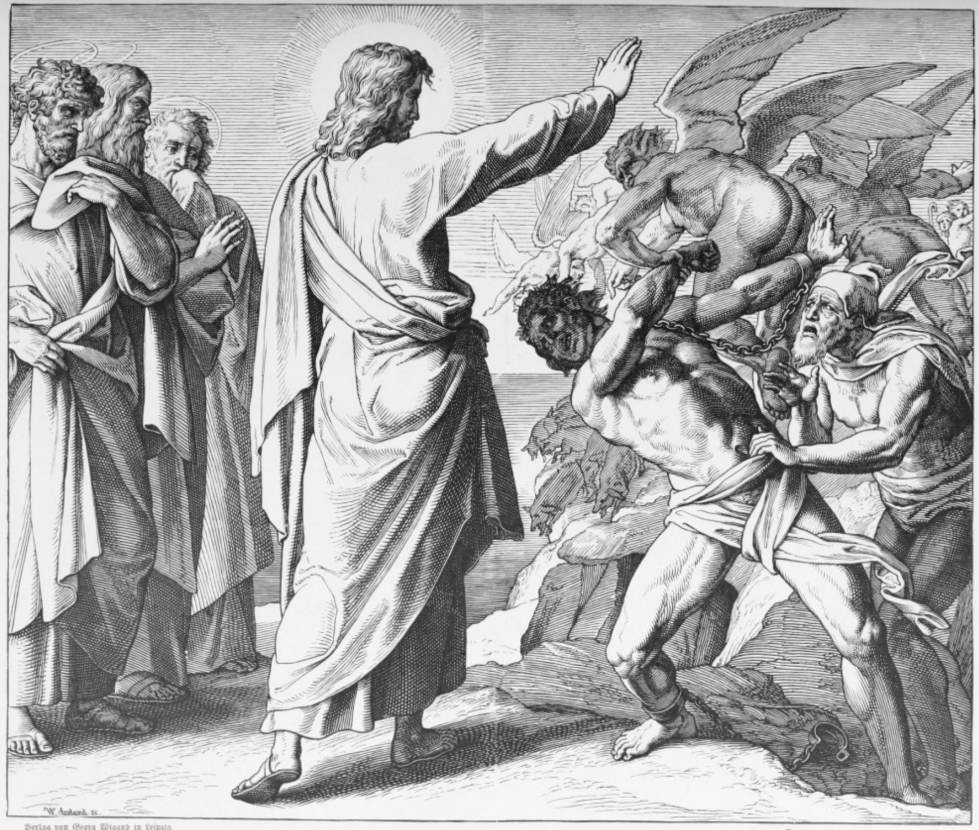
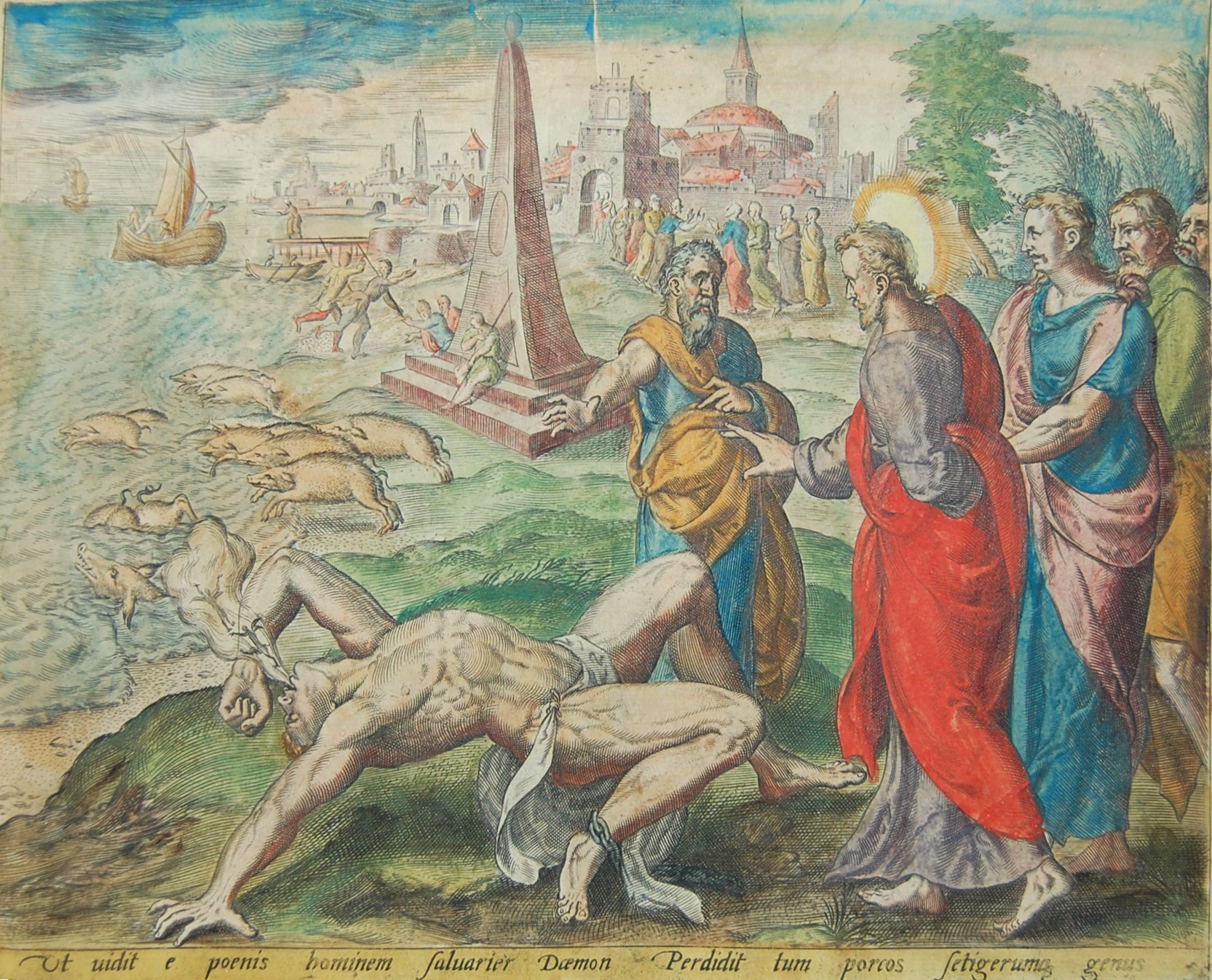
In stark contrast, Mark’s story of the man with the unclean spirits gives us a person marked by pain, loneliness, and madness. The man roams among the tombs, sleeping near the bones of the dead. His mind is dazed and unclear, and he is naked, alone, crying out in restless anguish, and engaging in violent acts of self-harm. The artwork and poetry for today portray the demon-possessed man in all his torment. In the engravings by Julius Schnorr von Carolsfeld and Johannes Wierix, he is physically contorted, harassed, and unaware of his surroundings. Pushkin’s stanzas describe the demons’ disquiet, screams, and cries in terms that mirror the man’s own. But then Jesus steps into the man’s inward and outward chaos.
Mark’s short phrase, “sitting and clothed and in his right mind,” has often brought me close to tears. It conveys the man’s complete transformation. Instead of aimless running, he is sitting; instead of being naked, he is clothed; instead of a tortured turmoil, peace governs his mind, soul, and body. What relief he must have felt. No wonder he longs to remain with Jesus, the one who set him free, and pleads that he will not be sent away. In obedience, however, he departs so that he may carry the message of God’s compassion. Although Mark ends his story here, I have no doubt that the man loved Jesus throughout the rest of his life and never tired of relating the story of his incredible deliverance.
In the same way that Jesus drove out the demons and brought back sanity and rest, in the same way that He calmed the tumult of the sea, so also, He can silence the storms we face, both those within ourselves and those that rage without. Even when He allows the storms in our lives to continue, His promise remains that “Peace I leave with you; my peace I give to you” (Jn 14:27). This peace is what made my moments in the coriander field a gift that has remained with me ever since. May I walk in the recollection of Christ’s much greater peace all my life, recounting with joy the story that every believer can tell, of the Lord’s compassion and the great things He has done for us.
Prayer
Dear Jesus, thank you that through Your death, You destroyed the one who has the power of death, that is, the devil, and that You set us free, who through fear of death were all our lives subject to slavery (Heb. 2:14-15). Please fulfill Your promise to keep us in perfect peace, because our minds are stayed on You and we trust in You (Isa. 26:3).
Dr. Laurie Wilson
Associate Professor, Torrey Honors College
Biola University
For more information about the artwork, music, and poetry selected for this day, we have provided resources under the “About” tab located next to the “Devotional” tab near the top of the page.
About the Artwork | 1
Jesus Casts Out the Devils
Julius Schnorr von Carolsfeld
1860
Engraving
Illustration for The Picture Bible
Public Domain
About the Artist
Julius Schnorr von Carolsfeld (1794–1872) was a German painter, chiefly of biblical subjects. As a young man he associated with the painters of the Nazarene movement, who revived the florid Renaissance style in religious art. He is remembered for his illustrations featured in the Picture Bible and his designs for stained glass windows in several cathedrals. Schnorr's third artistic period was marked by his biblical illustrations. His Picture Bible was published in Leipzig in 1852–60, and an English edition followed in 1861.
About the Artwork | 2
Christ Healing the Man Possessed by Devils
Johannes Wierix
1585
Engraving colored by hand
205 x 252 mm
British Museum
London, England
Public Domain
Christ Healing the Man Possessed by Devils by Flemish engraver Johannes Wierix illustrates a demonstration of Jesus's divine authority over evil spirits, showing a time He liberated a possessed man from demons. Christ is seen standing in profile to the right of the composition, extending His hand towards a convulsing man who is chained to the ground. As Christ expels the demons through the man’s mouth, they are permitted to enter into a herd of pigs, who rush into the sea.
About the Artist
Johannes Wierix (1549–c. 1620) was a Flemish engraver, draughtsman, and publisher. He was a very accomplished engraver who made prints after his own designs as well as designs by local and foreign artists. He further made engravings on silver and ivory. Together with other members of the Wierix family of engravers, he played an important role in spreading appreciation for Netherlandish art abroad as well as in creating art that supported the Catholic cause in the Southern Netherlands. Johannes Wierix is also known for his miniature pen drawings.
About the Music
Chain Breaker (Live from Harding Prison)
If you've been walking the same old road for miles and milesIf you've been hearing the same old voice tell the same old lies
If you're trying to fill the same old holes inside
There's a better life, there's a better life
If you've got pain, He's a pain taker
If you feel lost, He's a way maker
If you need freedom or saving, He's a prison-shaking Savior
If you got chains, He's a chain breaker
We've all searched for the light of day in the dead of night
We've all found ourselves worn out from the same old fight
We've all run to things we know just ain't right
When there's a better life, there's a better life
If you've got pain, He's a pain taker
If you feel lost, He's a way maker
If you need freedom or saving, He's a prison-shaking Savior
If you got chains, He's a chain breaker
If you believe it, if you receive it
If you can feel it, somebody testify
If you believe it, if you receive it
If you can feel it, somebody testify, testify
If you believe it, if you receive it
If you can feel it, somebody testify
If you've got pain, He's a pain taker
If you feel lost, He's a way maker
If you need freedom or saving, He's a prison-shaking Savior
If you got chains, He's a chain breaker
If you need freedom or saving, He's a prison-shaking Savior
If you got chains, He's a chain breaker
(Applause)
About the Composers
Jonathan Smith, Mia Fieldes and Zach Williams
Jonathan Smith is a multiple Grammy- and Dove Award–winning songwriter/producer. Smith attended Belmont University, where he developed a friendship with fellow songwriter Jason Ingram. This served as the catalyst for Smith’s first publishing deal with Essential Music Publishing (2012). Jonathan was instrumental in Zach Williams’ recording deal at Provident Label Group, ushering in 2017’s massively impactful RIAA Platinum single “Chain Breaker.” Smith proceeded to garner more songwriting success with a series of culture-shaping radio singles, including Tauren Wells’ “Hills & Valleys,” Matthew West’s “The God Who Stays,” and “House of the Lord,” recorded by Phil Wickham. In 2022 Smith was awarded the BMI Christian Song of the Year for “There Was Jesus,” recorded by Zach Williams and Dolly Parton.
Mia Fieldes is an Australian Christian musician, songwriter, and worship leader known for her influential contributions to contemporary worship music. Born in Sydney, Australia, she began her music career writing and performing with Hillsong Church before relocating to Nashville, Tennessee, where she serves as a worship leader at The Belonging Co and writes songs for artists worldwide. Her solo work includes the EP Ashes (2015), and she has penned numerous worship songs recorded by major Christian artists. Fieldes’s songs—such as “Christ Is Risen” and “Fearless”—have resonated across the global church and helped shape modern worship.
About the Performer/Composer
Zachary (Zach) Williams is an American Christian rock musician. From 2007 through 2012 he was a member and lead vocalist of Zach Williams and The Reformation. Williams’ powerful and poignant journey shows how a boy with a storybook childhood filled with wonderfully nurturing parents, and a strong and supportive grounding in the church and community, was seduced away by the illusion of rock-and-roll stardom and the drug/alcohol excesses that often accompany that lifestyle. After Zach Williams and the Reformation disbanded, Williams and guitarist Robby Rigsbee dedicated their lives to Christ and began playing music in their church. The church band, the Brothers of Grace, became Zach Williams and the Brothers of Grace. In 2016 he went solo, becoming one of CCM’s leading artists and songwriters by carving a niche with his singular blend of Southern rock, country, and faith-filled songwriting, which quickly earned him a Grammy Award with his debut album, 2017’s Chain Breaker. Williams released his second album, Rescue Story, which includes the single "There Was Jesus," with Dolly Parton.
About the Poetry and Poet
Alexander Sergeyevich Pushkin (1799–1837) was a Russian poet, playwright, and novelist of the Romantic era. He is considered by many to be the greatest Russian poet, as well as the founder of modern Russian literature. Pushkin was born into the Russian nobility in Moscow, Russia. He published his first poem at the age of fifteen and was widely recognized by the literary establishment by the time of his graduation from the Tsarskoye Selo Lyceum. Upon graduation from the Lycée, Pushkin recited his controversial poem "Ode to Liberty," one of several that led to his exile by Emperor Alexander I. While under strict surveillance by the emperor's political police and unable to publish, Pushkin wrote his most famous play, Boris Godunov. Pushkin was fatally wounded in a duel with his wife's alleged lover.
About the Devotion Writer
Laurie Wilson, an assistant professor in the Torrey Honors College at Biola University, received her master’s degree in Greek and Latin and her doctoral degree in classics from the University of St. Andrews in Scotland, where she was an H. B. Earhart Foundation fellow and a postgraduate fellow in the James Wilson Programme for Constitutional Studies. This background reflects her passion for classical studies and for her interdisciplinary research, which has focused on Augustine, Cicero, and writings from the American founders.