March 3: Christ Faces Skepticism from the Locals in His Hometown
♫ Music:
Mark 6:1-6 (NKJV)
Then He went out from there and came to His own country, and His disciples followed Him. And when the Sabbath had come, He began to teach in the synagogue. And many hearing Him were astonished, saying, “Where did this Man get these things? And what wisdom is this which is given to Him, that such mighty works are performed by His hands! Is this not the carpenter, the Son of Mary, and brother of James, Joses, Judas, and Simon? And are not His sisters here with us?” So they were offended at Him.
But Jesus said to them, “A prophet is not without honor except in his own country, among his own relatives, and in his own house.”Now He could do no mighty work there, except that He laid His hands on a few sick people and healed them. And He marveled because of their unbelief. Then He went about the villages in a circuit, teaching.
Poetry
“For a Skeptic”
by Countee Cullen
Blood-brother unto Thomas whose
Weak faith doubt kept in trammels,
His little credence strained at gnats—
But grew robust on camels.
Christ Faces Skepticism from the Locals in His Hometown
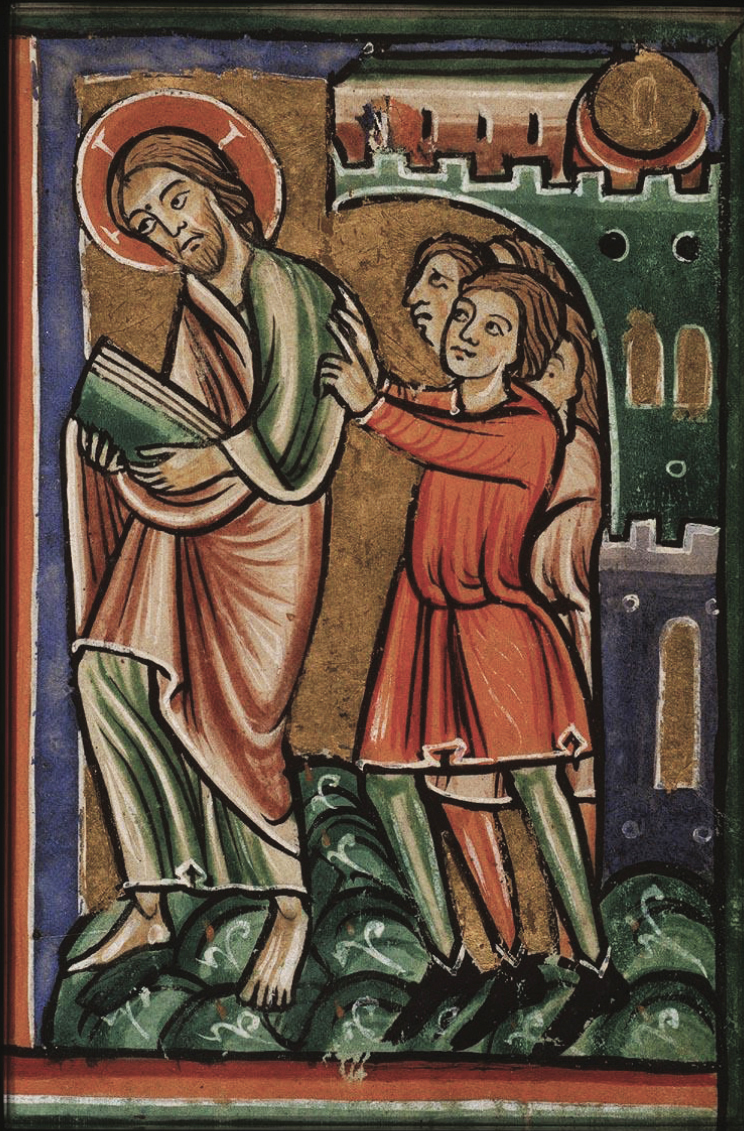
I love the fact that Jesus, in our passage, seeing himself as a prophet without honor in his hometown, leaves to carry on his ministry of word and deed, performing no mighty works except a few miraculous healings! Amazing love! Yet our painting adds visual interpretation not given in the passage. Unlike the healing touch of Jesus’ laying of his hands, the hands of his neighbors and familiars are pushing him out. His ministry of word is intact as he carries his (anachronistic) Bible with him. The figure carries a Bible, not a Torah scroll, which the twelfth-century artist might have associated with the community worship of any one of his Jewish neighbors. Sad to say, any Medieval painting of how the Jews treated Jesus is already laced with Christendom’s cultural history steeped in social exclusion and hatred of Jews. Excluded from many professions, Jews were cast as moneylenders, becoming a trope in literary plots and international conspiracies. The antisemitic hatred and violence we witness even today are testament to dangers in this painting that Christianizes Jesus out of his Jewishness, and so loses the logic of redemption that leads him inexorably through Mark’s gospel to the cross as the Son of Man. In our passage, the relatives and denizens of Mark’s Gospel are not identified as Jews. Their failing is not ethnic or racial, but one common to humanity: unbelief. And even so, Jesus still heals some and keeps his ministry moving forward in that country.
The danger of stereotypes flooding and distorting our vision is evident in Countee Cullen’s poetic epitaph to “The Skeptic.” The Skeptic, we are told, is blood-bound to the famously ‘doubting’ Thomas. Cullen recognizes that simple ties of blood do not define a person, but the pacts they make in their undertakings. This Skeptic embodies the hypocrisy that Jesus condemns in Matthew 23:34: he “strained at gnats—/ But grew robust on camels.” In his first published poetry collection, Color, Cullen waxes romantically, sensually, as a 22-year-old man might, while driven to grapple with his color, and with death, which may be much of the same thing. And yet, Thomas? Is it for understanding or for the sake of Nazareth-neighbor-patronizing that we look down our collective noses at, or even with Cullen impishly empathize with, Thomas?
Cullen’s play with religious texts and themes is sobering for his poetry’s refrain to the lack of humanity ascribed to him for his black skin. A whole series of these epitaphs, these sepulchral inscriptions, place death at the heart of a young man’s poetic vision. We must suppose, as we walk through Lent toward Jesus’ death, that the Cross calls us to grapple with the death and death-shadowed lives of others who because of our glibness or ease remain skeptics, happily chomping down on camels as we might end up straining at gnats. So, we point to Jesus, the Jesus not of art or cultural appropriation, but of the Bible. And we look to his generosity and gentleness and rebuke, so as to heed him and his ways.
In doing so, we may end up discredited ourselves. So take heart, sisters and brothers, with the quintessentially Jamaican sound of reggae in the Our Father’s Music Business track that has a brilliant line in addressing the way Jesus and his followers can be dismissed out of hand. “You’re reviewed before you’re read.” They sing, “When you’re from the other side of the track / You will face unwanted sneers and attacks/ But ignore their prejudice/And move on, move on with it.” Our immersion in the Scripture and media of today’s devotion calls out our prejudices that prevent us from comprehending our need for Christ, and the common humanity in need of Christ that we share with all others.
Prayer
Come, Lord Jesus,
Lay your hands on my unbelief,
Heal me,
Bind me to your person
By your Words and Deeds,
Lead me to where I must be led,
As I learn to believe and heed.
Amen
Dr. Andy Draycott
Associate Professor of Theology
Talbot School of Theology
Biola University
For more information about the artwork, music, and poetry selected for this day, we have provided resources under the “About” tab located next to the “Devotional” tab near the top of the page.
About the Artwork
The Jews Chase Christ Out of the City of Nazareth
Unknown artist
1190–1200
Illuminated manuscript
Koninklijke Bibliotheek National Library of the Netherlands
The Hague, Netherlands
From the gospel of John, "Can anything good come out of Nazareth?" is a famous biblical question posed by Nathanael out of skepticism over whether Jesus of Nazareth could be the true Messiah. Though Jesus was born in Bethlehem, Nazareth was the small and overlooked town where He grew up, making it a powerful symbol of God’s ability to bring greatness from unexpected places for His purposes.
About the Music
“Can Anything Good Come Out of Nazareth” from the album Reggae for Christ: Volume 2
Oooh, Oooh, Oooh, Oooh, Oooh.
When you’re from the other side of the track (other side of the track),
You will face unwanted sneers and attacks.
People from the upper crust,
Will treat you with disgust,
They’ll say you lack nobility,
Upward mobility,
But that is nothing new,
Cause it was said about Jesus too.
Can anything good, can anything good?
Come out of Nazareth,
Come out of Nazareth? (Repeat)
When you’re a child of Jesus Christ,
You are seen in a different light, Oooh Yeah
A dark cloud hangs over your head,
You’re reviewed before you’re read,
But ignore their prejudice
And move on, move on with it
Cause you’re a child of the Nazarene
So who cares if they scream?
Can anything good, can anything good,
Come out of Nazareth,
Come out of Nazareth? (Repeat)
It’s all Good, It’s all Good, all Good
Jesus Christ (All Good). It's all Good (Jesus Christ).
About the Composer
Tennyson Walters is a composer who works with Our Father’s Music Business in Jamaica.
About the Performers
Our Father’s Music Business featuring Richie Stephens and the Grafton Studio Singers, Kingston, Jamaica
Our Father's Music Business (OFMB) is a gospel recording group that is committed to spreading the good news of our Lord and Saviour Yeshua Hamashiach, translated as Jesus the Messiah. Born out of Kingston, Jamaica, West Indies, OFMB's music is a fusion of gospel, reggae, and soul. The OFMB team endeavors to present "Music That Feeds The Soul." The music is contemporary while paying homage to the past. The group's lyrical content is based on the Word of God. Therefore, it always edifies, encourages, and shares the salvation message with those who don't know the truth of Christ.
Richard Stephenson (b. 1966), better known as Richie Stephens, is a Jamaican R&B and reggae singer and producer. Stephens worked in the early 1990s as part of the twice Grammy Award–winning act Soul II Soul. He recorded at Motown and recorded for the VP label before establishing his own label, Pot of Gold Records. Since 1998, Stephens has focused his music on Christian-related themes. In 2006, Stephens received the Jamaican Governor-General's Achievement Award for contributing to civic, social, and recreational projects in and around the parish of Westmoreland. He released a new album, God is on My Side, in 2012, under Pot of Gold/VPAL. In 2014, following the growth of EDM in Jamaica, Stephens sought to capitalize on this by launching a new riddim called “Skatech,” which was an amalgamation of Jamaican ska and EDM.
"Grafton Studio Singers" refers to backing vocalists who appear on the countless reggae tracks recorded at the Grafton Studio, a recording facility in Jamaica, where musicians such as Dijahti/dittymusik and jah vinci have recorded their work. It is not a distinct, named vocal group but rather an identifier for individuals who have used this particular recording studio
About the Poetry and Poet
Countee Cullen (1903–1946) was an American poet, novelist, children's writer, and playwright. He was particularly well known during the Harlem Renaissance. After graduating from high school, he attended New York University (NYU). Cullen had some of his poetry published in national periodicals—Harper's, Crisis, Opportunity, The Bookman, and Poetry—and he began to earn a national reputation. After NYU, Cullen entered Harvard to pursue a master's in English; this was at about the same time that his first collection of poems, Color, a landmark of the Harlem Renaissance, was published. Written in a careful, traditional style, the work celebrated Black beauty and deplored the effects of racism. The book included "Heritage" and "Incident," probably his most famous poems. "Yet Do I Marvel," about racial identity and injustice, showed the literary influence of poets such as William Wordsworth, William Blake, John Keats, and Edna St. Vincent Millay, and his exposure to Greco-Roman classics and English literature. Because of Cullen’s success in both Black and white cultures, and because of his romantic temperament, he formulated an aesthetic that embraced both cultures. He came to believe that art transcended race and that it could be used as a vehicle to minimize the distance between Black and white people. Much of Cullen’s poetry deals with such universal subjects as faith and doubt, love, and mortality. Toward the end of his life, in the 1940s, Cullen was relatively successful as a dramatist. With another collaborator, Owen Dodson, he worked on several projects, including “The Third Fourth of July,” a one-act play printed in Theatre Arts in 1946.
About the Devotion Writer
Trained in Christian Ethics and Political Theology, Andy Draycott has become a leading authority on the reception history of John Bunyan’s The Pilgrim’s Progress (1678/1684). He is on the Executive Committee of the International John Bunyan Society. He is co-editor of The Pilgrim’s Progress for the Norton Library series (2025) and author of Into the Pilgrimverse (2025). His articles and chapters have dealt with graphic novels, book covers, illustrations, and Bible studies drawing upon this spiritual classic. Besides an integration seminar on his specialism, he also teaches Systematic Theology, and Gospel, Kingdom, and Culture.