March 23: The Parable of the Wicked Vinedressers
♫ Music:
Mark 12:1-12 (NKJV)
Then He began to speak to them in parables: “A man planted a vineyard and set a hedge around it, dug a place for the wine vat and built a tower. And he leased it to vinedressers and went into a far country. Now at vintage-time he sent a servant to the vinedressers, that he might receive some of the fruit of the vineyard from the vinedressers. And they took him and beat him and sent him away empty-handed. Again he sent them another servant, and at him they threw stones, wounded him in the head, and sent him away shamefully treated. And again he sent another, and him they killed; and many others, beating some and killing some. Therefore still having one son, his beloved, he also sent him to them last, saying, ‘They will respect my son.’ But those vinedressers said among themselves, ‘This is the heir. Come, let us kill him, and the inheritance will be ours.’ So they took him and killed him and cast him out of the vineyard.
“Therefore what will the owner of the vineyard do? He will come and destroy the vinedressers, and give the vineyard to others. Have you not even read this Scripture:
‘The stone which the builders rejected
Has become the chief cornerstone.
This was the Lord’s doing,
And it is marvelous in our eyes’?”
And they sought to lay hands on Him, but feared the multitude, for they knew He had spoken the parable against them. So they left Him and went away.
Poetry
“Longing for Prophets”
by Shirley Kaufman
Not for their ice-pick eyes,
their weeping willow hair,
and their clenched fists beating at heaven.
Not for their warnings, predictions
of doom. But what they promised.
I don’t care if their beards
are mildewed, and the ladders
are broken. Let them go on
picking the wormy fruit. Let the one
with the yoke around his neck
climb out of the cistern.
Let them come down from the heights
in their radiant despair
like the Sankei Juko dancers descending
on ropes, down from these hills
to the earth of their first existence.
Let them follow the track
we’ve cut on the sides of mountains
into the desert, and stumble again
through the great rift, littered
with bones and the walls of cities.
Let them sift through the ashes
with their burned hands. Let them
tell us what will come after.
The Parable of the Wicked Tenants
Although Jesus intended the meanings of most of his parables to be hidden from “those outside” (Mark 4:11-12), the meaning of this parable, spoken days before his death, was clear to his opponents, the Jewish leadership in Jerusalem.
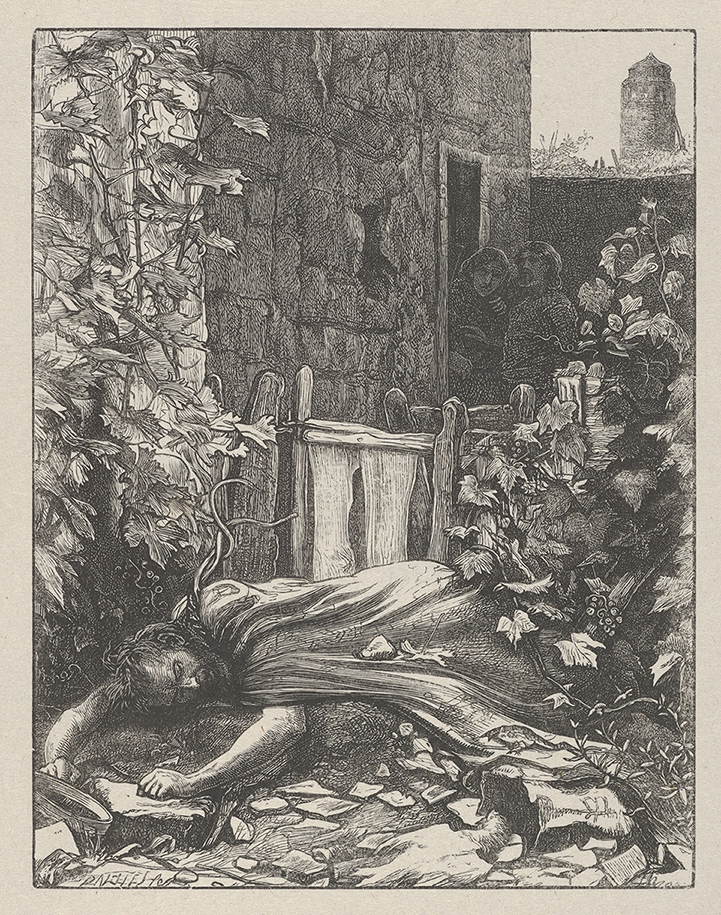
They understood that the vineyard represented the people of Israel and that the owner of the vineyard represented God. Jesus made this clear at the beginning of his parable by using imagery drawn directly from Isaiah’s “Song of the Vineyard” (Isa. 5:1–7). As in the song, so in the parable, a man plants a vineyard, digs a wine press, and builds a tower (pictured in the etching by Millais). The end of Isaiah’s song explains: “The vineyard of the Lord of Hosts is the house of Israel.”
The opponents also understood that the wicked tenants (the “vinedressers”) who abused the owner’s servants represented them and that the owner’s son killed by the tenants represented Jesus. They knew this because they were planning to kill Jesus.
The primary meaning of the parable couldn’t be clearer: God will bring judgment on the religious leaders for killing his son.
By picturing the tenants persecuting God’s prophets and killing his son, the parable makes the reason for God’s judgment on the religious leaders clear. They had not merely failed to keep or enforce His laws; they were rebels, personally rejecting God by rejecting his representatives. The parable exposes their ultimate motive: they want to replace God as ruler of his people.
With this remarkable parable, Jesus not only exposes the leaders, their plans, and prophesies their coming judgement; he also reveals his identity, his plan, and prophesies his coming exaltation. By representing himself as the owner’s son, Jesus indicates that he is not merely another prophet but Israel’s true king. God had promised King David that he would give one of his descendants an eternal throne. He told David he would be a father to this king (2 Sam. 7:14), with the implication that Israel (God’s nation) and all the nations (God’s creation) would belong to God’s son as his inheritance (Psalm 2:7–8). The people of Israel called this coming king the “anointed one” (“messiah” in Hebrew and “Christ” in Greek), and in this parable Jesus was publicly presenting himself as the Christ, the Son of God.
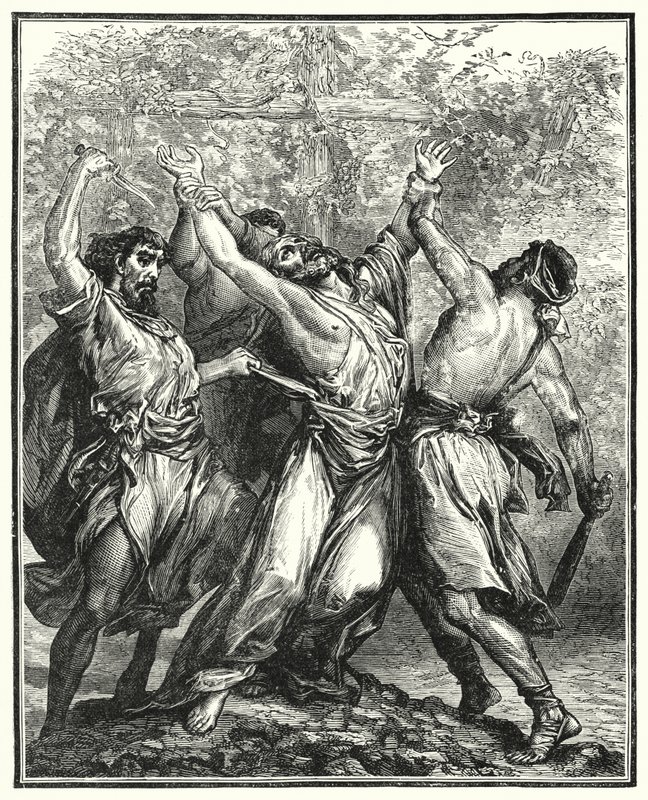
The parable also announces what is about to happen (in the words of the poet, “tell[s] us what will come after”): Jesus will not destroy his opponents; they will kill him. (The unknown artist of the woodcut suggests that Jesus is prophesying his death with the cross-shaped trellis above the son being murdered.) It is God who will destroy the opponents, and he will exalt Jesus to the place of the “cornerstone,” or perhaps “the keystone of the arch.” If God is going to exalt Jesus, he cannot remain dead. So the parable implies that God will raise Jesus from the dead.
Just before Jesus came to Jerusalem to confront the religious leaders, he told his disciples, “Those who are considered rulers of the Gentiles lord it over them… but whoever would be great among you must be your servant” (Mark 10:42–43). God would bring the Jewish leaders, who lorded it over his people, down to destruction, but he would raise Jesus, who laid down his life as a servant, and exalt him as Lord over heaven and earth (Phil. 2:6–11).
Prayer
Jesus, we acknowledge you as God’s true Son, the heir of all things. We give you praise that by your Spirit you have made us sons, co-heirs with you, provided that we suffer with you. As you came not to be served but to serve, we ask that you would enable us to follow your example, laying down our lives for others trusting God to raise us up with you. Amen.
Dr. Joe Henderson
Associate Professor of the Old Testament
Torrey Honors College
Biola University
For more information about the artwork, music, and poetry selected for this day, we have provided resources under the “About” tab located next to the “Devotional” tab near the top of the page.
About the Artwork | 1
The Parable of Wicked Husbandman
Unknown artist
1880
Engraving on paper
British School
Illustration for The Churchmans Family Bible
Public Domain
The parable of the wicked husbandman, also known as the parable of the bad tenants, is a parable of Jesus found in the gospel of Matthew, the gospel of Mark, and the gospel of Luke. A common Christian interpretation is that this parable was about the chief priests and Pharisees, and was given to the people present within the temple in Jerusalem during the final week before the death of Jesus. This parable is widely interpreted as Jesus's condemnation of the religious leaders of His time for rejecting God's messengers (the prophets) and ultimately the Son of God Himself.
About the Artist
Unknown artist
About the Artwork | 2
The Wicked Husbandmen
Sir John Everett Millais
1864
Etching on paper
13.9 x 10.9 cm
Engraved by the Dalziel Brothers
Metropolitan Museum of Art
New York, New York
Public Domain
It took artist John Everett Millais seven years to design twenty images inspired by New Testament parables for the Dalziel Brothers, and the resulting prints are considered pinnacles of wood engraved illustration. The artist wrote to his publishers, "I can do ordinary drawings as quickly as most men, but these designs can scarcely be regarded in the same light—each Parable I illustrate perhaps a dozen times before I fix [the image]." After completing a design, Millais transferred it to a woodblock coated with "Chinese" white for skilled engravers to carve. Finally, he reviewed proofs, and final adjustments were made before the final printing. Pre-Raphaelite ideals shaped the combination of detailed naturalism and down-to-earth imagery to produce a work distinctly different from most religious art of the period.
About the Artist
Sir John Everett Millais (1829–1896) was an English painter and illustrator who was one of the founders of the Pre-Raphaelite Brotherhood. He was a child prodigy who, at age eleven, became the youngest student to enter the Royal Academy Schools. The Pre-Raphaelite Brotherhood was founded at his family home in London, England. Millais became the most famous exponent of the style. His painting Christ in the House of His Parents (1849–50) generated considerable controversy, and he produced a picture that could serve as the embodiment of the historical and naturalist focus of the group, Ophelia, in 1851–1852. By the mid-1850s, Millais was moving away from the Pre-Raphaelite style to develop a new form of realism in his art. His later works were enormously successful, making Millais one of the wealthiest artists of his day.
About the Music
“Cornerstone”
Oh the stone that the builders rejected,
Became the cornerstone of a whole new world.
The stone that the builders rejected,
Became the cornerstone of a whole new world.
Oh the stone that the builders rejected,
The stone that the builders rejected,
The stone that the builders rejected,
Became the cornerstone of a whole new world.
A grain of wheat may be knocked to the ground,
And suffer through the winter’s cold.
Only to rise up again and bear it’s seed a thousand fold.
Oh the stone that the builders rejected,
Became the cornerstone of a whole new world.
The stone that the builders rejected,
Became the cornerstone of a whole new world.
Oh the stone that the builders rejected,
The stone that the builders rejected,
The stone that the builders rejected,
Became the cornerstone of a whole new world.
Never can our journey fail,
A little child will lead the way.
Whose eyes are filled with a shining light
To whom the night is bright as day.
Oh the stone that the builders rejected,
Became the cornerstone of a whole new world.
The stone that the builders rejected,
Became the cornerstone of a whole new world.
Oh the stone that the builders rejected,
The stone that the builders rejected, (rejected)
The stone that the builders rejected, (rejected)
Became the cornerstone of a whole new world.
The love that rolls the stone away,
Give us life that we may sing,
Grave where is thy victory?
Death, oh Death where is thy sting?
Oh the stone that the builders rejected.
Became the cornerstone of a whole new world.
The stone that the builders rejected,
Became the cornerstone of a whole new world.
Oh the stone that the builders rejected,
The stone that the builders rejected,
The stone that the builders rejected,
Became the cornerstone of a whole new world.
The cornerstone of a whole new world.
About the Composer
Shawn Kirchner is a composer, arranger, and songwriter based in Los Angeles whose choral works are performed throughout the world. His long creative relationship with the Los Angeles Master Chorale and artistic director Grant Gershon culminated in his tenure as the ensemble’s Swan Family Composer-in-Residence from 2012 to 2015. Equally active as a performer, Kirchner has sung twenty seasons as a tenor with the Los Angeles Master Chorale and the Los Angeles Philharmonic in concerts featuring the world’s leading conductors, composers, and soloists. As a pianist, Kirchner appears throughout the country in performances of his music with collaborating choirs and is celebrated for his wide stylistic range, improvisation, and musicianship. Kirchner’s composing commissions have included numerous premieres with the Los Angeles Master Chorale at LA’s Disney Hall; he has also written for Conspirare, San Antonio Chamber Choir, Atlanta Master Chorale, Fort Worth Chorale, Lorelei Ensemble, Tonality, Princeton Chapel Choir, Rockefeller Chapel Choir, Golden Bridge, Choral Arts Northwest, and WomenSing. Kirchner’s music finds a middle ground between classical choral and instrumental traditions and the inheritance of the folk, carol, and hymn traditions.
About the Performers
The Concordia Choir of Concordia University in Irvine, California, maintains a distinctive tradition of excellence with performances throughout the United States, Western Europe, Asia, and South America. The critically acclaimed ensemble of fifty-five voices performs a diverse selection of fine sacred choral literature from a variety of cultures and historical eras. The Concordia Choir performs regularly before large audiences in the beautiful acoustics of the Concordia Center for Worship and Performing Arts. Their annual performances include national tours, the popular Concordia Christmas Concerts, a fall festival of hymns, and a MasterWorks Concert series with professional orchestra.
About the Poetry and Poet
Shirley Kaufman (1923–2016) was an American Israeli poet and translator known for her accomplished, deeply thoughtful poetry and translations. Born in Seattle to Polish immigrant parents, she earned a B.A. from UCLA and later an M.A. in creative writing from San Francisco State University. Kaufman published several poetry collections, including The Floor Keeps Turning (1970), Roots in the Air: New and Selected Poems (1996), Threshold (2003), and Ezekiel’s Wheels (2009). Her work appeared in Ploughshares, The American Poetry Review, The New Yorker, and other leading literary journals. Beyond her own poems, she translated major Hebrew poets into English and co‑edited a bilingual anthology of Hebrew feminist poetry. Kaufman lived many years in Jerusalem after immigrating to Israel in 1973 and received awards such as a National Endowment for the Arts fellowship and the Shelley Memorial Award.
About the Devotion Writer
Joe Henderson teaches Western classics and Bible in the Torrey Honors College. He studied the Old Testament at Asbury Seminary and Fuller Seminary, and he writes about the book of Jeremiah. He is interested in God’s plan to rule his creation through humans and the personal, relational nature of God and humans.