March 22: Jesus's Authority Questioned
♫ Music:
Week Six Introduction | March 22–28:
Christ Concludes His Public Ministry and the "Olivet Discourse"
Christ concluded His public ministry in the temple by condemning the hypocrisy of the Jewish religious leaders. “The common people heard Him gladly” (Mark 12:37), but the scribes and Pharisees were outraged at His disturbing words. As Christ was about to exit the temple after this last series of strained exchanges, His disciples commented on the temple’s grandeur—and Jesus quickly responded with a poignant prophecy: “Not one stone shall be left upon another” (13:2). Christ’s prediction of the temple's destruction in 70 AD seemed to be a foreshadowing of His own impending death—the ending of the old covenant and the beginning of the new.
There was much speculation and confusion among the people about Jesus and His role as the Messiah and what He had actually come to do. Just a few short days before His disruptive temple conversations, He had been hailed in the streets of Jerusalem as the long-awaited “Son of David, who comes in the name of the Lord.” And only a few days after that, He was found guilty of blasphemy and sedition by the Sanhedrin. Many of those who considered Christ to be the Messiah viewed His anointing as political. They had hoped He would somehow overthrow Roman rule, restore Jewish sovereignty, and usher in God’s kingdom of peace on earth. Even though Christ had spoken about His coming crucifixion with His disciples on a number of occasions, no one was prepared for what actually took place. They thought that somehow the Messiah would reign as conquering King and not be executed as a treasonous criminal on a Roman cross.
The Olivet Discourse is a series of significant prophetic sayings found in all three of the Synoptic Gospels. Christ gave these admonitions to His disciples on the Mount of Olives during some of the most intense moments of His life, right before His passion. In the discourse, Christ responded to His disciples' questions regarding the temple's destruction, the end of the age, the great tribulation and His second coming. Three times near the end of the discourse, He stated, “Watch and pray,” stressing the importance of being spiritually vigilant. Over the years, the mysterious content of the Olivet Discourse has been the subject of much debate among biblical scholars. C. S. Lewis spoke wisely regarding Christ’s second coming by reminding fellow Christians that three things are crystal clear: “(1) Christ will certainly return. (2) We cannot possibly find out when. (3) And we must always be ready for Him.” The Lord’s final words from the Olivet Discourse taken from the Amplified Bible are, “What I say to you I say to everyone, ‘Be on the alert [stay awake and be continually cautious]!’” (Mark 13:37).
Sunday, March 22 | Jesus's Authority Questioned
Mark 11:27-34 (NKJV)
Then they came again to Jerusalem. And as He was walking in the temple, the chief priests, the scribes, and the elders came to Him. And they said to Him, “By what authority are You doing these things? And who gave You this authority to do these things?”
But Jesus answered and said to them, “I also will ask you one question; then answer Me, and I will tell you by what authority I do these things: The baptism of John—was it from heaven or from men? Answer Me.”
And they reasoned among themselves, saying, “If we say, ‘From heaven,’ He will say, ‘Why then did you not believe him?’ But if we say, ‘From men’ ”—they feared the people, for all counted John to have been a prophet indeed. So they answered and said to Jesus, “We do not know.”
And Jesus answered and said to them, “Neither will I tell you by what authority I do these things.”
Poetry
“The Answer”
by R. S. Thomas
Not darkness but twilight
In which even the best
of minds must make its way
now. And slowly the questions
occur, vague but formidable
for all that. We pass our hands
over their surface like blind
men feeling for the mechanism
that will swing them aside. They
yield, but only to reform
as new problems; and one
does not even do that
but towers immovable
before us
Is there no way
of other thought of answering
its challenge? There is an anticipation
of it to the point of
dying. There have been times
when, after long on my knees
in a cold chancel, a stone has rolled
from my mind, and I have looked
in and seen the old questions lie
folded and in a place
by themselves, like the piled
graveclothes of love’s risen body.
Jesus's Authority Questioned
Most of us have imagined asking a supervisor, colleague, store manager, or some other person who has offended us the proverbial question: “Who gives you the right?” or its companion question: “Who do you think you are?” Did you hear a certain tone of voice when you imagined asking those questions? Did it sound like an honest question about the source of authority for this person’s words or commands? R.S. Thomas’ poem for today has a bit of that feel—searching for the answers without even knowing the right questions to ask.
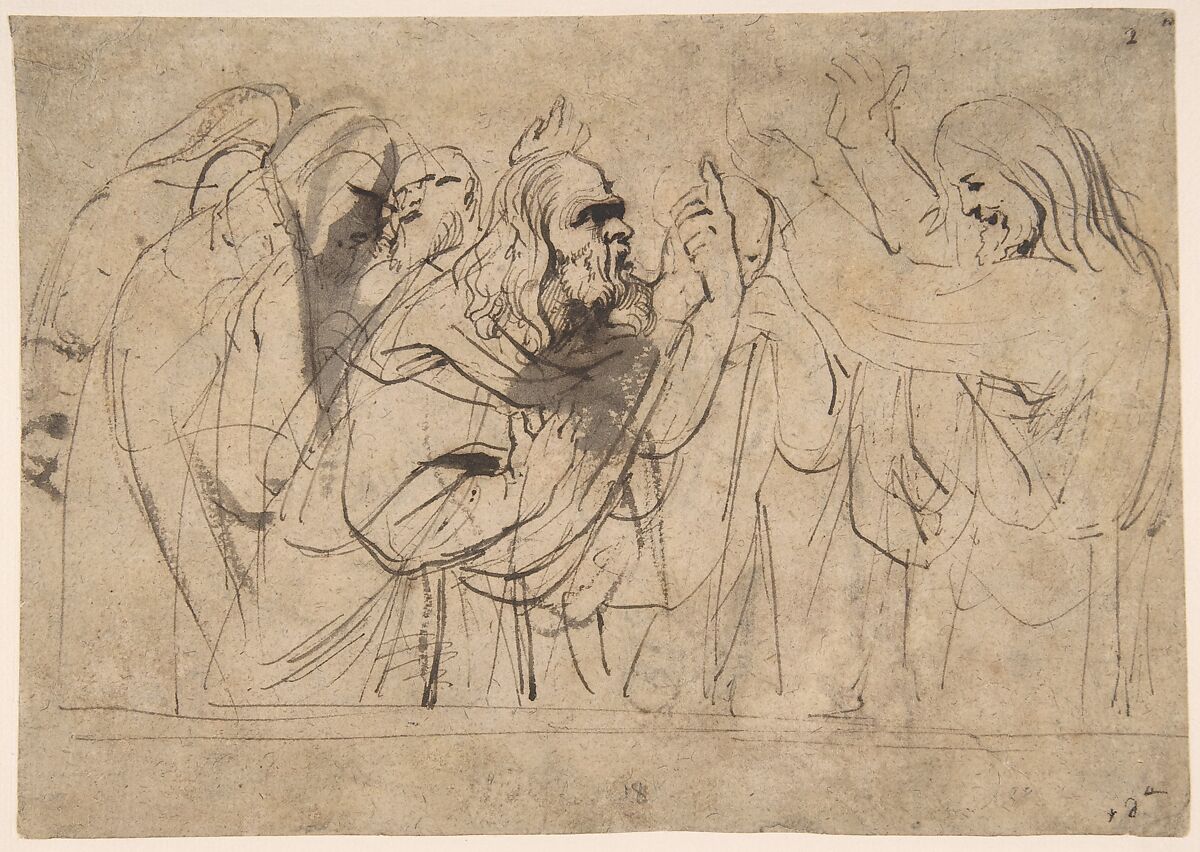
Like me, however, I am guessing that you had a far different tone in your head just now. One that likely resonated with the questioning Pharisee in today’s drawing from Van Dyck. The Pharisee’s body language offers a double message. As his right hand clutches his heart, his left is raised with a finger pointed skyward. The gesture has a “Who gives you the right!” panache to it, much like we’ve seen in films, television, or even personal experience; but it also points to heaven as if to tacitly accuse Jesus of claiming the authority of God. Jesus wastes no time in putting the question immediately back to him with what appears to be mutual agreement that there are limited options: “Does John’s authority come from God or man?” Van Dyck puts the answer in Jesus’ hands … literally! Both hands are raised to heaven because both interlocutors know that to speak the words that John the Baptist and Jesus uttered could only be justified under the authority of God.
The Pharisees clearly know what both Jesus’ and John’s answer must be, but they are denied the satisfaction of hearing it from Jesus, and they are unwilling to admit that they too already know the answer. Out of the mouths of babes, disciples, and crowds across Roman-occupied Israel, people had already embraced the truth that John’s authority came from God. No amount of huffing and finger pointing could change this. Nor could the Pharisees hide the fact that they greatly enjoyed their current system of man-granted authority as the resident authority granters.
I must admit as a reader of Mark’s story, I would have taken great delight if Jesus had then asked the Pharisees: “While we are on the subject, who granted you the authority!” and watched them squirm and evade admitting that their authority was (even in the best case scenario) indirectly from God, but primarily from men who came before them. Instead, the Lamb simply leaves them speechless, powerless, and answerless. They must confess the answer with their own tongues if they want eternal life. The gospel and the kingdom of heaven were unfolding before their eyes, but their tight grasp on control and authority blinded them to it.
In closing, may we never forget that in a few days they received an answer in the world-changing display of God’s “great might that he worked in Christ when he raised him from the dead and seated him at his right hand in the heavenly places, far above all rule and authority and power and dominion, and above every name that is named, not only in this age but also in the one to come.” (Ephesians 1:19-22)
Prayer
Listen once more to today’s musical re-telling of this story and pray with me.
Almighty Father, thank you for Jesus Christ who is “the head of all rule and authority” and in whom we put all of our hope. May we never confuse the appearance of authority, with the true authority that comes only from you. Thank you for that same Spirit who raised Christ from the dead and gives life to our mortal bodies. Amen. (Colossians 2:10, Romans 8:11)
Dr. Matt Van Hook
Assistant Director of Recruitment and Marketing
Associate Professor, Torrey Honors College
Biola University
For more information about the artwork, music, and poetry selected for this day, we have provided resources under the “About” tab located next to the “Devotional” tab near the top of the page.
About the Artwork
Christ and the Pharisees
Anthony van Dyck
Early seventeenth century
Pen and brown ink, brown wash on paper
15.2 x 21.5 cm
Metropolitan Museum of Art
New York, New York
Public Domain
Although best known as a portraitist, artist Anthony van Dyck executed many religious works during his formative period in his native city of Antwerp. Like other Flemish artists of his generation, his graphic manner was influenced by Rubens. In this study of the New Testament subject Christ and the Pharisees, van Dyck arranged the primary figures in a relieflike composition. Through facial expression, gesture, and the interrelationships between the poses of the figures, van Dyck explored the ferocity of the debate between Christ and Simon the Pharisee concerning fidelity to the law. He placed the figures in combative positions, directly opposite each other in strict profile, and connected the two through the interplay of their hands—their faces convey the intensity of the argument.
About the Artist
Sir Anthony van Dyck (1599–1641) was a Flemish baroque artist who became the leading court painter in England after success in the Spanish Netherlands and Italy. The seventh child of Frans van Dyck, a wealthy silk merchant in Antwerp, Anthony painted from an early age. He was successful as an independent painter in his late teens and became a master in the Antwerp Guild. By this time, he was working in the studio of the leading northern painter of the day, Peter Paul Rubens, who became a major influence on his work. In England, he developed a version of his style which combined a relaxed elegance and ease with an understated authority in his subjects which was to dominate English portrait painting to the end of the eighteenth century. His influence extends into the modern period. Cultural note: the Vandyke beard is named after him. During his lifetime, Charles I granted him a knighthood, and he was buried in St Paul's Cathedral, an indication of his standing at the time of his death.
About the Music
“The Question of Jesus’ Authority” from the album The Gospel of Mark: An Oratorio
And they come again to Jerusalem: and as he was walking in the temple,
there come to him the chief priests, and the scribes, and the elders,
And say unto him, By what authority doest thou these things?
and who gave thee this authority to do these things?
And Jesus answered and said unto them,
I will also ask of you one question, and answer me,
and I will tell you by what authority I do these things.
The baptism of John, was it from heaven, or of men? answer me.
And they reasoned with themselves, saying, If we shall say,
From heaven; he will say, Why then did ye not believe him?
But if we shall say, Of men; they feared the people:
for all men counted John, that he was a prophet indeed.
And they answered and said unto Jesus, We cannot tell.
And Jesus answering saith unto them,
Neither do I tell you by what authority I do these things.
About the Composer
A graduate of the University of British Columbia School of Music with a degree in composition, Christopher Tyler Nickel studied with renowned Canadian composer Stephen Chatman. Upon graduation, he continued his studies in New York and Los Angeles. Nickel is the composer-in-residence of the Lionsgate Sinfonia and the author of numerous concert works which have been performed by orchestras and chamber ensembles in Canada, the United States, and Europe. Works include a concerto for piccolo/flute/alto flute; Tranquility for solo English horn and orchestra, which was premiered by the Vancouver Symphony’s English hornist, Beth Orson; and in 2015 the premiere of his Oboe Concerto written for Roger Cole, principal oboe of the Vancouver Symphony. Other major works include a Requiem; his hour-long, one-movement Symphony No.2, and a seven-hour oratorio which sets the Gospel According to Mark to music.
About the Performers
Carman J. Price and the Vancouver Contemporary Orchestra conducted by Clyde Mitchell
Carman J. Price has a warm tenor sound and stylistic adaptability that have made him one of Vancouver’s most sought-after singers. His working trio with Canadian jazz legends Bill Coon (guitar) and Rene Worst (bass) has been delighting audiences for more than a decade, appearing at venues throughout the Vancouver area. In addition to his work in the jazz and choral world, Carman is an experienced studio singer, recording jingles and vocals for pop recordings. And his recent thrill has been being a guest on backing and lead vocals for the Steely Dan tribute band Steelin’ in the Years.
Vancouver Contemporary Orchestra (VCO), founded in 1919, is a Grammy and Juno–award winning Canadian orchestra. VCO performs more than one hundred fifty concerts each year, throughout Vancouver and the province of British Columbia, reaching over 270,000 people annually. On tour the VCO has performed in the United States, China, Korea, and across Canada. The orchestra presents passionate, high-quality performances of classical, popular and culturally diverse music, creating meaningful engagement with audiences of all ages and backgrounds.
Canadian-American conductor Clyde Mitchell studied piano, organ, and French horn before deciding to pursue a career in music. Music performance degrees from Louisiana State University (B. Mus.) and California State University-Northridge (M.A. in music) led to a performing career in Bogotá, Colombia; Tucson, Arizona; and Montreal, Quebec. In Montreal, he was associate principal l horn in the prestigious Montreal Symphony Orchestra under Charles Dutoit, and was professor of horn and chamber music studies and conductor of the brass choir at McGill University. Mitchell is an outspoken advocate for music education, and regularly conducts and holds workshops for honor bands and orchestras across North America. Mitchell is the founding conductor and music director of Lions Gate Sinfonia and the new Lions Gate Youth Orchestra. He recently moved to Los Angeles, where his wife, Sarah Jackson, plays solo piccolo with the world-famous Los Angeles Philharmonic.
About the Poetry and Poet
R. S. Thomas (Ronald Stuart Thomas, 1913–2000) was a Welsh poet and Anglican priest known for his spare, intense verse about rural life, faith, and the Welsh landscape. Educated in classics and ordained in the Church in Wales, he spent decades serving small rural parishes, experiences that shaped the stark realism and spiritual tension of his poetry.
He published more than twenty collections, including An Acre of Land and Song at the Year’s Turning, and received major honors such as the Queen’s Gold Medal for Poetry and the Lannan Lifetime Achievement Award. Thomas remains one of the most significant religious and national voices in twentieth-century Welsh literature.
About the Devotion Writer
Matt Van Hook teaches in Torrey Honors College at Biola University. He received his doctoral degree in political science from the University of Notre Dame. His research and teaching cross boundaries between philosophy, politics, literature, and history but often land somewhere close to the realm of statesmanship and American political thought. He is a retired officer who previously served as a US Air Force pilot and a professor at the US Air Force Academy.