March 24: Hard Questions for the Master Teacher
♫ Music:
Mark 12:13–34 (NKJV)
Then they sent to Him some of the Pharisees and the Herodians, to catch Him in His words. When they had come, they said to Him, “Teacher, we know that You are true, and care about no one; for You do not regard the person of men, but teach the way of God in truth. Is it lawful to pay taxes to Caesar, or not? Shall we pay, or shall we not pay?”
But He, knowing their hypocrisy, said to them, “Why do you test Me? Bring Me a denarius that I may see it.” So they brought it.
And He said to them, “Whose image and inscription is this?” They said to Him, “Caesar’s.”
And Jesus answered and said to them, “Render to Caesar the things that are Caesar’s, and to God the things that are God’s.”
And they marveled at Him.
Then some Sadducees, who say there is no resurrection, came to Him; and they asked Him, saying: “Teacher, Moses wrote to us that if a man’s brother dies, and leaves his wife behind, and leaves no children, his brother should take his wife and raise up offspring for his brother. Now there were seven brothers. The first took a wife; and dying, he left no offspring. And the second took her, and he died; nor did he leave any offspring. And the third likewise. So the seven had her and left no offspring. Last of all the woman died also. Therefore, in the resurrection, when they rise, whose wife will she be? For all seven had her as wife.”
Jesus answered and said to them, “Are you not therefore mistaken, because you do not know the Scriptures nor the power of God? For when they rise from the dead, they neither marry nor are given in marriage, but are like angels in heaven. But concerning the dead, that they rise, have you not read in the book of Moses, in the burning bush passage, how God spoke to him, saying, ‘I am the God of Abraham, the God of Isaac, and the God of Jacob’? He is not the God of the dead, but the God of the living. You are therefore greatly mistaken.”
Then one of the scribes came, and having heard them reasoning together, perceiving that He had answered them well, asked Him, “Which is the first commandment of all?”
Jesus answered him, “The first of all the commandments is: ‘Hear, O Israel, the Lord our God, the Lord is one. And you shall love the Lord your God with all your heart, with all your soul, with all your mind, and with all your strength.’ This is the first commandment. And the second, like it, is this: ‘You shall love your neighbor as yourself.’ There is no other commandment greater than these.”
So the scribe said to Him, “Well said, Teacher. You have spoken the truth, for there is one God, and there is no other but He. And to love Him with all the heart, with all the understanding, with all the soul, and with all the strength, and to love one’s neighbor as oneself, is more than all the whole burnt offerings and sacrifices.”
Now when Jesus saw that he answered wisely, He said to him, “You are not far from the kingdom of God.”
But after that no one dared question Him.
Poetry
“Variations on a Theme by William Carlos Williams”
by Kenneth Koch
1
I chopped down the house that you had been saving to live in next summer.
I am sorry, but it was morning, and I had nothing to do
and its wooden beams were so inviting.
2
We laughed at the hollyhocks together
and then I sprayed them with lye.
Forgive me. I simply do not know what I am doing.
3
I gave away the money that you had been saving to live on for the next ten years.
The man who asked for it was shabby
and the firm March wind was so juicy and cold.
4
Last evening we went dancing and I broke your leg.
Forgive me. I was clumsy, and
I wanted you here in the wards, where I am the doctor!
Hard Questions for the Master Teacher
Before there were ever twenty-first century arguments on the internet, there were first century rhetorical battles of wit in the public square. Today’s passage, three vignettes of rapid-fire dialogue, is the first century equivalent of viral content. In both Greco-Roman and Rabbinic societies, it is these intellectual jousts that solidify one’s authority as rhetor, philosopher or rabbi. Taken together, the dialogues with the Pharisees and Herodians, the Sadducees and the scribe demonstrate Jesus’s mastery in the realms of politics, theology, and the wisdom of life.
Jesus completes the challenge, solidifying his authority by articulating a grand summary statement of the Torah. The scribe asks for the Greatest Commandment, but Jesus—in his wisdom—offers two. It’s as if Jesus can’t mention love of God without mentioning love for neighbor within the same breath; the two are bound up together. The only proper response to love is love. To receive God’s love is to give love. The degree to which we extend love corresponds to the depth at which God’s love takes root in our heart.
But our love doesn’t always extend well, does it?
In signature facetious style, Kenneth Koch crafts a poem that serves as a counterpoint to the kind of selfless, agapic love God extends toward us. Too often, our actions don’t flow out of love, but out of our brokenness. In boredom and the pursuit of instant gratification, in mockery that we think will build connection, in feigned charity, in forced intimacy, we communicate not love but conceit.
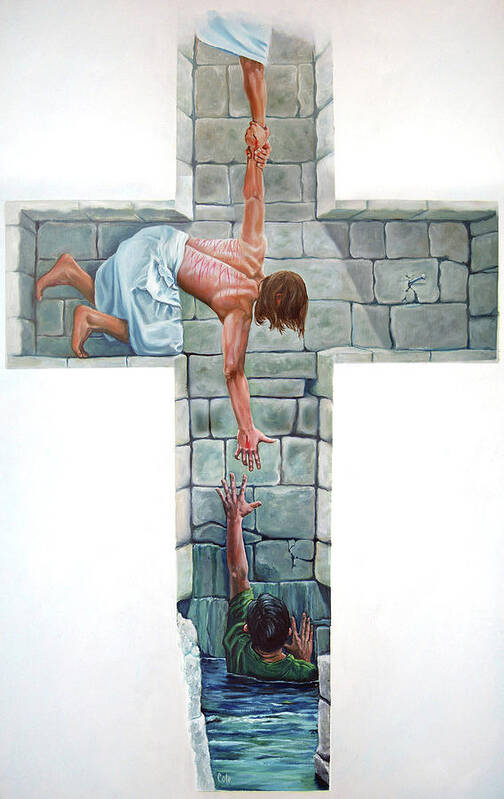
I don’t know for sure the original intention behind Larry Cole’s acrylic painting “Love,” but cast against this poem and these verses, I see my feeble attempts to love God with all the heart, with all the understanding, with all the soul, and with all the strength, and to love my neighbor as myself—and I know I’m not there yet. But in my grasping, I hear Jesus speak with authority: “You are not far from the kingdom of God.” I feel him reach his hand toward me. It’s only through Christ’s help that I enter into this way of the kingdom.
If I desire to live in the wisdom and way of Christ, if I desire to truly love God and communicate love to my neighbor, I need to have my mind renewed (Romans 12:2), to take on the mindset of Christ (Phil. 2:5) that he puts on display here. This pursuit of love for God and neighbor is superior to all the worship songs I can sing, all the tithes I can give, and all my accolades or credentials.
As I go about my day today, the voices of the Beckenhorst Singers remind me that I am “loved with an everlasting love” and call me to Christ's words from John 13:34, “As I have loved you, so love.”
Prayer
Abba,
You have loved me with an everlasting love. When I reflect on this truth, my heart wells up with joy and desires to extend that love to all within my reach—to love as you have loved me. But I confess, so often, I fail. Please, renew my mind today. Rid my motives of selfish ambition and vain conceit so that I may love as you have loved me. Thank you, God, all I have is yours. I love you—but I know I can only say that because you loved me first. In Jesus’s name, amen.
Chase Andre
Assistant Professor of Communication
Biola University
For more information about the artwork, music, and poetry selected for this day, we have provided resources under the “About” tab located next to the “Devotional” tab near the top of the page.
About the Artwork
Love
Larry Cole
2010
Acrylic on canvas
© Larry Cole Art
Used with permission of the artist
American contemporary artist Larry Cole paints a rather unusual depiction of the cross. The young man at the bottom is not carrying a cross; he is actually completely inside the cross—fully part of the cross. The risen Christ is reaching out to lift the struggling young man up from the encroaching waters below. One nail of Christ's crucifixion is visible to the right. Christ Himself is held by the hand of His Father, who is at the very top of the cross. The concept of Christ reaching down and saving us is a central theme in Christianity, symbolizing how Jesus Christ saves humanity from sin and despair through divine grace and mercy. The image of God reaching down to save us, as in Psalm 18:16, represents a direct, powerful intervention to rescue people and ultimately save them from sin and provide eternal life.
About the Artist
Larry Cole is a multitalented painter, illustrator, sculptor, musician, song writer, and worship leader. Many of Cole’s original paintings hang in homes, churches, and businesses in the United States and South America. A native of St. Louis, and now residing on Florida’s west coast, Cole has produced work that has been featured from the Waterloo Art Festival in northern Indiana to the Gulf Coast Art Center in South Florida. A graduate of Anderson College in Indiana, he studied painting and sculpture. He taught art in Indiana until interrupted by a tour of duty in the Air Force during the Vietnam war. As his portfolios reflect, his paintings range from depictions of wildlife to deeply spiritual works. Cole appears at church services, Christian schools, and community events, where he paints a sixty-by-eighty-inch painting of the face of Jesus while sharing his testimony and a message of encouragement with congregations and students, often to background music he has written and recorded. Cole is currently devoting himself to his art full-time.
About the Music
“In All Things Love” from the album Beckenhorst Choral Music Spring 2025
In all things
Love, Love, Love.
In all things Love.
In all things Love.
In all things Love.
As I have loved you.
So in all things love.
In all things Love.
Love, Love, Love.
In all things Love.
Love is patient.
Love is kind.
Always trusts.
Always hopes.
Always endures.
Love never fails.
In all things Love.
In all things Love.
In all things Love.
In all things Love.
The greatest of these is Love.
The greatest of these is Love.
The greatest of these is Love.
As I have loved you.
In all things Love.
About the Composer
Dan Forrest (b. 1978) has been described as having “an undoubted gift for writing beautiful music…that is truly magical” (NY Concert Review), with works hailed as “magnificent, very cleverly constructed sound sculpture” (Classical Voice), and “superb writing…full of spine-tingling moments” (Salt Lake Tribune). His music has sold millions of copies, has received numerous awards and distinctions, and has become well established in the repertoire of choirs around the world via festivals, recordings, radio/TV broadcasts, and premieres. Forrest’s work ranges from small choral works to instrumental solo works, wind ensemble works, and extended multimovement works for chorus and orchestra. His Requiem for the Living (2013) and Jubilate Deo (2016) have become standard choral/orchestral repertoire for ensembles around the world, and his more recent major works LUX: The Dawn From On High (2018) and the breath of life (2020) have also received critical acclaim. Dan holds a doctorate in composition and a master’s degree in piano performance, and served for several years as a professor and department head (music theory and composition) in higher education. He currently serves as editor at Beckenhorst Press; chair of the American Choral Directors Association Composition Initiatives Committee; and artist-in-residence at Mitchell Road Presbyterian Church in Greenville, South Carolina.
About the Performers
Beckenhorst Singers of Beckenhorst Press
Beckenhorst Press was founded by two talented composers, John Ness Beck and John Tatgenhorst. At the time, John Beck owned a retail sheet music establishment and was writing principally choral music while John Tatgenhorst was engaged in various musical pursuits. The initial intent was to publish choral, band, and orchestra music, with John Beck focusing on choral music and John Tatgenhorst directing his efforts toward instrumental works.
About the Poetry and Poet:
Kenneth Koch (1925–2002) was an American poet, playwright, and educator widely recognized as a leading figure of the New York School of poetry, a mid‑twentieth‑century movement marked by its inventive, often humorous, and avant‑garde style. Born in Cincinnati, Ohio, he earned his B.A. at Harvard University and later taught for many years at Columbia University. Koch published numerous volumes of poetry, including Poems (1953), The Art of Love (1975), One Train and On the Great Atlantic Rainway: Selected Poems 1950‑1988 (both 1994), the latter two earning him the Bollingen Prize for Poetry. His work also includes plays, prose, and influential books on teaching poetry such as Wishes, Lies and Dreams. Known for his wit and experimental spirit, Koch received major honors including the Phi Beta Kappa Poetry Award and the Rebekah Johnson Bobbitt National Prize for Poetry.
About the Devotion Writer
Chase Andre is an assistant professor in Biola University’s Division of Communication. He is passionate about helping students cultivate Christ-like communication in the diverse contexts to which God calls them. Chase lives in Los Angeles with his wife, Alicia Miller Andre, and their two kids, where they are active community members and lay leaders in a small multiethnic church on LA’s Eastside.