April 5: The Empty Tomb
♫ Music:
Week Eight Introduction | Bright Week | April 5–11:
Christ's Resurrection: Victory Over Sin and Death
It’s amazing to realize that on this glorious Easter Sunday the words “Christ is risen” are being proclaimed throughout the entire world. In grand cathedrals and lowly storefront churches, in large, televised outdoor gatherings and discreet, secret meetings of the persecuted, Christians are celebrating the joyous good news that Christ has conquered the forces of sin and death once and forever! In this, our final week together, we walk with Mark through the concluding moments of Christ’s earthly sojourn. Interestingly, Mark’s gospel seems to end as abruptly as it began.
Most scholars agree that Mark’s account of the life of Christ finishes at Mark 16:8: “So they went out quickly and fled from the tomb, for they trembled and were amazed. And they said nothing to anyone, for they were afraid.” The two earliest manuscripts of Mark, Codex Vaticanus and Codex Sinaiticus, stop at Mark 16:8 not at Mark 16:20, the typical ending that is found in almost every translation of the New Testament. No one knows who added the final verses, but it appears to be a rare instance of second-century scribes feeling that there needed to be a more appropriate ending to the gospel. The language and style of verses 9–20 differs significantly from the rest of Mark’s account and obviously draws from post-resurrection passages found in the other gospels, especially in the gospel of Luke.
Why would Mark end his powerful account of Christ’s earthly life in what feels like a terrible moment of defeat, “And they said nothing to anyone, for they were afraid”? What a shocking way to complete an account of the empty tomb! No wonder there were those who wanted to add a few more verses to round out Mark’s version of the story. But with his “Wait, what?” ending, Mark grabs our attention, forcing us to truly engage with the text. We’ve all experienced the gripping fear and disbelief the female followers of Christ realized. Rather than providing all the answers, Mark’s Gospel calls us into deeper reflection on the meaning of Christ’s life, death, and resurrection. It challenges us to respond personally to the good news and to carry its message forward in our own lives.
It is our prayer that this Lenten series has stirred within you some sort of new beginning. May the Lord pour out His blessings upon you as you continue to “bear your cross” for Him, as a faithful follower of Christ. God be with you until we meet again!
Sunday, April 5 | The Empty Tomb
Mark 16:1–7 (NKJV)
Now when the Sabbath was past, Mary Magdalene, Mary the mother of James, and Salome bought spices, that they might come and anoint Him. Very early in the morning, on the first day of the week, they came to the tomb when the sun had risen. And they said among themselves, “Who will roll away the stone from the door of the tomb for us?” But when they looked up, they saw that the stone had been rolled away—for it was very large. And entering the tomb, they saw a young man clothed in a long white robe sitting on the right side; and they were alarmed.
But he said to them, “Do not be alarmed. You seek Jesus of Nazareth, who was crucified. He is risen! He is not here. See the place where they laid Him. But go, tell His disciples—and Peter—that He is going before you into Galilee; there you will see Him, as He said to you.”
Poetry
“Resurrection”
by Michael Stalcup
Note from the Poet: Each word in this poem is contained in the word "Resurrection"
Cinereous stone
unset—our sun
is risen!
Sin in ruins,
terror's tenure
torn,
one rescuer
incurs, inters
our curse,
returns to us
our cure, our rest,
our course.
The Empty Tomb
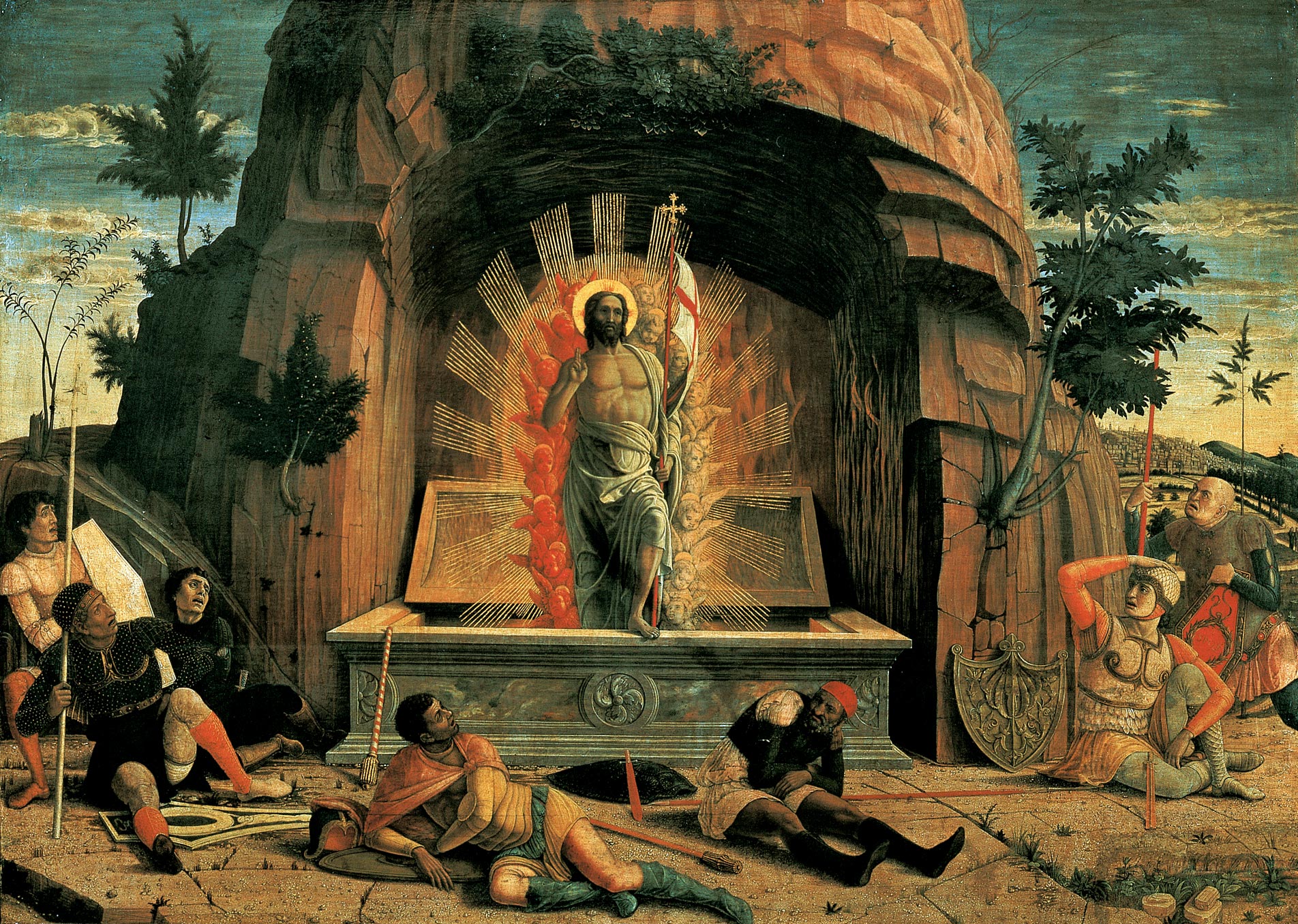
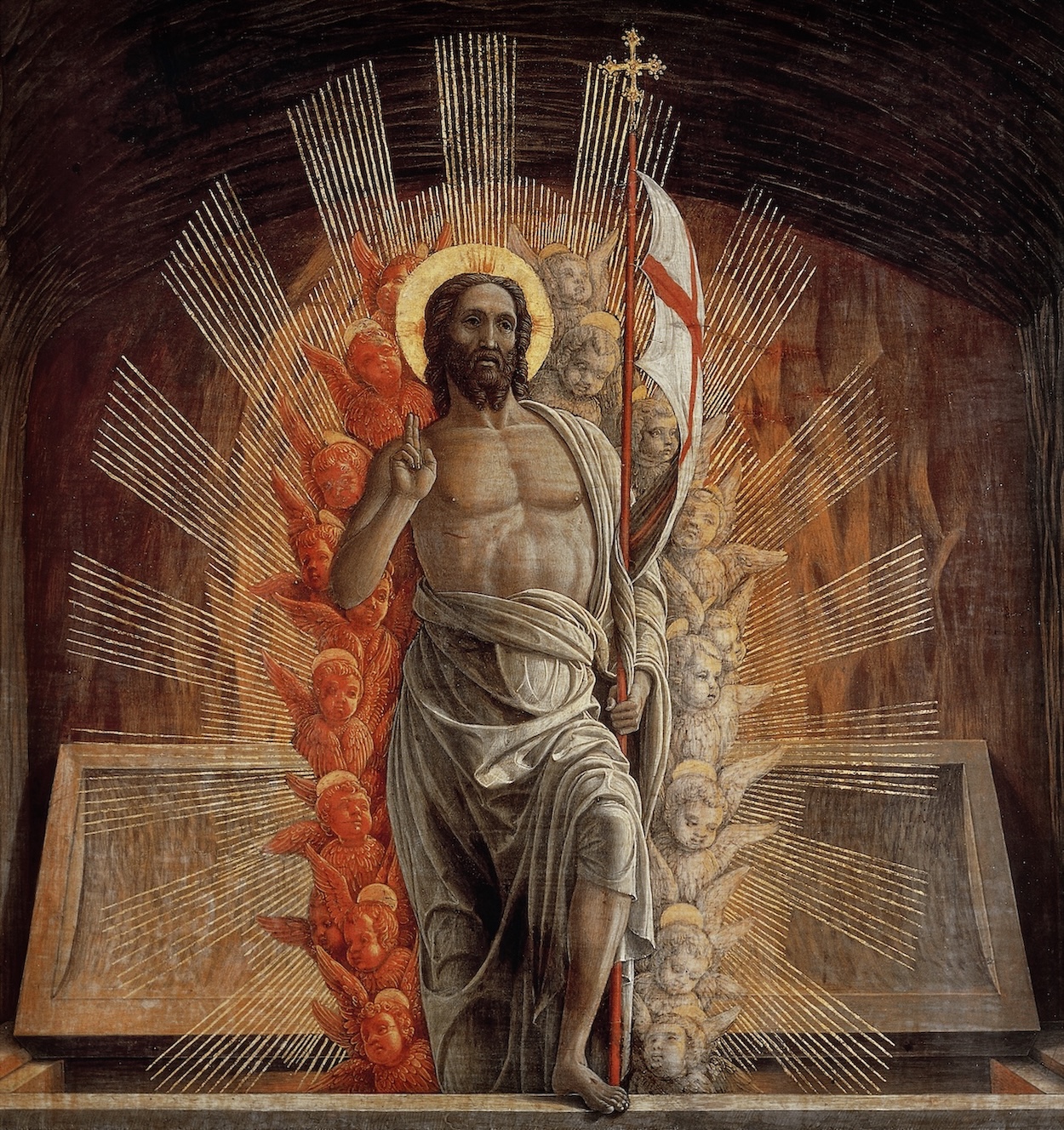
Jesus lifts his leg, stepping up, out of his tomb. His body, bursting with life, strength and health, bears still the marks of its breaking—the hole in his foot, the wound in his side are clearly present—but hamper him in no way. They are merely the signs of his glory, some of the graced means by which we know and recognize our Lord.
Caring for an elderly patient, years ago, my wife saw a strange tattoo on her patient’s arm. Numbers. A fellow nurse explained: “oh, we used to get those all the time…. Those are concentration camp tattoos.” The signs and the symbols of past pain and suffering.
But Christ’s is no partial recovery. No work of time that slowly allows, perhaps, past trauma to recede, the soul to regain some of its strength and vivacity. No slow forgetting or slow recovery. The earth knows of such slow change. It knows the power of a seed to slowly reach its roots into the tiniest cracks of rock, gradually crumbling stone, hill or mountain.
That is the slow work of change under the sun that we all know—the cracks in pavement, the fissures in mountains, even those painted in Andrea Mantegna’s Resurrection we know, and the partial slow crumbling of sadness and pain.
This is something new, something different, to which the power of trees over rock, even that of Treebeard and his ents, are but a sign and a pointer. This is not the slow work of change, the repetition of cycles anew, of new life in the spring, of gradually filing away the rough and jagged into the smooth.
This is the resurrection. This is something utterly new. Not the cracking of stone, but the moving of stone. Not a process but new life altogether. Not the diminishing or fading of pain and remembered loss, but of a step up and out of the possibility of pain altogether. Our hope, our joy, lies not in process, not in known or repeatable paths or exercises. These, of course, have their place. But our hope is in something beyond us, something entirely new. A bursting of life from death—a change so profound that scars lose their negative function entirely, and remain merely as the positive signs—the memory of glory, the badges of identification. No longer will they hamper motion or make us wince in pain. No longer will they cast a shadow of sadness over mind and spirit, bringing afresh past pain.
For Christ now, and us soon in him, our scars will be but the signs of glory, part of the marks by which we know and recognize each other. Only their positive function will remain in the joy of Easter light.
Prayer
Father, as we age (and some of us age far too soon),
We accumulate scars. Far too many scars. Some small, some large,
Leaving their mark not merely on flesh and bone, but on every aspect of our being.
Free us, Lord. Free us from our scars. Free us with the power of your resurrection,
For our scars to neither hinder nor hurt, but to be but the signs by which we know ourselves, each other, and you.
In the name of the Father, Son and Holy Spirit.
Amen.
Dr. Adam Johnson
Associate Professor
Torrey Honors College
Biola University
For more information about the artwork, music, and poetry selected for this day, we have provided resources under the “About” tab located next to the “Devotional” tab near the top of the page.
About the Artwork
Resurrection (overall and close-up views)
Andrea Mantegna
1457–1459
Tempera on panel
70 × 92 cm
Musée des Beaux-Arts de Tours
Tours, France
Public Domain
Resurrection is a tempera on panel painting by Andrea Mantegna dating from 1457 to 1459, now in the Musée des Beaux-Arts in Tours, France. It originally formed part of the predella of the San Zeno Altarpiece, commissioned in 1457. Here Christ steps triumphantly out from His opened tomb, which is set against a rocky landscape. His right hand is raised in blessing, while His left hand holds a resplendent flag symbolizing victory over death. He is surrounded by a multitude of cherubim and glowing rays of light that emanate from His resurrected body. Surrounding the tomb, Roman soldiers are startled awake by the monumental event unfolding behind them. The composition directs the viewer’s gaze upwards to Christ, highlighting His divine presence amidst the earthly setting. The delicate use of perspective and the attention to detail in both the figures and the landscape exemplify the hallmark characteristics of the High Renaissance.
About the Artist
Andrea Mantegna (about 1431–1506) was an Italian Renaissance painter, a student of Roman archaeology, and the son-in-law of Jacopo Bellini, one of the founders of the Renaissance style of painting in Venice and northern Italy. Like other artists of the time, Mantegna experimented with perspective, e.g. by lowering the horizon in order to create a sense of greater monumentality. His landscapes and somewhat stony figures give evidence of a fundamentally sculptural approach to painting. He also led a workshop that was the leading producer of prints in Venice before 1500. Mantegna's main legacy is considered the introduction of spatial illusionism, both in frescoes and in sacra conversazione paintings: his tradition of ceiling decoration was followed for almost three centuries.
About the Music
“Christ Arose/Christ the Lord Is Risen Today” from the album Classical Praise Easter
Instrumental
Christ Arose!
Low in the grave He lay,
Jesus, my Savior,
Waiting the coming day,
Jesus, my Lord!
Refrain:
Up from the grave He arose,
With a mighty triumph o’er His foes,
He arose a Victor from the dark domain,
And He lives forever, with His saints to reign.
He arose! He arose!
Hallelujah! Christ arose!
Vainly they watch His bed,
Jesus, my Savior;
Vainly they seal the dead,
Jesus, my Lord!
Death cannot keep his Prey,
Jesus, my Savior;
He tore the bars away,
Jesus, my Lord!
Christ the Lord is Risen Today!
Christ the Lord is ris’n today, Alleluia!
Sons of men and angels say, Alleluia!
Raise your joys and triumphs high, Alleluia!
Sing, ye heav’ns, and earth, reply, Alleluia!
Lives again our glorious King, Alleluia!
Where, O death, is now thy sting? Alleluia!
Once He died our souls to save, Alleluia!
Where thy victory, O grave? Alleluia!
Love’s redeeming work is done, Alleluia!
Fought the fight, the battle won, Alleluia!
Death in vain forbids His rise, Alleluia!
Christ hath opened paradise, Alleluia!
Soar we now where Christ hath led, Alleluia!
Foll’wing our exalted Head, Alleluia!
Made like Him, like Him we rise, Alleluia!
Ours the cross, the grave, the skies, Alleluia!
Hail the Lord of earth and heaven, Alleluia!
Praise to Thee by both be given, Alleluia!
Thee we greet triumphant now, Alleluia!
Hail the Resurrection, thou, Alleluia!
King of glory, Soul of bliss, Alleluia!
Everlasting life is this, Alleluia!
Thee to know, Thy pow’r to prove, Alleluia!
Thus to sing, and thus to love, Alleluia!
About the Composers
“Christ Arose” was composed by Robert Lowry, “Christ the Lord is Risen Today” was composed by Charles Wesley
The song "Christ Arose/Christ the Lord Is Risen Today" is an instrumental track by Phillip Keveren featured on the 2011 album "Classical Praise Easter.” It is a medley that combines the hymn "Christ the Lord Is Risen Today" with "Christ Arose," both of which are classic Easter hymns.
Robert Lowry (1826–1899) was an American preacher who became a popular writer of gospel music in the mid-to-late nineteenth century. His best-known hymns include "Shall We Gather at the River," "Christ Arose!,” "How Can I Keep from Singing?," and "Nothing But the Blood of Jesus." Lowry studied at the University at Lewisburg and entered the Baptist ministry in 1854. During the following forty-five years, he held a number of pastorates in New York, Pennsylvania, and New Jersey. From 1868 he acted as hymnals editor to Biglow and Main, the country's leading publisher of gospel and Sunday school music; under his supervision more than twenty hymnals were produced by the firm, many of wide and enduring popularity. Despite his protestations that preaching was his main vocation and that music was merely a sideline, it is as a hymnwriter that Lowry is chiefly remembered, ranking with W. H. Doane and Ira D. Sankey as one of the originators of a musical tradition that has lasted until the modern era of revival.
Charles Wesley (1707–1788) was an English leader of the Methodist movement and is most widely known for writing the words for over 6,500 hymns. His most famous works include "And Can It Be,” "Christ the Lord Is Risen Today," "Hark! The Herald Angels Sing,” and "Lo! He Comes with Clouds Descending.” He was a younger brother of Methodist founder John Wesley and Anglican cleric Samuel Wesley the Younger. Educated at Oxford University, where his brothers had also studied, Charles followed his father into the church in 1735. Following their evangelical conversions in 1738, the Wesley brothers traveled throughout Britain, converting followers to the Methodist revival through preaching and hymn-singing. It has been said that Charles Wesley usually celebrated each anniversary of his birthday by writing a hymn of praise to God. On his spiritual birthday—the first anniversary of his conversion—he celebrated by writing one of the most beloved hymns still in use today among Methodists—“O For a Thousand Tongues to Sing.” The hymn was placed first in John Wesley's A Collection of Hymns for the People Called Methodists, published in 1780. It was the first hymn in every (Wesleyan) Methodist hymnal from that time until the publication of Hymns and Psalms in 1983.
About the Performers
Phillip Keveren and Orchestra
A multitalented keyboard artist and composer, Phillip Keveren displays a tremendous versatility in both his original works and concert performances. He composes in a variety of genres, and is widely acclaimed for his piano publications. Mr. Keveren is a prolific arranger, orchestrator, and producer. His work is featured in numerous instrumental recordings, church choral, educational piano, and Christian artist releases, including recordings by Steve Green, Travis Cottrell, Larnelle Harris, Sandi Patty, Mandisa, Jeremy Camp, and the Brooklyn Tabernacle Choir. Phillip is coauthor, major composer, and orchestrator of the internationally acclaimed Hal Leonard Student Piano Library, a complete method of piano study for young students. His unique piano arrangements are also featured in the Phillip Keveren Series (Hal Leonard Publishing). Mr. Keveren holds a Bachelor of Music in Composition from California State University, Northridge, and a Master of Music in Composition from the University of Southern California.
About the Poetry and Poet
Michael Stalcup is a Thai American poet based in Bangkok, Thailand, where he serves in ministry alongside his wife and three children. His work explores the intersection of faith, justice, and wonder, and his poems have been published in outlets such as Sojourners, First Things, Red Letter Christians, and The Lent Project.
In addition to writing, he is dedicated to mentoring and supporting other artists. He coleads Spirit & Scribe, a workshop integrating spiritual formation and writing craft, and serves as a coleader for the PAX Fellowship’s Writing as Spiritual Formation Cohort. In Bangkok, he helps lead United Adoration Thailand, partnering with local churches to inspire creative engagement with God within their own language and cultural context.
About the Devotion Writer
Adam Johnson is a theologian and a professor for the Torrey Honors College who focuses on the doctrine of the atonement, exploring the many ways in which the death and resurrection of Jesus Christ affect the reconciliation of all things to God. His most recent book is Atonement and the Life of Faith. He and his wife, Katrina, have been married twenty-four years and have three sons. They love camping and exploring America’s national parks.