March 8: The Deaf and Mute Man Loudly Proclaims His Healing
♫ Music:
Week Four Introduction | March 8–14:
"You are the Christ, the Son of the Living God"
Mark wrote his gospel to prove to the Gentiles that the Lord Jesus Christ was and is the Messiah, the Son of God, sent by the Father to rescue and restore mankind to right relationship with the Trinity. “Christos” (Greek) translates from the Hebrew “Messiah," which means the “Anointed One.” Jesus was Israel’s long anticipated savior whose unexpected words and unorthodox actions caused many to ultimately reject His claims of divinity. Like people today, there were those who acknowledged Him as a great prophet, but could not bring themselves to worship Him as “the Christ, the Son of the living God” (Matthew 16:16).
Mark starts his story by telling us that Christ is the Messiah: “The beginning of the gospel of Jesus Christ, the Son of God” (Mark 1:1). Then, at Christ’s baptism, God’s voice from heaven declared, “You are My beloved Son” (Mark 1:11). And again at the transfiguration of Christ, the Father verbally stated once more, “This is my beloved Son” (Mark 9:7). These are all undeniable proof texts that lend credibility to Christ’s claim of being God’s chosen one. Obviously, contemporary readers of Mark’s account have an advantage over first-century followers of Christ, who seemed to be baffled about His true identity.
When Peter acknowledges Jesus as the Christ (Mark 8:29–30), pivotal verses in Mark’s gospel, it is the first deity-identifying statement of faith that any of Christ’s close followers verbalize. It is one of the most important passages in Mark’s account because it established Christ’s true nature. In the same account, but recorded in Matthew’s gospel, Christ answered Peter by saying, “For flesh and blood has not revealed this to you, but My Father who is in heaven” (Matthew 16:17). Yet Peter’s powerful confession is almost immediately thwarted by his dismissal of Christ’s next proclamation, one of impending crucifixion and death. "Get behind Me, Satan” (Mark 8:33) was the Lord’s abrupt rebuke. This illustrates a key theme in Mark where the disciples, including Peter, consistently fail to fully comprehend Jesus’s true mission.
An interesting phenomenon referred to as the “messianic secret” takes place in the gospels of both Matthew and Mark. As unclean spirits were fleeing or a healed person began praising God or Christ’s own disciples commented about Him, for a number of reasons, Christ cautioned almost everyone to remain silent about His deity. Ironically, it’s only at the crucifixion, near the end of the gospel, that one who played a central role in Christ’s execution gave a full-throated proclamation that Christ was indeed the Messiah. This is intriguing because “Son of God” was a title exclusively reserved for Roman emperors (Divi filius: "son of a god”). Mark’s story concludes with a clever twist: a pagan Roman officer emerged as a powerful evangelist, officially announcing what had been kept quiet throughout the gospel, “Truly this Man was [and is] the Son of God” (Mark 15:39).
Sunday, March 8 | The Deaf and Mute Man Loudly Proclaims His Healing
Mark 7:31–37 (NKJV)
Again, departing from the region of Tyre and Sidon, He came through the midst of the region of Decapolis to the Sea of Galilee. Then they brought to Him one who was deaf and had an impediment in his speech, and they begged Him to put His hand on him. And He took him aside from the multitude, and put His fingers in his ears, and He spat and touched his tongue. Then, looking up to heaven, He sighed, and said to him, “Ephphatha,” that is, “Be opened.”
Immediately his ears were opened, and the impediment of his tongue was loosed, and he spoke plainly. Then He commanded them that they should tell no one; but the more He commanded them, the more widely they proclaimed it. And they were astonished beyond measure, saying, “He has done all things well. He makes both the deaf to hear and the mute to speak.”
Poetry
“Deaf-Mute in the Pear Tree”
by P.K. Page
His clumsy body is a golden fruit
pendulous in the pear tree
Blunt fingers among the multitudinous buds
Adriatic blue the sky above and through
the forking twigs
Sun ruddying tree’s trunk, his trunk
his massive head thick-nobbed with burnished curls
tight-clenched in bud
(Painting by Generalíc. Primitive.)
I watch him prune with silent secateurs
Boots in the crotch of branches shift their weight
heavily as oxen in a stall
Hear small inarticulate mews from his locked mouth
a kitten in a box
Pear clippings fall
soundlessly on the ground
Spring finches sing
soundlessly in the leaves
A stone. A stone in ears and on his tongue
Through palm and fingertip he knows the tree’s
quick springtime pulse
Smells in its sap the sweet incipient pears
Pale sunlight’s choppy water glistens on
his mutely snipping blades
and flags and scraps of blue
above him make regatta of the day
But when he sees his wife’s foreshortened shape
sudden and silent in the grass below
uptilt its face to him
then air is kisses, kisses
stone dissolves
his locked throat finds a little door
and through it feathered joy
flies screaming like a jay
The Deaf and Mute Man Loudly Proclaims His Healing
An opening scene in Disney’s animated comedy The Emperor’s New Groove shows Yzma—the film’s villain—sitting on the Emperor's throne, pretending to be Emperor for a day. Yzma rolls her eyes at the peasant standing before her and says, “It is no concern of mine whether your family has…” She pauses. “What was it again?” “Um, food,” the peasant stammers. “Ha!” Yzma laughs. “You really should have thought of that before you became peasants!”
This scene—stripped of animated silliness—makes me wince. It strikes at something deep about what kingship is, and what kingship is not. Yzma’s cruel dismissiveness stands in stark contrast to Jesus’ mercy: true Servant Kingship.
P.K. Page’s poem depicts a simple, unremarkable scene of a deaf, mute man pruning his pear tree. He is able-bodied, though he cannot hear the birds singing. He notices his wife, though he cannot speak to her. The story of Mark 7 tells us that Jesus sees this man and heals him—however strange the scene of his healing appeared.
Over the course of my life, I have witnessed extraordinary miracles of Jesus’ healing. Yet, the testimony of one woman from a prayer conference stands out. As her group prayed for a man with advanced cancer, she thought: We should focus prayer time on big requests, like cancer, even though she quietly hoped the Lord would heal her of a hand injury that had caused years of pain. When her group finished praying for the man, she started to move her wrists and could not believe it! Her hands were completely healed! She rejoiced as she shared her story, reminding all of us there is no scarcity of healing available in Jesus.
I have my own wrestling matches with God in the midst of pain. For example, I have a knee issue which, on occasion, leaves me hardly able to walk. When I began to encounter the Lord’s miracles of healing in others’ lives, I cried out to Him in my pain. I have had friends, ministers, and even strangers pray for me over the years. The pain has not gone away. Yet, each time someone asks out of nowhere whether I have knee pain and if they can pray for me, I know Jesus sees me. And my goodness, how He loves me. It was actually some of these memories related to my knee that brought tears of gratitude as I listened to today’s song, “Counting My Blessings.”
Lent is a season to drop everything that hinders us as we run after Jesus. Much of what has hindered me in my own life is the resignation to endure things—both inward and outward—I believed were too unimportant for Jesus to heal. However, unlike Yzma and the peasant, King Jesus rises and flies down the throne room steps to draw near to us. His mercy has healed me in ways I could not have hoped for in my wildest dreams. Day by day, I’m being set free!
May you take heart this Lenten season and ask boldly of the Servant King for whom nothing is too small.
Prayer
O Lord, resurrect my hope by the testimony of your saints and the touch of our beloved Jesus. You have done all things well. You make both the deaf to hear and the mute to speak. For the timid places in me, wait with loving patience. Draw near, Lord, and draw to the surface those areas of my life you long to heal. Set me free to receive all you freely give. You are able.
Grace Shaw
Executive Assistant to the President
Biola University
For more information about the artwork, music, and poetry selected for this day, we have provided resources under the “About” tab located next to the “Devotional” tab near the top of the page.
About the Artwork | 1
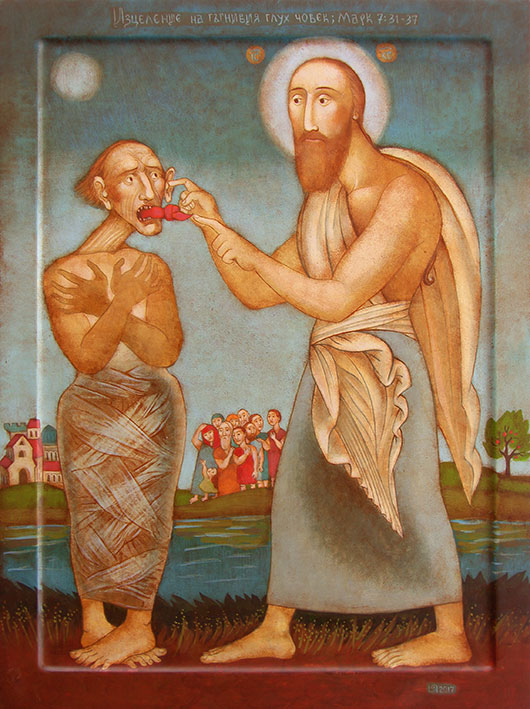
Healing of the Deaf and Dumb Man
Julia Stankova
2017
Acrylic on wood panel
53 x 40 cm
“Ephphatha!”––“Be opened,” says Jesus in Aramaic to this deaf and mute man. Everything about this man is turned and twisted, locked up in himself. Look at his shroud, his feet—he can move neither left nor right, he is hiding himself with his arms, and there is a knot in his tongue. Others must have brought him to Jesus, because on his own he would never have made it to Jesus. With a deep sigh, Jesus blows the man awake with a (re)creative breath, just like Adam in Paradise.
About the Artist
Julia Stankova is a contemporary Bulgarian artist. Despite her desire to be an artist, the direction of her life unexpectedly changed and she became a mining engineer. But after twelve years of being an engineer, she decided to quit her job and dedicate the rest of her life to her first love—art. Immediately after leaving her job, friends allowed her to help in their restoration studio, where she gained an appreciation for Bulgarian icons from the eighteenth and nineteenth centuries. When she left the restoration studio after two years, she was well-versed in the technique of painting with tempera on a primed wooden surface and began her own practice. Since that time she has gradually developed her own iconographic style and visual language.
About the Artwork | 2
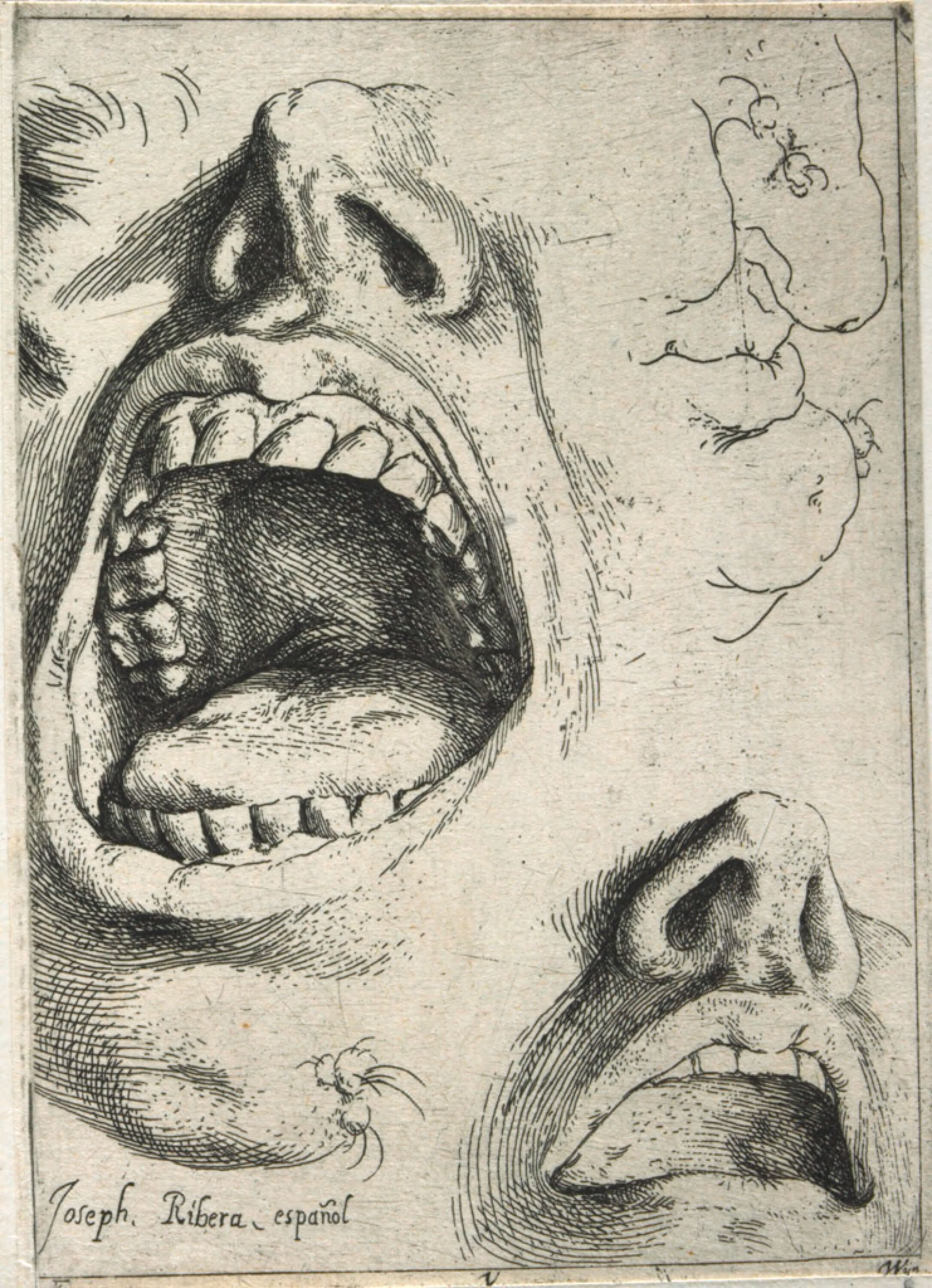
Studies of the Nose and Mouth
Jusepe de Ribera
1622
Engraving on paper
14.4 x 10.2 cm
Harvard Museum of Art/Fogg Museum
Cambridge, Massachusetts
Public Domain
About the Artist
Jusepe de Ribera (1591–1652) was a Spanish painter and printmaker. De Ribera created history paintings, as well as painting traditional biblical subjects and episodes from Greek mythology. He is perhaps best known for his numerous views of martyrdom, which at times are brutal scenes depicting bound saints and satyrs as they are flayed or crucified in agony. Less familiar are his occasional, but accomplished, portraits, still lifes, and landscapes. Nearly half of his surviving work consists of half-length portraits of workers and beggars, often older individuals in ragged clothes, posing as various philosophers, saints, apostles, and allegorical figures. De Ribera's paintings, particularly his early work, are characterized by stark realism using a chiaroscuro style. His later work embraced a greater use of color, softer light, and more complex compositions, although he never entirely abandoned his Caravaggisti leanings.
About the Music | 1
“O for a Thousand Tongues to Sing” from the album Worship
O for a thousand tongues to sing
My great Redeemer's praise!
My great Redeemer's praise!
The glories of my God and King,
The triumphs of his grace. (The triumphs of his grace.)
The triumphs of his grace. (The triumphs of his grace.)
The triumphs of his grace.
Jesus! the name that charms our fears,
That bids our sorrows cease;
That bids our sorrows cease;
'Tis music in the sinner’s ears,
'Tis life, and health, and peace! ('Tis life, and health, and peace!)
'Tis life, and health, and peace! ('Tis life, and health, and peace!)
'Tis life, and health, and peace!
He speaks, and listening to his voice
New life the dead receive;
New life the dead receive;
The mournful, broken hearts rejoice,
The humble poor believe. (The humble poor believe.)
The humble poor believe. (The humble poor believe.)
The humble poor believe.
Hear him, ye deaf, his praise, ye dumb,
Your loosened tongues employ;
Your loosened tongues employ;
Ye blind, behold your Savior come,
And leap, ye lame, for joy. (And leap, ye lame, for joy.)
And leap, ye lame, for joy. (And leap, ye lame, for joy.)
And leap, ye lame, for joy.
My gracious Master and my God,
Assist me to proclaim,
Assist me to proclaim,
To spread through all the earth abroad
The honors of thy name. (The honors of thy name.)
The honors of thy name. (The honors of thy name.)
The honors of thy name.
Thy name.
About the Composers
Lyrics composed by Charles Wesley, Music composed by Thomas Jarman
Charles Wesley (1707–1788) was an English leader of the Methodist movement and is most widely known for writing the words for over 6,500 hymns. His most famous works include "And Can It Be,” "Christ the Lord Is Risen Today," "Hark! The Herald Angels Sing,” and "Lo! He Comes with Clouds Descending.” He was a younger brother of Methodist founder John Wesley and Anglican cleric Samuel Wesley the Younger. Educated at Oxford University, where his brothers had also studied, Charles followed his father into the church in 1735. Following their evangelical conversions in 1738, the Wesley brothers traveled throughout Britain, converting followers to the Methodist revival through preaching and hymn-singing. It has been said that Charles Wesley usually celebrated each anniversary of his birthday by writing a hymn of praise to God. On his spiritual birthday—the first anniversary of his conversion—he celebrated by writing one of the most beloved hymns still in use today among Methodists—“O For a Thousand Tongues to Sing.” The hymn was placed first in John Wesley's A Collection of Hymns for the People Called Methodists published in 1780. It was the first hymn in every (Wesleyan) Methodist hymnal from that time until the publication of Hymns and Psalms in 1983.
Thomas Jarman (1776–1861) was an English composer, chiefly of hymn tunes. His father was a tailor and Baptist lay preacher. Like his father, Jarman began his career as a tailor. After teaching himself music, Jarman changed careers to work as a choir leader and composer, beginning at the local Baptist church. Under his guidance, the choir travelled to nearby locales. Around 1840, Jarman moved to Leamington, Warwickshire, where he was in charge of the music at the local Methodist church, and remained there for approximately seven years before returning to his hometown of Clipston. From the beginning of the 1800s to 1860, Jarman published seventeen collections of songs, hymns, and anthems, including Sacred Music, accounting for over six hundred total songs.
About the Performers
Founded in 1994 by Irish hymn writer Keith Getty, The New Irish Choir and Orchestra’s central purpose is to encourage people to worship God, whether that be by equipping and giving opportunity to musicians or leading congregations and audiences in praise to our God. They have several hundred volunteer musicians and their audio/visual team works together to produce a diverse program of creative events, mostly centered around music. Wherever possible, they work in partnership with local churches and organizations across Ireland.
About the Music | 2
“Counting My Blessings”
It's like it was yesterday
I was a praying for a miracle
Scared to have a little hope
And now looking back today
Seeing all the things You've done
I can't even add them up
One, two, three
Up to infinity
I'd run out of numbers
Before I could thank You for everything
God, I'm still counting my blessings
All that You've done in my life
The more that I look in the details
The more of Your goodness I find
Father on this side of Heaven
I know that I'll run out of time.
But I will keep counting my blessings
Knowing I can't count that high
And I know that seasons never last forever
So God, I will remember
All of the reasons
My heart has to be grateful
All the times You've been faithful to me
God, I'm still counting my blessings,
All that You've done in my life.
The more that I look in the details,
The more of Your goodness I find
Father on this side of heaven
I know that I'll run out of time
But I will keep counting my blessings
Knowing I can't count that high
Oh, I can't count that high
High
Oh, oh-oh-oh-oh-oh-oh
High
Oh, Your goodness, Your goodness
One, two, three
Up to infinity,
I'd run out of numbers
Before I could thank You for everything
God, I'm still counting my blessings
For all that You've done in my life
The more that I look in the details
The more of Your goodness I find
Father on this side of Heaven
I know that I'll run out of time
But I will keep counting my blessings
Knowing I can't count that high
I will keep counting my blessings
Knowing I can't count that high
About the Composers
Matt Maher (b. 1974) is a Canadian contemporary Christian music artist, songwriter, and worship leader who currently lives in the United States. He has written and produced nine solo albums to date. Three of his albums have reached the Top 25 Christian Albums Billboard chart and four of his singles have reached the Top 25 Christian Songs chart. Maher has been nominated for nine Grammy Awards in his career and was awarded the Songwriter of the Year at the 2015 GMA Dove Awards. Maher was born and raised in Newfoundland, Canada. His parents recognized his musical talent, and he grew up taking piano lessons and immersing himself in a broad variety of music, including playing in concert and jazz ensembles, singing in a choir, and playing in a garage rock band. Maher started his postsecondary studies at Memorial University of Newfoundland and continued his studies in the Jazz Department at Arizona State University. Maher currently lives in Nashville, Tennessee.
About the Composer/Performer
Joseph "Seph" Schlueter (b. 1999) is an American singer, songwriter, musician, and a leader of the Damascus Worship community, an American Catholic missionary movement based in Columbus, Ohio. In early 2023, he was signed to a deal by Provident Music Group. His song "Counting My Blessings" was No. 1 on both the Billboard Christian Airplay and Christian Adult Contemporary Airplay charts, in addition to being No. 2 on the Hot Christian Songs chart.
About the Poetry and Poet
Patricia Kathleen (P.K.) Page (1916–2010) was a Canadian poet, novelist, scriptwriter, playwright, essayist, journalist, librettist, teacher, and artist. She was the author of more than thirty published books that include poetry, fiction, travel diaries, essays, children's books, and an autobiography. As a visual artist, she exhibited her work as P. K. Irwin at a number of venues in Canada and abroad. Her works are in the permanent collections of the National Gallery of Canada, the Art Gallery of Ontario, and the Burnaby Art Gallery. By special resolution of the United Nations, in 2001 Page's poem "Planet Earth" was read simultaneously in New York, the Antarctic, and the South Pacific to celebrate the International Year of Dialogue Among Civilizations.
About the Devotion Writer
Grace Shaw is a graduate of Gordon College who went on to earn her Master of Fine Arts in Poetry from Seattle Pacific University and her Certificate in Spiritual Formation from Biola’s Talbot School of Theology. She is an emerging poet with work appearing in Fathom Magazine, Reformed Journal, and Christianity Today’s Ekstasis Magazine. You can keep up with her writing at graceshawpoetry.com.