March 7: Jesus Confronts the Heart
♫ Music:
Mark 7:1-23 (NKJV)
Then the Pharisees and some of the scribes came together to Him, having come from Jerusalem. Now when they saw some of His disciples eat bread with defiled, that is, with unwashed hands, they found fault. For the Pharisees and all the Jews do not eat unless they wash their hands in a special way, holding the tradition of the elders. When they come from the marketplace, they do not eat unless they wash. And there are many other things which they have received and hold, like the washing of cups, pitchers, copper vessels, and couches.
Then the Pharisees and scribes asked Him, “Why do Your disciples not walk according to the tradition of the elders, but eat bread with unwashed hands?”
He answered and said to them, “Well did Isaiah prophesy of you hypocrites, as it is written:
‘This people honors Me with their lips,
But their heart is far from Me.
And in vain they worship Me,
Teaching as doctrines the commandments of men.’
For laying aside the commandment of God, you hold the tradition of men—the washing of pitchers and cups, and many other such things you do.”
He said to them, “All too well you reject the commandment of God, that you may keep your tradition. For Moses said, ‘Honor your father and your mother’; and, ‘He who curses father or mother, let him be put to death.’ But you say, ‘If a man says to his father or mother,“Whatever profit you might have received from me is Corban”—’ (that is, a gift to God), then you no longer let him do anything for his father or his mother, making the word of God of no effect through your tradition which you have handed down. And many such things you do.”
When He had called all the multitude to Himself, He said to them, “Hear Me, everyone, and understand: There is nothing that enters a man from outside which can defile him; but the things which come out of him, those are the things that defile a man. If anyone has ears to hear, let him hear!”
When He had entered a house away from the crowd, His disciples asked Him concerning the parable. So He said to them, “Are you thus without understanding also? Do you not perceive that whatever enters a man from outside cannot defile him, because it does not enter his heart but his stomach, and is eliminated, thus purifying all foods?” And He said, “What comes out of a man, that defiles a man.For from within, out of the heart of men, proceed evil thoughts, adulteries, fornications, murders, thefts, covetousness, wickedness, deceit, lewdness, an evil eye, blasphemy, pride, foolishness. All these evil things come from within and defile a man.”
Poetry
“Moy Sand and Gravel”
by Paul Muldoon
To come out of the Olympic Cinema and be taken aback
by how, in the time it took a dolley to travel
along its little track
to the point where two movie stars' heads
had come together smackety-smack
and their kiss filled the whole screen,
those two great towers directly across the road
at Moy Sand and Gravel
had already washed, at least once, what had flowed
or been dredged from the Backwater's bed
and were washing it again, load by load,
as if washing might make it clean.
Jesus Confronts the Heart
My Grandma could smell dirt in a room. She cleaned constantly: the floors, the blinds, the carpets, the windows. And she cleaned us. Particularly on rainy (muddy) days, she would march my brothers and me (until middle school) to the bathroom, turn our backs to the toilet, and take a brush to our shoes over the rim. She would check our fingernails to see if we’d really washed our hands. Bath time was mandatory at Grandma’s house on Saturday nights: she wanted to make sure we were ready for church the next morning. And we were almost always at Grandma’s house on Saturday nights: it was a Ukrainian custom.
I was a mostly compliant child and absorbed the lesson from my Grandma that to be accepted by God, one had to have clean hands and clean clothes. What I didn’t realize until much later in my life was that there were people in Grandma’s church, in my youth group even, with clean hands and clean clothes who didn’t know God at all—their outward appearance hid an inner darkness. And that darkness was something I learned to dread in churches I visited over the years. Jesus’ stern words for the Pharisees echo in similarly stern warnings to churches in Revelation.
Chuck Smith, pioneer pastor of what would become the Calvary Chapel movement, famously knelt on the floor of his church foyer and washed the feet of hippies—young women and men who lived on the streets or in parks—seeking to attend his services. Leaders of his church had set up a hand-written “no bare feet” sign.
Jesus, in this passage, is being confronted by Pharisees who had already made up their minds about Him; they were convinced He was a rebel, a person whose claims about being the Messiah were not just dubious, but dangerous. Jesus, ever the teacher, hears their accusations about unclean eating practices and doesn’t answer them directly. He turns to the crowd and reminds them that nothing, as in messy hands, coming into one’s mouth can defile a body (it goes through their system and out the back end). Real defilement, Jesus reminded them, comes from within—evil in the human heart. That’s what to be wary of.
The poem today is a reflection on the emptiness of trying to wash away unclean elements of the dirt around us. Can we? And if we do, how long can we sustain the clean?
Temitope Peters, one of my former students, sings a lament in today’s devotional about “the Pharisee in me,” and his song is a cry for mercy, perhaps the stance of these Pharisees in our gospel passage after Jesus’ resurrection, maybe standing in the crowd hearing Peter’s sermon with the Spirit’s wind blowing over them.
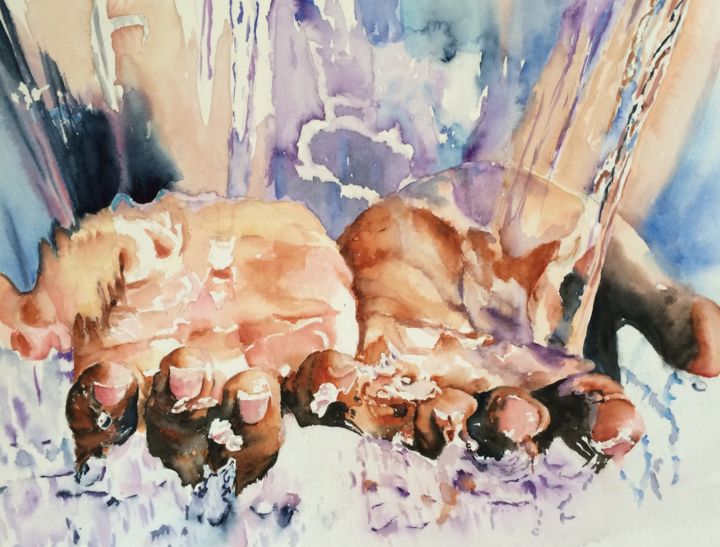
Something about the water in the artwork we see today is an invitation to receive the cleansing only Jesus can provide—an inner washing that bubbles up through our eyes and our mouths and our hands and feet.
Prayer
Jesus, in this dark, dirty world, I want to be clean. I long for purity of heart that only your Holy Spirit inside me can bring. Change my desires. Give me a revulsion for the sin that so easily besets me. And come, Holy Spirit. Blow out the dirt and filth that accumulates inside and bring me to my knees in repentance. Wash me. And let me live in that purity one day at a time. My past is gone. My future has not yet come. So today, purify my heart, my mind, my soul. And let the words of my mouth and the meditation of my heart be acceptable in your sight.
Michael A. Longinow
Professor of Digital Journalism & Media
School of Fine Arts & Communication
For more information about the artwork, music, and poetry selected for this day, we have provided resources under the “About” tab located next to the “Devotional” tab near the top of the page.
About the Artwork
I Wash My Hands
Ewa Helzen
2020
Watercolor on paper
5.8 x 19.7 in.
Private Collection
Used with permission from the artist
"I wash my hands" can literally mean a hygiene practice, but it also refers to the biblical phrase "I wash my hands of this,” which means to refuse responsibility for a situation. The latter comes from the biblical story of Pontius Pilate, who symbolically washed his hands to disavow responsibility for Jesus's crucifixion. In today's Scripture, Mark 7:1–23, Jesus teaches us that spiritual defilement comes from within the human heart, not from external sources like ceremonial handwashing or unclean foods. The passage highlights the hypocrisy of people who prioritize man-made religious traditions over the true commandments of God, and it lists evil thoughts and actions that originate from the heart as the source of sin. Jesus states that these internal corruptions—such as evil thoughts, murder, adultery, greed, and deceit—are what truly make a person unclean before God.
About the Artist
Ewa Helzen (b.1947) is a contemporary Swedish artist who specializes in watercolor and printmaking. She has since continuously trained with various famous artists, mainly in Sweden, Germany, and Malta. She has painted both oil and acrylic but has become enamored with the watercolor technique as her main form of artistic expression. Helzen is a course leader in watercolor technique and has illustrated three poetry books with her art. She is a member of the Nordic Watercolor Society.
About the Music
“Pharisee in Me”
I love in theory but not in practice
Am I worshiping You if I worship for status
Forgetting the ones lost in the margins
‘Cause I focus too hard on the laws and the doctrine
Neglecting the important things in life
Ignoring those here right before my eyes
Won’t You change my heart
Change my mind
Break down the stone
Break down my pride
The pharisee in me
Is falling to its knees
Begging You for mercy
Begging You to please
Change my heart
Think I’m full but my soul is starved
Busyness leaves my spirit parched
I’m desperate for the Bread of Life
And Living Water that satisfies
Jesus won’t You sit and dine with me
Oh, Your healing words are everything I need
To change my heart
Change my mind
Break down the stone
Break down my pride
The pharisee in me
Is falling to its knees
Begging You for mercy
Begging You to please
Help me live out what I sing
Not just empty melodies
My heart cries out humbly
Lord I need You
Let Your justice start with me
Pour out mercy to these streets
My heart cries out humbly
Lord I need You
To change my heart
Change my mind
Break down the stone
Break down my pride
The pharisee in me
Is falling to its knees
Begging You for mercy
Begging You to please
Change my heart
Change my mind
Break down the stone
Break down my pride
The pharisee in me
Is falling to its knees
Begging You for mercy
Begging You to please
Change my heart
Change my heart
About the Composers
Sam McCabe, a singer-songwriter and worship leader from Houston, Texas, endeavors to craft songs that resonate with the depth and complexity of real life. From moments of profound joy to the depths of grief, from the peaks of hope to the valleys of loss, McCabe's music explores the entirety of the human experience, intertwining themes of sanctification, doubt, and unwavering faith. His artistic journey surged forward with the release of his 2020 single "I Want To Serve God," marking the beginning of a prolific career. Subsequent singles, such as "Christ Be In My Heart" featuring the acclaimed Kristene DiMarco from Bethel Music and "Jesus Loves the World" featuring Leeland, further solidified his presence in the music scene. McCabe's albums, Altar Fire I and Altar Fire II, delve into the transformative journey of following Jesus, offering listeners a soul-stirring exploration of faith and spiritual growth.
Nick Schwarz was born and raised in Colorado Springs, Colorado. In 2009, when it came time for college, Schwarz made the move to Nashville to attend Trevecca Nazarene University. Halfway through his sophomore year, he discovered that music production was a career option and was the perfect marriage of the various instruments he loved. After graduating Trevecca, Schwarz decided to pursue his career in music production and songwriting full-time. After three years of building a brand and a client base, Schwarz sought the help of veteran producer/songwriter Chris Stevens. Schwarz was making music that garnered the industry’s attention, and it wasn’t long until he had publishing deal offers. During this time, he wrote hundreds of songs and had several cuts. One of which was “Rise Up (Lazarus)” with the artist CAIN. Currently he is still writing Christian music, country music, pop music, and film and TV music.
About the Performer/Composer
Temitope Peters, a Biola Alumnus, is a Nashville-based songwriter and worship leader, and his sound is as bold as his message—unity in diversity. Born in a multicultural household to Nigerian and British immigrants, Peters weaves cultures, rhythms, and perspectives into worship that resonates far beyond church walls. His collaborations with artists like Josh Baldwin, Zahriya Zachary, Eris Ford David, Nicole Binion, and Mitch Wong are echoes of a greater call to bring people together. With seven music collections already released, his artistry is rooted in Revelation 7—a vision of every nation and tongue standing as one. His music invites you into something bigger than a song, bigger than a moment—it’s an invitation to experience worship that crosses divides and creates space for everyone at the table.
About the Poetry and Poet
Paul Muldoon (b. 1951) is an Irish poet. He has published more than thirty collections and won a Pulitzer Prize for poetry and the T. S. Eliot Prize. At Princeton University he has been the Howard G. B. Clark '21 University Professor in the humanities and the founding chair of the Lewis Center for the Arts. He held the post of Oxford Professor of Poetry from 1999 to 2004 and has also served as president of the Poetry Society (UK) and poetry editor at The New Yorker. His poetry is known for his difficult, sly, allusive style, casual use of obscure or archaic words, understated wit, punning, and deft technique in meter and slant rhyme.
About the Devotion Writer
Michael Longinow grew up in Oak Park, a suburb of Chicago where as a child he celebrated Christmas Eve and Christmas Day in long robes walking and singing down candle-lit stone aisles of a vaulted Episcopal sanctuary. He also heard gospel teaching about Christ from Moody Bible Institute’s programming on his grandparents’ kitchen and car radios. As a former city news reporter, he teaches media ethics, intercultural reporting, investigative approaches to journalism, and news- related writing and podcasting in the School of Fine Arts & Communication. He has written chapters for seventeen anthologies on topics ranging from the history of revivalism to the rise of Christian media to the paradoxes of evangelical pop culture. His most recent research explored the role of biblical empathy in an era of social media rage. He has three children, all of whom attended Biola, and seven grandchildren. He and his wife live in Yorba Linda with their golden retriever, Bentley.