March 9: Physical Hunger & Spiritual Nourishment
♫ Music:
Mark 6:30–44 (NKJV)
Then the apostles gathered to Jesus and told Him all things, both what they had done and what they had taught. And He said to them, “Come aside by yourselves to a deserted place and rest a while.” For there were many coming and going, and they did not even have time to eat. So they departed to a deserted place in the boat by themselves.
But the multitudes saw them departing, and many knew Him and ran there on foot from all the cities. They arrived before them and came together to Him. And Jesus, when He came out, saw a great multitude and was moved with compassion for them, because they were like sheep not having a shepherd. So He began to teach them many things. When the day was now far spent, His disciples came to Him and said, “This is a deserted place, and already the hour is late. Send them away, that they may go into the surrounding country and villages and buy themselves bread; for they have nothing to eat.”
But He answered and said to them, “You give them something to eat.”
And they said to Him, “Shall we go and buy two hundred denarii worth of bread and give them something to eat?”
But He said to them, “How many loaves do you have? Go and see.”
And when they found out they said, “Five, and two fish.”
Then He commanded them to make them all sit down in groups on the green grass. So they sat down in ranks, in hundreds and in fifties. And when He had taken the five loaves and the two fish, He looked up to heaven, blessed and broke the loaves, and gave them to His disciples to set before them; and the two fish He divided among them all. So they all ate and were filled. And they took up twelve baskets full of fragments and of the fish. Now those who had eaten the loaves were about five thousand men.
Mark 8:1–21 (NKJV)
In those days, the multitude being very great and having nothing to eat, Jesus called His disciples to Him and said to them, “I have compassion on the multitude, because they have now continued with Me three days and have nothing to eat. And if I send them away hungry to their own houses, they will faint on the way; for some of them have come from afar.”
Then His disciples answered Him, “How can one satisfy these people with bread here in the wilderness?”
He asked them, “How many loaves do you have?”
And they said, “Seven.”
So He commanded the multitude to sit down on the ground. And He took the seven loaves and gave thanks, broke them and gave them to His disciples to set before them; and they set them before the multitude. They also had a few small fish; and having blessed them, He said to set them also before them. So they ate and were filled, and they took up seven large baskets of leftover fragments. Now those who had eaten were about four thousand. And He sent them away, immediately got into the boat with His disciples, and came to the region of Dalmanutha.
Then the Pharisees came out and began to dispute with Him, seeking from Him a sign from heaven, testing Him. But He sighed deeply in His spirit, and said, “Why does this generation seek a sign? Assuredly, I say to you, no sign shall be given to this generation.”
And He left them, and getting into the boat again, departed to the other side. Now the disciples had forgotten to take bread, and they did not have more than one loaf with them in the boat. Then He charged them, saying, “Take heed, beware of the leaven of the Pharisees and the leaven of Herod.”
And they reasoned among themselves, saying, “It is because we have no bread.”
But Jesus, being aware of it, said to them, “Why do you reason because you have no bread? Do you not yet perceive nor understand? Is your heart still hardened? Having eyes, do you not see? And having ears, do you not hear? And do you not remember? When I broke the five loaves for the five thousand, how many baskets full of fragments did you take up?”
They said to Him, “Twelve.”
“Also, when I broke the seven for the four thousand, how many large baskets full of fragments did you take up?”
And they said, “Seven.”
So He said to them, “How is it you do not understand?”
Poetry
“Loaves and Fishes”
by David Whyte
Reprinted with permission from Many Rivers Press, Langley, WA.
This is not
the age of information.
This is not
the age of information.
Forget the news,
and the radio,
and the blurred screen.
This is the time of loaves
and fishes.
People are hungry,
and one good word is bread
for a thousand.
Physical Hunger & Spiritual Nourishment
The story of the feeding of the five thousand is one of the first Bible stories we learn, and it is an important one: It shows up in all four gospels. Think of the little kids you’ve seen running around with their Sunday School papers with five loaves stuck in a “basket” on the page and two fish hanging on by a string. John’s gospel is the one that tells us that the fish and the loaves came from a little boy’s lunch. We learn early on that Jesus lets us help in His work of feeding and that even the little kids have a place.
The story exudes the sweetness of domesticity—the mom or dad or older sibling preparing the dried fish, baking the bread, packing the lunch, never dreaming that God Almighty would feed His children from a meal prepared for their own child. We never know what the Creator will choose to use! And note also the practical “housekeeping” nature of the event: “Have them sit down in groups.” (For those of us who plan church events: Jesus gets it!)
Jesus lets us help. He gives thanks (and so we say grace at meals, too!), and in His hands the bread is multiplied. He lets the disciples’ hands pass it out—He always lets us help. In ministry, we supply others with the bread we’ve been given.
It tickles me to no end that there are twelve baskets left over for the disciples, emphasizing the abundance of God’s supply for tired Christian workers who’d had no time to eat! This passage starts with the invitation to the disciples to “come away” for rest and replenishment. Then the crowds intervene with that and shut it down, but the story still ends with individualized leftovers for the twelve disciples.
Think of the change in the people’s energy in this story—the spiritual hunger that pushed them to rush to Him in the desert and keep them captivated until their hearts were filled and satiated with the words of life. And then the debilitating physical hunger that would have had them fainting on the way back to town. “People are hungry,” our poet reminds us. Jesus the Good Shepherd sees His hungry sheep. And does something about it. So now, twice fed, the crowd would be full of merriment and hope.
Here we see Jesus moved with compassion; we’re told that the Shepherd’s gut turns over with compassion for His flock. He loves and cares for us so!
So first He feeds their souls, then He feeds their bellies—the practical sweetness of this comes from our Savior, our human Savior, who knows the overwhelming, attention-grabbing demand of physical hunger. The godly sweetness of this comes from our Savior, our divine Savior, who knows the paramount urgency of feeding our souls.
Here the Shepherd feeds the sheep in green pastures, and it is enough. The sheep are satisfied with bread that is sustenance for both soul and body. This is what we are instructed to ask for after all: “Give us this day our daily bread.” He is our daily bread.
The Shepherd feeds the sheep; the Word passes out the Word. The Bread of Life gives them bread. Notice the meta-instruction here: Jesus’ physical miracles are supposed to teach us about spiritual reality. There is little to no distinction made between the physical and spiritual as they march along in unity. The point is, He is the source of all nurture and He is sufficient.
We cannot on our own escape the concerns and experiences of this physical world. We are taken up with it, we are bound to these aging bodies, and we are compelled to concentrate on them and their appetites. But Jesus’ point here is to show us that the physical world is not all there is. Used properly, the material world points us to a bigger, lasting reality—the spiritual world that we squint to see.
Here Jesus is foreshadowing the coming crucifixion of His body, His body broken and given as the bread of life, enough to feed the whole world.
When we have Him, we have enough.
Prayer
Our Father in heaven, we are so glad to be yours and we trust you. Please give us today our daily bread. Give us the supply we need so that your kingdom may come and your will be done—in us and through us. And may we share your provision with others. We ask in Jesus’ name, Amen.
Dr. Betsy Barber
Professor Emeritus of Spiritual Formation and Psychology
Talbot School of Theology
Biola University
For more information about the artwork, music, and poetry selected for this day, we have provided resources under the “About” tab located next to the “Devotional” tab near the top of the page.
About the Artwork
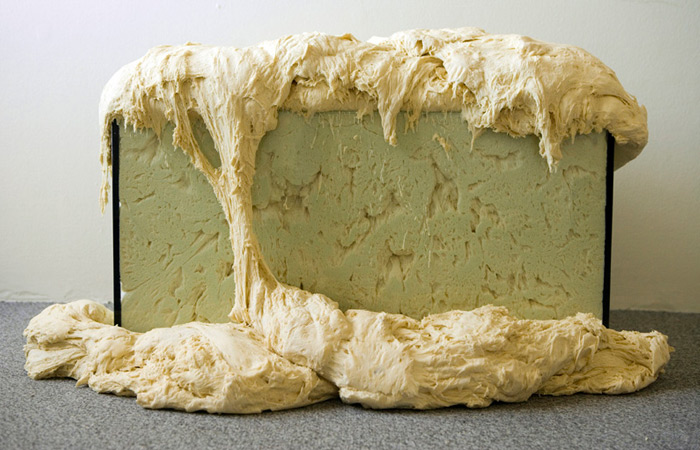
3-hour Sculpture
Søren Dahlgaard
2006
100-kg lump of dough with extra yeast in a glass aquarium
Used with permission of the artist
Danish artist Søren Dahlgaard creates “action sculptures” which start off one way and then end up being completely different by the end of their installation. In today's piece 3-hour Sculpture, Dahlgaard places a large lump of dough, enriched with extra yeast, into a clear glass aquarium and allows it to rise for three hours. A small amount of yeast can make bread double or triple in size. Without the yeast, the dough would simply sit at the bottom of the glass aquarium, but with the yeast, the dough overflows and bursts out of and over the glass container.
About the Artist
Søren Dahlgaard is a Danish visual artist who grew up in a suburb of Copenhagen, Denmark. He studied at the Slade School of Fine Art of University College in London, England. He met his wife there. She is from the Maldives and together they moved to this island nation after art school. In the Maldives, Søren made a vegetable farm on a small coral island for two years. There, he also developed his “inflatable island” idea, inspired by the rising sea level and how this prospect affects the future of the Maldives. Over the years, he has become widely known for his engaging, highly original, interactive, participatory work, which he carries out in a variety of public and community spaces and also in prestigious biennales. Today, Søren, his wife, and their children live in Melbourne, Australia.
About the Music
“Fishes and Loaves” from the album Prodigal Son
Boy, he could preach.
That man spoke of things,
Of heaven yet still on the earth.
He stood on that hill from morning until,
U\You could see the hunger in our eyes.
I turned to my mama, asked,
“What should we do?”
All we had were morsels left.
Something told me that my mama believed,
This preacher could use it more than me.
Oh, I'm trying to let it go.
My heart isn't easy, but I give you control.
I know it’s not much, but I know what I owe
So, I’ll give you all my fishes and loaves.
I saw his disciples.
They were there to witness that water turn wine.
They've seen with their eyes the lame man arise,
So, I walked up to them and said.
Oh, I'm trying to let it go.
My heart isn't easy, but I give you control.
I know it’s not much, but I know what I owe,
I give you all my fishes and loaves.
My fishes and loaves.
They brought me to the man,
I put the food into his hands.
I held back my questioning thoughts.
But something told me that the preacher could see,
The war between my head and heart.
Then He said Oh, my child, let it go,
I know you're uneasy, but I’m in control.
I don't need that much for me to show,
I’ll make the most of your fishes and loaves.
About the Composer/Performer
Josiah Queen (b. 2003) is an American Christian contemporary singer-songwriter from Tampa, Florida. He was a nominee for New Artist of the Year at the 2024 GMA Dove Awards. Queen began releasing music at age sixteen with "God of Miracles" in 2020. His debut album, The Prodigal, was released in 2024, and reached No.1 on the Billboard Top Christian Albums chart. The album's title track was nominated for Pop/Contemporary Song of the Year at the 2024 GMA Dove Awards, and certified gold by the Recording Industry Association of America.
About the Poetry and Poet
David Whyte (b. 1955) is an Anglo-Irish poet. He has said that all of his poetry and philosophy are based on "the conversational nature of reality.” His book The Heart Aroused: Poetry and the Preservation of the Soul in Corporate America (1994) topped the bestseller charts in the United States. Whyte has a degree in marine zoology from Bangor University. During his twenties, Whyte worked as a naturalist and lived in the Galápagos Islands and also led anthropological and natural history expeditions in the Andes, the Amazon, and the Himalayas. In 1981, he moved to the United States, where he began a career as a poet and speaker. Whyte has written ten volumes of poetry and four books of prose. He has an honorary degree from Neumann College, Pennsylvania, and from Royal Roads University, British Columbia, and is associate fellow of both Templeton College, Oxford, and Said Business School, Oxford.
David Whyte, “Loaves and Fishes”, from RIVER FLOW: New and Selected Poems (Revised). Copyright © 2012 David Whyte. Reprinted with permission from Many Rivers Press, Langley, WA. www.davidwhyte.com
About the Devotion Writer
Betsy Barber has a clinical practice with specialization in the soul care and mental health of Christian workers. She has taught courses in spiritual formation, soul care, missions, maturity, and marital relationships. She has particular interest in spiritual formation and supervision of students in spiritual direction and mentoring. She worked with her husband as a missionary in Bible translation and counseling ministries for twenty-four years. In addition to being a licensed clinical psychologist, she has background and training in spiritual direction.