March 28: The Anointing at Bethany and the Resulting Betrayal
♫ Music:
Mark 14:1–11 (NJKV)
After two days it was the Passover and the Feast of Unleavened Bread. And the chief priests and the scribes sought how they might take Him by trickery and put Him to death. But they said, “Not during the feast, lest there be an uproar of the people.”
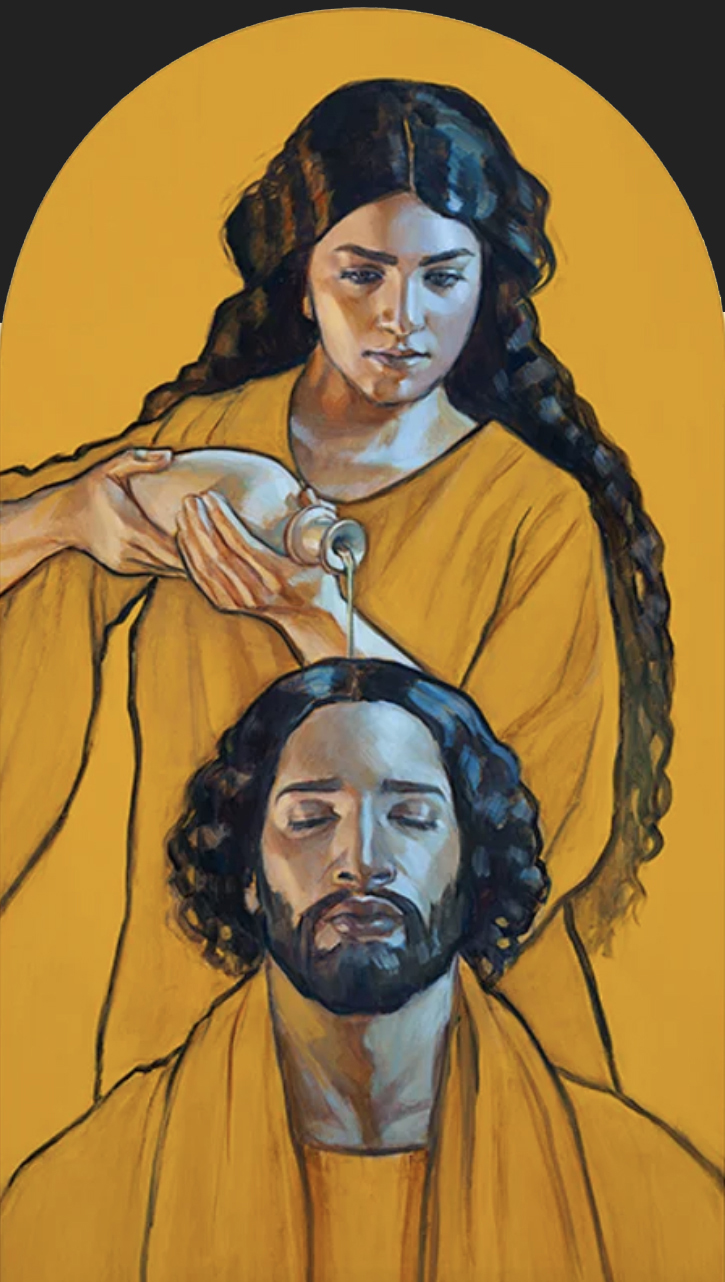
And being in Bethany at the house of Simon the leper, as He sat at the table, a woman came having an alabaster flask of very costly oil of spikenard. Then she broke the flask and poured it on His head. But there were some who were indignant among themselves, and said, “Why was this fragrant oil wasted? For it might have been sold for more than three hundred denarii and given to the poor.” And they criticized her sharply.
But Jesus said, “Let her alone. Why do you trouble her? She has done a good work for Me. For you have the poor with you always, and whenever you wish you may do them good; but Me you do not have always. She has done what she could. She has come beforehand to anoint My body for burial. Assuredly, I say to you, wherever this gospel is preached in the whole world, what this woman has done will also be told as a memorial to her.”
Then Judas Iscariot, one of the twelve, went to the chief priests to betray Him to them. And when they heard it, they were glad, and promised to give him money. So he sought how he might conveniently betray Him.
Poetry
“Judas”
by Stanley Moss
Judas, patron saint of bankers,
I run an internal revenue service, audit me.
For my losses carried forward more than a half
century,
allow only the last five years as deduction.
Call my write-off for European travel
and business entertainment, mere pleasure trips.
There is a difference between writing, rewriting
and cooking the books. Accounting in the dark
I have mortgaged more than my house,
my heart pays usurious interest.
To whom is such a price paid, to what treasury?
Judas, your God with his small coins
of good and evil, lends himself to fictions.
I am in the market for bracelets,
chains, necklaces and rings of illumination.
The Anointing at Bethany and the Resulting Betrayal
Against the backdrop of Jesus’ impending death, a woman (unnamed by Mark) brings what is likely her most valuable possession—imported oil of nard, worth a year’s wages—and pours it over Jesus’ head as an anointing. (Despite similarities, this is not the “sinful woman” described in Luke 7.)
Who is this woman and why does she do this?
According to John’s account, she is Mary, sister of Martha and Lazarus. A few paragraphs earlier, John describes Jesus weeping over the death of Lazarus, declaring Himself to be “the resurrection and the life,” and then raising his friend back to life.
So Mary’s motivation is obvious: gratitude, love, worship. What more could she give to honor and bless the One who has done so much for her?
And Jesus lovingly receives Mary’s gift—saying, literally, “She has done a beautiful thing to me.”
Others at the dinner scorn Mary for the wasteful extravagance: the money could have been given to the poor. John identifies Judas as a spokesman for this view, whose true motivation was to line his own pockets as the group’s treasurer.
We need not assign bad motives to everyone, however. Don’t we all feel a tension between beauty and utility—between worship and service? Jesus cuts across our tension.
He doesn’t downplay giving to the poor. “You have the poor with you always” evokes Deuteronomy 15:11, which goes on to say that because of this you should “open your hand wide” to the poor. Jesus regularly affirms caring for the poor. It’s a standing obligation, always important.
But not the only thing that’s important; and not always what’s needed in every circumstance. Mary understood that what was most important and needful in her situation was to honor Jesus in extravagant, beautiful worship.
Sydney Carter’s folk song nails it: besides Jesus, the dinner’s two central characters are Mary and Judas. They alone seem to grasp that Jesus is about to suffer and die. Their responses, however, are universes apart. To Mary, it is urgent to honor Jesus, for “My love . . . is going away.”
To Judas, it is urgent to go to the religious leaders and offer to betray Jesus. Perhaps the pieces fell into place when Judas heard Jesus describe Mary’s gift as an anointing for His burial. Disappointment: Jesus is not a political Messiah after all. Maybe also greed, as John implies.
Mary and Judas responded differently to Jesus and His impending death because they had radically different visions of who Jesus is. For Mary, Jesus is the loving source of true life. Stanley Moss’s poem suggests Judas’ view: “Judas, your God with his small coins/of good and evil, lends himself to fictions.” Judas worships a different god, a fictional one who promises the currency of wealth, comfort, and political power in this life, on our terms.
“Who is Jesus?” is an important question for us, too. Indeed, as with Mary and Judas, it’s the important question. How we answer it determines the course of our lives.
Prayer
Lord Jesus, may my vision of who You truly are impel me to pour myself out to You and others in love and gratitude today, and may it be to You a beautiful thing. Amen.
David Horner (D.Phil., Oxford)
Professor of Theology and Philosophy
Director of the Malcolm Initiative for Arts in Evangelism and Missions
Talbot School of Theology
Biola University
For more information about the artwork, music, and poetry selected for this day, we have provided resources under the “About” tab located next to the “Devotional” tab near the top of the page.
About the Artwork
Anointing for Burial
Rose Datoc Dall
Oil on canvas
Used with permission of the artist
Mary is most commonly depicted as lovingly anointing Jesus’s feet (John 12:2–8). Less remembered is that Mary also anointed Jesus’s head (Matthew 26:6–13; Mark 14:3–9). The disciples protest Mary’s extravagant expression of using spikenard, an expensive ointment, to anoint Christ, but Jesus rebukes them. For it is Mary alone who realizes something that the disciples don’t seem to comprehend—her anointing is a memorial act intended for Christ’s impending death and burial.
About the Artist
Filipina American artist Rose Datoc Dall was born in Washington, D.C., and raised in northern Virginia. She received her B.F.A. from Virginia Commonwealth University School of the Arts in 1990. Mrs. Dall works predominantly as a contemporary figurative painter. Dall’s figurative work is distinctive for her graphic compositions, her unconventional use of color, and her linear graphic sensibility. Rose is also known for her body of religious artwork in addition to her figurative work. Mrs. Dall has received several awards and honors for her work, and several of her works are a part of permanent collections in public and private institutions. Rose’s art has appeared on book covers, in books, and is featured in several publications online and in print. Currently, in addition to exhibiting, Mrs. Dall enjoys teaching private figure drawing and painting workshops, and lectures on occasion as a way of giving back to her community.
About the Music
“Judas and Mary” from the album Sydney Carter in Concert
“Oh Mary, Oh Mary, oh think of the poor.
Why your ointment, it could have been sold.
And think of the blankets, think of the bread,
You could’ve bought with that silver and gold.”
He said, “Bought with the silver and gold.”
“Tomorrow, tomorrow, I’ll think of your poor.”
“Tomorrow,” she said, “Not today.”
“Dearer than all of the poor of this world,
Is my love that is going away,’ she said.
“My love and he’s going away.”
Said Jesus to Mary, “Girl, your love is so deep
Today you may do as you will.
Tomorrow, you say girl, that I’m going away.
But my body I leave with you still,” he said.
“My body I leave with you still.”
“The poor of the world they are my body,” he said.
“To the end of the world they shall be.
The bread and the blankets
You give to the poor.
You’ll know you have given to me” he said.
“You have given them to me.”
“My body will hang on the cross of the world
Tomorrow” he said “and today.”
And Mary and Martha will find me again.
And wash all my sorrow away,” I heard him say.
“Wash all my sorrow away.”
Said Judas to Mary
“Now whatcha gonna do with your ointment so rich and so rare?”
“I’ll pour it all over the feet of my Lord,
And wipe it away with my hair,” she said.
“Gotta wipe it away with my hair.”
My hair.
About the Composer
Sydney Bertram Carter (1915–2004) was an English poet, songwriter, and folk musician who was born in Camden Town, London. He is best known for the song "Lord of the Dance" (1963), whose music is based on the Shaker song "Simple Gifts,” and for the song "The Crow on the Cradle,” which was recorded by Jackson Browne and used on the soundtrack to the films In the King of Prussia (1983) and No Nukes (1980). His other notable songs include "Julian of Norwich,” based on words of Julian of Norwich, "One More Step Along the World I Go," "When I Needed a Neighbour," "Friday Morning,” "Every Star Shall Sing a Carol," "The Youth of the Heart,” and "Sing John Ball.”
About the Performer
Franciscus Henricus Antheunis, professionally known as Franciscus Henri (b. 1947) is a musician and children's entertainer. He has dual Dutch and Australian nationality. In 1970 he gained national prominence when he competed in the TV talent quest New Faces, which led to a recording contract with the Melbourne-based independent label Fable Records. In 1972 Henri toured with English poet Sydney Carter, and in 1973 he left teaching to join the Monash University Theatre company as a set designer, actor, and musician. From 1997, he also has performed as Mister Whiskers, a travelling singer who loves children and performs for them with his dog companion, Smiggy.
About the Poetry and Poet
Stanley Moss (1925–2024) was an American poet, publisher, and art dealer. Born in Woodhaven, New York, he began publishing poetry with his first collection, The Wrong Angel, in 1966 and went on to produce more than a dozen books of poems over a career spanning nearly six decades. Moss also founded Sheep Meadow Press in 1977, a nonprofit press devoted to poetry and belles lettres, and served as its publisher and editor. In addition to his literary work, he was a private art dealer specializing in Spanish and Italian old masters.
About the Devotion Writer
David Horner is in his 26th year teaching theology and philosophy at Biola University, where he directs the Malcolm Initiative for Arts in Evangelism and Missions. He is also president of The Illuminatio Project, an effort to bring a classical biblical vision of goodness, truth, and beauty into the thinking of the church and culture through strategic research and communication. Prior to teaching, Dr. Horner worked as a laborer in an iron foundry, as an underground missionary in communist Eastern Europe, and as a pastor. He is an avid guitarist, hiker, and fly fisherman. Dr. Horner and his wife, Deborah, have two grown daughters and six grandchildren, and live in Fullerton, California. His most recent book, coauthored with J. P. Moreland, is Metaethics: A Short Companion (B&H Academic, 2024).