March 27: Christ's Teaching on His Second Coming
♫ Music:
Mark 13:24-37 (NKJV)
“But in those days, after that tribulation, the sun will be darkened, and the moon will not give its light; the stars of heaven will fall, and the powers in the heavens will be shaken. Then they will see the Son of Man coming in the clouds with great power and glory. And then He will send His angels, and gather together His elect from the four winds, from the farthest part of earth to the farthest part of heaven.
“Now learn this parable from the fig tree: When its branch has already become tender, and puts forth leaves, you know that summer is near. So you also, when you see these things happening, know that it is near—at the doors! Assuredly, I say to you, this generation will by no means pass away till all these things take place. Heaven and earth will pass away, but My words will by no means pass away.
“But of that day and hour no one knows, not even the angels in heaven, nor the Son, but only the Father. Take heed, watch and pray; for you do not know when the time is. It is like a man going to a far country, who left his house and gave authority to his servants, and to each his work, and commanded the doorkeeper to watch. Watch therefore, for you do not know when the master of the house is coming—in the evening, at midnight, at the crowing of the rooster, or in the morning— lest, coming suddenly, he find you sleeping. And what I say to you, I say to all: Watch!”
Poetry
“Disappointments of the Apocalypse”
by Mary Karr
Once warring factions agreed upon the date
and final form the apocalypse would take,
and whether dogs and cats and certain trees
deserved to sail, and if the dead would come or be left
a forwarding address, then opposing soldiers
met on ravaged plains to shake hands
and postulate the exact shade
of the astral self—some said lavender,
others gray. And physicists rocketed
copies of the decree to paradise
in case God had anything to say,
the silence that followed being taken
for consent, and so citizens
readied for celestial ascent.
Those who hated the idea stayed indoors
till the appointed day. When the moon
clicked over the sun like a black lens
over a white eye, they stepped out
onto porches and balconies to see
the human shapes twist and rise
through violet sky and hear trees uproot
with a sound like enormous zippers
unfastening. And when the last grassblades
filled the air, the lonely vigilants fell
in empty fields to press their bodies
hard into dirt, hugging their own outlines.
Then the creator peered down from his perch,
as the wind of departing souls tore the hair
of those remaining into wild coronas,
and he mourned for them as a father
for defiant children, and he knew that each
small skull held, if not some vision
of his garden, then its aroma of basil
and tangerine washed over by the rotting sea.
They alone sensed what he’d wanted
as he first stuck his shovel into clay
and flung the planets over his shoulder,
or used his thumbnail to cut smiles and frowns
on the first blank faces. Even as the saints
arrived to line before his throne singing
and a wisteria poked its lank blossoms
through the cloudbank at his feet,
he trained his gaze on the deflating globe
where the last spreadeagled Xs clung like insects,
then vanished in puffs of luminous smoke,
which traveled a long way to sting his nostrils,
the journey lasting more than ten lifetimes.
A mauve vine corkscrewed up from the deep
oblivion, carrying the singed fume
of things beautiful, noble, and wrong.
Christ's Teaching on His Second Coming
This is a difficult passage upon which to reflect. Here, Jesus draws on some of the most extreme imagery in the whole Bible. Like the prophets before him, he wants to emphasize the profound and even cosmic upheaval that the final day of the Lord will bring. And so, like those who heed the words of God’s prophets, we should hear these startling words as much more than a curious prediction of future distress. Instead, we should embrace them as those who also desperately need God’s deliverance.
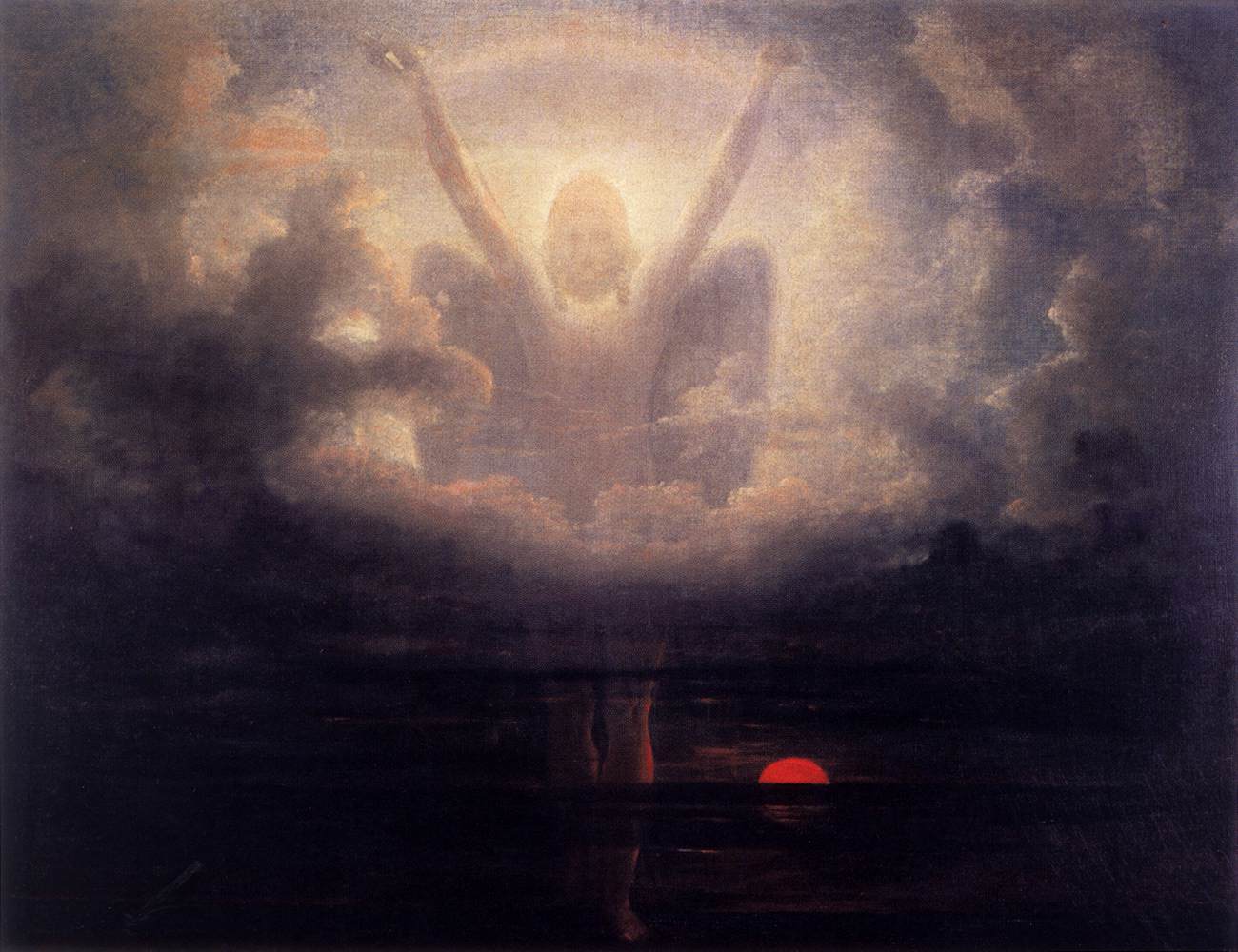
In every age, God’s people have cried out for his deliverance. Deliverance from the curse of sin. From ignorance of his ways. From their enemies, both without and within. And, in reply, God’s promise of deliverance was most often expressed through images at least as intense as the suffering being endured. Along these lines, then, the otherworldly glow of Francis Danby’s canvas, just as the haunting refrains of Paris’ “Watch and Pray,” speak to our imaginations about the Bible’s awesome signs of God’s looming judgment. And yet, while Jesus’ words echo the old prophecies, there is something unusual and different here.
For starters, Jesus’ shocking admission that not even he knows the hour of final judgment alerts us to a new dynamic. It seems that our best guesses about the end of days amount to little more than, in the words of poet Mary Karr, the singed fumes “of things beautiful, noble, and wrong.” While Jesus’ first advent may have been hard to accept, his second advent remains hard to even imagine. Indeed, as Augustine intimates, a great shift is on the way:
“The first coming of Christ the Lord, God’s Son and our God, was in obscurity. The second will be in the sight of the whole world. When he came in obscurity, no one recognized him but his own servants. When he comes openly, he will be known by both the good and the bad. When he came in obscurity, it was to be judged. When he comes openly, it will be to judge.” (Augustine, Sermons 18.1-2)
Yet, even as so much is still veiled in mystery, there is one unassailable truth upon which our hope can rest: Jesus himself is our deliverance. In other words, the safest place to be when it all goes down is with the one who was already condemned in our place, who absorbed the fullness of God’s judgment and still forgives. At the Resurrection, his deliverance from death became the guarantee of ours.
For those who have already surrendered to the Spirit’s conviction of sin, there is no need to fear. The judge has sided decisively with the repentant, and their deliverance is assured. Like Job, they can wait and watch for their healing to appear:
For I know that my Redeemer lives,
And He shall stand at last on the earth;
And after my skin is destroyed, this I know,
That in my flesh I shall see God,
Whom I shall see for myself… (Job 19:25–7)
Prayer
“Lord Jesus Christ, Son of God, have mercy on me, a poor sinner. Amen.”
—The Jesus Prayer
Dr. Taylor Worley
Visiting Associate Professor of Art History
Wheaton College
Wheaton, Illinois
For more information about the artwork, music, and poetry selected for this day, we have provided resources under the “About” tab located next to the “Devotional” tab near the top of the page.
About the Artwork
Scene from the Apocalypse (Revelation 10)
Francis Danby
1829
Oil on canvas
61 x 77 cm
Private Collection
Public Domain
Irish painter Francis Danby usually painted small, exquisite landscapes, on which his fame today largely rests. His oils, ink drawings, and watercolors, focusing on lyrically romantic landscapes, represent one of the most significant contributions made by any artist to nineteenth-century British landscape painting. He also concerned himself with religious themes, which he treated in a visionary manner. This painting is one of four depicting scenes from the Apocalypse. In a Romantic nocturnal landscape evoking the infinity of the cosmos, Danby creates a vision of a giant angel descending in a cloud from heaven with a rainbow over his head and legs like columns of fire. Danby uses a dark and dramatic palette to create a sense of mystery and danger. Dark tones of blue, gray, and black are combined with hints of red and yellow to create a tense and foreboding apocalyptic atmosphere. The natural scene in which the visionary apparition is set evinces a coloration and sophisticated painterly handling that explains Danby's rank as one of the finest British landscapists of the nineteenth century.
About the Artist
Francis Danby (1793–1861) was an Irish painter of the Romantic era. Danby initially developed his imaginative style while he was the central figure in a group of artists who have come to be known as the Bristol School. Danby painted "vast illusionist canvases" of fantastical and poetic subjects which chimed exactly with the Byronic taste of the 1820s.
About the Music
“Watch and Pray” from the album Beyond a Dream
The enemy roams
Like a roaring lion
Looking for the sleeping
Looking for the sleeping.
When he comes here
Let him find us keeping our promises
Holding to faithfulness
Down on our knees, eyes to the East.
Watch and pray
No one knows the moment
No one knows the hour
Or the day
Watch and pray
Till you see Him coming
Coming through the clouds in white array
To take His bride away.
The King will appear
With a shout of glory
All the earth awaking
All the earth awaking.
Until He comes
Let us keep on taking the highest ground
Listening for the sound
Down on our knees, eyes to the East.
Watch and pray
No one knows the moment
No one knows the hour
Or the day.
Watch and pray
Till you see Him coming
Coming through the clouds in white array
To take His bride away.
Behold the Bridegroom
Behold the Bridegroom
He is coming soon
Prepare Him room.
Watch and pray
No one knows the moment
No one knows the hour
Or the day.
Watch and pray
Till you see Him coming
Coming through the clouds in white array
To take His bride away.
Watch and pray
No one knows the moment
No one knows the hour
Or the day.
Watch and pray
Till you see Him coming
Coming through the clouds in white array
To take His bride away.
Watch and pray
Till you see Him coming
Coming through the clouds in white array
To take His bride away.
About the Composer/Performer
Twila Paris (b. 1958) is a contemporary Christian music singer, songwriter, author, and pianist. Since 1980, Paris has released twenty-two albums, amassed thirty-three number one Christian radio singles, and was named the Gospel Music Association Female Vocalist of the Year three years in a row. Many of her earlier songs, such as "He Is Exalted," "We Will Glorify,” "Lamb of God," and "We Bow Down,” are found in church hymnals or otherwise sung in church settings. She was inducted into the Gospel Music Association Hall of Fame in May 2015.
About the Poetry and Poet
Mary Karr is an award-winning poet, essayist, and bestselling memoirist. She is the author of the critically acclaimed and New York Times–bestselling memoirs The Liars’ Club, Cherry, and Lit, as well as The Art of Memoir. She has also published five poetry collections, most recently Tropic of Squalor.
Karr is a songwriter who has collaborated with artists including Rodney Crowell, Norah Jones, and Lucinda Williams on the country album KIN. Her honors include the Whiting Writers’ Award, a National Endowment for the Arts fellowship, a Radcliffe Bunting fellowship, and a Guggenheim fellowship. She is a regular contributor to The New Yorker, The Atlantic, and Poetry magazine. Karr is the Peck Professor of Literature at Syracuse University and lives in New York City.
About the Devotion Writer
Taylor Worley is visiting associate professor of art history at Wheaton College and director of a research project on art and transformation. He completed a Ph.D. in the areas of contemporary art and theological aesthetics in the Institute for Theology, Imagination, and the Arts at the University of St. Andrews and is the author of Memento Mori in Contemporary Art: Theologies of Lament and Hope (Routledge, 2020). Taylor is married to Anna, and they have four children: Elizabeth, Quinn, Graham, and Lillian.