March 29: Christ Celebrates the Passover with His Disciples
♫ Music:
Week Seven Introduction | March 29–April 4:
The Suffering Servant Sacrifices His Life as an Offering for All
The gospel of Mark was written to convince Gentile readers, particularly Romans, that Jesus was the Messiah/Son of God whose death via crucifixion was intended as a universal sacrifice for the sins of the human race. Jesus as “Suffering Servant” is clearly seen in Mark 10:45, where He states, “the Son of Man did not come to be served, but to serve, and to give His life a ransom for many.” When Mark wrote his account (probably between 65 and 70 AD), Christians were being tortured and executed at the hand of the notorious Roman emperor Nero for their refusal to acknowledge and worship false deities. Mark's gospel was an immense comfort to these early Christian martyrs, who found courage to continue living in the face of adversity and impending death by hearing Mark’s gospel and understanding what Jesus had done for them.
Mark’s account of the passion begins in Mark 14, where he tells the story of an anonymous woman who pours expensive perfume all over the head of Jesus. Christ responds by saying, “She has come beforehand to anoint My body for burial.” This extravagant, selfless act mirrors Christ’s amazing pouring out of life, as He gave Himself up on the cross. Bishop Robert Barron notes that the fragrance of this perfume “wafts over the whole of Holy Week.”
The original Passover was an intense and serious meal as the children of Israel, on pins and needles, were anxious to escape Egypt. Likewise, Mark’s description of the Last Supper is filled with foreboding as Christ is about to enter into the greatest suffering of his life. “This is My blood of the new covenant, which is shed for many.” But before they leave the upper room, Christ has His disciples join Him in the singing of a hymn. Spirit-filled music has always played a significant role in building Christian community and instilling peace, especially in the midst of deep trauma, dread, and terror.
One thing the Romans were especially good at was torturing and killing their enemies in the most painful possible ways. The apex of Christ’s excruciating passion and crucifixion comes as He cries out to God the Father and breathes His last. Taking it all in at the foot of the cross was the Roman centurion who had supervised the crucifixion. No doubt he had witnessed hundreds of heinous deaths. As the earth shook and the veil of the temple was torn in two, this pagan officer boldly proclaimed, “Truly this Man was the Son of God!” Some scholars feel that this centurion was the first person in Mark’s gospel to fully comprehend who Jesus really was. Tradition suggests that this tough guy went on to become one of the first Roman followers of Christ and eventually died a martyr’s death.
As we walk the painful path to Calvary and weep with the early followers of Christ, may this Holy Week be like none other—may it be deep and rich in ceaseless worship and vibrant thanksgiving to our Servant King!
Sunday, March 29 | Christ Celebrates the Passover with His Disciples
Mark 14:12-31 (NKJV)
Now on the first day of Unleavened Bread, when they killed the Passover lamb, His disciples said to Him, “Where do You want us to go and prepare, that You may eat the Passover?”
And He sent out two of His disciples and said to them, “Go into the city, and a man will meet you carrying a pitcher of water; follow him. Wherever he goes in, say to the master of the house, ‘The Teacher says, “Where is the guest room in which I may eat the Passover with My disciples?” ’ Then he will show you a large upper room, furnished and prepared; there make ready for us.”
So His disciples went out, and came into the city, and found it just as He had said to them; and they prepared the Passover.
In the evening He came with the twelve. Now as they sat and ate, Jesus said, “Assuredly, I say to you, one of you who eats with Me will betray Me.”
And they began to be sorrowful, and to say to Him one by one, “Is it I?” And another said, “Is it I?”
He answered and said to them, “It is one of the twelve, who dips with Me in the dish. The Son of Man indeed goes just as it is written of Him, but woe to that man by whom the Son of Man is betrayed! It would have been good for that man if he had never been born.”
And as they were eating, Jesus took bread, blessed and broke it, and gave it to them and said, “Take, eat; this is My body.”
Then He took the cup, and when He had given thanks He gave it to them, and they all drank from it. And He said to them, “This is My blood of the new covenant, which is shed for many. Assuredly, I say to you, I will no longer drink of the fruit of the vine until that day when I drink it new in the kingdom of God.”
And when they had sung a hymn, they went out to the Mount of Olives.
Then Jesus said to them, “All of you will be made to stumble because of Me this night, for it is written:
‘I will strike the Shepherd,
And the sheep will be scattered.’
“But after I have been raised, I will go before you to Galilee.”
Peter said to Him, “Even if all are made to stumble, yet I will not be.”
Jesus said to him, “Assuredly, I say to you that today, even this night, before the rooster crows twice, you will deny Me three times.”
But he spoke more vehemently, “If I have to die with You, I will not deny You!”
And they all said likewise.
Poetry
“Communion at Lunch”
by William Stafford
All that tends not to charity is figurative. - Pascal, 669
Eating my sandwich (little but bread these days)
while Anderson or someone was explaining the language of scripture
I heard a tiny cry: of course it was in code.
Oh how far meaning comes today! Across empty fields.
I swung around slow, believing all the swing
with the arc I saw, and settled the eyes
on on any holiest thing: even sight is in code,
but wakes in an instant, shocked, in the still show,
Memorizing what happens. A man in a fumbling house
looks from the eyes: oh it is far out there,
and strange, he feels, as he follows like fading string
what he knows can never reach the final code.
Now any littlest call may start the tiniest
thread that leads from the last, real spool;
and I remember hearing Anderson, or someone, say,
“The only thing not a symbol for something else is God.”
Christ Celebrates the Passover with His Disciples
On this day, Palm Sunday, exultation fills our churches as we remember our Lord entering Jerusalem on a young donkey. Our Scripture readings tell of Jerusalem’s crowds, many having traveled to this great city to celebrate Passover, laying palm branches and coats on the road before Jesus, exclaiming “Hallelujah! Blessed is He who comes in the name of the Lord!” Our Lord, on a humble colt, receives the welcome of a King.
Today’s passage, however, prompts us toward Thursday, when Jesus instructs the disciples to prepare for Passover and then leads them in the celebration. For Passover was to be a celebration: a festival of freedom commemorating Israel’s liberation from Egyptian slavery.
I wonder what it might have been like to be with Jesus that night, to be among the disciples? The week had begun with exultation. The day had begun with a miracle, as they found the upper room prepared for them just as Jesus said. And this night was to be a celebration, a commemoration of God-given freedom.
And yet, today’s passage is filled with foreboding: As Jesus dips His bitter herbs in a dish, He says, “One of you will betray me.” As He breaks the bread, He tells them, “This is my body.” As He shares the cup, He teaches them, “This is my blood, for a new covenant.” And in the darkness on the Mount of Olives, He cautions them, “Tonight, you will stumble on account of me.”
I sometimes read too quickly through scripture; it takes effort to slow down and attend to the unfolding scenes. But today, it may be worth pausing over details, imagining what it might have been like to be a disciple on that unsettling night: the sight of the table, the scent of the meal, the sound of voices, the feel of the other disciples sitting all around as Jesus’ words land in minds and hearts.
So let’s take a moment to slow down with the sights, sounds, tastes, and feel of this weighty Passover meal. What do you see on their faces, sense in the air, and hear in the room as you read these words of Scripture once more?
In the evening He came with the twelve. Now as they sat and ate, Jesus said, “Assuredly, I say to you, one of you who eats with Me will betray Me.” And they began to be sorrowful, and to say to Him one by one, “Is it I?” And another said, “Is it I?” He answered and said to them, “It is one of the twelve, who dips with Me in the dish. The Son of Man indeed goes just as it is written of Him, but woe to that man by whom the Son of Man is betrayed! It would have been good for that man if he had never been born.”
And as they were eating, Jesus took bread, blessed and broke it, and gave it to them and said, “Take, eat; this is My body.” Then He took the cup, and when He had given thanks He gave it to them, and they all drank from it. And He said to them, “This is My blood of the new covenant, which is shed for many. Assuredly, I say to you, I will no longer drink of the fruit of the vine until that day when I drink it new in the kingdom of God.”
Now, listen once more to today’s hymn. As Jesus’ words unfold through the choir’s voices, consider again what it might have been like to witness Jesus offer these words over the meal. Notice as each detail of this Passover night becomes, as our poet writes, “the tiniest / thread that leads from the last, real spool,” where “The only thing not a symbol for something else is God.”
Prayer
Lord Jesus, as we walk with you this week toward your cross, give us moments of pause, where we might remember and consider anew your earthly presence with your people so long ago, your love for this world, and the lengths that you traveled so that we may be forever present with you.
Lisa Igram
Assistant Professor of Theology
Rosemead School of Psychology
Biola University
For more information about the artwork, music, and poetry selected for this day, we have provided resources under the “About” tab located next to the “Devotional” tab near the top of the page.
About the Artwork
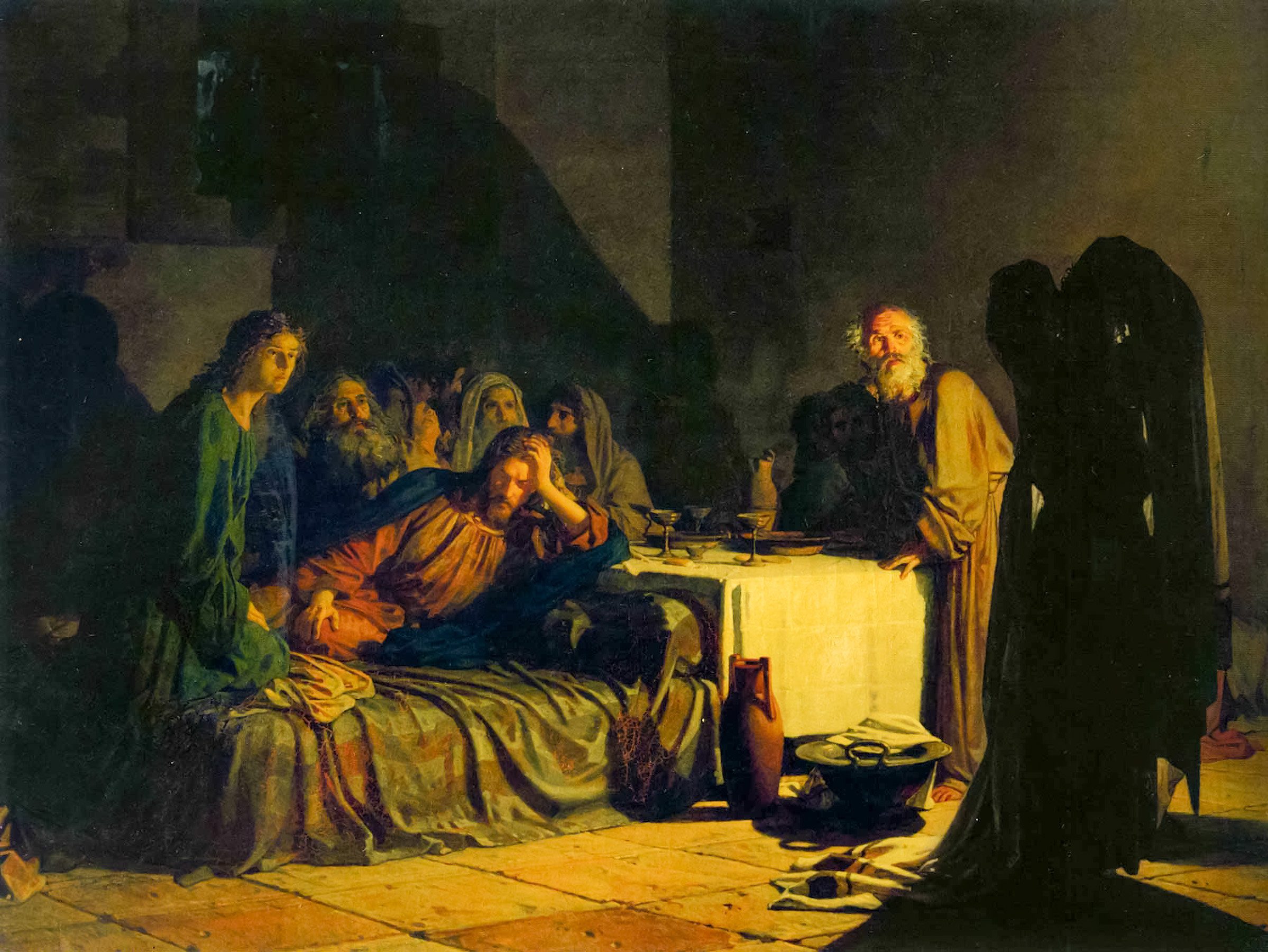
The Last Supper
Nikolai Nikolaevich Ge
1863
Oil on canvas
283 × 382 cm
State Russian Museum
St. Petersburg, Russia
Public Domain
The Last Supper of Jesus and the twelve apostles has always been a popular theme in Christian art. This painting depicts the Last Supper, which is the last meal Christ had with His disciples, during which He predicted that one of them will betray Him. Russian artist Nikolai Ge breaks the traditional treatment of the subject matter in his painting. In the traditional iconography of the Last Supper, a long table with the twelve apostles sitting around it became the norm. The artist alters this usual, balanced composition by showing Jesus reclining amid His disciples, who appear to be transfixed by the shadowy figure of Judas, who moves into darkness both literally and figuratively. A lamp brightly illuminates the table and the faces of the two apostles, young John on the left and elderly Peter on the right. Ge endows each of them with expressive emotions. The Savior, in contrast to them, does not express emotion and is immersed in private thoughts, perhaps reflecting on Judas’s betrayal. The figurative composition is based on a battle of light and dark, symbolizing the good and evil concentrated in the figures of Jesus and Judas Iscariot.
About the Artist
Nikolai Nikolaevich Ge (1831–1894) was a Russian realist painter and an early Russian symbolist. He was famous for his works on historical and religious subjects. In 1850, Ge gave up his career in science and enrolled in the Imperial Academy of Arts in Saint Petersburg and visited Germany, Switzerland, and France to study art. In 1860 he settled in Italy, where he met Russian neoclassical artist Alexander Andreyevich Ivanov in Rome. Ivanov became a strong influence on Ge's future work. In 1861, Ge painted The Last Supper, using a photograph of writer Aleksandr Ivanovich Herzen as an image for his central figure of Christ. This was the first known occasion where photography was used as the main source for a central character in a painting, and it foreshadowed the deep influences that photography would later have on art. In 1870, Ge again returned to Saint Petersburg, where he turned to Russian history for subject matter. He bought a small farm in Ukraine and became acquainted with Russian author Leo Tolstoy. In the early 1880s, Ge returned to religious subjects and portraits. His later paintings on New Testament subjects were praised by liberal critics but criticized by conservatives for illustrating a more philosophical approach and less accurate biblical representation of the gospel, and therefore were banned by authorities for blasphemy.
About the Music
“In My Father’s Kingdom”
This bread is My body
Broken for you
This cup is My blood of the covenant
Poured out for you
I will not drink of the fruit of this vine
Until I drink it anew with you
In my Father's Kingdom
In my Father's Kingdom
This bread is My body
Broken for you
This cup is My blood of the covenant
Poured out for you
I will not drink of the fruit of this vine
Until I drink it anew with you
I will not drink of the fruit of this vine
Until I drink it anew with you
In my Father's Kingdom
In my Father's Kingdom
About the Composer
Fernando Ortega (b. 1957) is an evangelical Christian singer-songwriter and worship leader heavily influenced by traditional hymns, as well as his family’s New Mexico heritage. He is noted for his interpretations of many traditional hymns and songs, such as “Give Me Jesus,” “Be Thou My Vision,” and “Praise to the Lord, the Almighty.” Much of his current inspiration comes from the North American Anglican liturgy. It is from his heritage and classical training at the University of New Mexico that Ortega derives his sound, embracing country, classical, Celtic, Latin American, world, modern folk, and rustic hymnody. From the late 1970s to the mid-1990s, he served in music ministry at a number of churches in New Mexico and Southern California.
About the Performers
Christian choir Jigdaljahu—the Netherlands, arranged and conducted by Arjan Wouters
The Christian choir Jigdaljahu is a choir that shares its love of music and faith with a wide audience. They are a group of passionate singers who, under the guidance of professional musicians, strive to touch people with a varied repertoire, including sacred songs, classical works, psalms, revival music, and spirituals. The name “Jigdaljahu” comes from Hebrew, meaning "May God be glorified" or "God will be glorified." It is often used in the Jewish tradition as an expression of praise and worship. With this, they connect their Judeo-Christian roots with contemporary Christian culture.
Arjan Wouters (b. 1995) is a young musician from Lisse in the Western Netherlands. He is active in the music world as an organist, pianist, and conductor. Arjan has been the conductor of Christian choir Jigdaljahu since the ensemble was founded in 2016. Wouters began receiving organ lessons from Leen Schippers and Frank Segers at the age of six. In 2015, he was admitted to the conservatory in Rotterdam (Codarts Music Education), where he studied organ for a year. In his second year of music education, he switched from organ to piano as his main instrument. In daily life, Wouters is very active in the music world alongside his studies. He conducts two choirs and is regularly asked to accompany on organ and piano.
About the Poetry and Poet
William Stafford (1914–1993) was an American poet celebrated for his accessible, thoughtful verse and deep engagement with nature and everyday experience. Born in Hutchinson, Kansas, he studied at the University of Kansas and later earned a Ph.D. from the University of Iowa. During World War II he served as a conscientious objector, an experience he recounted in his prose memoir Down in My Heart. Stafford taught for many years at Lewis and Clark College in Oregon. His first major poetry collection, Traveling Through the Dark (1962), won the National Book Award for Poetry, and he went on to publish dozens of volumes of poetry and prose. He served as consultant in poetry to the Library of Congress (now known as the U.S. poet laureate) and as poet laureate of Oregon, and received honors including a Guggenheim fellowship and the Shelley Memorial Award. Stafford’s work is noted for its plainspoken clarity, moral insight, and quiet philosophical depth.
About the Devotion Writer
Lisa Igram’s twenty-plus years in higher education includes a variety of teaching and co-curricular leadership experiences. She is a trained spiritual director and holds an MDiv in Spiritual Formation and a PhD in New Testament Studies. She currently serves as an Assistant Professor of Theology at Rosemead School of Psychology, and her research focuses broadly on the value of embodiment for spiritual growth. When she's not reading up on the apostle Paul's theology or spiritual formation, you'll find her taking her niece to try a new ice-cream shop, finding good food with friends, or walking her dog on local trails.