March 10: Peter's Remarkable Confession
♫ Music:
Mark 8:27–30 (NKJV)
Now Jesus and His disciples went out to the towns of Caesarea Philippi; and on the road He asked His disciples, saying to them, “Who do men say that I am?”
So they answered, “John the Baptist; but some say, Elijah; and others, one of the prophets.”
He said to them, “But who do you say that I am?”
Peter answered and said to Him, “You are the Christ.”
Then He strictly warned them that they should tell no one about Him.
Poetry
“The Secret”
by Denise Levertov
Two girls discover
the secret of life
in a sudden line of
poetry.
I who don't know the
secret wrote
the line. They
told me
(through a third person)
they had found it
but not what it was
not even
what line it was. No doubt
by now, more than a week
later, they have forgotten
the secret,
the line, the name of
the poem. I love them
for finding what
I can't find,
and for loving me
for the line I wrote,
and for forgetting it
so that
a thousand times, till death
finds them, they may
discover it again, in other
lines
in other
happenings. And for
wanting to know it,
for
assuming there is
such a secret, yes,
for that
most of all.
Who Do You Say That I Am?
Spirit, change us as we reflect on this Gospel conversation, and shape us according to your will.
Jesus and his followers are on the move. He sent them out to do his work - praying, preaching, healing, casting out demons. After they gathered back together, Jesus miraculously fed multitudes (again), he rebuked the Pharisees (again), he chided the disciples for their short memories (again), and he miraculously healed someone (again). And again, they’re on the road (possibly enjoying some good traveling music by Don Potter?). This time they’re headed to Caesarea Philippi.
It’s an in-between time. Maybe everyone is feeling some relief after active ministry, maybe wondering what kind of reception they’ll receive at their destination. This is when Jesus asks a vital question, preceded by an important setup question. And this setup question is one that we should be asking ourselves too: Who do people say Jesus is?
Today, Jesus is trending. Reports from all sides show that Jesus is getting views and clicks, and there are many, many reports of lives being transformed by the Gospel. Praise God!
And as with anything trending, Jesus is being used for click bait and the pushing of agendas. We find people picking and choosing sayings of Jesus to justify a wide variety of things. His earthly ministry was marked by his wisdom, kindness, unorthodox social connections, and willingness to speak strongly against “the establishment.” Each of those things is true of him, but none of them is the complete truth on its own.
So after the setup question, Jesus asks the bigger question. “Who do you say that I am?”
Peter could have answered a number of true things: that Jesus was the wisest of all teachers, a healer, an exorcist, a rebel, the greatest of all the prophets. But Peter aimed higher and truer, and we’re called to do the same.
“You are the Christ.”
Messiah! Liberator! The greater David! King of Kings and Lord of Lords! God with us!
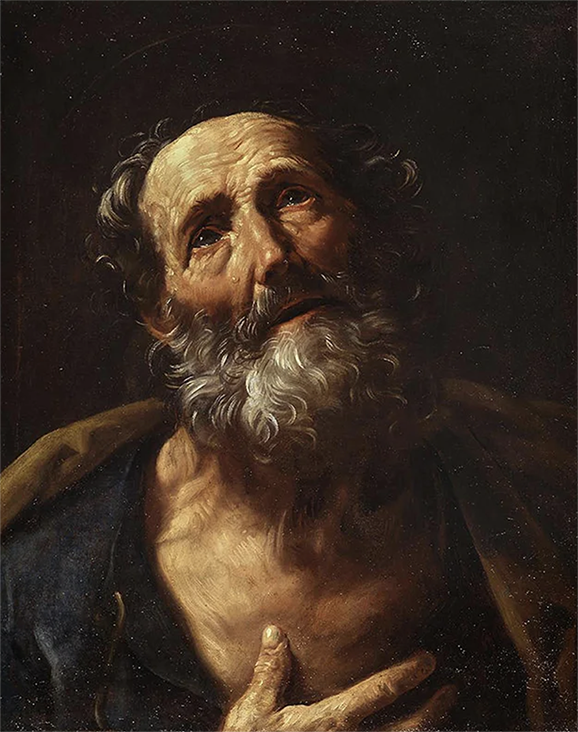
Denise Levertov’s The Secret brings a sweet, and difficult, way to think about Peter’s story. He has such faith, and in this encounter he got it exactly right! But in the next paragraph, he has “forgotten the secret.” We know there will be more peaks and valleys as time goes on, which bring him astounding hope and crushing regret. That complicated mix of hope and regret can be seen powerfully in Guido Reni’s Saint Peter Penitent.
This is where we find ourselves in this age, this in-between time. Our Messiah has come, and in him we have victory over death! We are citizens of his new kingdom, but sin’s final defeat has not yet come. We still live a life marked with sin and failure. We have glimpses of glory, and then we “forget… so that a thousand times, till death finds [us, we] may discover it again.” Let us daily remember that Jesus is the Christ, our hope, our forgiveness, our Savior.
Prayer
Jesus, Messiah, Eternal King, God with us,
I pray that as we travel this road, that we will look beyond who they say you are. Help us to always hear your most vital question, “Who do you say I am?” God, help us to always rely on your Word. Spirit, guide us in all truth and make us like Jesus, to the glory of God the Father.
Amen.
Chuck Koontz, MLIS
Librarian for Systems and Special Collections
Adjunct faculty for School of Fine Arts & Communications
Biola University
For more information about the artwork, music, and poetry selected for this day, we have provided resources under the “About” tab located next to the “Devotional” tab near the top of the page.
About the Artwork
Saint Peter Penitent
Guido Reni
1634
Oil on satin
76 x 61 cm
Museo del Prado
Madrid, Spain
Public Domain
Artist Guido Reni paints a repentant St. Peter who gazes heavenward, his head resting on his right hand and his mouth half open. The pathos with which Reni renders the saint is heightened by the signs of old age in the saint’s face—the deep wrinkles serving as channels for the tears that fall from his weary eyes, the tousled grey hair, and the unkempt beard. All these elements suggest that the theme was in fact the so-called “tears of Saint Peter,” the moment when the apostle implores Christ’s forgiveness after publicly denying knowing Jesus three times. As exemplified in this portrait, Reni’s holy figures were known to arouse the empathy of the faithful by reflecting a range of emotions drawn from their own reality. The painting thus became a means of teaching the principles espoused by the church, with a penitent Saint Peter embodying human weakness and illustrating the mercy and forgiveness available in repentance.
About the Artist
Guido Reni (1575–1642) was an early Italian baroque painter noted for the classical idealism of his paintings of mythological and religious subjects. In his artwork, Reni evolved a style that tempered baroque exuberance and complexity with classical restraint. The frescoes of Raphael and ancient Greek sculptures were main inspirations for him. Reni’s graceful, classical style featured refined colors, delicate and varied flesh tones, soft modeling, and gentle emotion. He strove toward a classical harmony in which reality is presented in idealized proportions. His religious compositions made him one of the most famous painters of his day in Europe, and a model for later baroque artists.
About the Music
“Who Do You Say I Am?” from the album I Live Here
Children come and gather around,
I have something I want to ask.
Soon there’ll be a trumpet sound,
If you completed the task.
You’ve cast out demons in My name,
Opened blind eyes and healed the lame,
Baptized the lost,
Forgiven the shame,
But one question still remains.
Who do you say I am?
Who do you say I am?
Some say Elijah, some say John,
But who do you say I am?
We have loved those that didn't love first,
We have tried to quench their thirst,
We have carried your Word to other lands,
We have prayed by laying on hands.
We have cast out demons in Your name,
Opened blind eyes and healed the lame,
We have baptized the lost, forgiven the shame,
But one question still remains.
Who do you say I am?
Who do you say I am?
Some say Elijah, some say John,
But who do you say I am?
You are the Christ.
You are the Lord.
You are Messiah, Oh, God of all.
You are the Master of all men.
Now, I know I am, you are the Lord
You are my Lord,
King of Kings, my Lord.
You are my Lord.
Hallelujah, you are my Lord.
Hallelujah, you are my Lord.
Hallelujah.
Hallelujah. (You are my Lord).
Hallelujah.
About the Composer/Performer
Don Potter is an American musician and producer in Nashville, Tennessee. A longstanding producer for Wynonna Judd, he has become known as "the man who created the Judds' sound.” Potter has been singing, playing guitar, writing songs, and recording and producing music since the 1960s, and has performed with many notable artists. He played acoustic guitar on the 1971 release of Chuck Mangione's Friends and Love - a Chuck Mangione Concert, and contributed vocals to several Mangione albums, including the soundtrack to the 1978 film Children of Sanchez. Potter's website gives emphasis to his ministry as a worship leader in churches, with the style of prophetic worship, as he seeks to be led by the Holy Spirit in every meeting. As well as recording numerous albums of his own music, Potter has written many articles and a book about worship called Facing the Wall.
About the Poetry and Poet
Denise Levertov (1923–1997) was educated entirely at home and claimed to have decided to become a writer at the age of five. When she was twelve, she sent some of her poetry to T. S. Eliot, who responded by encouraging her to continue writing. At age seventeen, she had her first poem published in Poetry Quarterly. Her poems of the 1950s won her widespread recognition and her book With Eyes at the Back of Our Heads (1959) established her as one of the great American poets. Levertov went on to publish more than twenty volumes of poetry, and was also the author of four books of prose. Levertov’s conversion to Christianity in 1984 was the impetus for her religious poetry. In 1997, she brought together thirty-eight poems from seven of her earlier volumes in The Stream & the Sapphire, a collection intended, as Levertov explains in the foreword to the collection, to "trace my slow movement from agnosticism to Christian faith, a movement incorporating much doubt and questioning as well as affirmation."
About the Devotion Writer
Chuck Koontz is the Systems Librarian and Archivist at Biola University, having worked at Biola since 2001. He also works as a freelance musician playing tuba in various settings around Los Angeles. He has been happily married to Faith since 2001, and they have three sons. The Koontzes are members of Grace Evangelical Free Church in La Mirada, California.