April 1: Peter Denies Christ
♫ Music:
Mark 14:53-72 (NKJV)
And they led Jesus away to the high priest; and with him were assembled all the chief priests, the elders, and the scribes. But Peter followed Him at a distance, right into the courtyard of the high priest. And he sat with the servants and warmed himself at the fire.
Now the chief priests and all the council sought testimony against Jesus to put Him to death, but found none. For many bore false witness against Him, but their testimonies did not agree.
Then some rose up and bore false witness against Him, saying, “We heard Him say, ‘I will destroy this temple made with hands, and within three days I will build another made without hands.’ ” But not even then did their testimony agree.
And the high priest stood up in the midst and asked Jesus, saying, “Do You answer nothing? What is it these men testify against You?” But He kept silent and answered nothing.
Again the high priest asked Him, saying to Him, “Are You the Christ, the Son of the Blessed?”
Jesus said, “I am. And you will see the Son of Man sitting at the right hand of the Power, and coming with the clouds of heaven.”
Then the high priest tore his clothes and said, “What further need do we have of witnesses? You have heard the blasphemy! What do you think?”
And they all condemned Him to be deserving of death.
Then some began to spit on Him, and to blindfold Him, and to beat Him, and to say to Him, “Prophesy!” And the officers struck Him with the palms of their hands.
Now as Peter was below in the courtyard, one of the servant girls of the high priest came. And when she saw Peter warming himself, she looked at him and said, “You also were with Jesus of Nazareth.”
But he denied it, saying, “I neither know nor understand what you are saying.” And he went out on the porch, and a rooster crowed.
And the servant girl saw him again, and began to say to those who stood by, “This is one of them.” But he denied it again.
And a little later those who stood by said to Peter again, “Surely you are one of them; for you are a Galilean, and your speech shows it.”
Then he began to curse and swear, “I do not know this Man of whom you speak!”
A second time the rooster crowed. Then Peter called to mind the word that Jesus had said to him, “Before the rooster crows twice, you will deny Me three times.” And when he thought about it, he wept.
Poetry
“The Denial”
By J. Marshall Jenkins
“Woman, I know him not,” Peter replied
on behalf of us all. Give him credit:
He did not altogether lie. Who then
could claim to know Christ? Time and again
he worked wonders and forbade
the healed to tell, a futile command,
true, but to our eyes, it sufficed
to scatter him like jigsaw puzzle pieces.
It took his executioner, the one who broke
and scattered his body once and for all
to see him whole after the final throe:
“Surely this man was God’s Son!” Meanwhile,
Peter spoke for us all, for he knew him not,
nor do we, despite all the foretellings
on the road, despite minted, printed
Bibles we open in quiet hours
to review the passion, Christ’s, Peter’s, ours.
Christ’s death awakens us: Then we know him,
then we realize that it was ourselves
we did not know, it was he who knew us,
how we did not know what we were doing.
The Rooster Crows
Just hours before the courtyard scene in our Scripture today, Peter declared with absolute certainty: Even if all fall away, I will not (Mark 14:29). And then he doubled down on his declaration: Even if I have to die with you, I will never disown you (Mark 14:31). Such boldness seemed justified at that moment as he rightfully recognized Jesus as the long-awaited Messiah, and in doing so, received his very name (Peter, meaning rock) as a sign of the foundation he would become for Jesus’ church (Matthew 16:16-18). Peter had followed Jesus for the past three years, listening to his teachings and parables, traveling and ministering together, breaking bread together, and even defending him by drawing his sword (John 18:10).
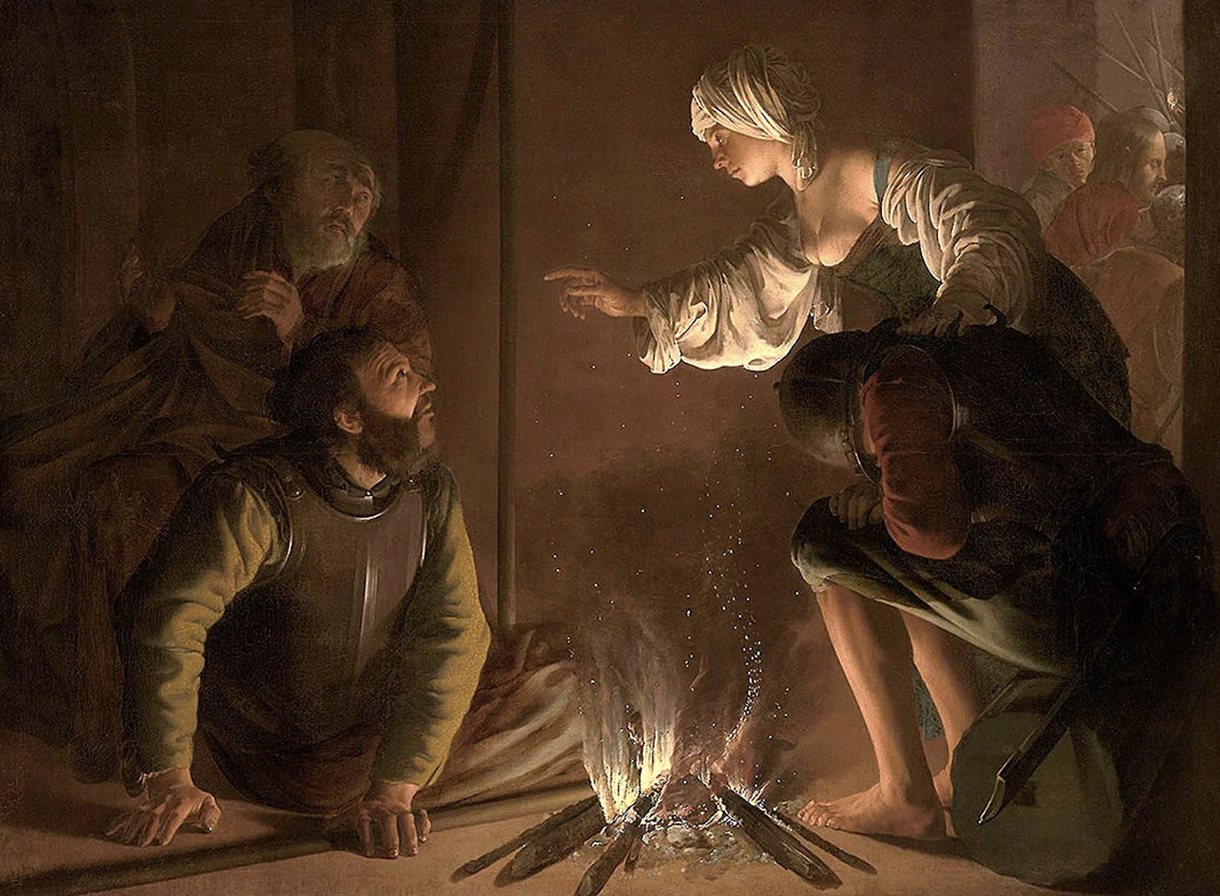
But sometimes the unsteady light of a simple courtyard fire illuminates the truth we’ve been hiding from ourselves. And though it might be painful to realize, this allows us to embrace honesty and wholeness as the path to healing. Sometimes it’s hard to access these parts of ourselves, so art can help us reach past our intellectual defenses and invite us to see the hidden places where our own denials might be taking shelter.
We see this in the way ter Brugghen captures Peter’s expression emerging from the darkness as the servant girl gestures accusingly. It’s not defiance. It’s not anger. It’s not even distress. It’s the dawning horror of self-realization. Peter is realizing that he thought he knew Jesus, but Jesus had known and seen him all along; he is only beginning to see himself the way Jesus had always seen him.
Brown’s song complements this journey into self-awareness. The composition moves through Peter’s emotional journey, from initial bravado, to creeping fear, to desperate disclaimers, and finally to the crushing weight of realization.
Jenkins’ poem draws us into the turmoil of Peter’s inner world, revealing that his denial ran deeper than mere self-preservation. It exposes the gap between the disciple he imagined himself to be and the anxious man who emerged under pressure.
How often do we find ourselves in these very courtyards, drawn to the warmth while our convictions grow cold? We promise faithfulness in moments of comfort, but when pressure mounts, we uncover our capacity for betrayal and self-preservation. Maybe we deny Jesus like Peter when we prioritize our comforts over His commands and call on our lives. Maybe our denials don’t sound like Peter’s, but they’re the words we leave unsaid when courage is required.
I invite you to linger on the last two words of our Scripture today: he wept. Peter could have tried to numb himself from his failure. He could have unleashed his combative side. He could have pretended it didn’t happen. He didn’t do any of these things. Peter allowed Jesus’ words to convict his heart, and his self-realization opened him up to repentance and his need for Jesus once again. What might we be noticing about ourselves that we need to bring to light, even though it might be painful?
As you consider this, remember that Peter’s story doesn’t end here (and ours doesn’t either). Not only is he reinstated by Jesus (John 21), but he learns to build Jesus’ church not on his bravado but through weakness made whole by grace. The goal isn’t simply self-awareness, but a return to Jesus. The rooster still crows in our lives, inviting us back from our denials and drawing us deeper into the grace of the One who’s always known, accepted, and loved us.
Prayer
Lord, forgive me. I repent of the way I’ve denied you, the way I’ve overestimated my abilities, and the unawareness of how deep my self-preservation lies. Teach me to hear the rooster’s crow in my life that I might learn to walk in weakness, lean on your grace, and build your church faithfully. Amen.
Mike Ahn, Ph.D., M.Div.
Dean of Spiritual Development
Biola University
For more information about the artwork, music, and poetry selected for this day, we have provided resources under the “About” tab located next to the “Devotional” tab near the top of the page.
About the Artwork
Denial of St. Peter
Hendrick Jansz ter Brugghen
1628
Oil on canvas
132 x 178 cm
The Art Institute of Chicago
Chicago, Illinois
Public Domain
The Denial of Saint Peter by Hendrick Jansz ter Brugghen depicts one of three denials of Christ by Peter, as recounted in all four gospels. The painting’s action takes place in an interior where two soldiers are warming themselves around a fire. One evidently is asleep, but a servant woman rouses the other soldier by pointing at and accusing Peter of being affiliated with Jesus. Peter cowers in the dark shadows at the very left of the painting. The turbulent emotions behind Peter's denial and later repentance have been the subject of major works of art and music for centuries.
About the Artist
Hendrick Jansz ter Brugghen (1588–1629) was a Dutch painter of genre scenes and religious subjects. He was one of the Dutch followers of Caravaggio—the so-called Utrecht Caravaggisti. Along with Gerrit van Hondhorst and Dirck van Baburen, Ter Brugghen was one of the most important Dutch painters to have been influenced by Caravaggio.
About the Music
“Song of Peter’s Denial” from the album The Life and Times of Jesus Christ
After all that I had saidAfter all that I had promised I would do
I never dreamed it would all end like this
Thought that I would be Your rock
Thought I would weather all the fear
But now I find here at the end
I was too weak to resist.
And all the words I promised you come crashing down
Useless ′round my feet
Remembrances of my promises flood back over me
And remind me of my defeat.
I said that I would follow
I even promised You I would die
But when the choice had to be made
I left You all alone
So many expectations
Now all I have are regrets and empty words
That fog my mind
And cut me to the bone.
And all the words I promised you come crashing down
Useless 'round my feet
Remembrances of my promises flood back over me
And remind me of my defeat.
And now if You were here
Could You still look on me with eyes of love?
Kept choosing to deny time and again
As if once were not enough
If only I had listened
Maybe I could have been strong
But even as you warned me
I swore that you were wrong.
I swore that you were wrong
How I wish You had been wrong
And all the words I promised you come crashing down
Useless ′round my feet
Remembrances of my promises flood back over me
And remind me of my defeat
My defeat
My defeat
About the Composer/Performer
Ryan Brown is an accomplished higher education administrator, award-winning composer, and San Francisco Conservatory of Music (SFCM) alumnus. He has been instrumental in establishing professional development opportunities at SFCM, including founding the professional development academic department and adding numerous course offerings and opportunities in that area. In addition to his administrative roles, Brown is a highly respected educator, having taught music history, composition, and music theory at Princeton University, Rutgers, California State Long Beach, and SFCM. Outside of academia, Brown is an internationally performed composer with a rich catalog of works. He, along with two other SFCM alumni, cofounded Switchboard Music, a nonprofit music presenting organization, and his compositions have been featured in numerous venues and festivals around the world. Brown holds a Ph.D. from Princeton University and a master’s in music from SFCM.
About the Poetry and Poet
J. Marshall Jenkins, Ph.D. is a psychologist in private practice in Rome, Georgia, providing individual and couples psychotherapy for adults. From 1987 to 2020, he served as director of counseling at Berry College. He holds a bachelor’s degree in philosophy from Davidson College (1980) and a Ph.D. in counseling psychology from the University of North Carolina at Chapel Hill (1986).
Dr. Jenkins is also an author and spiritual director. His most recent book is Blessed at the Broken Places: Reclaiming Faith and Purpose with the Beatitudes, and his previous works include A Wakeful Faith: Spiritual Practice in the Real World and The Ancient Laugh of God: Divine Encounters in Unlikely Places. He holds certificates in spiritual formation from Columbia Theological Seminary and in spiritual guidance in the Christian contemplative tradition from the Shalem Institute, and he leads teaching and discussion sessions in spiritual formation. He is a Licensed Lay Preacher and Catechist in the Atlanta Diocese of the Episcopal Church.
About the Devotion Writer
Mike Ahn oversees the various departments in spiritual development at Biola: chapel programs, worship teams, Torrey Memorial Bible Conference, student-led ministries, and pastoral care. He is a graduate of Haverford College (B.A., History, ’01) and Talbot School of Theology (M.Div., Spiritual Formation, ’09; Ph.D., Educational Studies, ’22). If he could, he would have two In-N-Out cheeseburgers with chopped chilis, animal-style fries, and a Pamplemousse LaCroix for every meal.