March 31: Christ Is Arrested in Gethsemane
♫ Music:
Mark 14:43-52 (NKJV)
And immediately, while He was still speaking, Judas, one of the twelve, with a great multitude with swords and clubs, came from the chief priests and the scribes and the elders. Now His betrayer had given them a signal, saying, “Whomever I kiss, He is the One; seize Him and lead Him away safely.”
As soon as he had come, immediately he went up to Him and said to Him, “Rabbi, Rabbi!” and kissed Him.
Then they laid their hands on Him and took Him. And one of those who stood by drew his sword and struck the servant of the high priest, and cut off his ear.
Then Jesus answered and said to them, “Have you come out, as against a robber, with swords and clubs to take Me? I was daily with you in the temple teaching, and you did not seize Me. But the Scriptures must be fulfilled.”
Then they all forsook Him and fled.
Now a certain young man followed Him, having a linen cloth thrown around his naked body. And the young men laid hold of him, and he left the linen cloth and fled from them naked.
Poetry
“The Sword”
by Ann Stanford
I made the sword.
Here in the fire I plunged the steel
white hot bearing the beat of the apprentice’s
hammers, one-two-three over and over
on the steel bar -- over and over the firing
the beating of hammers till the bar is dense
with the struggle, and I bend it again and again.
Over and over the pounding, the cutting, the bending,
layer on layer the crude bar resists me.
I have given it courage. It has held day and night
against heat, against pounding. At last I have shaped it,
hardened its edges.
It becomes a mirror of my hand hardened in fire
with the metal that resists and is beaten
folded and beaten to the luster
of the still pond that is windless
that carries one gold curving branch in its center
spread with the gold leaves of springtime
and waiting
to bring you this mirror, this hardness, this ardor of hammering home.
The Arrest of Jesus
Quickly we are progressing towards the climax of our journey of Lent. Now, during “Passion Week,” we daily face another crucial scene that takes us to the fulfillment of Christ’s purpose on earth, the unthinkable reality of Christ being betrayed and arrested in the dark of night. As I re-read these Scriptures, I was struck by the contradictory actions that seem to jump out of the story. Nothing was as it was expected.
Jesus calmly enters the darkness of the garden, and willingly approaches those who come with swords and clubs. He is then approached by one of his followers, Judas, and is kissed—not in affection, but in betrayal. He is called by the respected name, “Rabbi”—again, not with honor, but with deceit. Another of his disciples (we are told in John it is Simon Peter), does what seems honorable to defend Jesus, taking his sword and attacks. Immediately, instead of Jesus thanking his disciple for trying to protect him, he reprimands Peter for resorting to violence. All the disciples then abandon Jesus once he is arrested. Had they not heard his teaching of love, peace and forgiveness during the three years of following him? Did they want the violent overthrow of their oppressors so badly that they didn’t believe Jesus’ teachings? I wonder how often I claim to be a follower of Jesus, yet don’t live by his teachings when life gets hard.
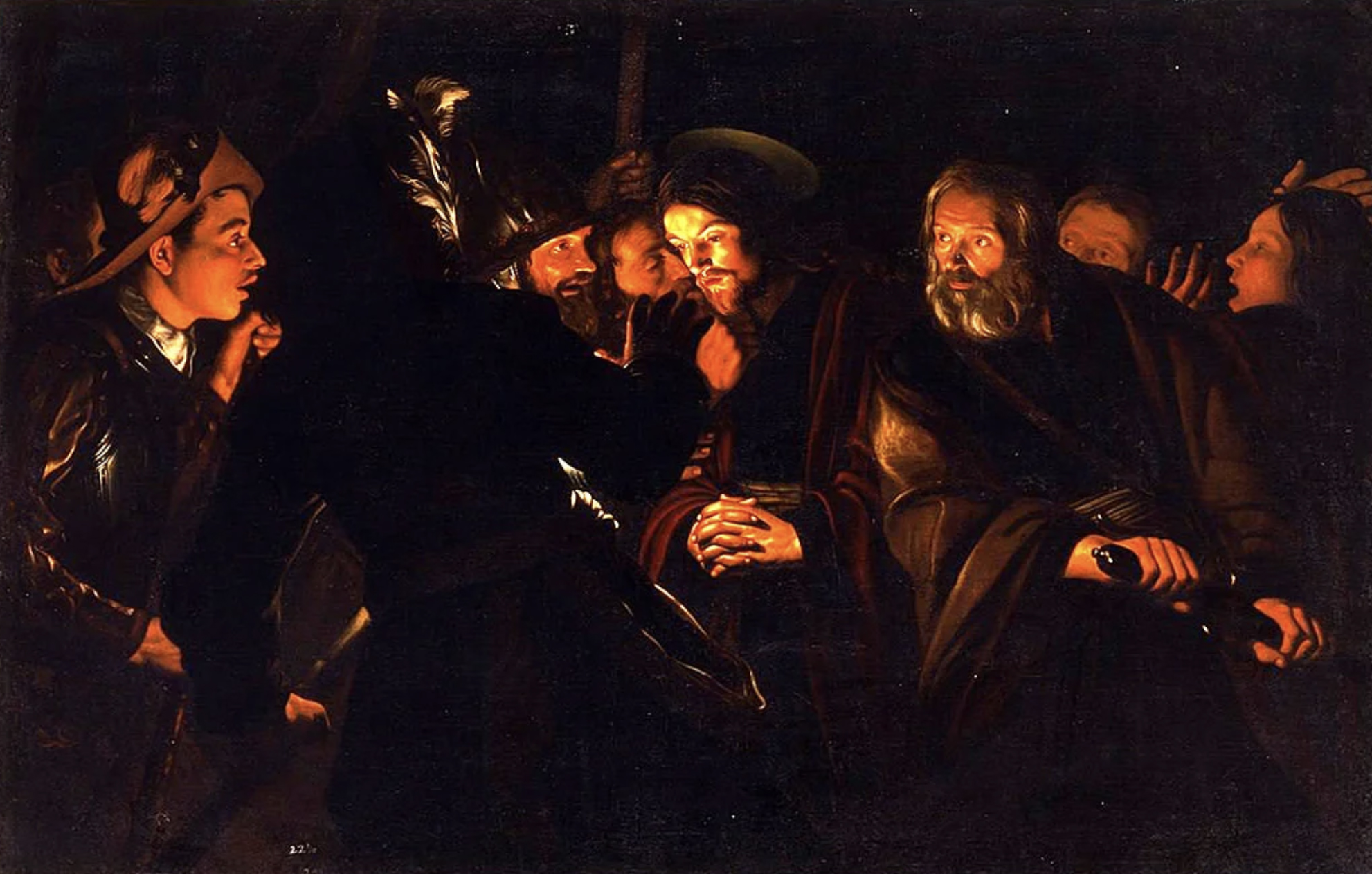
Today’s painting, in the style of seventeenth-century Caravaggio and attributed to one of his Flemish followers, sets the tone of this horrible scene through dramatic light effects and expressive gestures. Christ’s calm expression and folded hands contrast greatly to the fear, anger and deceit of those around him. Again, the contrast between human fear and Christ’s obedient trust becomes clear.
I found the music of today, from The Passion of the Christ to be most congruent of the scene described in our passage. The human cries of grief, pain and despair were a perfect, though difficult to listen to, background to the activities of the arrest of Jesus, the Son of God.
Our poem by the twentieth-century California poet depicts the making of a sword—a striking image that stands in tension with what Jesus consistently reveals about the nature of God’s kingdom. Throughout his three years of teaching and embodied ministry, Jesus refuses to locate the advance of the kingdom in human violence or coercive power. Instead, he exposes a deeper order at work in the world, one governed by love, mercy, and faithful obedience to the Father. This is most fully revealed at the cross, where Jesus does not summon violent retribution against those who betray, abandon, and crucify him, but entrusts himself to the justice of God while praying for their forgiveness. In doing so, he redefines strength and victory, calling his followers not to abandon judgment altogether, but to relinquish vengeance and learn to love even their enemies as witnesses to a kingdom not built by the sword.
Prayer
Lord, God of Abraham, God of the Prophets, God of Love, you created us and you call us to live as brothers and sisters. Give us the strength daily to be instruments of peace; enable us to see everyone who crosses our path as our brother or sister. Make us sensitive to the plea of our citizens who entreat us to turn our weapons of war into implements of peace, our trepidation into confident trust, and our quarreling into forgiveness.
Keep alive within us the flame of hope, so that with patience and perseverance we may opt for dialogue and reconciliation. In this way may peace triumph at last, and may the words “division”, “hatred” and “war” be banished from the heart of every man and woman. Lord, defuse the violence of our tongues and our hands. Renew our hearts and minds, so that the word which always brings us together will be “brother”, and our way of life will always be that of: Shalom….
Amen.
—Taken from A Prayer for Peace, Pope Francis 1936-2025
Dianne B. Collard, D.Miss
Alumna, Cook School of International Studies
Biola University
For more information about the artwork, music, and poetry selected for this day, we have provided resources under the “About” tab located next to the “Devotional” tab near the top of the page.
About the Artwork
The Arrest of Jesus
Gerard Seghers or Adam de Coster
Between 1600 and 1650
Oil on canvas
154 x 235 cm
Real Academia de Bellas Artes de San Fernando
Madrid, Spain
Public Domain
There seems to be some dispute among scholars over which Flemish Caravaggisti artist produced this work, so both artists are included in our posting. In The Arrest of Jesus, Judas has just kissed Jesus to identify Him for the soldiers. The figures are arranged before a dark background which obscures the surrounding environment. The artist has used light from the soldier’s lanterns to illuminate the animated faces of those assembled. The lighting is reminiscent of the Italian baroque master Caravaggio (1571–1610), whose technique of chiaroscuro intensified the tension and drama of his paintings. On the right side of the painting, Peter is just about to draw his sword and cut off the ear of the high priest's servant in an attempt to defend Jesus.
About the Artist
Gerard Seghers or Adam de Coster
Gerard Seghers (c. 1591–1651) was a Flemish painter, art collector, and art dealer. After a period of study and residence in Italy, he returned to Flanders, where he became one of the leading representatives of the Flemish Caravaggisti movement. In his later career he abandoned the Caravaggist style and genre motifs to become an important painter of large altarpieces for local churches.
Adam de Coster (c. 1586–1643) was a Flemish painter. He was a prominent member of the Antwerp Caravaggisti. These Caravaggisti were part of an international movement of European artists who interpreted the work of Caravaggio and the followers of Caravaggio in a personal manner. He is mainly known for his genre scenes with strong chiaroscuro effects. He was called a Pictor Noctium (Painter of Nights) because of his preference for tenebrist scenes. Details about the life and training of Adam de Coster are sketchy. He was not in the habit of signing or dating his works and as a result many of his works were attributed to other Caravaggisti artists.
About the Music
“Jesus Arrested” from the album The Passion of the Christ (motion picture soundtrack)
Instrumental
About the Composers
Ron Allen, Chris Bleth, and John Debney
Ron Allen is a Toronto-based, Juno-nominated music producer, songwriter, and DJ. Ron is also the founder of legendary dance music imprint Strobe Records, an instrumental label in developing the sounds of house music and techno music in the early ’90s. Having cofounded Strobe with Hayden Andre Brown, Ron Allen stands as one of the defining architects of early ’90s house and techno music. A DJ turned producer, Allen's passion for music drove him into the studio, where he crafted tracks that would resonate far beyond the dance floor. From pop to R & B, hip-hop, rock, and even country, his production prowess has made him a go-to collaborator across genres. Decades later, Allen’s legacy endures as he continues to create and release music, proving that his influence on the dance music landscape is far from over.
Chris Bleth is an American woodwind player. He plays orchestral woodwinds as well as world-music wind instruments. Bleth plays for films, TV shows, TV and radio commercials, video games, albums, and live concerts.
John Cardon Debney (b. 1956) is an American composer and conductor of film, television, and video game scores. His work encompasses a variety of mediums and genres, including comedy, horror, science fiction, thriller, fantasy, and action-adventure. He is a longtime collaborator of the Walt Disney Company, having written music for their films, television series, and theme parks. He has also collaborated with film directors such as Brian Robbins, Jon Favreau, Garry Marshall, Tom Shadyac, Peter Hyams, John A. Davis, Brad Anderson, Howard Deutch, Mark Dindal, Robert Rodriguez, and Paul Tibbitt. He composed some of Disney Parks' Nighttime Spectaculars, including World Of Color Celebrate! in Disney's California Adventure; The Magic, The Memories And You!; Celebrate the Magic in Walt Disney World Magic Kingdom; and Celebrate! Tokyo Disneyland in Tokyo Disneyland; as well as an arrangement of "When You Wish Upon a Star" as a fanfare for the Walt Disney Pictures logo from 1985 to 2006.
About the Performers
Nick Ingram and his Orchestra
Nick Ingram is a music producer, recording/mixing engineer, and songwriter. Over the past fifteen years, Nick has worked hard in the music industry creating a unique sound and making a name for himself. Artist credits include Beartooth, Dayseeker, Hawthorne Heights, Like Moths To Flames, and more.
About the Poetry and Poet
Ann Stanford (1916–1987) was an American poet and teacher known for her lyrical, meditative poetry and her engagement with myth, history, and the natural world. Born in La Habra, California, she earned degrees from Stanford University and the University of California, Los Angeles. Stanford published several poetry collections, including The White Bird, The Peacock King, and In Mediterranean Air, and her work received honors such as the Yale Series of Younger Poets Award. She taught for many years at the University of Southern California, where she influenced generations of writers. Stanford’s poetry is noted for its musical language, intellectual depth, and spiritual resonance.
About the Devotion Writer
Dr. Dianne Collard is a long-term missionary and creative catalyst. She serves as the Europe Ministries Director for Artists in Christian Testimony International. She is the author of numerous published articles and the book, I Choose to Forgive: The Expanded Edition. A short film, Abstraction, which introduces her journey of forgiveness and her calling as an encourager to artists was produced by Makoto Fujimura. Dianne, and her husband, Glenn, have three children and five adorable granddaughters, two grandsons-in-law, two great-granddaughters and an adorable “grand-dog.”