February 28: More Profound Truths Found in Simple Stories
♫ Music:
Mark 4:21-34 (NKJV)
Also He said to them, “Is a lamp brought to be put under a basket or under a bed? Is it not to be set on a lampstand? For there is nothing hidden which will not be revealed, nor has anything been kept secret but that it should come to light. If anyone has ears to hear, let him hear.”
Then He said to them, “Take heed what you hear. With the same measure you use, it will be measured to you; and to you who hear, more will be given. For whoever has, to him more will be given; but whoever does not have, even what he has will be taken away from him.”
And He said, “The kingdom of God is as if a man should scatter seed on the ground, and should sleep by night and rise by day, and the seed should sprout and grow, he himself does not know how. For the earth yields crops by itself: first the blade, then the head, after that the full grain in the head. But when the grain ripens, immediately he puts in the sickle, because the harvest has come.”
Then He said, “To what shall we liken the kingdom of God? Or with what parable shall we picture it? It is like a mustard seed which, when it is sown on the ground, is smaller than all the seeds on earth; but when it is sown, it grows up and becomes greater than all herbs, and shoots out large branches, so that the birds of the air may nest under its shade.”
And with many such parables He spoke the word to them as they were able to hear it. But without a parable He did not speak to them. And when they were alone, He explained all things to His disciples.
Poetry
“Parable”
by Louise Glück
First divesting ourselves of worldly goods, as St. Francis teaches,
in order that our souls not be distracted
by gain and loss, and in order also
that our bodies be free to move
easily at the mountain passes, we had then to discuss
whither or where we might travel, with the second question being
should we have a purpose, against which
many of us argued fiercely that such purpose
corresponded to worldly goods, meaning a limitation or constriction,
whereas others said it was by this word we were consecrated
pilgrims rather than wanderers: in our minds, the word translated as
a dream, a something-sought, so that by concentrating we might see it
glimmering among the stones, and not
pass blindly by; each
further issue we debated equally fully, the arguments going back and forth,
so that we grew, some said, less flexible and more resigned,
like soldiers in a useless war. And snow fell upon us, and wind blew,
which in time abated — where the snow had been, many flowers appeared,
and where the stars had shone, the sun rose over the tree line
so that we had shadows again; many times this happened.
Also rain, also flooding sometimes, also avalanches, in which
some of us were lost, and periodically we would seem
to have achieved an agreement; our canteens
hoisted upon our shoulders, but always that moment passed, so
(after many years) we were still at that first stage, still
preparing to begin a journey, but we were changed nevertheless;
we could see this in one another; we had changed although
we never moved, and one said, ah, behold how we have aged, traveling
from day to night only, neither forward nor sideward, and this seemed
in a strange way miraculous. And those who believed we should have a purpose
believed this was the purpose, and those who felt we must remain free
in order to encounter truth, felt it had been revealed.
Bright and Dark; Small and Slow
A bright light is put on a stand. All is seen and revealed. There is no place I can run despite my cockroach impulse to scatter until I find some safe, hidden corner. This image is a warning to me as I traffic in the darker creases of my soul. Even these places will be revealed. My secret measures of anger or condemnation or strategy will be turned against me. My mental accusation against others by which I try in vain to protect my security, safety, and confidence will be turned against me. As I judge and find others wanting, my own lacks will be revealed. The light will shine and the hard truth will be clear: I am just like them. As they fail, I fail. As they sin, I sin.
The light on the stand is not a spotlight. It does not pick me out on a stage where I act out my best self. I am happy for the spotlight, but I don’t want the divine surgeon’s light that penetrates.
I have ears—good ears, but do I hear?
For what should I listen?
Over the din of my internal chatter directed at others, there is another voice I need to hear. The kingdom of God is here. It is real. It is life.
How is it that the kingdom comes?
It comes to us small and slow. It comes in a way so small we can hardly see. Seed scattered—even the smallest of seeds—scattered nearly indiscriminately across the terrain. Once it leaves the hand of the farmer, he cannot see it. It is over the ground, now invisible.
Then the kingdom is slow. It comes slowly. So slowly that we go to sleep and rise again many, many times before we know it is there—before we see any sign of life. All the time it is growing, as it depends not on the will or strategy of any human being but on God.
Then it is seen. Once visible, the kingdom is a light that gives light to the world.
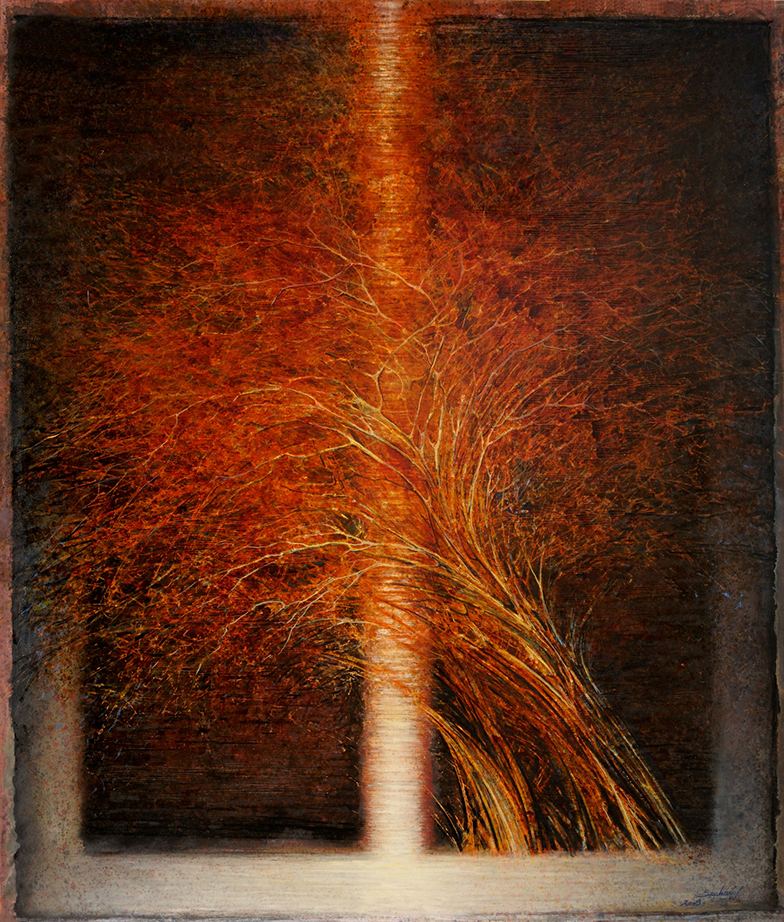
Gaze at the picture for a moment, for two moments. Mark the mustard plant that is thrown across our line of sight. Mark how it captures and reflects the light. The smallest of seeds and a slow patient process that produces this resplendent growth. That is the kingdom.
If I have ears and if I hear—if I stop and listen to the slow, small, nearly silent growth of His kingdom—it will be revealed. Not in the way of my secret schemes. Not in the way of the spotlight. But slowly. First the blade, then the head, after that the full grain in the head.
If I have anything real, it is a gift and more will be given. If I cling to the facades of nothingness, the light will shine and these will be shown to be less than a vapor.
But the kingdom grows. It is a large sweeping tree in which I can find shelter.
Prayer
Your kingdom, O Lord, comes in ways unexpected. Shine Your light into those parts of my soul that prevent me from seeing and hearing. Help me stop and listen. Help me trust that You are producing Your work in Your time. Help me take shelter in You.
Dr. Greg E. Ganssle
Professor of Philosophy
Talbot School of Theology
Biola University
For more information about the artwork, music, and poetry selected for this day, we have provided resources under the “About” tab located next to the “Devotional” tab near the top of the page.
About the Artwork
Mustard Seed
Imre Szakács
2009
Mixed media on canvas
150×130 cm
Private Collection in Budapest
Artist Imre Szakács is, in his own words, a “visual writer.” He is one of the most important artists in Hungary today making religious artworks. He is known for dramatic paintings with mysterious symbolism and surrealistic traits. One of Imre Szakács’s paintings, Mustard Seed, was inspired by Anna Jókai, the grand lady of Hungarian literature. Her story Togetherness, in which she deals with what gives meaning to life, inspired by this painting. The painting features a kind of whirlwind or pillar of fire that descends in the center of the canvas. It breaks the static white window frame open. Life radiates from it. The seed sprouts and grows into branches interlaced with light. Out of and into the light grow branches, nourished by the same source, nurtured by life-giving vertical and horizontal relationships. That’s how towering a tiny seed with a little light and water can become. The promise is that the tiny mustard seed has matured and now gives room to other life.
About the Artist
Imre Szakács (b. 1948) is a Hungarian artist. Devoted to art and artists, Szakács has initiated and worked for several art movements and associations. He is an active member of the Artist Fund of the Republic of Hungary, the National Association of Hungarian Artists, the Society of Hungarian Painters, and the Old Artist Colony of Szentendre. Since 2011 he has been a member of the Fine Art Section of the Association for National Culture. Szakács has participated in various exhibitions at home and abroad since 1969. His works can be found in several public collections, such as those at Ferenczy Museum (Szentendre), Esztergom Christian Museum, and the Cultural Foundation at the renowned art colony at Worpswede, Germany. His paintings can be found in Hungary, Canada, the USA, Cuba, India, and Europe.
About the Music
“He Who Has Ears to Hear”from the album Van McCoy Soul Improvisations
Once upon a time there was a prophet
And he went from town to town
Preaching the truth
Oh, but few were they who took the time to listen
Though the miracles that he performed were proof
He was the sweet Messiah
He who have ears to hear let him hear
He who have ears to hear let him hear
He preached that every man should love his brother
But the world of little faith would not believe
He saw and prophesied his own destruction
And in the end for greed and gold, he was deceived
He was the Lamb of God
He who have ears to hear let him hear
He who have ears to hear let him hear
That was long ago and far away
But I wonder if he came again today
Would the world embrace him or betray
The Prince of Peace
He who have ears to hear let him hear
He who have ears to hear let him hear
About the Composer/Performer
Van Allen Clinton McCoy (1940–1979) was a Black American record producer, arranger, songwriter, and singer. He is known for his 1975 internationally successful hit The Hustle. He has approximately seven hundred song copyrights to his credit, and produced songs for such recording artists as Brenda and the Tabulations, David Ruffin, the Stylistics, the Presidents, Faith, Hope and Charity, New Censation, Gladys Knight and the Pips, Aretha Franklin, Peaches and Herb, Lesley Gore, and Stacy Lattisaw.
About the Poetry and Poet
Louise Elisabeth Glück (1943-2023) was an American poet. Glück was considered by many to be one of America’s most talented contemporary poets. The poet Robert Hass called her “one of the purest and most accomplished lyrical poets now writing....her poetry is noted for its technical precision, sensitivity, and insight into loneliness, family relationships, divorce, and death.” Glück was appointed poet laureate consultant in poetry to the Library of Congress in 2003 after serving as a special bicentennial consultant three years prior in 2000. She won the National Book Award for Poetry in 2014 for Faithful and Virtuous Night. In addition to the Pulitzer and Bollingen Prizes, she received many awards and honors for her work, including the Lannan Literary Award for Poetry, the MIT Anniversary Medal, and fellowships from the Guggenheim Foundation, the Rockefeller Foundation, and the National Endowment for the Arts.
About the Devotion Writer
Gregory E. Ganssle is professor of philosophy at Talbot School of Theology. His latest book is Our Deepest Desires: How the Christian Story Fulfills Human Aspirations (IVP, 2017). He is currently writing a book tentatively titled, Life, Death, and Freedom: Jesus Questions Nietzsche.