February 27: The Parable of the Sower: Mysteries of the Kingdom of God
♫ Music:
Mark 4:1-20 (NKJV)
And again He began to teach by the sea. And a great multitude was gathered to Him, so that He got into a boat and sat in it on the sea; and the whole multitude was on the land facing the sea. Then He taught them many things by parables, and said to them in His teaching:
“Listen! Behold, a sower went out to sow. And it happened, as he sowed, that some seed fell by the wayside; and the birds of the air came and devoured it. Some fell on stony ground, where it did not have much earth; and immediately it sprang up because it had no depth of earth. But when the sun was up it was scorched, and because it had no root it withered away. And some seed fell among thorns; and the thorns grew up and choked it, and it yielded no crop. But other seed fell on good ground and yielded a crop that sprang up, increased and produced: some thirtyfold, some sixty, and some a hundred.”
And He said to them, “He who has ears to hear, let him hear!”
But when He was alone, those around Him with the twelve asked Him about the parable. And He said to them, “To you it has been given to know the mystery of the kingdom of God; but to those who are outside, all things come in parables, so that
‘Seeing they may see and not perceive,
And hearing they may hear and not understand;
Lest they should turn,
And their sins be forgiven them.’ ”
And He said to them, “Do you not understand this parable? How then will you understand all the parables? The sower sows the word. And these are the ones by the wayside where the word is sown. When they hear, Satan comes immediately and takes away the word that was sown in their hearts.These likewise are the ones sown on stony ground who, when they hear the word, immediately receive it with gladness; and they have no root in themselves, and so endure only for a time. Afterward, when tribulation or persecution arises for the word’s sake, immediately they stumble. Now these are the ones sown among thorns; they are the ones who hear the word, and the cares of this world, the deceitfulness of riches, and the desires for other things entering in choke the word, and it becomes unfruitful. But these are the ones sown on good ground, those who hear the word, accept it, and bear fruit: some thirtyfold, some sixty, and some a hundred.”
Poetry
“The Sower”
by Victor Hugo, translated by Toru Dutt
Sitting in a porchway cool,
Fades the ruddy sunlight fast,
Twilight hastens on to rule--
Working hours are wellnigh past
Shadows shoot across the lands;
But one sower lingers still,
Old, in rags, he patient stands,--
Looking on, I feel a thrill.
Black and high his silhouette
Dominates the furrows deep!
Now to sow the task is set,
Soon shall come a time to reap.
Marches he along the plain,
To and fro, and scatters wide
From his hands the precious grain;
Moody, I, to see him stride.
Darkness deepens. Gone the light.
Now his gestures to mine eyes
Are august; and strange--his height
Seems to touch the starry skies.
The Parable of the Sower
Sometimes, when approaching a Scripture passage and trying to understand not just what it’s saying, but what it is saying to us—how to apply what is taught to our own lives—it can be hard to know which part to pay attention to.
For example, in the story of the Good Samaritan, are we those passing by on the side of the road? Are we the man who’s injured and dying? Are we the man who helps?
In that case, the answer is famously yes. In the course of our lives, we will almost certainly be all three (God granting us the grace to actually occasionally help our neighbors).
And even more famously, the answer is: Really, the very most important person in the story is Jesus. He, the storyteller, is the one who stops in front of us, the dying man, binds up our wounds, and spends everything it takes to see that we are restored, cared for, and kept safe.
The parable of the sower is similar. When I look at it, I wonder, Am I supposed to be thinking about how to spread the good news? Am I supposed to be comforted by the fact that whether or not the seed grows isn’t something I can control? Am I supposed to be making sure my own heart is good soil—pulling out the weeds of worldly distractions, persevering under temptation, putting on the armor of God to deflect the arrows of the evil one?
The answer is yes—yes to all of that.
But even more than that, the answer is once again Jesus. He is the true sower, and when we share the good news, or when we receive it in a good heart, we only ever are walking in His footsteps.
And this in itself is great good news!
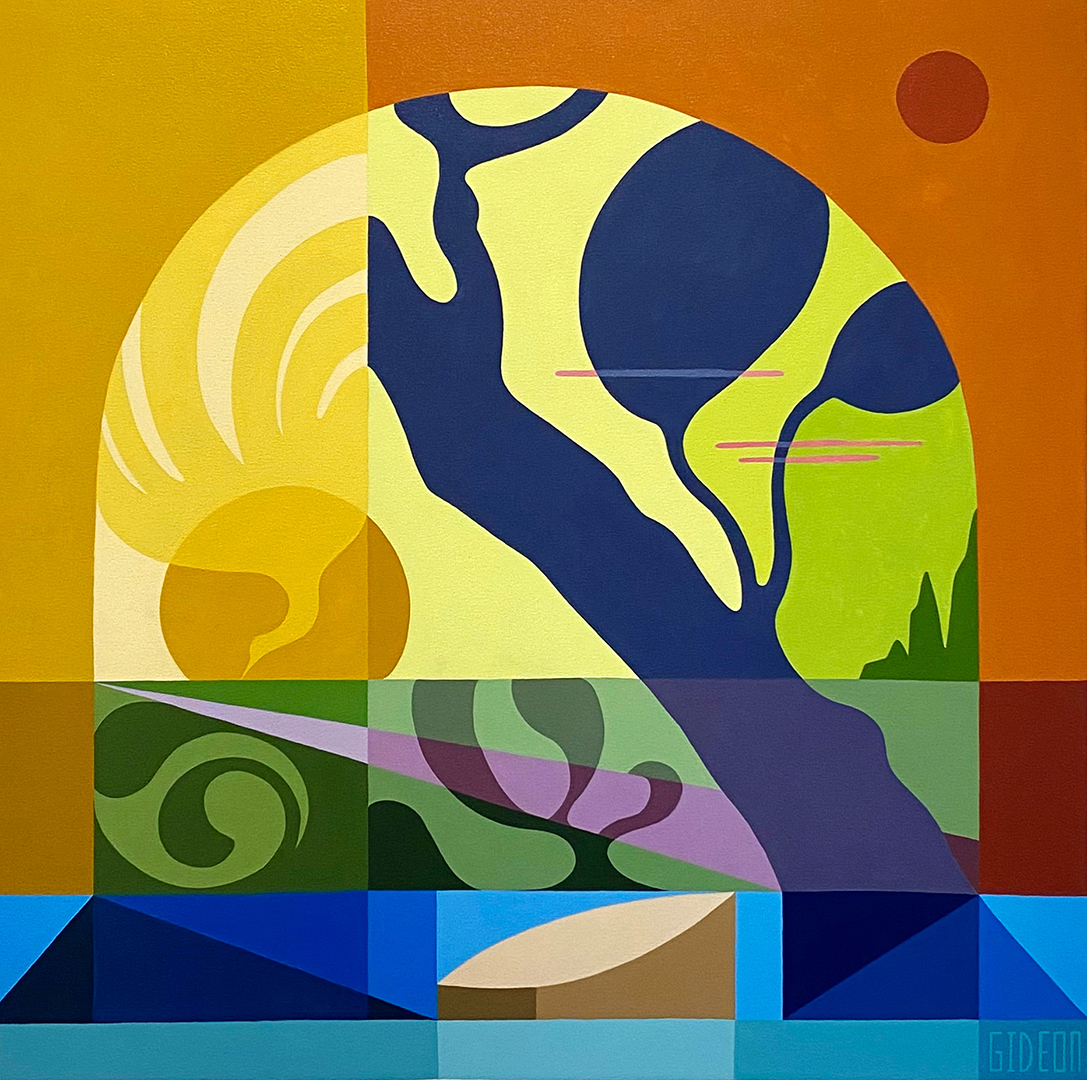
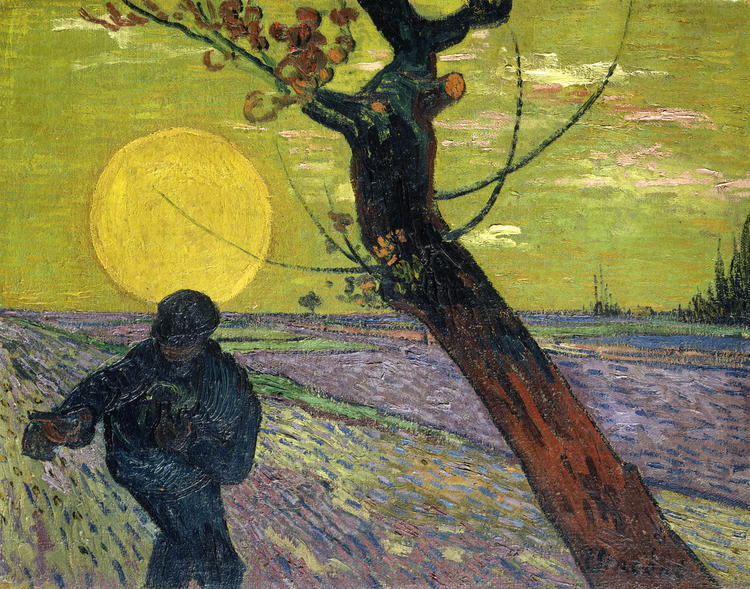
From that viewpoint, I’d simply like to invite you to look at the absolute beauty of the accompanying art and music—the sunset light in the Van Gogh, the evocative words of Victor Hugo, the clear colors of Gideon Nel, and above all, the glorious, rich, overwhelming crescendo of Andrew Peterson’s magnificent The Sower’s Song.
They all are pointing to something true: The beauty and glory that are the reason anyone does the work of sowing seed in the first place. When God sows the seed of His word, He knows He is sowing the seed of a magnificent creation (and re-creation!).
Green and growing things are a glory. They feed us, they shelter us, they delight our eyes and our noses and our hearts.
And it is trees and plants that Jesus points to over and over again as pictures both of His followers individually and of the kingdom of God as a whole. Those who abide in Him are branches attached to the vine. Later in this chapter of Mark, the kingdom of God is “greater than all herbs, and shoots out large branches, so that the birds of the air may nest under its shade” (v. 32).
Rest and shelter and food and beauty. This is found where God’s word has been planted, taken root, and become fruitful. This is found in the kingdom He builds, with His word bearing fruit among His people. May we spread the word. May we let the word abide in our hearts—good soil, by God’s grace. May we be diligent to root out the weeds quickly, before they can take over.
And more than anything else, may we rest content knowing that though we don’t know how the plant grows (vv. 26–28), God does, and that, as Peterson sings, the word of the Lord
will not return void…
We shall be led in peace,
And go out with joy,
And the sower leads us,
And the sower leads us,
And the sower leads us.
Our sower leads us. Amen.
Prayer
O God, you have made of one blood all the peoples of the earth, and sent your blessed Son to preach peace to those who are far off and to those who are near: Grant that people everywhere may seek after you and find you; bring the nations into your fold; pour out your Spirit upon all flesh; and hasten the coming of your kingdom; through Jesus Christ our Lord. Amen.
—from The Book of Common Prayer, ACNA 2019 version
Jessica Snell
Writer and Editor
Alumna of Biola University
For more information about the artwork, music, and poetry selected for this day, we have provided resources under the “About” tab located next to the “Devotional” tab near the top of the page.
About the Artwork | 1
Die Saaier, 136 (The Sower, 136)
Gideon Nel
2024
Acrylic on canvas
100 x 100 cm
In creating this work, South African artist Gideon Nel was inspired by Van Gogh’s painting by the same name. "Die Saaier" means "The Sower" in the South African language Afrikaans. Nel used the number “136” in the title of his work to refer to the number of years between Van Gogh's The Sower, painted in 1888, and his own work done in 2024. Nel’s artwork unpacks the parable of the sower (Mark 4) in four distinct panels, with each depicting a different seed in the parable.
About the Artist
Gideon Nel (b. 1992) is a South African artist, designer, and lecturer based in Cape Town, South Africa. He has worked as a graphic designer for various companies and has lectured in graphic design at Stellenbosch Academy of Design and Photography and Greenside Design Center in Johannesburg. He was a designer, lecturer, and youth leader at Stellenbosch Gemeente for three years, and there he developed visual and interactive ways to communicate the treasures of the biblical narrative. In 2021, he completed an M.A. degree in information design at the University of Pretoria, the capital of South Africa. Currently, he is a full-time artist who explores the intersections between art, theology, psychology, and philosophy.
About the Artwork | 2
The Sower
Vincent Van Gogh
1888
Oil on canvas
32.5 x 40.3 cm
Van Gogh Museum
Vincent van Gogh Foundation
Amsterdam, Netherlands
Public Domain
Vincent Van Gogh had a special interest in sowers throughout his artistic career. He made more than thirty drawings and paintings on this theme. He painted this sower in the autumn of 1888. Encouraged by fellow artist Paul Gauguin (1848–1903) to draw less on reality and more on his imagination, here Van Gogh uses colors meant to express emotion and passion. He assigned the leading roles to the greenish-yellow of the sky and the purple of the field. The bright yellow sun looks like a halo, turning the sower into a saint. The Sower thematically signifies the eternal cycle of life, hope, and renewal—representing both the agricultural act of sowing seeds and a spiritual sower of God's word. The symbolism is enhanced by the vibrant, emotional colors, the radiant sun, and the contrasting imagery of the sower, the ripe fields, and the bare tree.
About the Artist
Vincent Willem Van Gogh (1853–1890) was a postimpressionist painter of Dutch origin whose work, notable for its rough beauty, emotional honesty, and bold color, had a far-reaching influence on twentieth-century art. After years of painful anxiety and frequent bouts of mental illness, he died aged thirty-seven from a gunshot wound generally accepted to be self-inflicted. Van Gogh did not begin painting until his late twenties, completing many of his best-known works during the last two years of his life. In just over a decade, he produced more than 2,100 artworks, consisting of 860 oil paintings and more than 1,300 watercolors, drawings, sketches and prints. His work included self-portraits, landscapes, still lifes, portraits, and paintings of cypresses, wheat fields, and sunflowers. In March 1886, he moved to Paris and discovered the French impressionists. When he moved to the south of France, his work grew brighter in color and he developed the unique and highly recognizable style he is known for today. The extent to which his mental health affected his painting has been a subject of much speculation since his death. According to art critic Robert Hughes, Van Gogh’s late works show an artist at the height of his ability, completely in control and “longing for concision and grace.”
About the Music
“The Sower’s Song” from the album The Burning Edge of Dawn
Oh God, I am furrowed like the field
Torn open like the dirt
And I know that to be healed
That I must be broken first
I am aching for the yield
That You will harvest from this hurt
Abide in me
Let these branches bear You fruit
Abide in me, Lord
As I abide in You
So I kneel
At the bright edge of the garden
At the golden edge of dawn
At the glowing edge of spring
When the winter’s edge is gone
And I can see the color green
I can hear the sower’s song
Abide in me
Let these branches bear You fruit
Abide in me, Lord
Let your Your word take root
Remove in me
The branch that bears no fruit
And move in me, Lord
As I abide in You
As the rain and the snow fall
Down from the sky
And they don’t return but they water the earth and they bring forth life
Giving seed to the sower, bread for the hunger
So shall the word of the Lord be with a sound like thunder
And it will not return, it will not return void
We shall be led in peace
And go out with joy
And the hills before us
Will raise their voices
And the trees of the field will clap their hands as the land rejoices
And instead of the thorn now
The cypress towers
And instead of the briar the myrtle blooms with a thousand flowers
And it will make a name
Make a name for our God
A sign everlasting that will never be cut off
As the earth brings forth sprouts from the seed
What is sown in the garden grows into a mighty tree
So the Lord plants justice, justice and praise
To rise before the nations till the end of days
As the rain and the snow fall
Down from the sky
And they don’t return but they water the earth and they bring forth life
Giving seed to the sower, and bread for the hunger
So shall the word of the Lord be with a sound like thunder
And it will not return, it will not return void
It will not return, it will not return void
It will not return, it will not return void
We shall be led in peace
And go out with joy
And the sower leads us
And the sower leads us
And the sower leads us
About the Composer/Performer
Andrew Peterson (b. 1974) is an American Christian author and musician who plays folk, rock, and country gospel music. Peterson is a founding member of the Square Peg Alliance, a group of Christian songwriters. He has toured with Caedmon's Call, Fernando Ortega, Michael Card, Sara Groves, Ben Shive, and other members of the Square Peg Alliance. Peterson is the author of The Wingfeather Saga, a series of children’s and young adult fantasy novels. The four-part series is currently being adapted into an animated TV show. Andrew’s second nonfiction book, The God of the Garden: Thoughts on Creation, Culture, and the Kingdom, followed his memoir, Adorning the Dark: Thoughts on Community, Calling, and the Mystery of Making. In 2008, driven by a desire to cultivate a strong Christian arts community, Andrew founded a ministry called the Rabbit Room, which has led to a yearly conference, countless concerts and symposiums, and the Rabbit Room Press, which has published over thirty books to date.
About the Poetry and Poet
Victor-Marie Hugo (1802–1885) was a French Romantic author, poet, essayist, playwright, journalist, human rights activist, and politician. His most famous works are the novels The Hunchback of Notre-Dame (1831) and Les Misérables (1862). In France, Hugo is renowned for his poetry collections, such as Les Contemplations and La Légende des siècles (The Legend of the Ages). Hugo was at the forefront of the Romantic literary movement with his play Cromwell and drama Hernani. His works have inspired music, both during his lifetime and after his death, including the opera Rigoletto and the musicals Les Misérables and Notre-Dame de Paris. He produced more than four thousand drawings in his lifetime, and campaigned for social causes such as the abolition of capital punishment and slavery. Although he was a committed royalist when young, Hugo's views changed as the decades passed, and he became a passionate supporter of republicanism, serving in politics as both deputy and senator. His work touched upon most of the political and social issues and the artistic trends of his time. He was given a state funeral in the Panthéon of Paris, which was attended by over two million people, the largest in French history.
About the Devotion Writer
Jessica Snell is a freelance editor who loves helping authors polish their books till they shine! She is also a writer, and her work has appeared in Compelling Science Fiction, Christ and Pop Culture, Focus on the Family, and more. In her free time, she reads, knits, and spends time with her husband and their four children. You can follow her on Twitter at @theJessicaSnell, and her website is jessicasnell.com.