March 21: Christ’s Vivid Illustrations and Actions Regarding True Worship and Prayer
♫ Music:
Mark 11:12–26 (NKJV)
Now the next day, when they had come out from Bethany, He was hungry. And seeing from afar a fig tree having leaves, He went to see if perhaps He would find something on it. When He came to it, He found nothing but leaves, for it was not the season for figs. In response Jesus said to it, “Let no one eat fruit from you ever again.”
And His disciples heard it.
So they came to Jerusalem. Then Jesus went into the temple and began to drive out those who bought and sold in the temple, and overturned the tables of the money changers and the seats of those who sold doves. And He would not allow anyone to carry wares through the temple. Then He taught, saying to them, “Is it not written, ‘My house shall be called a house of prayer for all nations’? But you have made it a ‘den of thieves.’ ”
And the scribes and chief priests heard it and sought how they might destroy Him; for they feared Him, because all the people were astonished at His teaching. When evening had come, He went out of the city.
Now in the morning, as they passed by, they saw the fig tree dried up from the roots. And Peter, remembering, said to Him, “Rabbi, look! The fig tree which You cursed has withered away.”
So Jesus answered and said to them, “Have faith in God. For assuredly, I say to you, whoever says to this mountain, ‘Be removed and be cast into the sea,’ and does not doubt in his heart, but believes that those things he says will be done, he will have whatever he says. Therefore I say to you, whatever things you ask when you pray, believe that you receive them, and you will have them.
“And whenever you stand praying, if you have anything against anyone, forgive him, that your Father in heaven may also forgive you your trespasses. But if you do not forgive, neither will your Father in heaven forgive your trespasses.”
Poetry
“What the Fig Tree Said”
by Denise Levertov
Literal minds! Embarrassed humans! His friends
were blurting for Him
in secret: wouldn’t admit they were shocked.
They thought Him
petulant to curse me!—yet how could the Lord
be unfair?—so they looked away,
then and now.
But I, I knew that
helplessly barren though I was,
my day had come. I served
Christ the Poet,
who spoke in images: I was at hand,
a metaphor for their failure to bring forth
what is within them (as figs
were not within me). They who had walked
in His sunlight presence,
they could have ripened,
could have perceived His thirst and hunger,
His innocent appetite;
they could have offered
human fruits—compassion, comprehension—
without being asked,
without being told of need.
My absent fruit
stood for their barren hearts. He cursed
not me, not them, but
(ears that hear not, eyes that see not)
their dullness, that withholds
gifts unimagined.
What the Father Wants
I have a little lemon tree in a pot on my patio. Some years it yields a lot of lemons, but other years only one, or even none at all. I see that tree as a metaphor for life—annoyingly arbitrary and random, no matter how carefully I tend it. So, I get why Jesus would notice a fig tree, full of leaves, but no other sign of fruit, and decide to use it as a life lesson for his disciples. But it’s not easy to grasp the exact meaning of that lesson.
I used to agree with the disciples in Levertov’s poem: how petulant of Jesus to curse the tree. But, as Levertov says, he is Christ the Poet, who speaks in images; and the tree is willing to serve its creator. What’s more, Jesus is the Word who remembers the first curse in his beautifully created and newly fallen world (Genesis 3:14-17). And unlike the way we humans have taken over cursing, this fig tree curse is a lesson, not a blight; it’s a message, not an affliction.
But what is the message? Like many of Jesus’ parables, this account of him cursing a barren fig tree speaks to us on many levels. First, Mark connects it with Jesus’ teaching on faith-filled effective prayer and the necessity of forgiveness. (Sorry, dear readers, we don’t have time to unpack what it might mean to “move a mountain.”) Second, many commentators say it is about living truly fruitful lives—not having merely the appearance of righteousness, but bearing fruit. Fruit in keeping with repentance, fruit that grows when we abide in the Vine, fruit that lasts (Luke 3:8, John 15:4-5, John 15:16).
Third, the chronology and narrative in Mark connects the disciples’ stunning experience with the fig tree to Jesus’ even more shocking actions in the temple. As Jesus clears out merchants and money-changers, he reminds them of Scripture. “Is it not written, ‘My house shall be called a house of prayer for all nations’? But you have made it a ‘den of thieves.’” In that last phrase Jesus’ words echo Jeremiah 7:11 where the prophet decries people who think their association with the temple will mean they can keep oppressing the poor with impunity: “Has this house, which is called by my name, become a den of thieves in your eyes?” There’s also Malachi 3:9-10: “You are cursed with a curse, for you have robbed me, even this whole nation. Bring all the tithes into the storehouse.” The way we keep God’s gifts for ourselves makes us like the poor unfruitful fig tree.
But it’s not just cheating, exploitation, and greed that pains Jesus. He was also quoting from Isaiah 56:1-8, a passage about outsiders being gathered together to worship the Lord in a “house of prayer for all nations.” The exclusionary practices of the temple in Herod’s time are about to be overturned. Jesus will break down the “dividing wall” between Jews and all others, as Paul says in Eph 2:14. In God’s coming Kingdom, people from “every nation, tribe, people and language” will worship the Lamb (Rev 7:9). That is the fruit Jesus is looking for.
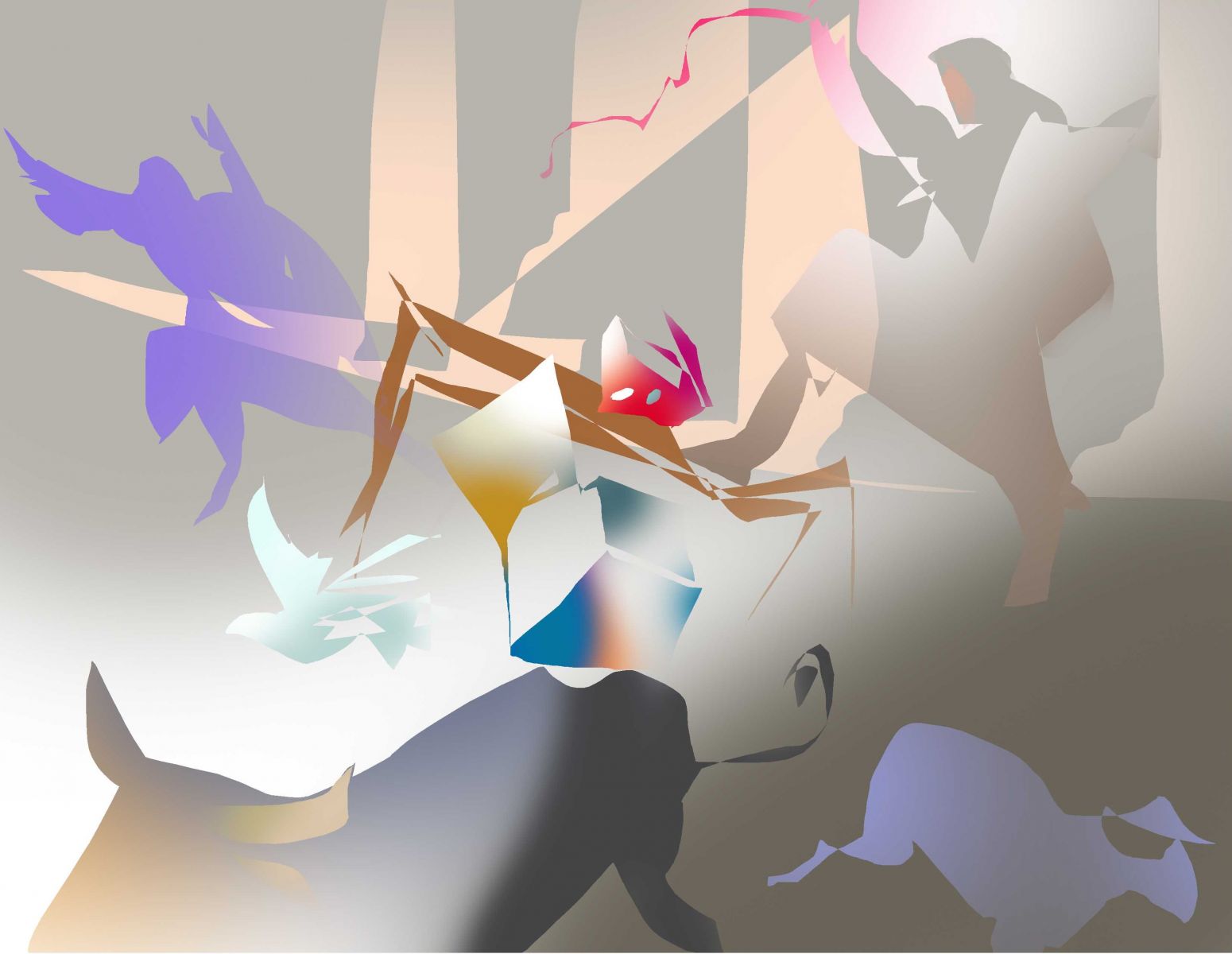
Friedrich Peter’s The Cleansing of the Temple is pale and abstract. Although its strong lines and movement convey Jesus’ serious distress with the temple, the art has none of the bright color and rough texture we might associate with a middle-Eastern market. Perhaps this helps us not distance ourselves from Jesus’ message by thinking he’s talking about some exotic and foreign bazaar. The magenta money box in the center of the print could be a symbol of our own strategies for control and security. Our own profit-oriented ministries. Our own self-centered ways of forgetting God’s expansive welcome to all.
Prayer
Holy Spirit, make today’s lesson for my heart clear to me. Do I need to submit to the master gardener in order to live a more fruitful life? Is my spiritual life short on faith or lacking in forgiveness? Have I been hoarding what has been given to me instead of giving it back to God? Does my church care so much about financial stability or moral rule-keeping that we have edged far from the Father’s will? Have I, or has my church, been constructing barriers so that people from different ethnic groups are kept away from instead of drawn to God? Speak to me, please, Lord.
Dr. Kitty Purgason
Professor Emerita of Applied Linguistics and TESOL
Biola University
For more information about the artwork, music, and poetry selected for this day, we have provided resources under the “About” tab located next to the “Devotional” tab near the top of the page.
About the Artwork
The Cleansing of the Temple
Friedrich Peter
Digital print
Size: Variable
This digital work by the German Canadian artist Friedrich Peter pictures the cleansing of the temple in an expressive manner. After a long life of design, calligraphy, and painting in water colors, also as an instructor at the Academy of Art in Vancouver, Canada, Peter reached for digital art when an illness forced him to stay inside. He strove for spontaneity and “blessed effortlessness” in these works. Jesus, with a red face and a pink whip, rises high in the upper right section of the picture. He kicks over the table, causing the cage of the dove to break open and enabling the dove to escape. One man, a bull, and a sheep also run away in the face of Jesus’s holy anger. The ignominious money box, exactly in the middle of the picture, will be smashed to pieces, as Jesus cannot endure to see His Father’s house sunk to the level of a marketplace. God does not tolerate other gods beside Himself.
About the Artist
Friedrich Peter (b. 1933) was born in Germany. After an apprenticeship in graphic arts in East Germany, he studied at the Academy of Visual Arts in West Berlin from 1950 to 1957. He married and came to Canada in 1957, settling and raising a family in Vancouver, British Columbia. He has taught at the Vancouver School of Art, the Vancouver College of Art, and the Emily Carr Institute of Art and Design. Throughout his long teaching career, Peter pursued his own diverse work, including painting, book illustration, calligraphy, and design (coins, medals, postage stamps, banners, and murals). Award-winning typeface designs including Vivaldi have brought him international recognition. He has sustained a continuing interest in the intersection of painting, calligraphy, and computer graphics. The discovery of the spiritual dimension of life has shaped him, and his work reflects the liberating experience of faith, hope, and joy in the freedom to create.
About the Music
“House of Prayer”
Your presence is not for sale
Your Word is not merchandise
We’re not here to trade our worship
For ways You can bless our lives
We’re not here to make a profit
We’re not here to steal what’s Yours
We’re turning the tables over
There’s only room for the Lord’s
This is a House of Prayer
This is a House of Prayer
Your Spirit above our schedules
Our sermons, our sets, our views
We won’t stand between Your people
And how You might choose to move
We’re not here to build a brand
Or platforms that serve ourselves
‘Cause only the Church You’re building
Can withstand the gates of hell
This is a House of Prayer
This is a House of Prayer
This is a House of Prayer
This is a House of Prayer
In Your House there’s more than a song
In Your House the weak are made strong
In Your House the hearts that are broken will be restored
Will be restored
In Your House we share what we own
In Your House the orphans find home
In Your House the widows in need are provided for
Provided for
In Your House we pray for the sick
In Your House we move in Your gifts
In Your House Your Spirit pours out and there’s always more
There’s always more
In Your House the bound are set free
In Your House the enemy flees
In Your House we witness the Gospel worth dying for
Worthy dying for
In Your House we take of the bread
In Your House we drink of the wine
In Your House we honour You Jesus above it all
Above it all
In Your House let Your Kingdom come
In Your House let Your will be done
In Your House we give all the glory to You alone
To You alone
This is a House of Prayer
This is a House of Prayer
This is a House of Prayer
This is a House of Prayer
About the Composer/Performer
Mitch Wong is an Australian-born Grammy award–winning songwriter and worship leader residing in Nashville with his wife, Steph. He began writing songs as a teenager and quickly developed an obsession for it—captivated by the miracle of how atmospheres can shift, lives can change, and faith can break out at the sound of music, melody, and a message. It’s a mystery that he hasn’t fully figured out and hopes he never will. With this in mind, Mitch is passionate about making music that moves the heart of God and ministers to the church. His sound ranges from energetic praise to intimate, psalm-like worship, all created with the intent of drawing people to Jesus. To this day, he is incredibly humbled by and grateful for the opportunities he has had to write songs and sing them, whether in crowded rooms or alone with the Lord. He has collaborated with some of today’s most influential Christian worship leaders, such as CeCe Winans, Chris Tomlin, Matt Redman, and Brooke Ligertwood.
About the Poetry and Poet
Denise Levertov (1923–1997) was a British-born American poet who became one of the most respected voices in twentieth-century poetry. She published more than two dozen books of poetry as well as essays and translations, and her work ranged from lyrical explorations of everyday experience to politically engaged protest poetry. Influenced early in her career by the Black Mountain poets and by writers such as William Carlos Williams, Levertov’s clear, organic style helped shape American poetry in the postwar era. She moved to the United States in 1948, became a naturalized citizen, and taught at institutions including Stanford University. Among her honors were the Shelley Memorial Award and the Robert Frost Medal.
About the Devotion Writer
Kitty Barnhouse Purgason is professor emerita of TESOL at Biola University. The author of Professional Guidelines for Christian English Teachers (William Carey Library), she is a three-time Fulbright fellow and a US State Department English Language Specialist. She is a grandmother, mother, and widow.