March 6: Christ' Sovereignty Over Nature
♫ Music:
Mark 4: 35-41 (NJKV)
On the same day, when evening had come, He said to them, “Let us cross over to the other side.” Now when they had left the multitude, they took Him along in the boat as He was. And other little boats were also with Him. And a great windstorm arose, and the waves beat into the boat, so that it was already filling. But He was in the stern, asleep on a pillow. And they awoke Him and said to Him, “Teacher, do You not care that we are perishing?”
Then He arose and rebuked the wind, and said to the sea, “Peace, be still!”And the wind ceased and there was a great calm. But He said to them, “Why are you so fearful? How is it that you have no faith?” And they feared exceedingly, and said to one another, “Who can this be, that even the wind and the sea obey Him!”
Mark 6:45–52 (NKJV)
Immediately He made His disciples get into the boat and go before Him to the other side, to Bethsaida, while He sent the multitude away. And when He had sent them away, He departed to the mountain to pray. Now when evening came, the boat was in the middle of the sea; and Hewas alone on the land. Then He saw them straining at rowing, for the wind was against them. Now about the fourth watch of the night He came to them, walking on the sea, and would have passed them by. And when they saw Him walking on the sea, they supposed it was a ghost, and cried out; for they all saw Him and were troubled. But immediately He talked with them and said to them, “Be of good cheer! It is I; do not be afraid.” Then He went up into the boat to them, and the wind ceased. And they were greatly amazed in themselves beyond measure, and marveled. For they had not understood about the loaves, because their heart was hardened.
Poetry
“Maybe”
by Mary Oliver
Sweet Jesus, talking
his melancholy madness,
stood up in the boat
and the sea lay down,
silky and sorry.
So everybody was saved
that night.
But you know how it is
when something
different crosses
the threshold — the uncles
mutter together,
the women walk away,
the young brother begins
to sharpen his knife.
Nobody knows what the soul is.
It comes and goes
like the wind over the water —
sometimes, for days,
you don’t think of it.
Maybe, after the sermon,
after the multitude was fed,
one or two of them felt
the soul slip forth
like a tremor of pure sunlight
before exhaustion,
that wants to swallow everything,
gripped their bones and left them
miserable and sleepy,
as they are now, forgetting
how the wind tore at the sails
before he rose and talked to it —
tender and luminous and demanding
as he always was —
a thousand times more frightening
than the killer sea.
“Peace, Be Still.”
The sea in Mark’s Gospel is not merely scenery. It is restless, threatening, and unpredictable, much like the fears that rose within the disciples and, even now, within ourselves. In today’s passages, the waters become the place where Jesus reveals not only His power over nature, but also His nearness to those who are afraid. The chaos of the sea exposes what lies beneath the surface of the human heart: fear, doubt, and the longing for rescue.
The disciples are seasoned fishermen, yet they are undone by a sudden storm. Waves crash into the boat while Jesus sleeps, and their fear sharpens into accusation: “Teacher, do You not care that we are perishing?” When Jesus rises, He does not wrestle the storm. He speaks to it with divine authority. “Peace, be still!” The sea responds instantly. The disciples ask, “Who can this be, that even the wind and the sea obey Him?” Nature recognizes its Lord before they do.
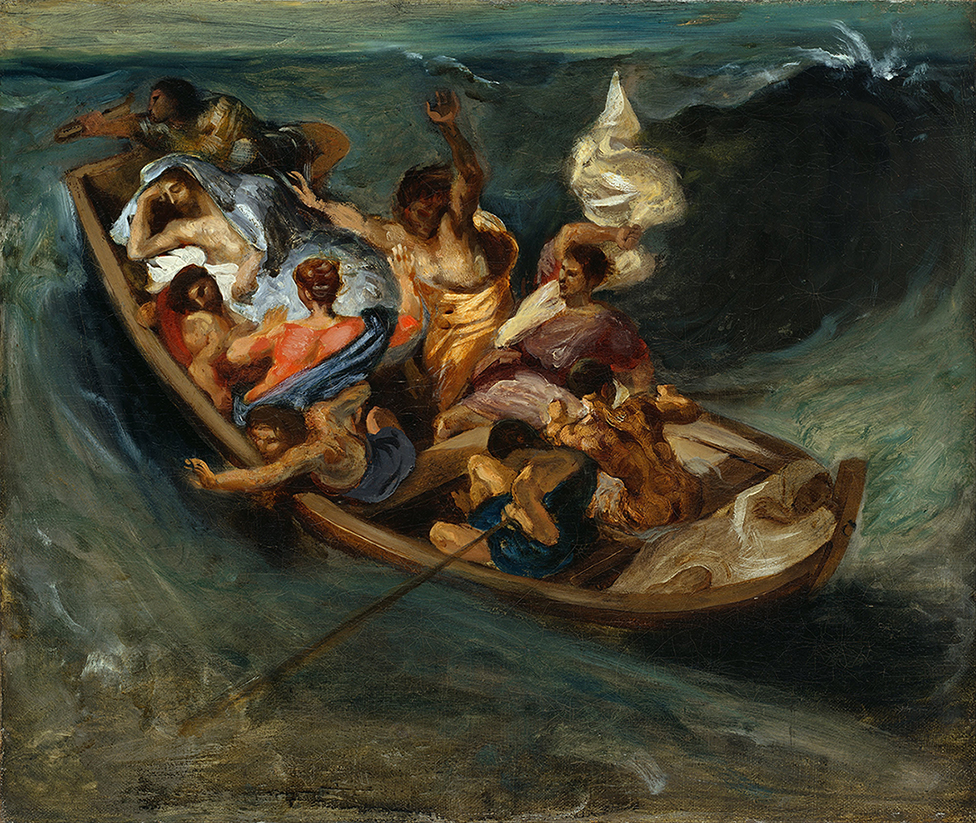
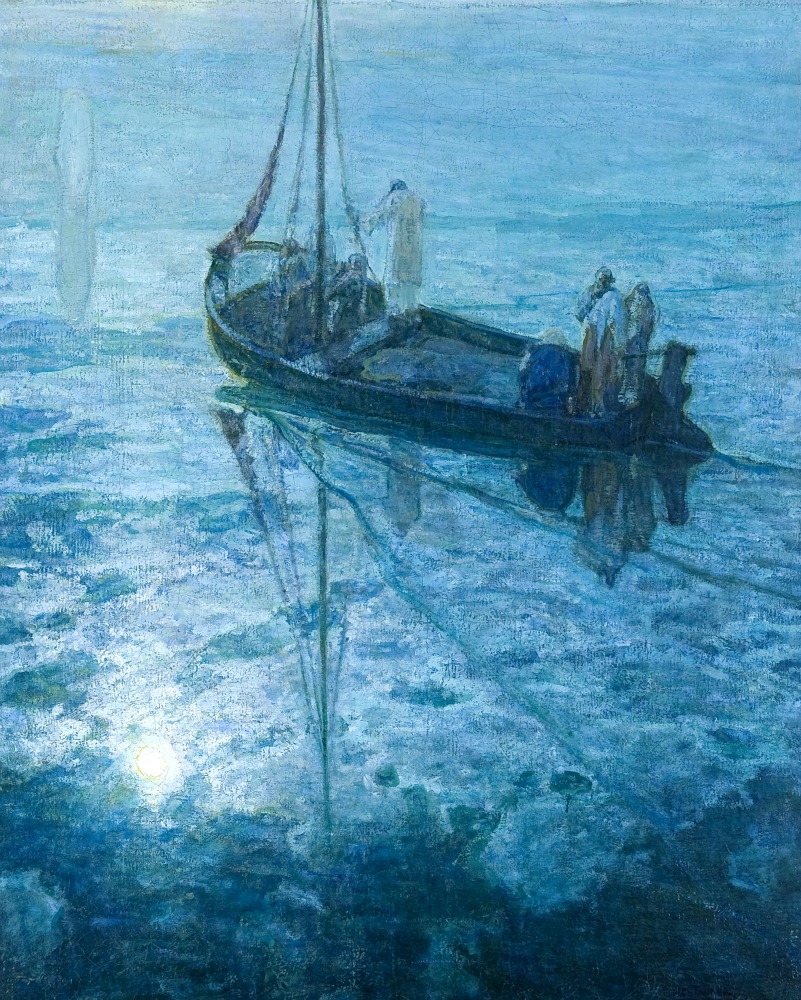
Eugène Delacroix’s Christ on the Sea of Galilee captures this moment of terror through dark tones and strained figures. The disciples labor against the chaos, their bodies twisted with fear, while Christ is pictured sleeping peacefully amid the storm. Henry Ossawa Tanner’s The Disciples See Christ Walking on Water reiterates this tension as the disciples are illuminated by moonlight, confronted with an ethereal and unsettling vision of a Lord they do not yet recognize. “Be of good cheer! It is I; do not be afraid.” Once again, Jesus reveals His assured authority and compassionate presence in their time of fear.
The hymn, “Master, the Tempest Is Raging,” echoes the disciples’ cry and our own. We sing it not because storms disappear, but because Christ meets us within them. His authority, although absolute, does not always remove “struggles or evil whatever it be”, but still assures us that chaos does not reign. “Peace, be still; peace, be still.”
Whether Jesus seems asleep, distant, or suddenly near, He is and always has been near, both to the disciples and to us. His presence is not measured by our clear sight of Him or by the calmness of our circumstances, but by His faithful promise to remain with His people. In moments of fear, silence, or exhaustion, Christ does not abandon the boat. He does not abandon us. He sees our struggle and comes to us in His perfect time, revealing that even when we cannot perceive Him, His sovereign care is at work. As Mary Oliver puts it, He is a Savior who is “a thousand times more frightening / than the killer sea.”
The question that remains for us is whether we will trust Him when the waters rise and recognize His presence when He comes to us in the dark.
Prayer
Lord, in moments when the waters rise and the night feels long, grant us eyes to recognize Your presence. When we cry out amid the storm, remind us that You hear us, that You see our struggle, and that You are never absent from us. Speak Your peace over our chaos, in Your perfect time and according to Your will, and lead us to rest in the assurance that even the wind and the waves still obey Your voice. Amen.
Sarah Bucek
CCCA Staff
Biola Alumna
For more information about the artwork, music, and poetry selected for this day, we have provided resources under the “About” tab located next to the “Devotional” tab near the top of the page.
About the Artwork | 1
Christ on the Sea of Galilee
Eugène Delacroix
1841
Oil on canvas
59.8 × 73.3 cm
The Nelson-Atkins Museum of Art
Kansas City, Missouri
Public Domain
French painter Eugene Delacroix was profoundly attracted by this biblical subject showing Christ asleep during a storm, His disciples terrified by a raging sea. He referred to the subject as early as 1824–1826 in a sketchbook at the Louvre. From 1841, Delacroix began to work on the theme of Christ on the Sea of Galilee, and painted the first two pictures. He returned to the theme in 1853–1854 when he made four other versions of it. Quite small paintings, they were probably intended for friends or collectors. The most famous painting of this series is the one at the Metropolitan Museum of New York. The figures’ expressionism, the impetuous and unleashed handling, and the dark and intense colours gave rise to great admiration. Van Gogh upon viewing the painting wrote, “Ah – E. DELACROIX’s beautiful painting – Christ’s boat on the sea of Galilee, he – with his pale lemon halo – sleeping, luminous – within the dramatic violet, dark blue, blood-red patch of the group of stunned disciples. On the terrifying emerald sea, rising, rising all the way up to the top of the frame.”
(Van Gogh to Emile Bernard, 26 June 1888, in Fritz Erpel (éd.), Vincent van Gogh. Recueil des lettres, t. 5, Borhheim-Merten 1985, p. 261.)
About the Artist
Eugène Delacroix (1798–1863) was a French Romantic artist regarded from the outset of his career as the leader of the French Romantic School. As a painter and muralist, Delacroix's use of expressive brushstrokes and his study of the optical effects of color profoundly shaped and influenced the work of the impressionists, while his passion for the exotic inspired the artists of the symbolist movement. A fine lithographer, Delacroix illustrated various works of William Shakespeare, the Scottish author Walter Scott, and the German author Johann Wolfgang von Goethe. Dramatic and romantic content characterized the central themes of his mature work, and led him not to the classical models of Greek and Roman art, but to travel to North Africa, in search of the exotic. He was inspired by the art of Rubens and painters of the Venetian Renaissance. Delacroix was also strongly inspired by Lord Byron, with whom he shared a strong identification and passion with the "forces of the sublime" in nature.
About the Artwork | 2
The Disciples See Christ Walking on Water
Henry Ossawa Tanner
1907
Oil on canvas
51.5 x 42 in.
Des Moines Art Center
Des Moines, Iowa
Public Domain
Artist Henry Ossawa Tanner favored religious subjects, in part because of his family’s strong spiritual convictions and professional ties to the church. In the painting entitled The Disciples See Christ Walking on the Water, rather than making Jesus the focus of the composition, Tanner highlights both the mystical atmosphere and the apostles’ startled reactions to the apparition walking upon the sea. The composition is cropped below the horizon line, which allows for the entire event to happen in the monochromatic expanse of the water, enhancing the uncanny tone of the work. Interestingly, Tanner portrays the sea as calm, although the gospel describes it as “tossed with waves,” because he preferred meditative scenes. In the boat, each apostle poses with expressive tension—Peter, the tallest figure, lowers his head and appears to be either extending his arms in acceptance or perhaps grasping the rigging for security, another kneels in prayer yet arches backwards with trepidation, and the figures in the stern cower and cover their eyes. Christ is depicted as a ghostly column of light in the upper left corner of the painting, and His path is lit by the moon’s reflection on the sea. Alongside this compelling narrative, the painting is one the strongest examples of Tanner’s masterful use of color. The thick layers of paint add a rich texture to the surface, and add even more depth and shading to the water, sky, and figures.
About the Artist
Henry Ossawa Tanner (1859–1937) was an American artist who spent much of his career in France. He became the first African American painter to gain international acclaim. Tanner moved to Paris, France, in 1891 to study at the Académie Julian and gained acclaim in French artistic circles. In 1923, the French government elected Tanner Chevalier of the Legion of Honor. Tanner painted landscapes, religious subjects, and scenes of daily life in a realistic style that echoed that of painter Thomas Eakins. While works like The Banjo Lesson depicted everyday scenes of African American life, Tanner later painted religious subjects. It is likely that Tanner's father, a minister in the African Methodist Episcopal Church, was a formative influence for him.
About the Music
“Master the Tempest is Raging” from The Good and the Beautiful
Master, the tempest is raging.
The billows are tossing high.
The sky is o'ershadowed with blackness.
No shelter or help is nigh.
Carest Thou not that we perish?
How canst Thou lie asleep,
When each moment so madly is threat’ning,
A grave in the angry deep?
Master, with anguish of spirit,
I bow in my grief today.
The depths of my sad heart are troubled.
Oh, waken and save, I pray.
Torrents of sin and of anguish,
Sweep o'er my sinking soul.
And I perish, I perish, dear Master.
Oh, hasten and take control.
The winds and the waves shall obey Thy will.
Peace, be still; peace, be still.
Whether the wrath of the storm-tossed sea
Or struggles or evil whatever it be.
No water can swallow the ship where lies.
The Master of ocean and earth and skies.
They all shall sweetly obey Thy will.
Peace, be still; peace, be still.
They all shall sweetly obey Thy will.
Peace, peace, be still.
Master, the terror is over,
The elements sweetly rest.
Earth's sun in the calm lake is mirrored,
And Heaven’s within my breast.
Linger, oh blessed Redeemer.
Leave me alone no more.
And with joy I shall make the blest harbor
And rest on the blissful shore.
The winds and the waves shall obey Thy will.
Peace, be still; peace, be still.
Whether the wrath of the storm-tossed sea,
Or struggles or evil whatever it be.
No water can swallow the ship where lies,
The Master of ocean and earth and skies.
They all shall sweetly obey Thy will.
Peace, be still; peace, be still.
They all shall sweetly obey Thy will.
Peace, peace, be still.
About the Composers
Mary Anna Baker (1832–1925) was an American composer and singer. She was an active member of a Baptist congregation. She is known for her temperance songs. "Master the Tempest is Raging" was composed by Baker and H. R. Palmer. In 1874 Baker was commissioned by Palmer to compose a song related to the biblical verses about Jesus stilling the tempest. Baker and Palmer's hymn enjoyed some moderate appeal amongst religious schools and churches. Almost two decades later Baker reflected on a new political connection for her composition: "During the weeks when we kept watch by the bedside of our greatly beloved President Garfield, it was republished as especially appropriate to the time, and was sung at some of the many funeral services held throughout the United States." During the twentieth century, the hymn gained lasting popularity, appearing in more than 254 hymnals to date.
Horatio Richmond Palmer (1834-1907) was an American composer, musician, and hymnwriter who made significant contributions to the world of church music. Palmer is best known for his work as a hymnwriter. One of his most famous hymns is "Yield Not to Temptation," which he composed in 1868. This hymn became widely popular and has been included in numerous hymnals and collections over the years. It is characterized by its uplifting message and memorable melody. In addition to composing hymns, Palmer was also an editor of hymnbooks, contributing to the musical education and worship practices of many churches. His editorial work ensured that a wide range of hymns and sacred music reached congregations across America and beyond. Throughout his career, Palmer remained dedicated to the spiritual and musical enrichment of church communities. His hymns continue to be sung and cherished by congregations worldwide, reflecting his enduring legacy in church music.
About the Performers
Life in 3D is Daylon, Daura, and Devon, three siblings who love to create harmonies and uplift others through their music. One day while doing dishes, they started harmonizing in the kitchen and their parents told them that they sounded pretty good. So, they turned to YouTube to create a few videos to share with their family and to learn how to create inspiring music together.
About the Poetry and Poet
Mary Oliver (1935–2019) was an American poet who won the National Book Award and the Pulitzer Prize. Oliver’s poetry was grounded in memories of Ohio and her adopted home of New England. Influenced by both Walt Whitman and Henry David Thoreau, she is known for her clear and poignant observances of the natural world. Her poems are filled with imagery from her daily walks near her home: shore birds, water snakes, the phases of the moon, and humpback whales. Oliver has been compared to Emily Dickinson, with whom she shares an affinity for solitude and inner monologues. “Mary Oliver’s poetry is an excellent antidote for the excesses of civilization,” wrote one reviewer for the Harvard Review, “for too much flurry and inattention, and the Baroque conventions of our social and professional lives. She is a poet of wisdom and generosity whose vision allows us to look intimately at a world not of our making.
About the Devotion Writer
Sarah Bucek is an alumna of Biola University and currently serves on staff with the Center for Christianity, Culture, and the Arts. In her role, she helps tell the story of how faith and creativity intersect through the work of artists, writers, and musicians. In her spare time, she can usually be found surrounded by her little boys—and finding new ways to wear them out. She is married to Andrew, who is also a Biola alumnus.