February 24: Jesus Challenges Traditional Religious Assumptions
♫ Music:
Mark 2:18-3:6 (NKJV)
The disciples of John and of the Pharisees were fasting. Then they came and said to Him, “Why do the disciples of John and of the Pharisees fast, but Your disciples do not fast?”
And Jesus said to them, “Can the friends of the bridegroom fast while the bridegroom is with them? As long as they have the bridegroom with them they cannot fast. But the days will come when the bridegroom will be taken away from them, and then they will fast in those days. No one sews a piece of unshrunk cloth on an old garment; or else the new piece pulls away from the old, and the tear is made worse. And no one puts new wine into old wineskins; or else the new wine bursts the wineskins, the wine is spilled, and the wineskins are ruined. But new wine must be put into new wineskins.”
Now it happened that He went through the grainfields on the Sabbath; and as they went His disciples began to pluck the heads of grain. And the Pharisees said to Him, “Look, why do they do what is not lawful on the Sabbath?”
But He said to them, “Have you never read what David did when he was in need and hungry, he and those with him: how he went into the house of God in the days of Abiathar the high priest, and ate the showbread, which is not lawful to eat except for the priests, and also gave some to those who were with him?”
And He said to them, “The Sabbath was made for man, and not man for theSabbath. Therefore the Son of Man is also Lord of the Sabbath.”
And He entered the synagogue again, and a man was there who had a withered hand. So they watched Him closely, whether He would heal him on the Sabbath, so that they might accuse Him. And He said to the man who had the withered hand, “Step forward.” Then He said to them, “Is it lawful on the Sabbath to do good or to do evil, to save life or to kill?” But they kept silent. And when He had looked around at them with anger, being grieved by the hardness of their hearts, He said to the man, “Stretch out your hand.”And he stretched it out, and his hand was restored as whole as the other. Then the Pharisees went out and immediately plotted with the Herodians against Him, how they might destroy Him.
Poetry
“1985, V”
by Wendell Berry
From A Timbered Choir: The Sabbath Poems 1979-1997, Counterpoint Press
How long does it take to make the woods?
As long as it takes to make the world.
The woods is present as the world is, the presence
of all its past and of all its time to come.
It is always finished, it is always being made, the act
of its making forever greater than the act of its destruction.
It is a part of eternity for its end and beginning
belong to the end and beginning of all things,
the beginning lost in the end, the end in the beginning.
What is the way to the woods, how do you go there?
By climbing up through the six days' field,
kept in all the body's years, the body's
sorrow, weariness, and joy. By passing through
the narrow gate on the far side of that field
where the pasture grass of the body's life gives way
to the high, original standing of the trees.
By coming into the shadow, the shadow
of the grace of the strait way's ending,
the shadow of the mercy of light.
Why must the gate be narrow?
Because you cannot pass beyond it burdened.
To come into the woods you must leave behind
the six days' world, all of it, all of its plans and hopes.
You must come without weapon or tool, alone,
expecting nothing, remembering nothing,
into the ease of sight, the brotherhood of eye and leaf.
Who is This Man: Undiminished by Religious Expectations
As a chaplain, it is not uncommon for me to visit those who are in the hospital. I had been called by a family to come visit them and they shared with me news that was medically devastating. They explained to me that in their religious practice illness, sadness, and suffering were experienced only as outward signs of their god’s displeasure and judgment. I had been invited that day because they had done all the right things to appease their god and illness still found them. There were many tears and a spokesman for the family whispered, “we asked you here because we have noticed that your God is not diminished by sickness.”
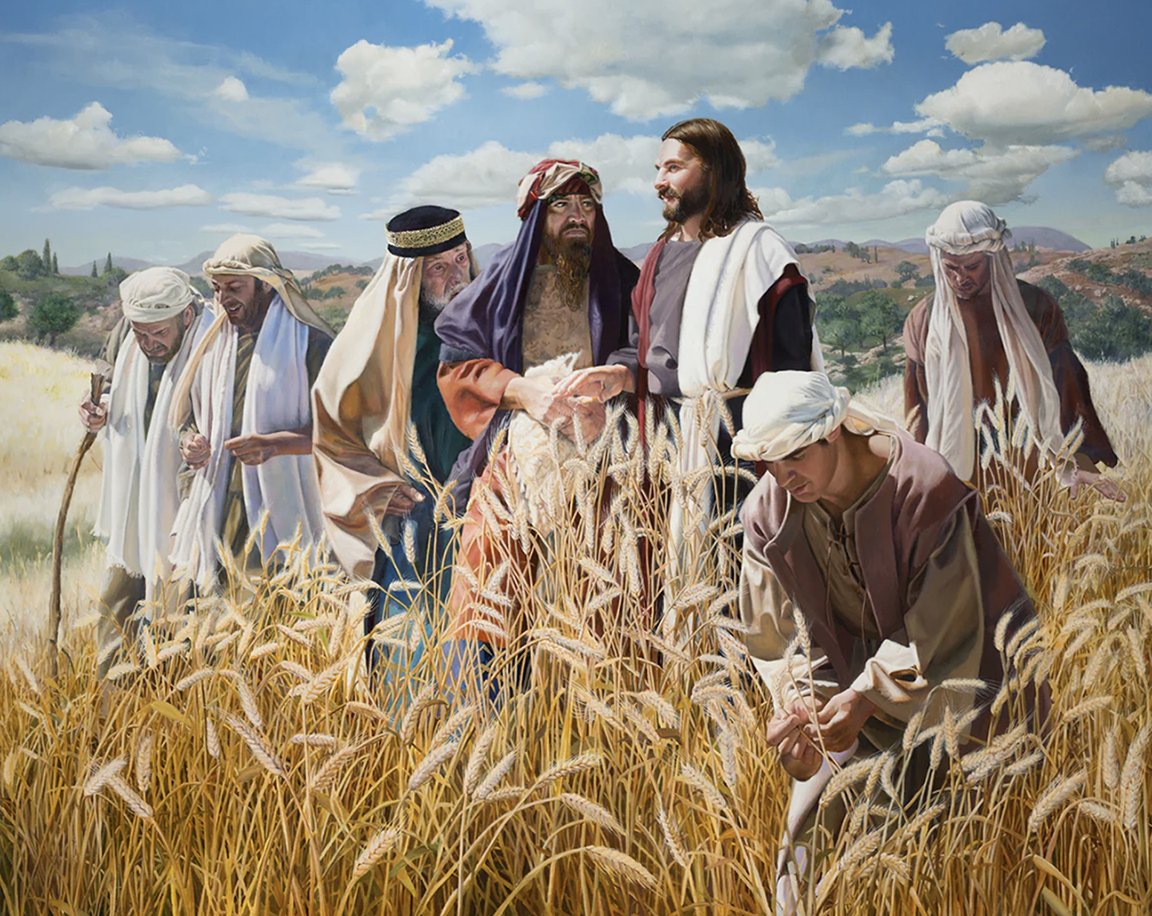
A God undiminished is also the image shared in Mark 2 and 3. The religious men at the time are quick to notice, judge, and question Jesus’ behavior. They comment upon lack of adherence to their understanding of religious piety. Their expectations lead them to the conclusion that goodness, holiness, and righteousness must be absent. Liz Swindle paints their faces squinting to gain understanding of behaviors and control over their own righteousness. Their own religious expectations blinding them from seeing God Himself in human form in front of them.
Like the Pharisees, our own expectations of outcomes and right behavior can blind us to God Himself. A quest for pleasing God is not bad, unless our expectations of what pleases God detracts from God Himself and our need for a Messiah.
Undiminished. Jesus is not merely declaring His Messianic nature in His response to religious leaders. Jesus is making a declaration that He alone is “Lord of the Sabbath.” Mark emphasizes that it is God Himself that defines what true obedience and mercy look like—not merely adherence to external expectations.
In his poem, Wendell Berry paints a picture of God’s heart by describing a path through a field leading to a grove of trees. He describes the walk as one marked by “Sorrows, weariness, and joy.” His image of life’s journey is not limited by expected results of obedience but instead includes all ranges of emotions and experiences and is defined by God’s “shadow of grace” and calling to an unburdened life in God that is free from what is expected as God himself removes our burden.
The family spokesman continued, “A God undiminished is more powerful in suffering than a god controlled by it.” The image of the withered hand in Mark and the coinciding Sabbath day expectations did not diminish God’s response. In the hospital the illness before me did not diminish the truth that God spoke through this family and their suffering. We serve an undiminished God.
Prayer
Dear God, let us not diminish You through our expectations, but embrace You as Messiah in the unexpected. Increase our faith in who You are and let our religious structures, rhythms, and obedience draw us toward Your Lordship.
Amie Cross, M.Div.
Chaplain and Missionary
Alumna of Torrey Honors College
Biola University
For more information about the artwork, music, and poetry selected for this day, we have provided resources under the “About” tab located next to the “Devotional” tab near the top of the page.
About the Artwork | 1
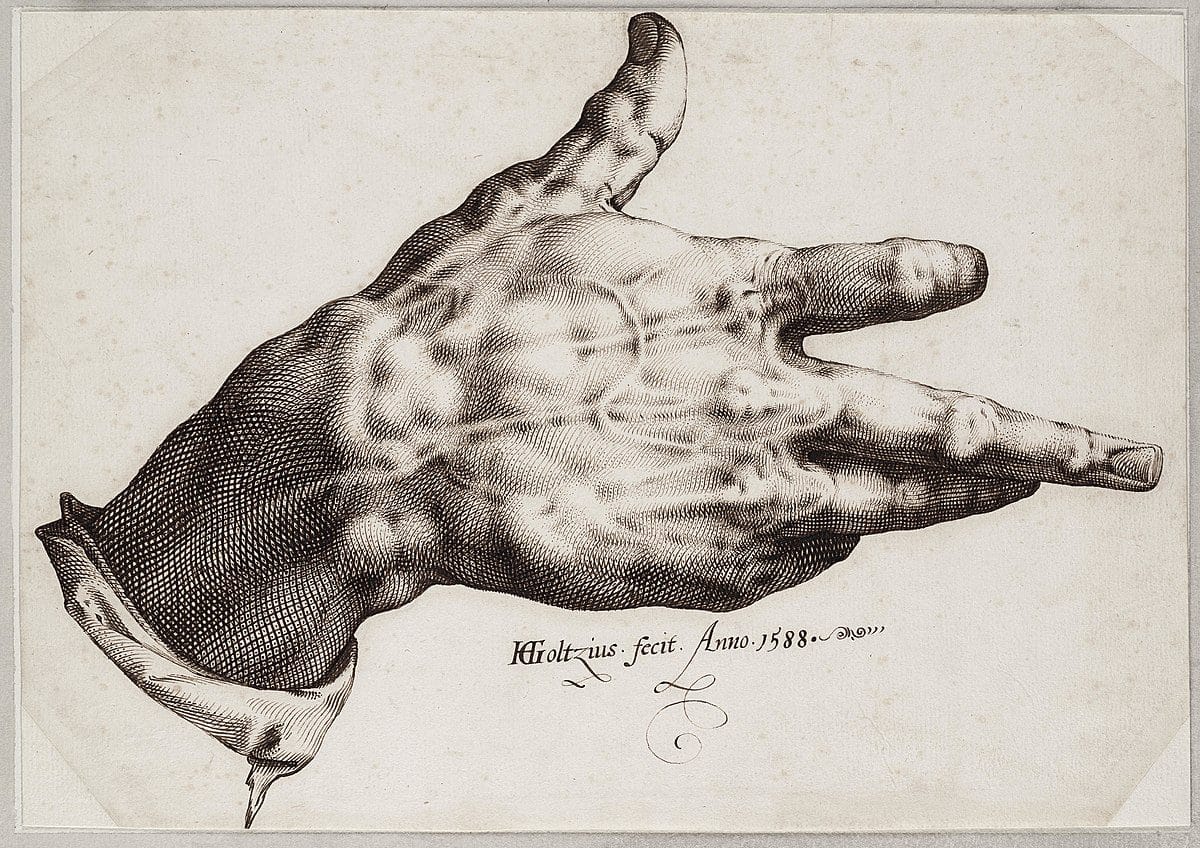
Right Hand
Hendrick Goltzius
1588
Pen in brown ink on paper
230 x 322 cm
Teylers Museum
Haarlem, The Netherlands
Public Domain
Artist Henrick Goltzius had a malformed right hand. The damage was caused by a fire when he was just an infant. This hand turned out to be especially well-suited to holding the burin, a steel tool used for engraving.
About the Artist
Hendrick Goltzius (1558–1617) was a German-born Dutch printmaker, draftsman, and painter. He was the leading Dutch engraver of the early baroque period or Northern mannerism, lauded for his sophisticated technique, technical mastership, and the "exuberance" of his compositions. According to A. Hyatt Mayor, Goltzius "was the last professional engraver who drew with the authority of a good painter and the last who invented many pictures for others to copy.” In the middle of his life he began to produce paintings.
About the Artwork | 2
Lord of the Sabbath
Liz Lemon Swindle
Oil on canvas
Used with permission from Havenlight
It was against the Jewish law to gather grain on the Sabbath, so when the Pharisees saw Jesus' disciples plucking and eating as they walked through the fields, they complained. But Jesus reminded them that Sabbath was made for man, and not man for the Sabbath. From the very beginning, God gave His children the gift of the Sabbath day, a time each week to draw closer to His Son by leaving behind the cares of the world. This painting reminds us to keep the Sabbath day holy.
About the Artist
Liz Lemon Swindle (b. 1953) is a painter and artist known for her religious paintings. Swindle studied fine arts at Utah State University. She tutored under wildlife artist Nancy Glazier and worked as a set designer and painter. Her early success was for work as a wildlife artist, and her work was featured in western galleries. She received the Founders Favorites Award from the National Park Foundation and experienced a career turning point when she shifted to portraiture. Swindle is perhaps most known for her paintings of Jesus Christ.
About the Music
"Come Sunday" from Black, Brown and Beige - Accapella
Lord, dear Lord of love
God almighty, God above
Please look down and see my people through
God, dear God of love
God almighty, God above
Please look down and see my people through
I believe the sun and moon
Will shine up in the sky
When the day is gray
I know it's clouds passing by
He'll give peace and comfort
To every troubled mind
Come Sunday, oh come Sunday, that's the day
Often we'll feel weary
But he knows our every care
Go to him in secret
He will hеar your every prayer
Liliеs on the valley
They neither toil nor spin
And flowers bloom and springtime birds sing
Often we'll feel weary
But he knows our every care
Go to him in secret
He will hear your every prayer
Up from dawn 'til sunset
Man work hard all day
Come Sunday, oh come Sunday, that's the day
About the Composer/Performer
Duke Ellington (1899–1974) was an American composer, pianist, and bandleader widely regarded as one of the most influential figures in jazz history. Born Edward Kennedy Ellington in Washington, D.C., he rose to prominence in the 1920s and led his renowned orchestra for more than fifty years. The Duke Ellington Orchestra became one of the most important ensembles in jazz, known for its distinctive sound, virtuosic soloists, and innovative arrangements.
Ellington composed thousands of works, including classics such as “Mood Indigo,” “It Don’t Mean a Thing (If It Ain’t Got That Swing),” and “Take the ‘A’ Train.” His music expanded the scope of jazz through extended suites, sacred concerts, and ambitious large-scale compositions that blended improvisation with sophisticated orchestration. Over the course of his career, Ellington received numerous honors, including Presidential recognition and multiple Grammy Awards, cementing his legacy as a defining architect of American music.
About the Performer
Mahalia Jackson (1911-1972) is known as the “Queen of Gospel” and is revered as one of the greatest musical figures in United States history. Jackson initially found her inspiration at Mt. Moriah Baptist Church in New Orleans, Louisiana, where she sang throughout her childhood. After devouring the music of singers like Bessie Smith in her teen years, Mahalia developed a much freer and more rhythmic style. In 1947, her hit recording “Move On Up a Little Higher,” sold millions of copies, becoming the most purchased gospel single in history. As a result she was catapulted to international celebrity. Dr. Martin Luther King, Jr. asked her to sing at the 1963 March on Washington where she galvanized the audience. Jackson is remembered for her impassioned singing, her deep commitment to Christ, and her lasting inspiration to listeners of all faiths.
About the Poetry and Poet
Wendell Erdman Berry (b. 1934) is an American novelist, poet, environmental activist, cultural critic, and farmer who was educated at the University of Kentucky, where he became Distinguished Professor of English in 1971. The intensity of his writing’s involvement with the human and natural characters of his native locality has gained Berry recognition as one of the leading writers of the twentieth century. A prolific author, he has written many novels, short stories, poems, and essays. He is an advocate of Christian pacifism, as shown in his book Blessed Are the Peacemakers: Christ’s Teachings About Love, Compassion and Forgiveness. He states that the theme in his writing is “that all people in the society should be able to use the gifts that they have, their natural abilities, and they ought to use them responsibly for their benefit as individuals and as a community.” Berry was named the recipient of the 2013 Richard C. Holbrooke Distinguished Achievement Award, an annual US literary award recognizing the power of the written word to promote peace.
About the Devotion Writer
Amie Cross has lived in East Africa for thirteen years. She completed her undergraduate studies at Biola as a part of the Torrey Honors Society cohort before getting her MDiv in Community Chaplaincy. For the last four years she has served as a school chaplain for an international school. She is grateful for the opportunity to witness God’s undiminished nature in day to day life. She describes it as having a front row seat to a God that transcends class, race, injustice, and suffering. In free time you can find her writing, playing board games and swinging on hammocks with her husband and five kids.