February 23: Christ Eats With Sinners
♫ Music:
Mark 2:13-17 (NKJV)
Then He went out again by the sea; and all the multitude came to Him, and He taught them. As He passed by, He saw Levi the son of Alphaeus sitting at the tax office. And He said to him, “Follow Me.” So he arose and followed Him.
Now it happened, as He was dining in Levi’s house, that many tax collectors and sinners also sat together with Jesus and His disciples; for there were many, and they followed Him. And when the scribes and Pharisees saw Him eating with the tax collectors and sinners, they said to His disciples, “How is it that He eats and drinks with tax collectors and sinners?”
When Jesus heard it, He said to them, “Those who are well have no need of a physician, but those who are sick. I did not come to call the righteous, but sinners, to repentance.”
Poetry
“Augustine’s Pears”
by Chard deNiord
“For the sake of a laugh, a little sport, I was glad to do harm
and anxious to do another, and without thought of profit
for myself or retaliation for injuries received! And all because
we are ashamed to hold back when others say “Come on! Let’s do it!”
—Augustine’s Confessions
“O taste and see!” I called to the others, for it
was foul and I loved it: The mere idea of stealing
them—the mauve safou—from my neighbor’s tree,
a sweet desire my mind’s dark tongue
was first to savor again and again before
my other tongue, so pink and dumb. But this
was before I suffered grace which has no fruit
and scrubs the soul of any interest in fallen
things, except for these confessions that lie
exposed like grilled oblations for famished angels.
So I shook the branches from top to bottom and tasted
a few that weren’t as sweet as I thought they’d be
but hung like plunder enticing me in women’s
voices to snap them off and stuff my pockets,
then slip away undetected to sweeten
the swill for the swine back home who roam
their sty like former men with terrible hunger.
Who Belongs at Jesus’s Table?
Dynamic good news is walking among the multitude foot-by-foot. That’s the ethos of Mark 2:13-17. Anticipation is in the air.
Mark shows us that Jesus teaches not only through words, but through where He goes, whom He sees, and with whom He dwells.
Mark’s depiction of Jesus swiftly moves through three scenes:
Scene One (2:13): “The multitudes” - a people with varying socioeconomic backgrounds - keep coming toward Jesus and Jesus keeps teaching them. Notice how Jesus responds to their initiation. It’s as if the multitude is saying, “I am needy and I know it! I want what Jesus has.” The hunger of the thirsty is palpable. It’s like the aroma of prayer itself.
Am I also hungry to be taught by Jesus? Do I experience my life under His care and authority?
Scene Two (2:14): Jesus passes by Levi the tax collector sitting in the tax booth. Notice how Jesus sees Levi and then says, “Follow Me.” It matters how Jesus sees. There’s no condition in His call. Levi responds by arising from his seat of status and follows Jesus.
My heart starts to wonder, even hunger.
Do I have a readiness to leave my seat of status/privilege and a willingness to learn (anew) with Jesus by giving my “yes” to His “I see you”? Am I even willing to get out of my head with all of its self-rationalizations? Am I content with being apprehended by Jesus’s gaze vs. stimulated by a multitude of attention-snatchers?
Scene Three (2:15-17): We are now in Levi’s house. It’s a microcosm of “the multitudes.” As Levi follows Jesus, his living faith makes space for others. The generosity of Jesus’s initial sight toward Levi begets hospitality for others. Yet, it’s a very “unclean” hospitality to the ever-correcting eyes of religious behavioral managers: “many tax collectors and sinners also sat together with Jesus and His disciples; for there were many, and they followed Him.”
In what manner will Jesus teach in this place of complex belonging? Will it become a revelatory space? A revelatory moment is emerging, a crucial conversation is at hand.
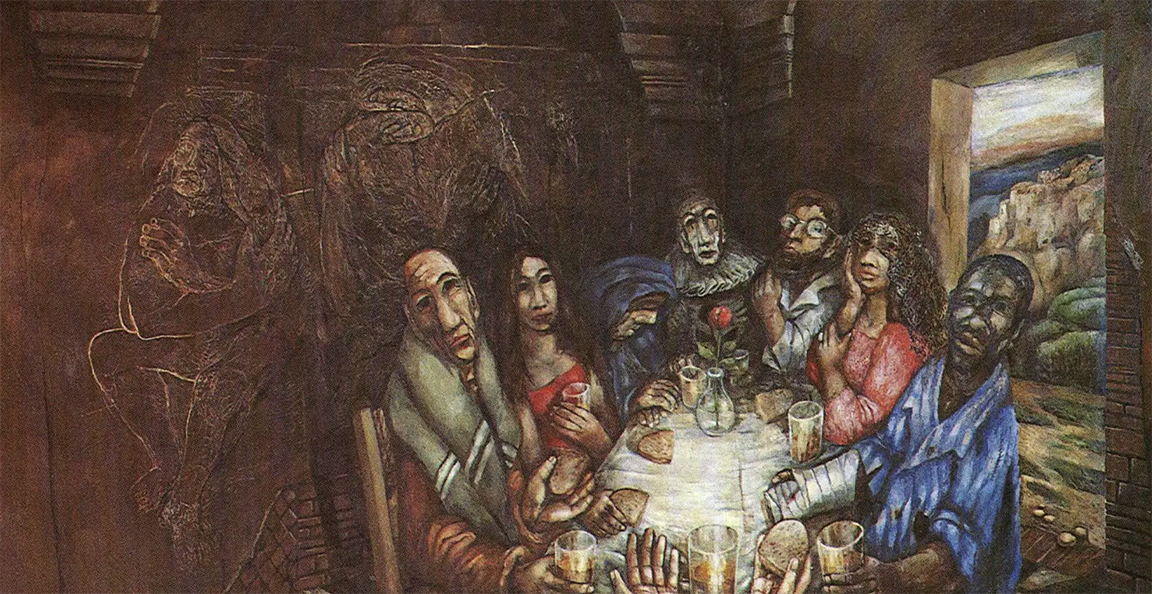
Scene Three crescendos into the climax of our passage and brings us face-to-face with Father Sieger Köder’s magnificent artwork. Linger with it. What do you notice? Etched into the background on the left side, is that meant to be an embracing prodigal son and father?
Do you see how the painting is from the perspective of Him whose hands are extended outward, offering bread to those at the table”? Jesus sees those at the table as His. Do I believe that I am seen as His?
The scene at Levi’s table is a profound mic drop on selfish ambition, vanity, cruelty and callousness with all of its self-righteousness. But to scandalous grace, my inner, sarcastic cynicism boasts with the poet’s words,
“O taste and see!” I called to the others, for [my sin] was foul and I loved it . . .”
When offended by Jesus - including his mercy and generosity toward those “undeserving,” it's easy to put “God in the Dock.” I crave justification for “being offended.”
Do I have the mentality of an “orphan” - existentially abandoned - a cynic, a critic, a suspicious judge of God’s action among “them” who don’t fit my grid? Am I willing to see as Jesus would see or are my eyes being fathered by Scribes and Pharisees . . . and, eventually, like the accusatory mob and Pilate?
Jesus’s presence at Levi’s table is a holy announcement among a wholly messy humanity: “those who are well have no need of a physician, but those who are sick.”
It’s as if Jesus’s table fellowship in Levi’s home foretastes - even becomes - the “Lord’s table,” not just another social gathering or club.
The Son of Man’s words and actions shape the atmosphere:
“I did not come to call the righteous, but sinners, to repentance.”
Receiving these words with honest reception must entail seeing accurately.
Prayer
Jesus,
How can I see myself more clearly as Yours, among the “sick” and “sinners”? I am so easily self-satisfied to be among self-justified, spiritual orphans?
Clothe me in Your righteousness, my Righteous One - Physician, Healer, Deliverer, Savior. You do not need (my) saving, protecting, rescuing, or defending. I do.
I surrender my control and entrust myself to You, High Priest of Heaven!
Amen.
Joseph E. Gorra
Writer and Educator
Biola Alum
For more information about the artwork, music, and poetry selected for this day, we have provided resources under the “About” tab located next to the “Devotional” tab near the top of the page.
About the Artwork
All Are Welcome (Christ Eats with Sinners)
Father Sieger Köder
1925–29
Oil on canvas
Artist and priest Father Sieger Koder’s painting All Are Welcome (Christ Eats with Sinners) refers to the biblical accounts in which Jesus dined and associated with tax collectors and other marginalized individuals. The religious elite of the day condemned Jesus for keeping company with people they considered unclean and corrupt, such as tax collectors, who were often seen as traitors for collaborating with the Romans. In Koder’s painting, Jesus is invisibly at the center—we only see His hands offering the bread and a cup to the gathered guests, who appear to mostly come from a lower socioeconomic status. At the far left are some (literally) isolated sketchy and shadowy figures—legalists and separatists who didn’t like Jesus and the company He kept. They remain isolated and quietly critical in the dark. Jesus practiced radical hospitality that included everyone, further illustrating Jesus' message of mercy and compassion compared to self-righteous judgment of the Pharisees.
About the Artist
The German priest-painter Father Sieger Köder (1925–2015) was born in Wasseralfingen in Swabia. Koder was a prisoner of war during World War II and also participated in the Catholic Neudeutschland movement. He trained as a silversmith and painter, and worked for some years as a secondary school art teacher. At the age of forty-one he went to study theology in Tubingen and was ordained a priest in 1971. He combined his vocation as a parish priest with his work as an artist, producing numerous paintings, altarpieces, and stained glass windows for churches within and outside Germany. He continued painting long into his retirement, decorating the St. James Pilgrim House in Hohenberg, Germany, with a series of remarkable external murals and setting up eleven stations on the Franconian-Swabian Camino route to Santiago de Compostela. Koder’s work shows the artistic influence of artist Marc Chagall and is distinctive for its strong colors and robust figures.
About the Music
“Jesus, Friend of Sinners” from the album Come to the Well
Jesus, friend of sinners, we have strayed so far away
We cut down people in Your name
But the sword was never ours to swing
Jesus, friend of sinners
The truth's become so hard to see
The world is on their way to You
But they're trippin' over me.
Always lookin' around, but never lookin' up
I'm so double minded
A plank eyed saint with dirty hands
And a heart divided.
Oh, Jesus, friend of sinners
Open our eyes to the world
At the end of our pointing fingers
Let our hearts be led by mercy
Help us reach with open hearts and open doors
Oh, Jesus, friend of sinners
Break our hearts for what breaks Yours.
Yeah, (yeah), yeah.
Jesus, friend of sinners
The one who's writing in the sand
Made the righteous turn away
And the stones fall from their hands.
Help us to remember we are all the least of these
Let the memory of Your mercy
Bring Your people to their knees
Nobody knows what we're for
Only what we're against when we judge the wounded
What if we put down our signs
Crossed over the lines and love like You did?
Oh, Jesus, friend of sinners
Open our eyes to the world
At the end of our pointing fingers
Let our hearts be led by mercy
Help us reach with open hearts and open doors
Oh, Jesus, friend of sinners
Break our hearts for what breaks Yours.
You love every lost cause
You reach for the outcast (every outcast)
For the leper and the lame
They're the reason that You came.
Lord, I was that lost cause (I was that lost cause)
And I was the outcast (and I was the outcast)
But You died for sinners just like me
A grateful leper at Your feet.
'Cause You are good, Oh, You are good
And Your love endures forever
Oh, You are good, You are good
And Your love endures forever.
You are good (You are good)
Yes, You are good (You are good)
And Your love endures forever
Oh, You are good, (You are good)
You are good, (You are good)
And Your love, (and Your love), endures forever.
Jesus, friend of sinners
Open our eyes to the world
At the end of our pointing fingers
Let our hearts be led by mercy
Help us reach with open hearts and open doors
Oh, Jesus, friend of sinners
Break our hearts for what breaks yours.
I was the lost cause
and I was the outcast
You died for sinners just like me
A grateful leper at your feet.
About the Composers
John Mark Hall (b. 1969) is an American musician. He is the lead vocalist for the Georgia-based contemporary Christian music group Casting Crowns, a seven-member group composed of worship leaders. He is also youth pastor at Eagle's Landing First Baptist Church in McDonough. Casting Crowns began as the student worship band that Hall formed while he was serving at First Baptist Daytona Beach in 1999. Other members at that time included Juan DeVevo (guitar), Melodee DeVevo (vocals and violin), Hector Cervantes (guitar), and Darren Hughes (production manager). Mark Hall received several Dove Award nominations at the 36th GMA Dove Awards. In 2007, Hall was nominated for a Dove Award for Male Vocalist of the Year at the 38th GMA Dove Awards. The Casting Crowns song "Praise You in This Storm,” written by Hall, was also nominated for Song of the Year.
Matthew Joseph West (b. 1977) is an American contemporary Christian singer-songwriter. He has released five studio albums and is known for his songs "More," "You Are Everything," and "The Motions." He was nominated for five Dove Awards in 2005, two of which were for his major-label debut album, Happy. West won the 2013 American Music Award for Best Contemporary Inspirational Artist. In addition to his main solo career, West has worked as a songwriter for many Christian musicians and groups, such as Point of Grace, Mandisa, Natalie Grant, and Casting Crowns, as well as mainstream country acts including Rascal Flatts, Billy Ray Cyrus, and Vince Gill.
About the Performers
Casting Crowns is a contemporary Christian and Christian rock band started in 1999 by youth pastor Mark Hall, the band's lead vocalist, as part of a youth group at First Baptist Church in downtown Daytona Beach, Florida. They later moved to Stockbridge, Georgia, where more band members joined. Some members of the band currently work as ministers for Eagle's Landing First Baptist Church in McDonough, Georgia. The band has won both a Grammy and a Dove Award. In 2023, the band announced their The Healer Tour, which included artists Ben Fuller and We Are Messengers.
About the Poetry and Poet
Chard deNiord is the author of nine poetry collections, including Asleep in the Fire; Sharp Golden Thorn; Night Mowing; The Double Truth; Speaking In Turn, a collaboration with Tony Sanders; In My Unknowing; One As Other; and Westminster West. His book Sad Friends, Drowned Lovers, Stapled Songs is a collection of interviews with seven eminent American poets, including Robert Bly, Lucille Clifton, Jack Gilbert, Donald Hall, Galway Kinnell, Maxine Kumin, and Ruth Stone. His second book of interviews, titled I Would Lie To You If I Could: Interviews with Ten American Poets (2018), includes interviews with Natasha Thretheway, Jane Hirshfield, Martin Espada, Steven Kuusisto, Stephen Sandy, Ed Ochester, Carolyn Forche, Peter Everwine, Galway Kinnell, and James Wright's widow, Anne Wright. He also has written a book of essays on contemporary poetry, Some Main Things.
About the Devotion Writer
Joseph Gorra is a frequent contributor to Biola’s Lent and Advent projects. His writings have also appeared at VeritasLifeCenter.org, ChristianityToday.com, Patheos.com, Equip.org, and in various academic publications, including the Journal of Spiritual Formation & Soul Care and the Journal of Markets and Morality.