February 25: Great Multitudes Come to Him for Help
♫ Music:
Mark 3:7–12 (NKJV)
But Jesus withdrew with His disciples to the sea. And a great multitude from Galilee followed Him, and from Judea and Jerusalem and Idumea and beyond the Jordan; and those from Tyre and Sidon, a great multitude, when they heard how many things He was doing, came to Him. So He told His disciples that a small boat should be kept ready for Him because of the multitude, lest they should crush Him. For He healed many, so that as many as had afflictions pressed about Him to touch Him. And the unclean spirits, whenever they saw Him, fell down before Him and cried out, saying, “You are the Son of God.” But He sternly warned them that they should not make Him known.
Mark 6:53-56 (NKJV)
When they had crossed over, they came to the land of Gennesaret and anchored there. And when they came out of the boat, immediately the people recognized Him, ran through that whole surrounding region, and began to carry about on beds those who were sick to wherever they heard He was. Wherever He entered, into villages, cities, or the country, they laid the sick in the marketplaces, and begged Him that they might just touch the hem of His garment. And as many as touched Him were made well.
Poetry
“Crowds Surround Us”
by Tom Thompson
agile founderings and piecemeal flotations.
The crowd constitutes a gravitational field
that slaps back at the ground, numbed
and maddened by ground’s constant suckling.
The crowd embodies a depression in fabric
more than an attraction. Its angled, arteried, fleet
fantasias of need sway in
a loopy, bobbing dance without strings.
It’s this sense of movement the organism uses
to believe in its own existence, the palpable presence
of an intangible parade, uncertain
planetary marches, a supernumerary of stars.
In its mania for artifice the crowd has sewn the sky
with these shiny extras. Embodied
adoration, they snap the organism shut
before tickling it open again
with reedy gestures. Breathe.
The crowd’s louche body
clings and parts in place, an ovation
rigid and adrift, alive. It is the sea
that sweeps the sea.
Broom tight with inner bickering.
A mortal scour. Meaning,
how the crowd hates the crowd.
Outwardly. It admits you or me
as an enormous lidless eye admits glittering
beams. Endless watching, washing us in.
The crowd’s object, its point,
is always vanishing into its own mass. It is a sea
with no concern for us, even as it scores.
The Great Multitudes Come to Him for Help
The theme for this week is the question that runs throughout Mark’s Gospel, “Who is this Man?” Today’s passages, Mark 3:7-12 and Mark 6:53-56, both take place in Galilee, where Jesus has been ministering since His baptism in the Jordan River by John the Baptist, preaching and teaching, forgiving sins, casting out demons, and healing the sick (Mark 1:32-34). People did not really know who Jesus was, but they saw miracles taking place, and, hoping for release from physical and spiritual ailments, had begun to flock around Him and follow Him everywhere.
In Mark 3, Jesus had just restored a man’s shriveled hand at the synagogue at Capernaum before retreating with His disciples to the Sea of Galilee. He often went to the Sea of Galilee as a place of refuge, yet he still could not escape the crowds; they followed him all the way to the shoreline. He had healed so many that more came hoping just to touch him. According to the passage, he asked his disciples to keep a boat nearby “…lest [the multitude] should crush him.”
The poem by Tom Thompson, “Crowds Surround Us,” provides a sense of what Jesus may have experienced in the midst of these crowds, the movement, the sense of disorientation, and above all, the aching needs of the people. “The crowd embodies a depression in fabric more than an attraction. Its angled, arteried, fleet fantasias of need sway in a loopy, bobbing dance without strings.” Jesus cared for the people and wanted to meet their needs, but in his humanity he must have felt exhausted at times as so many surrounded Him.
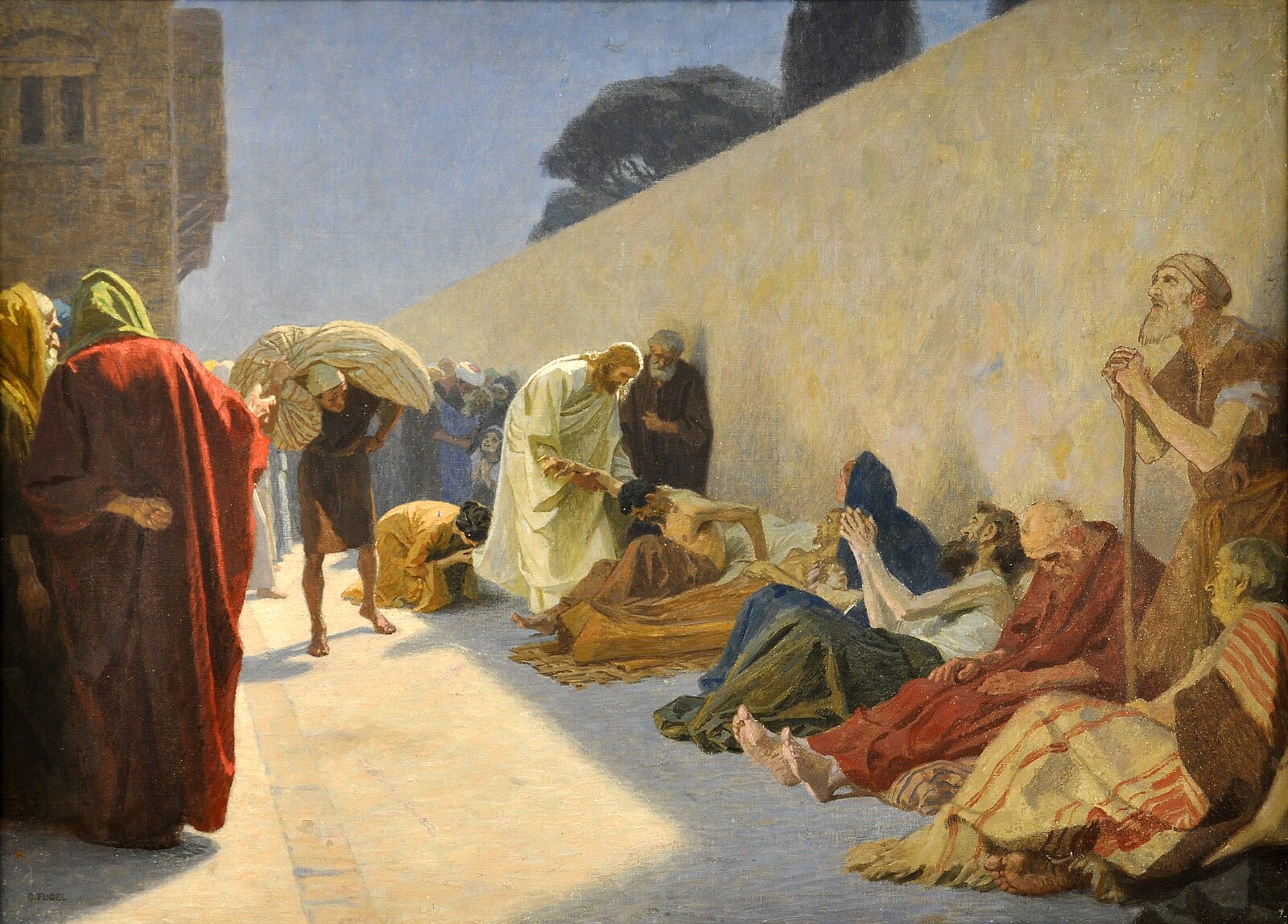
The painting by Gebhard Fugel, Christ Heals the Sick, shows Jesus walking among many gathered with arms outstretched, most unable to stand. The song “Gentle Healer” by Michael Card reveals Jesus’ power to heal although he seemed to be just “…an ordinary man with dirty feet and rough but gentle hands…” Mark 6:53-56 describes how people brought those too sick to walk on beds to see Him and whenever he entered a village or rural area, the sick came or were brought to him in the marketplaces just so they could touch the hem of his garment.
Jesus’ power over physical illness and disability revealed His divine authority, for only God has the power to heal in this way. His casting out of demons revealed His divinity, showing He had power over the spiritual realm as well. Even the demons cried out and recognized that He was the Son of God. Many recognized who He was and followed Him.
In his song “Sea of Souls”, Michael Card explores how people left what they were doing and followed Jesus. This was His primary mission, to redeem souls from the wages of sin, from death, and from eternal separation from God. His power over illness and over demons revealed to those with faith to see that He was the Son of God, the One who had the power to save them not just from troubles in this life but most importantly could give them the gift of eternal life.
Prayer
Lord, please help us to worship you for who you are, for your power over nature and over all spiritual realms. We know that you are the Son of God and have the power to save us from sin and death and hell. Help us to trust You and follow You for all of our days. In Jesus’ Name, Amen.
Dr. Alicia M. Dewey
Professor of History
Biola University
For more information about the artwork, music, and poetry selected for this day, we have provided resources under the “About” tab located next to the “Devotional” tab near the top of the page.
About the Artwork
Christ Heals the Sick
Gebhard Fugel
1920
Oil on canvas
Diözesanmuseum Freising Museum of Art
Bavaria, Germany
Public Domain
In Christ Heals the Sick by Gebhard Fugel, the German painter does not depict Jesus as a majestic figure, but rather as someone whose compassionate heart is for attending to the needs of the infirm. Jesus is shown tenderly helping a sick man to sit upright. Behind Jesus, a woman is praying after she has been healed, while another woman is touching the hem of Jesus' cloak. In the foreground, the sick and blind are waiting to encounter Jesus. In 1893 Gebhard Fugel founded the German Society for Christian Art, as an "oriented forum for a lively dialogue between artists, theologians, philosophers and art lovers.” They valued the healing power of art in society and wanted to bring Christ to people by using art, believing that it could serve as a healing lifeline for those affected by personal traumas, suffering, and pain.
About the Artist
Gebhard Fugel (1863–1939) was a German painter specializing in Christian themes. He is best known for his work as the leading artist of the Crucifixion Panorama in Altötting, Germany. While still a student, he began to focus on Christian motifs inspired by the works of the Nazarene movement. In 1885, his painting Christ Heals the Sick received favorable notice in an exhibition at the Kunstverein München. This enabled him to exhibit more widely. In 1890, he moved to Munich permanently and participated in the founding of the German Society for Christian Art (DGCK). He soon focused on altarpieces and large-format church murals. In 1895 he created a panorama of the Crucifixion of Christ for Kevelaer, a pilgrimage destination at the Lower Rhine. In 1902/03, he was the leading artist of the team creating the Crucifixion Panorama, a mural of 12,270 square feet of the passion of Jesus for a specially built exhibition building in Altötting. It is one of the last surviving panoramas and is unusual for portraying a religious subject. He created one hundred thirty-six religiously themed large-format pictures displayed in classrooms for educational purposes. Many were also used as illustrations for school texts and various other books.
About the Music | 1
“Sea of Souls” from the album A Fragile Stone
All thru the night of toil and sweat
With empty souls and empty nets
So hopeless I will not forget
That night so dark and cold
Then with the dawn He rose in view
And filled our nets and my soul too
With the fisher king my rendezvous
Upon the sea of souls
Upon the sea of souls
We ride the tides of time
And Jesus shouts, behold
You stand beside a sea of souls
I left my nets and boats behind
To follow Him so I could find
A way to cast a different line
Upon the sea of souls
Upon the sea of souls
We ride the tides of time
And Jesus shouts, behold
You stand beside a sea of souls
About the Music | 2
“Gentle Healer” from the album Scandalon
The gentle Healer came into our town today.
He touched blind eyes, and the darkness left to stay.
But more than the blindness, He took their sins away.
The gentle Healer came into our town today.
The gentle Healer came into our town today.
He spoke one word, that was all He had to say.
And the One who had died just rose up straight away.
The gentle Healer came into our town today.
Oh, He seems like just an ordinary man.
With dirty feet and rough but gentle hands.
But the words He says are hard to understand,
And yet, He seems like just an ordinary man.
The Gentle Healer, He left our town today.
I just looked around and found He'd gone away.
Some folks from town who followed Him, they say,
That the gentle Healer is the Truth, the Light, the Way.
About the Composer/Performer | 1 & 2
In a career that spans over thirty years, Michael Card (b. 1957) has recorded over thirty-one music albums, authored or co-authored over twenty-four books, hosted a radio program, and written for a wide range of magazines. He has penned such favorite songs as “El Shaddai,” “Love Crucified Arose,” and “Immanuel.” He has sold over four million albums and written over nineteen number-one hits. Card’s original goal in life was to simply and quietly teach the Bible and proclaim Christ. Although music provided him the opportunity to share insight gained through his extensive scholarly research, he felt limited by having to condense the vast depth and richness of Scripture into three-minute songs. This prompted him to begin to write articles and books on topics that captured his imagination through conversations with Bible teachers, friends, and contemporaries in both Christian music and the academic community, and Card has continued to write to this day. Card travels frequently each year, teaching and sharing his music at Biblical Imagination Conferences, and facilitating the annual Life of Christ Tours to Israel.
About the Poetry and Poet
Tom Thompson is the author of three poetry collections: Passenger (2018), The Pitch (2006), and Live Feed (2001). His work has also been anthologized in both InFiltration: An Anthology of Innovative Poetry from the Hudson River Valley (2016), edited by Anne Gorrick and Sam Truitt, and Lit from Inside: 40 Years of Poetry from Alice James Books (2013), edited by Carey Salerno and Anne Marie Macari.
Thompson, who has won many grants and awards from the Academy of American Poets and the Poetry Society of America, lives in New York City.
About the Devotion Writer
Alicia Dewey received her doctorate from Southern Methodist University and has taught at Biola University since 2007. Her courses include the History of the American West; California History; American Democracy, Civil War, and Reconstruction, 1800–77; the Rise of Modern America (1877–1920); Research Methods in History; the U.S. History Survey; and U.S. History Since 1865. When she is not teaching, researching, or writing, she enjoys the outdoors and experiencing the American West through hiking, camping, canoeing, bird-watching, and landscape painting, as well as spending time with her Maltese dog, Ranger. She is a member of Kindred Community Church in Anaheim Hills, California.