March 14: If Your Hand Causes You to Sin, Cut It Off!
♫ Music:
Mark 9:38–50 (NKJV)
Now John answered Him, saying, “Teacher, we saw someone who does not follow us casting out demons in Your name, and we forbade him because he does not follow us.”
But Jesus said, “Do not forbid him, for no one who works a miracle in My name can soon afterward speak evil of Me. For he who is not against us is on our side. For whoever gives you a cup of water to drink in My name, because you belong to Christ, assuredly, I say to you, he will by no means lose his reward.
“But whoever causes one of these little ones who believe in Me to stumble, it would be better for him if a millstone were hung around his neck, and he were thrown into the sea. If your hand causes you to sin, cut it off. It is better for you to enter into life maimed, rather than having two hands, to go to hell, into the fire that shall never be quenched— where
‘Their worm does not die
And the fire is not quenched.’
And if your foot causes you to sin, cut it off. It is better for you to enter life lame, rather than having two feet, to be cast into hell, into the fire that shall never be quenched— where
‘Their worm does not die
And the fire is not quenched.’
And if your eye causes you to sin, pluck it out. It is better for you to enter the kingdom of God with one eye, rather than having two eyes, to be cast into hell fire— where
‘Their worm does not die
And the fire is not quenched.’
“For everyone will be seasoned with fire, and every sacrifice will be seasoned with salt. Salt is good, but if the salt loses its flavor, how will you season it? Have salt in yourselves, and have peace with one another.”
Poetry
from “Kyrie”
by Ellen Bryant Voigt
Publisher: W. W. Norton & Company
You wiped a fever-brow, you burned the cloth.
You scrubbed a sickroom floor, you burned the mop.
What wouldn’t burn you boiled like applesauce
out beside the shed in the copper pot.
Apple, lightwood, linen, feather-bed—
it was the smell of that time, that neighborhood.
All night the pyre smouldered in the yard.
Your job: to obliterate what had been soiled.
But the bitten heart no longer cares for risk.
The orthodox still passed from lip to lip
the blessed relic and the ritual cup.
To see in the pile the delicate pillowslip
she’d worked by hand, roses and bluets—as if
hope could be fed by giving up—
If Your Hand Causes You to Sin, Cut It Off!
I’ve only ever met one person in my lifetime who claimed to have reached the state of sinless perfection. He was an Anglican theology professor at the Bible college I attended in Toronto years ago. I periodically think of Dr. Simmons in my ongoing struggles with sin. I also hear the voice of Isaac the Syrian (c. 613-700), “He who senses his sins, is greater than he who raises the dead with his prayer.” Instead of rationalizing away sinful behavior, I need to honestly acknowledge just how much I am enmeshed in the passions and attachments of this world.
In today’s Scripture passage, Christ is talking to his disciples about the sin in their lives. His shocking words, no doubt, gave his followers pause. After watching Christ cast a demon out of a possessed boy they themselves could not deliver (Mark 9:28), they encountered a stranger who was successfully casting out evil spirits in the name of Jesus. “We told him to stop because he’s not one of us” they relayed to Jesus. Christ’s response, “He who is not against us is on our side.”
I grew up in an Evangelical community that was wary of other Protestant groups. I remember a discouraged missionary returning from the field saying that the greatest threat to the Gospel in South America was another (more aggressive) Christian denomination. Over the years, I slowly came to realize that we all see through a “mirror dimly” (I Corinthians 13:12), and are called not to condemn those who claim to be followers of Christ, but instead to earnestly pray for them and offer them a “cup of cold water in his name.”
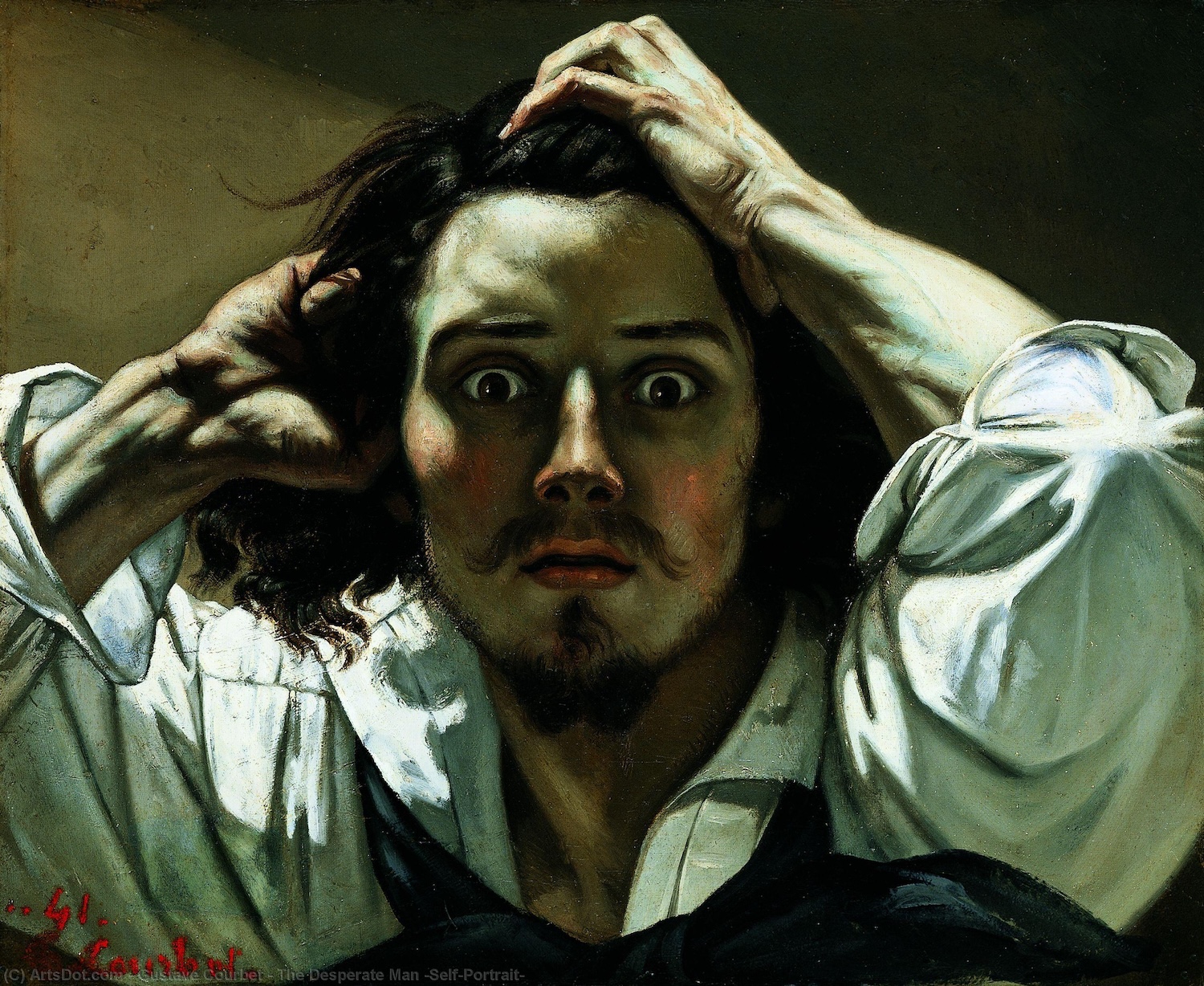
I chose today’s work of art, Desperate Man, a self portrait by virtuoso painter, Gustave Courbet, because it convincingly captures the frustration, failure and utter despondency of a believer who is in the throes of a battle with sin. Courbet’s raw, aggressive approach strikingly epitomizes Romans 7:15, “For what I will to do, that I do not practice; but what I hate, that I do.” Often, as our poem suggests, “to obliterate what has been soiled” seems almost impossible.
Christ’s solution to persistent sin, at first hearing sounds crazy, “If your eye, hand or foot offend, remove them! It’s better to be maimed in this life, than to end up in hell.” Whoa! Christ clearly doesn’t mince any words here. What is he really saying anyway? Sin is serious business that needs to be rooted out if you want to be his follower—like surgically extracting a diseased body part. A contemporary paraphrase might read, “Immediate, drastic action is required. Eliminate whatever is causing you to stumble. Do it cold turkey. If your smart phone is part of the problem, throw it out, now! Nothing that this world offers compares with the glories of eternal life in Heaven, nothing is worse than the horrors of everlasting Hell!”
Christ is calling his disciples to radical sacrifice! He goes on to say, “Everyone will be salted with fire,” often understood as the final judgment. In light of these sobering truths, we are encouraged to live lives of integrity, in the presence of God and our fellow human beings. Christ referred to his followers as “the salt of the earth”(Matthew 5:13). Salt is used in the Bible as a symbol of God’s enduring promises, of spiritual purity or holiness, the preserver of truth, the enricher of wisdom, and as part and parcel of a sacrificial offering. As we steadily mature in our faith through continual refinement, we acknowledge with clear-eyed humility (like Paul did late in his ministry) —“I am “the chief of sinners.” There appears to be no room for the notion of sinless perfection in this life. Instead Christ offers these helpful words, “You must have the qualities of salt among yourselves and live in peace with each other.” (Mark 9:50, NLT). That indeed, is more than enough for most of us to concentrate on, as we work in cooperation with the Holy Spirit at being conformed to the image of Christ!
Prayer
Almighty God,
Who alone can order the unruly wills and affections of sinful men,
grant to your people that they may love what you command and
desire what you promise, that so among the many changes of the world,
our hearts may be surely fixed where true joys are to be found.
Through Jesus Christ Our Lord,
Amen
—Alistair Begg adaptation from the Book of Common Prayer
Barry Krammes
Professor Emeritus, Art Department
Biola University
Advent and Lent Project Curator
For more information about the artwork, music, and poetry selected for this day, we have provided resources under the “About” tab located next to the “Devotional” tab near the top of the page.
About the Artwork
The Desperate Man (Le Désespéré)
Gustave Courbet (1843–1845)
Oil on canvas
45 cm × 54 cm
Owned by Qatar Museums, on loan to the Musée d'Orsay, Paris
Le Désespéré (The Desperate Man) is a striking self-portrait by Gustave Courbet, painted between 1843 and 1845. The work depicts the artist with wide, alarmed eyes and hands clutching his head, conveying intense psychological turmoil and emotional urgency. Unlike Courbet’s later realist scenes of everyday life, this early painting is highly dramatic and expressive, drawing on Romantic conventions to explore inner anguish and self-conscious identity. The exaggerated expression and close framing create a sense of immediacy, offering a rare glimpse into the artist’s emotional state and ambition during his formative years.
About the Artist
Gustave Courbet (1819–1877) was a French painter and a leading figure of the realist movement in nineteenth-century art. Rejecting idealized and historical subjects favored by academic tradition, Courbet focused on ordinary people, everyday life, and the physical reality of the world around him. His large-scale works, such as The Stone Breakers and A Burial at Ornans, challenged prevailing artistic norms and sparked controversy for their unembellished portrayal of labor and rural life. Courbet was also politically active, particularly during the Paris Commune, a stance that affected his career and later life. His commitment to realism and artistic independence had a lasting influence on modern art.
About the Music
“Temptations to Sin” from the album The Gospel of Mark: An Oratorio
Multi-award-winning Canadian composer Christopher Tyler Nickel has created a truly unique magnum opus with his The Gospel According to Mark, a seven-hour oratorio setting to music the disciple’s text from the King James Bible in its entirety.
And whosoever shall offend one of these little ones
that believe in me, it is better for him that a millstone
were hanged about his neck, and he were cast into the sea.
And if thy hand offend thee, cut it off: it is better for thee
to enter into life maimed, than having two hands to go into hell,
into the fire that never shall be quenched:
Where their worm dieth not, and the fire is not quenched.
And if thy foot offend thee, cut it off: it is better for thee
to enter halt into life, than having two feet to be cast into hell,
into the fire that never shall be quenched:
Where their worm dieth not, and the fire is not quenched.
And if thine eye offend thee, pluck it out: it is better for thee
to enter into the kingdom of God with one eye,
than having two eyes to be cast into hell fire:
Where their worm dieth not, and the fire is not quenched.
For every one shall be salted with fire,
and every sacrifice shall be salted with salt.
Salt is good: but if the salt have lost his saltness,
wherewith will ye season it? Have salt in yourselves,
and have peace with another.
About the Composer
A graduate of the University of British Columbia School of Music with a degree in composition, Christopher Tyler Nickel studied with renowned Canadian composer Stephen Chatman. Upon graduation, he continued his studies in New York and Los Angeles. Christopher is the composer-in-residence of the Lionsgate Sinfonia and the author of numerous concert works which have been performed by orchestras and chamber ensembles in Canada, the United States, and Europe. Works include a concerto for piccolo/flute/alto flute; Tranquility for solo English horn and orchestra, which was premiered by the Vancouver Symphony’s English hornist, Beth Orson; and in 2015 the premiere of his Oboe Concerto written for Roger Cole, principal oboe of the Vancouver Symphony. Other major works include a Requiem; his hour-long, one-movement Symphony No.2; and a seven-hour oratorio setting the Gospel According to Mark to music.
About the Performers
Catherine Redding, Fabiana Katz, Carman J. Price, Steven Bélanger and the Vancouver Contemporary Orchestra conducted by Clyde Mitchell
Catherine Redding is a Canadian Irish soprano described as “warm, clear and impeccably controlled” (The Irish Times), and she has performed internationally in opera, oratorio, and recital. Catherine has performed the operatic roles of Oscar (A Masked Ball) and Zerlina/Donna Anna (Don Giovanni) with Opera 2005, Barbarina (The Marriage of Figaro) and Emmie (Albert Herring) with Opera Project, and Sandman/Dew Fairy (Hansel and Gretel) with Longborough Festival Opera. Catherine has been a guest soprano soloist with ensembles including the Guinness Choir, Resurgam, the Irish Baroque Orchestra, the Tallaght Choral Society, the Galway Choral Association, RBS Singers, the Ranelagh Singers, the Dublin Bach Singers, and the University College Dublin Choirs and Orchestra. As a recitalist, Redding’s performances in Canada, Italy, Austria, England, and Ireland have encompassed a repertoire of baroque to contemporary works. Redding sang the solo soprano role in Christopher Tyler Nickel’s Requiem (2024) and his seven-disc-long Gospel According to Mark (2023), released by AVIE Records. Catherine holds a postgraduate diploma from the Royal Academy of Music, London, and a B.M. degree from the University of British Columbia, Vancouver, Canada.
Fabiana Katz is an Argentine-born Canadian soloist and choral conductor. After being immersed in music in her native Argentina, Fabiana moved to Canada at the age of fourteen. She earned her B.Mus. at the University of Calgary and her Masters of Music in choral conducting from the College-Conservatory of Music at the University of Cincinnati, Ohio. Fabiana has appeared as a soloist with the Regina Symphony Orchestra, the Berkshire Choral Festival, Symphony Nova Scotia, the National Arts Centre Orchestra, the Pacific Baroque Orchestra, the Prince George Symphony Orchestra, the CBC Radio Orchestra, to name a few. She currently sings professionally with the Vancouver Chamber Choir, under the direction of Jon Washburn. Fabiana was a founding member of the a cappella trio Kallisto, which has received accolades around Canada. As a recitalist, Fabiana focuses on repertoire which highlights her varied cultural background: Spanish, Latin American, and Sephardic.
Carman J. Price has a warm tenor sound and stylistic adaptability that have made him one of Vancouver’s most sought-after singers. His working trio with Canadian jazz legends Bill Coon (guitar) and Rene Worst (bass) has been delighting audiences for more than a decade, and they have appeared at venues throughout the Vancouver area. In addition to his work in the jazz and choral world, Carman is an experienced studio singer, recording jingles and vocals for pop recordings. And his recent thrill has been being a guest on backing and lead vocals for the Steely Dan tribute band Steelin’ in the Years.
Steven Bélanger is an accomplished clarinetist and singer and a graduate of Queen’s University (B.Mus., B.A.) and McGill University (M.Mus.). He has performed with ensembles of all sizes and genres across Canada including the Opéra de Montréal, VivaVoce, the Elmer Iseler Singers, the Canadian Chamber Choir, and the Arion Baroque Orchestra. He has appeared as soloist with the McGill Baroque Orchestra, Voix Libres, the Kingston Symphony Orchestra, the Queen’s University Symphony Orchestra, the Quinte Symphony, and the Prince George Symphony Orchestra. Bélanger has participated in over a dozen recordings for such labels as Decca, ATMA, Naxos, Centrediscs, and Grouse Records, and has recorded music for radio, television, and Cirque du Soleil. He is currently the general manager of the Vancouver Chamber Choir and is a featured artist on their newest recording of the music of Canadian composer R. Murray Schafer, entitled The Love that Moves the Universe.
Vancouver Contemporary Orchestra (VCO), founded in 1919, is a Grammy and Juno–award winning Canadian orchestra. VCO performs more than one hundred fifty concerts each year, throughout Vancouver and the province of British Columbia, reaching over 270,000 people annually. On tour the VCO has performed in the United States, China, Korea, and across Canada. The orchestra presents passionate, high-quality performances of classical, popular, and culturally diverse music, creating meaningful engagement with audiences of all ages and backgrounds.
Canadian-American conductor Clyde Mitchell studied piano, organ, and French horn before deciding to pursue a career in music. Music performance degrees from Louisiana State University (B. Mus.) and California State University-Northridge (M.A.in music) led to a performing career in Bogotá, Colombia; Tucson, Arizona; and Montreal, Quebec. In Montreal, he was associate principal l horn in the prestigious Montreal Symphony Orchestra under Charles Dutoit, and was professor of horn and chamber music studies and conductor of the brass choir at McGill University. Clyde Mitchell is an outspoken advocate for music education, and regularly conducts and holds workshops for honor bands and orchestras across North America. Mitchell is the founding conductor and music director of Lions Gate Sinfonia and the new Lions Gate Youth Orchestra. He recently moved to Los Angeles, where his wife, Sarah Jackson, plays solo piccolo with the world-famous Los Angeles Philharmonic.
About the Poetry and Poet
Ellen Bryant Voigt (1943–2025) was an American poet known for her precise lyricism, her disciplined use of form, and her sustained attention to themes of family, memory, and the natural world. Raised in rural Virginia and long connected to the New England literary landscape, she published numerous acclaimed collections, including Kyrie and Messenger; the latter was a finalist for the National Book Award.
Voigt is admired for her ability to unite narrative clarity with musical intensity and for her innovative work with traditional forms such as the sonnet and the extended poetic sequence. A MacArthur fellow and former Vermont state poet, she also cofounded the first low-residency MFA program in the United States at Warren Wilson College.
About the Devotion Writer
Artist and educator Barry Krammes (b. 1951) received his B.F.A. in printmaking and drawing from the University of Wisconsin-Eau Claire and his M.F.A. in two-dimensional studies from the University of Wisconsin, Madison. For thirty-five years, he was employed at Biola University in La Mirada, California, where he was the Art Chair for fifteen years. Krammes is an assemblage artist whose work has been featured in both solo and group exhibitions, regionally and nationally. His work can be found in various private collections throughout the United States and Canada. He has taught assemblage seminars at Image Journal’s annual Glen Summer Workshop in Santa Fe, New Mexico. Krammes has served as the Visual Arts Coordinator for the C.S. Lewis Summer Institute in Cambridge, England, and was the Program Coordinator for both Biola University’s annual arts symposium and the Center for Christianity, Culture, and the Arts (CCCA) for several years. He has also been the editor of CIVA: Seen Journal for Christians in the Visual Arts (CIVA), a national arts organization. Krammes was the originator of Biola's Advent and Lent Projects.