March 15: Christ's Teaching on Relationships
♫ Music:
Week Five Introduction | March 15–21:
No One Ever Taught like You: Marveling at the Wisdom of Christ
There’s a wonderful line from the seventh chapter of the gospel of John that describes the words and teachings of Jesus like this: “No man ever spoke like this Man!” (John 7:46). That phrase captures the essence of who Christ was and is as a teacher. Author Ann Spangler writes, “Jesus was an enormously popular teacher who drew crowds wherever he went, using questions, discussions, proverbs, symbolic actions, parables, and even miracles in order to teach people the way to live.” His life-giving words were unique, filled with extraordinary wisdom and supernatural power. His godly assertions and divine ideologies set Him apart from all the other religious figures of His day.
Obviously, Christ’s teachings caused serious disagreement among those surrounding Him. Some people were transformed by encounters with Him while others sought to silence Him. The Pharisees and ruling elite questioned His legitimacy as a rabbi since it appears Christ went directly from practicing carpentry to teaching in the synagogue. This infuriated these “live by the rules” leaders because they had spent years training and studying under a master teacher before they themselves were ordained and then began to mentor others. In Jesus’s day it was customary for a master rabbi to have disciples. These disciples often lived with their teacher and were committed to him for life. Christ chose twelve men to nurture, similar to the twelve tribes of Israel, in keeping with the practices of His time.
In this week’s gospel readings, Christ’s actions speak as clearly as His words. With His entry into Jerusalem, Jesus taught that He was the promised Messiah, the fulfillment of Old Testament prophecies like “Behold, your King is coming to you; He is just and having salvation, lowly and riding on a donkey” (Zechariah 9:9). Later on, Christ used the cursing of a barren fig tree along with the unforgettable cleansing of the temple to teach His disciples what true worship and effective prayer really meant. Today, the Great Rabbi continues to call disciples to Himself. As His followers, we must stick close to Him, allowing the Master to instruct and guide us in the ways that we should go.
Sunday, March 15 | Christ's Teaching on Relationships
Mark 10:1–16 (NKJV)
Then He arose from there and came to the region of Judea by the other side of the Jordan. And multitudes gathered to Him again, and as He was accustomed, He taught them again.
The Pharisees came and asked Him, “Is it lawful for a man to divorce his wife?” testing Him.
And He answered and said to them, “What did Moses command you?”
They said, “Moses permitted a man to write a certificate of divorce, and to dismiss her.”
And Jesus answered and said to them, “Because of the hardness of your heart he wrote you this precept. But from the beginning of the creation, God ‘made them male and female.’ ‘For this reason a man shall leave his father and mother and be joined to his wife, and the two shall become one flesh’; so then they are no longer two, but one flesh. Therefore what God has joined together, let not man separate.”
In the house His disciples also asked Him again about the same matter. So He said to them, “Whoever divorces his wife and marries another commits adultery against her. And if a woman divorces her husband and marries another, she commits adultery.”
Then they brought little children to Him, that He might touch them; but the disciples rebuked those who brought them. But when Jesus saw it, He was greatly displeased and said to them, “Let the little children come to Me, and do not forbid them; for of such is the kingdom of God. Assuredly, I say to you, whoever does not receive the kingdom of God as a little child will by no means enter it.” And He took them up in His arms, laid His hands on them, and blessed them.
Poetry
“Whoever Welcomes”
by Malcolm Guite
From Parable and Paradox (Canterbury Press, 2016).
Used by kind permission of Canterbury Press and Malcolm Guite.
‘Welcome’, the word is always on your lips,
Each welcome warms another one inside,
An interleaving of relationships,
An open door where arms are open wide.
First welcome to the child and through the child
A welcome to the Saviour of the world
And through the Saviour’s welcome all are called
Home to the Father’s heart. Each call is curled
And nested in another, as you were
Nested and nestled in your mother’s womb,
As Mary carried One who carried her,
And we are wrapped in you, deep in the tomb,
Where you turn our rejection into welcome,
And death itself becomes our welcome home.
Christ's Teaching on Relationships
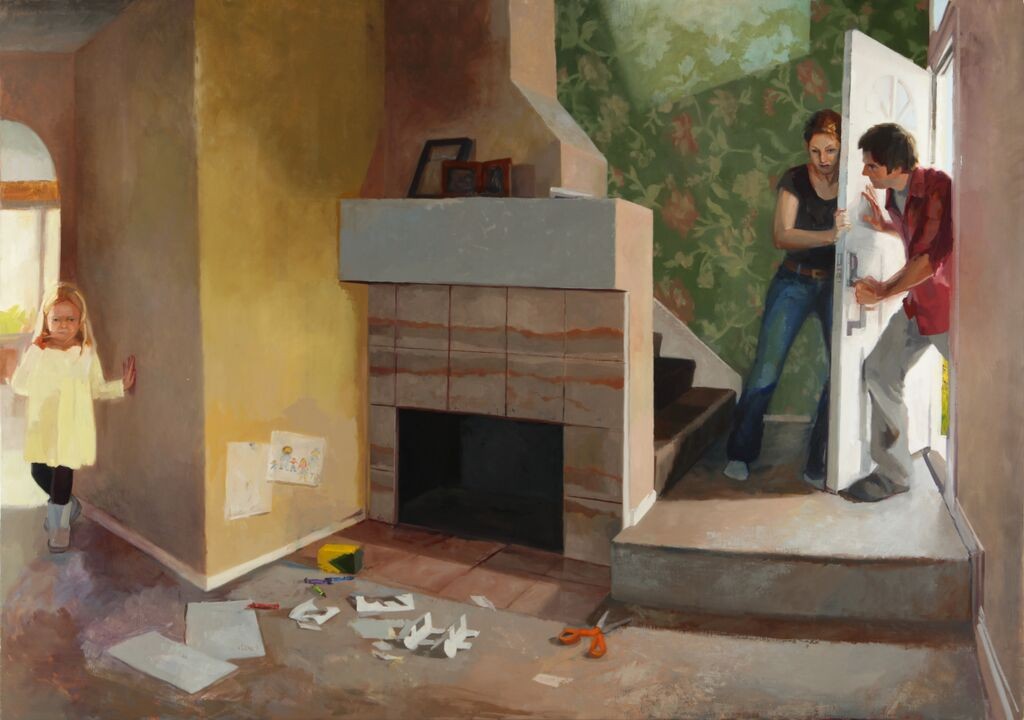
This is a really challenging passage of Scripture for me. As one whose parents divorced, the tension of the passage feels deeply personal. I did not want my parents to divorce. When I was young, I prayed for them to love each other again. In my 13-year-old heart, I knew how it “should” be and cried out to the Lord to make it happen. In my painting, Home is Not, this tension is embodied. The parents are on one side of the painting, their young daughter on the other. The liminal space in-between the figures is both a sparse living room and a space that evidences creativity and play. The parents on opposite sides of the door communicate conflict and uncertainty. The girl stands pensive, quietly listening, waiting, hoping.
In “In His Arms,” Michael Card sings
They came into Capernaum
And settled in the house where they had stayed
Jesus asked if they would say
Why they had quarreled on the way
They would not answer
They could not answer
In his arms He held the children
Said whoever welcomes one of them
For the one who is small
Will be greatest of all
And in them you welcome Me.
Card juxtaposes quarreling with welcoming. In Malcolm Guite’s poem, “Whoever Welcomes,” Guite creates repeated imagery of being embraced: nested, nestled, welcomed, wrapped within. I have good friends who have young kids, and I am always blessed by the hugs I receive from them. Kneeling down to their level, and feeling their young arms wrapped around me warms my heart.
Jesus is greatly displeased when the disciples try to bar those who were bringing the children to Him from getting too close. Jesus told his disciples, “Let the children come to me, and do not forbid them; for of such is the Kingdom of Heaven.” Each Sunday at my church, the children are invited to come to the front of the sanctuary, where our Children's Pastor leads the congregation in a prayer of blessing over them. I watch how these little ones excitedly file after one another, leaving their seats in the pews to go together to the front. I see their faces and the way they welcome one another—exuberant and radiant with joy. This is indeed the Kingdom of God in action!
I often wonder if, like so much other brokenness in our world, we have to hold multiple things at the same time when it comes to divorce. Christ directs us, showing us the best way, and Christ’s arms are open wide, always welcoming. Do not separate what God has joined together. Yet, separation happens. In our weakness we injure one another. The two are no longer one. But that is not the final word. As Malcolm Guite writes in his last stanza of today’s poem, Christ “turns our rejection into welcome, and death itself becomes our welcome home.”
In another of Malcolm Guite’s books, Waiting on the Word, Guite counters a statement made in one of John Keats’ poems, In drear nighted December:
In drear nighted December,
Too happy, happy tree,
Thy branches ne’er remember
Their green felicity–
Disagreeing with Keats, Guite explains: “Indeed, it is just because those bleak, rainlashed December branches do remember their ‘green felicity’, and former green-ness, that they will unfold into leaf again in spring and be able, as Larkin said, of trees in May, to ‘begin afresh, afresh, afresh’.” (Malcolm Guite, Waiting on the Word: A Poem a Day for Advent, Christmas and Epiphany [Norwich: Canterbury Press, 2015], 41.) In my painting, the child’s drawing tacked to the wall in the middle of the living room is a family portrait. My Mom, my Dad, my brothers, and me. We remember our green felicity. We know goodness. And even when circumstances do not bring forth the trees afresh as soon as we want, we keep asking and keep holding insistently—even desperately—onto hope. I saw this hope near the end of my Dad’s earthly life when I witnessed in each of my parents a kind acknowledgement of the other.
Prayer
Jesus, be my hope.
Do not waste my greatest sorrows, O God, but
use them to teach me to live in your presence--
fully alive to pain and joy and sorrow and hope--
in the places where my shattering
and your shaping meet.
—From A Liturgy for the Anniversary of a Loss (McKelvey, Douglas Kaine. Every Moment Holy. Volume 1. Rabbit Room Press, 2019.)
Kari Dunham
Adjunct Professor, Drawing and Painting
Department of Art
Biola University
For more information about the artwork, music, and poetry selected for this day, we have provided resources under the “About” tab located next to the “Devotional” tab near the top of the page.
About the Artwork
Home is Not
Kari Dunham
Oil on Linen
53"x76"
2013
Used with kind permission from the artist
About the Artist
Kari Dunham is an adjunct professor in the Art Department at Biola University. Her current body of work is an exposition on family and how the home has the propensity to be a place of both comfort and risk. A representational painter, her work derives from personal narratives and simultaneously invites the viewer to recall his or her own narratives. In addition to teaching at Biola, Dunham is an adjunct professor in the Art and Design Department at Azusa Pacific University. She earned her M.F.A. in Painting from Laguna College of Art and Design and was recently featured in Southwest Art Magazine.
About the Music
“In His Arms” from the album Mark: The Beginning of the Gospel
They came into Capernaum,
And settled in the house where they had stayed.
Jesus asked if they would say,
Why they quarreled on the way.
They would not answer,
They could not answer.
In His arms He held the children,
Said whoever welcomes one of them,
For the one who is small,
Will be greatest of all,
And in them you welcome Me.
Caught up in another argument,
With those who chose to put their wives away,
Jesus saw their hearts were numb,
To be wed is to be one,
They could not sever what God had put together.
In His arms He held their children.
He would always make the time for them,
Though some fathers pretend,
For Himself as much as them.
He held the children in His arms.
In His arms He held the children,
Said whoever welcomes one of them.
For the one who is small,
Will be greatest of all
And in them you welcome Me,
And in them you welcome Me.
About the Composer/Performer
In a career that spans over thirty years, Michael Card (b. 1957) has recorded over thirty-one music albums, authored or coauthored over twenty-four books, hosted a radio program, and written for a wide range of magazines. He has penned such favorite songs as “El Shaddai,” “Love Crucified Arose,” and “Immanuel.” He has sold over four million albums and written over nineteen #1 hits. Card’s original goal in life was to simply and quietly teach the Bible and proclaim Christ. Although music provided him the opportunity to share insight gained through his extensive scholarly research, he felt limited by having to condense the vast depth and richness of Scripture into three-minute songs. This prompted him to begin to write articles and books on topics that captured his imagination through conversations with Bible teachers, friends, and contemporaries in both Christian music and the academic community, and Card has continued to write to this day. Card travels frequently each year, teaching and sharing his music at Biblical Imagination Conferences, and facilitating the annual Life of Christ Tours to Israel.
About the Poetry and Poet
Malcolm Guite (b. 1957) is a poet, author, Anglican priest, teacher, and singer-songwriter based in Cambridge, England. He has published six collections of poetry: Saying the Names, The Magic Apple Tree, Sounding the Seasons: Poetry for the Christian Year, The Singing Bowl, Waiting on the Word, and the recently released Parable and Paradox: Sonnets on the Sayings of Jesus and Other Poems. Rowan Williams and Luci Shaw have both acclaimed his writing, and his Antiphons appeared in Penguin’s Best Spiritual Writing, 2013. Guite’s theological works include What Do Christians Believe? and Faith, Hope, and Poetry: Theology and the Poetic Imagination. Guite is a scholar of J. R. R. Tolkien, C. S. Lewis, and the British poets, and serves as the Bye-Fellow and chaplain at Girton College at the University of Cambridge, while supervising students in English and theology. He lectures widely in England and the USA, and in 2015 he was the CCCA Visionary-in-Residence at Biola University. Guite plays in the Cambridge rock band Mystery Train and his albums include The Green Man and Dancing Through the Fire.
About the Devotion Writer
Kari Dunham is an Adjunct Art Professor at Biola University. She holds a M.F.A. in Painting from Laguna College of Art + Design and a B.F.A. in Art from Evangel University in Springfield, Missouri. She also teaches at Irvine Valley College and was recently a Visiting Instructor for Gordon in Orvieto, the Global Education Program in Orvieto, Italy with Gordon College. She lives in Southern California and enjoys serving on the art curatorial team for her church, Church by the Sea, in Laguna Beach.