March 5: John the Baptist Beheaded
♫ Music:
Mark 6:14–29 (NKJV)
Now King Herod heard of Him, for His name had become well known. And he said, “John the Baptist is risen from the dead, and therefore these powers are at work in him.”
Others said, “It is Elijah.”
And others said, “It is the Prophet, or like one of the prophets.”
But when Herod heard, he said, “This is John, whom I beheaded; he has been raised from the dead!” For Herod himself had sent and laid hold of John, and bound him in prison for the sake of Herodias, his brother Philip’s wife; for he had married her. Because John had said to Herod, “It is not lawful for you to have your brother’s wife.”
Therefore Herodias held it against him and wanted to kill him, but she could not; for Herod feared John, knowing that he was a just and holy man, and he protected him. And when he heard him, he did many things, and heard him gladly.
Then an opportune day came when Herod on his birthday gave a feast for his nobles, the high officers, and the chief men of Galilee. And when Herodias’ daughter herself came in and danced, and pleased Herod and those who sat with him, the king said to the girl, “Ask me whatever you want, and I will give it to you.” He also swore to her, “Whatever you ask me, I will give you, up to half my kingdom.”
So she went out and said to her mother, “What shall I ask?”
And she said, “The head of John the Baptist!”
Immediately she came in with haste to the king and asked, saying, “I want you to give me at once the head of John the Baptist on a platter.”
And the king was exceedingly sorry; yet, because of the oaths and because of those who sat with him, he did not want to refuse her. Immediately the king sent an executioner and commanded his head to be brought. And he went and beheaded him in prison, brought his head on a platter, and gave it to the girl; and the girl gave it to her mother. When his disciples heard of it, they came and took away his corpse and laid it in a tomb.
Poetry
“Even Such is Time"
By Sir Walter Raleigh
EVEN such is Time, that takes in trust
Our youth, our joys, our all we have,
And pays us but with earth and dust;
Who in the dark and silent grave,
When we have wander’d all our ways,
Shuts up the story of our days;
But from this earth, this grave, this dust,
My God shall raise me up, I trust.
John the Baptist Beheaded
Betrayal is among the most painful of human trials. All who have experienced its peculiar trauma—the abandoned spouse, the unjustly dismissed employee, the victim of false accusation—share with Jesus the discovery of an enemy within one’s own circle of trust. Sharing this experience with many biblical figures—Joseph and his brothers, Paul in Caesarea, Jacob and Esau, Cain and Abel, and David with his son Absalom—does not lessen the brokenness of heart that John the Baptist may have felt in Matthew 11. As it dawns on him that having prepared the way—”making straight the path” for the Messiah—does not necessarily guarantee his own safety, he languishes in Herod’s prison. He wonders perhaps if he had it all wrong. Why would he message the disciples of Jesus with his question if he had not expected more, more protection, more of everything. Prison was a horrible, disconnected place in the dark, separated from the reassuring evidence of expected abundance. And then, at the whim of a capricious and inebriated ruler, his executioner arrives without warning.
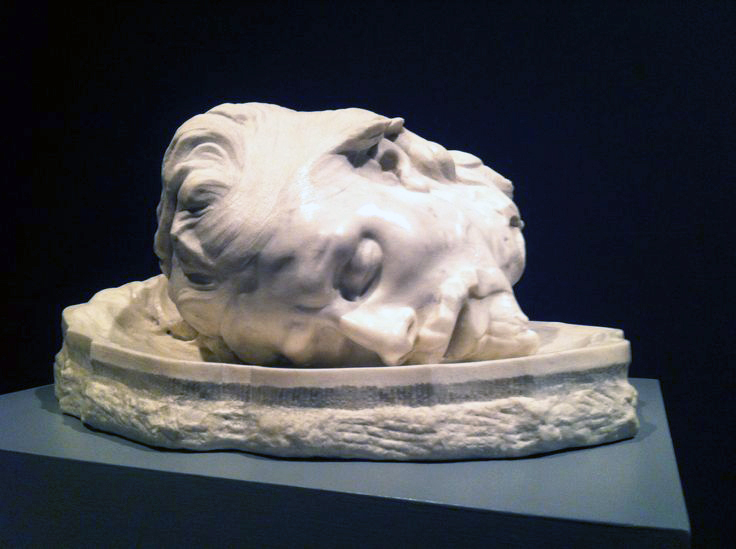
Auguste Rodin, himself no stranger to the envious rejection of his peers because of his innovative anti-classicism and avoidance of religious imagery, gives us John’s head on a platter—a bowl evocative of baptism, no less. It is a poignant follow-through to his Walking Man, with its severed-head interpretation of John the Baptist, breaking neoclassical rules of posture and refined modeling.
Ironically, even the explorer and courtier Sir Walter Raleigh—who experienced the shifting fortunes of power, imprisonment, and eventual execution—still finds the temerity, and perhaps the desperation, to hope that death will not have the final word: “My God shall raise me up, I trust.”
The frenzied lament of Wójcik-Zawierucha’s Polish choral piece The Beheading of John the Baptist suggests more impassioned haste and even frantic wailing than Caravaggio’s Death of a Virgin, where mourners lean quietly into the gloom of Mary’s passing.
When it comes down to it, perhaps some of us might, like Peter, claim we would remain full of faith in such a moment. Perhaps we imagine we can summon the bravado of Tom Petty, who “won’t back down,” even “against the gates of hell.” I for one feel more in common (and experience) with David, abandoned by his own men after the abduction of their families at Ziklag (1 Sam. 30:6). In such intensely pressured moments, I pray that, like David and John, I will turn to the Lord for comfort and counsel, and act accordingly.
Prayer
Dear Jesus, In whatever dark night of the soul awaits us, grant us the courage and serenity to turn to you, trusting your wisdom, your example, and your sustaining strength.
James Tughan (B.Th., Hon. BA, MTS/DPT cand.)
Artist, Educator, and Writer
For more information about the artwork, music, and poetry selected for this day, we have provided resources under the “About” tab located next to the “Devotional” tab near the top of the page.
About the Artwork | 1
The Severed Head of Saint John the Baptist
Auguste Rodin
ca. 1887
Marble
23.9 × 39 cm
Museo Soumaya
Mexico City, Mexico
Public Domain
Head of Saint John the Baptist is a marble sculpture by French artist Auguste Rodin, sculpted in 1887 as part of a series of sculptures based on Saint John the Baptist, exhibited for the first time in 1880 with great acceptance and recognition from critics. In this sculpture, Rodin decides not to present the fragment as a bust, the most obvious choice, but to set the head on its side on a baptismal font in order to establish a greater reference to the biblical account of the beheading of John the Baptist and to separate it from the rest of the fragment that would later be nicknamed The Walking Man, which had been stripped of all religious references.
About the Artwork | 2
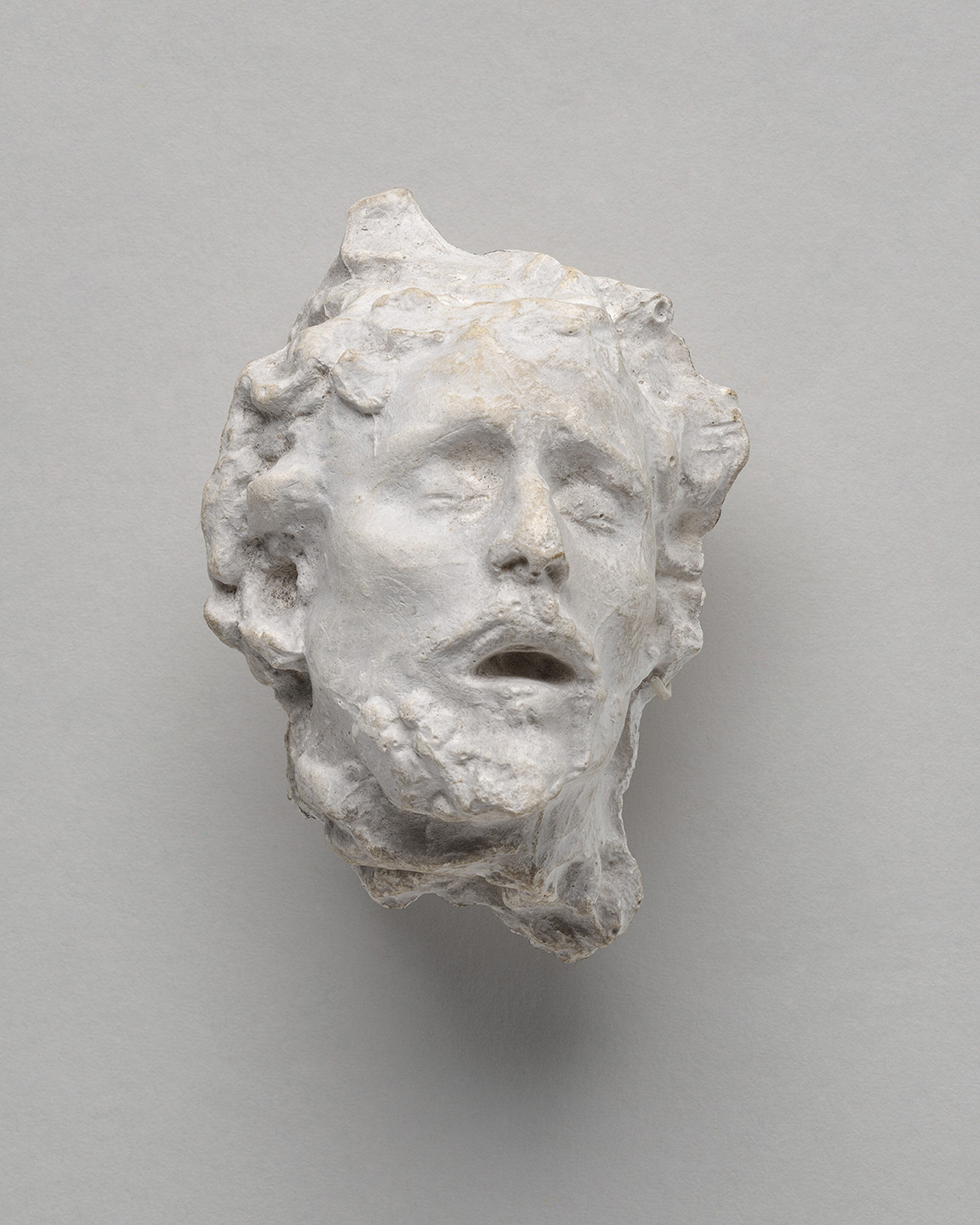
Head of Saint John the Baptist
Auguste Rodin
ca 1887
Plaster
Overall: 6.7 cm
National Gallery of Art
Washington, D.C.
Public Domain
About the Artist | 1 & 2
Francois Auguste René Rodin (1840–1917) was a French sculptor generally considered the founder of modern sculpture. He was schooled traditionally and took a craftsman-like approach to his work. Rodin possessed a unique ability to model a complex, turbulent, and deeply texturized surface in clay. He is known for such sculptures as The Thinker, Monument to Balzac, The Kiss, The Burghers of Calais, and The Gates of Hell. Many of Rodin's most notable sculptures were criticized, as they clashed with predominant figurative sculpture traditions in which works were decorative, formulaic, or highly thematic. Rodin's most original work departed from traditional themes of mythology and allegory. He modeled the human body with naturalism, and his sculptures celebrate individual character and physicality. Although Rodin was sensitive to the controversy surrounding his work, he refused to change his style, and his continued output brought increasing favor from the government and the artistic community.
About the Music
“The Beheading of John the Baptist”
No translation available.
About the Composers
Lukasz Wójcik-Zawierucha is a Polish composer.
About the Performer/Composer
Leszek Mozdzer (b. 1971) is a Polish jazz pianist, composer, arranger, and actor known for his improvisational freedom and subtle, mystical atmosphere. His classical training and improvisations on Fryderyk Chopin's themes have made him a virtuoso of the European jazz scene. Mozdzer has won numerous awards, including the Krzysztof Komeda Prize in 1992, the Fryderyk for Jazz Musician of the Year in 1998, and the Knight's Cross of the Order of Polonia Restituta in 2013
About the Poetry and Poet
Sir Walter Raleigh (c. 1553–1618) was an English statesman, soldier, writer, and explorer. One of the most notable figures of the Elizabethan era, he played a leading part in English colonization of North America, suppressed rebellion in Ireland, helped defend England against the Spanish Armada, and held political positions under Queen Elizabeth I. Raleigh's poetry is written in the relatively straightforward, unornamented mode known as the plain style. C. S. Lewis considered Raleigh one of the era's "silver poets,” a group of writers who resisted the Italian Renaissance influence of dense classical reference and elaborate poetic devices. His writing contains strong personal treatments of themes such as love, loss, beauty, and time. Most of his poems are short lyrics that were inspired by actual events.
About the Devotion Writer
James Tughan, in his own visual work as one of the world’s foremost pastel artists, has developed the style dubbed “Cartographic Realism,”a marriage of aerial visual mapping, natural symbolism, and a Christian theology of the person. This style of imagery respectfully draws metaphors for the seen and unseen world of spirit from the natural surface topography of the visual subject matter itself. It exploits amazing detail and surface patterning, texture, colour, lighting and narrative possibilities. This style infers that there is more to see than immediately meets the eye that is suggested by mapping, the mapping of ideas. His work has been commissioned by major corporations throughout North America and such magazines as Rolling Stone, Esquire, GQ, Saturday Night and House & Garden. As an educator, he has served on the faculty of Redeemer University College (Ancaster), and Tyndale Seminary and University (Toronto) Sheridan University Institute, Oakville, Kings Christian Collegiate, (Oakville), The Kingsbridge School of The Arts, (Burlington) and the Halton Waldorf High School, (Burlington). He is the founder of the Semaphore Fellowship and co-founder of the Flagship Gallery, (Hamilton), and its current offspring the Portage Arts Group, with its mental health in art focus. James is also currently enrolled in the MTS/DPT graduate program at McMaster Divinity College where he is artist in residence. Most recently he has become a published poet and author in CONTACT: The Artistry of Christ in Nine Faces, available at Book Baby’s Bookshop website, and on Amazon.ca. See his work at Tughansemaphore.wordpress.com.