March 20: Christ's Triumphal Entry into Jerusalem
♫ Music:
Mark 11:1–11 (NKJV)
Now when they drew near Jerusalem, to Bethphage and Bethany, at the Mount of Olives, He sent two of His disciples; and He said to them, “Go into the village opposite you; and as soon as you have entered it you will find a colt tied, on which no one has sat. Loose it and bring it. And if anyone says to you, ‘Why are you doing this?’ say, ‘The Lord has need of it,’ and immediately he will send it here.”
So they went their way, and found the colt tied by the door outside on the street, and they loosed it. But some of those who stood there said to them, “What are you doing, loosing the colt?”
And they spoke to them just as Jesus had commanded. So they let them go. Then they brought the colt to Jesus and threw their clothes on it, and He sat on it. And many spread their clothes on the road, and others cut down leafy branches from the trees and spread them on the road. Then those who went before and those who followed cried out, saying:
“Hosanna!
‘Blessed is He who comes in the name of the Lord!’
Blessed is the kingdom of our father David
That comes in the name of the Lord!
Hosanna in the highest!”
And Jesus went into Jerusalem and into the temple. So when He had looked around at all things, as the hour was already late, He went out to Bethany with the twelve.
Poetry
“My Triumph”
By John Greenleaf Whittier
The autumn-time has come;
On woods that dream of bloom,
And over purpling vines,
The low sun fainter shines.
The aster-flower is failing,
The hazel’s gold is paling;
Yet overhead more near
The eternal stars appear!
And present gratitude
Insures the future’s good,
And for the things I see
I trust the things to be;
That in the paths untrod,
And the long days of God,
My feet shall still be led,
My heart be comforted.
O living friends who love me!
O dear ones gone above me!
Careless of other fame,
I leave to you my name.
Hide it from idle praises,
Save it from evil phrases:
Why, when dear lips that spake it
Are dumb, should strangers wake it?
Let the thick curtain fall;
I better know than all
How little I have gained,
How vast the unattained.
Not by the page word-painted
Let life be banned or sainted:
Deeper than written scroll
The colors of the soul.
Sweeter than any sung
My songs that found no tongue;
Nobler than any fact
My wish that failed of act.
Others shall sing the song,
Others shall right the wrong,—
Finish what I begin,
And all I fail of win.
What matter, I or they?
Mine or another’s day,
So the right word be said
And life the sweeter made?
Hail to the coming singers!
Hail to the brave light-bringers!
Forward I reach and share
All that they sing and dare.
The airs of heaven blow o’er me;
A glory shines before me
Of what mankind shall be,—
Pure, generous, brave, and free.
A dream of man and woman
Diviner but still human,
Solving the riddle old,
Shaping the Age of Gold!
The love of God and neighbor;
An equal-handed labor;
The richer life, where beauty
Walks hand in hand with duty.
Ring, bells in unreared steeples,
The joy of unborn peoples!
Sound, trumpets far off blown,
Your triumph is my own!
Parcel and part of all,
I keep the festival,
Fore-reach the good to be,
And share the victory.
I feel the earth move sunward,
I join the great march onward,
And take, by faith, while living,
My freehold of thanksgiving.
King and Servant
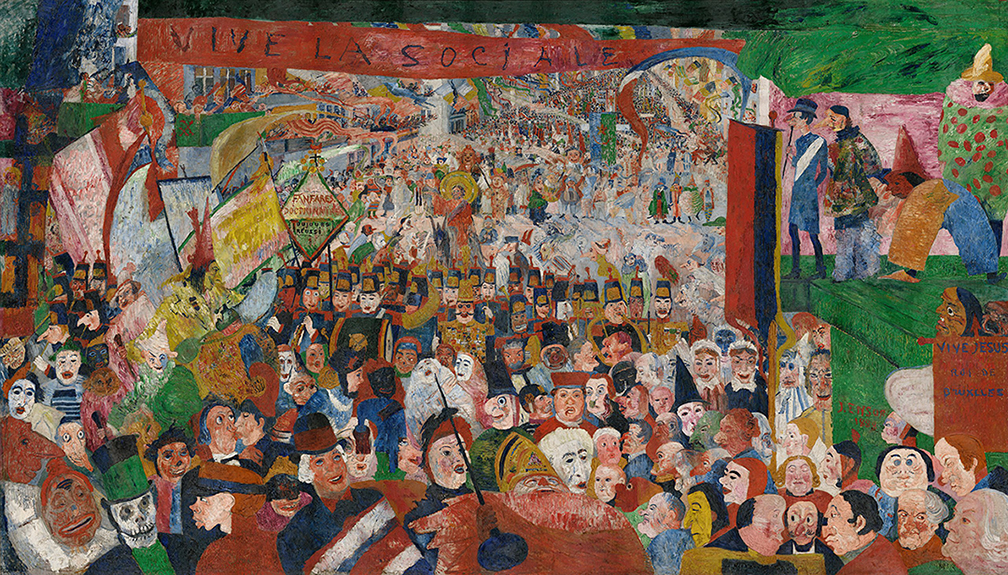
Today’s work of art, The Entry of Christ into Brussels by James Ensor, is a mural-sized painting that resides at the Getty Museum in Los Angeles. I have visited this painting often. Its displacement from its original European context to an arcadian hilltop museum in Southern California transforms its intensely specific references to place (Brussels) and to people (numerous locally meaningful portraits) into distant echoes. Nevertheless, the work’s dense surface and composition remain as urgent as when Ensor first painted them.
The Entry of Christ into Brussels fuses theological reflection with contemporary social critique. On occasion, after looking at the painting, I have stepped out onto one of the Getty’s beautiful terraces and looked across the 405 freeway at the Los Angeles skyline. What if Jesus was to triumphally enter downtown L.A.? Would anyone show up to shout praise? How would all the power structures (political, economic, religious, etc.) in my own place and time respond to Him? How would I? How would His mere humanity and humility contrast with all that we have built here?
The Triumphal Entry is described in all four gospels as they shift toward their complementary renderings of the events of Holy Week. This moment in the life of Jesus holds both His sovereignty and His humility in equal measure. Mark records Jesus sending the disciples to find a pre-ordained, pre-placed, unridden donkey colt (fulfilling the words spoken through Zechariah). He stunningly gives them a prepared answer to an anticipated objection to their borrowing of the donkey. This has clearly all been intimately and supernaturally orchestrated. He then publicly enters Jerusalem, the City of David, riding on a donkey like His ancestor Solomon, signaling His royal lineage and His intent—He has come not as conqueror but as the King of Peace.
The crowd lauds and heralds Jesus, praise which Jesus receives as appropriate and inevitable (Luke 19:40). The crowd seems to understand, at least in part, the signs being given to them, but Jesus was often wary of crowds. He understood well their inherent fickleness, and how the cheering throng might shift from praise to condemnation within an afternoon. I can imagine, even at this exuberant moment, Jesus looking into the hearts of people in the crowd, seeing in each a complex mixture of elation, hope, joy, confusion, fear, anger, and desperation.
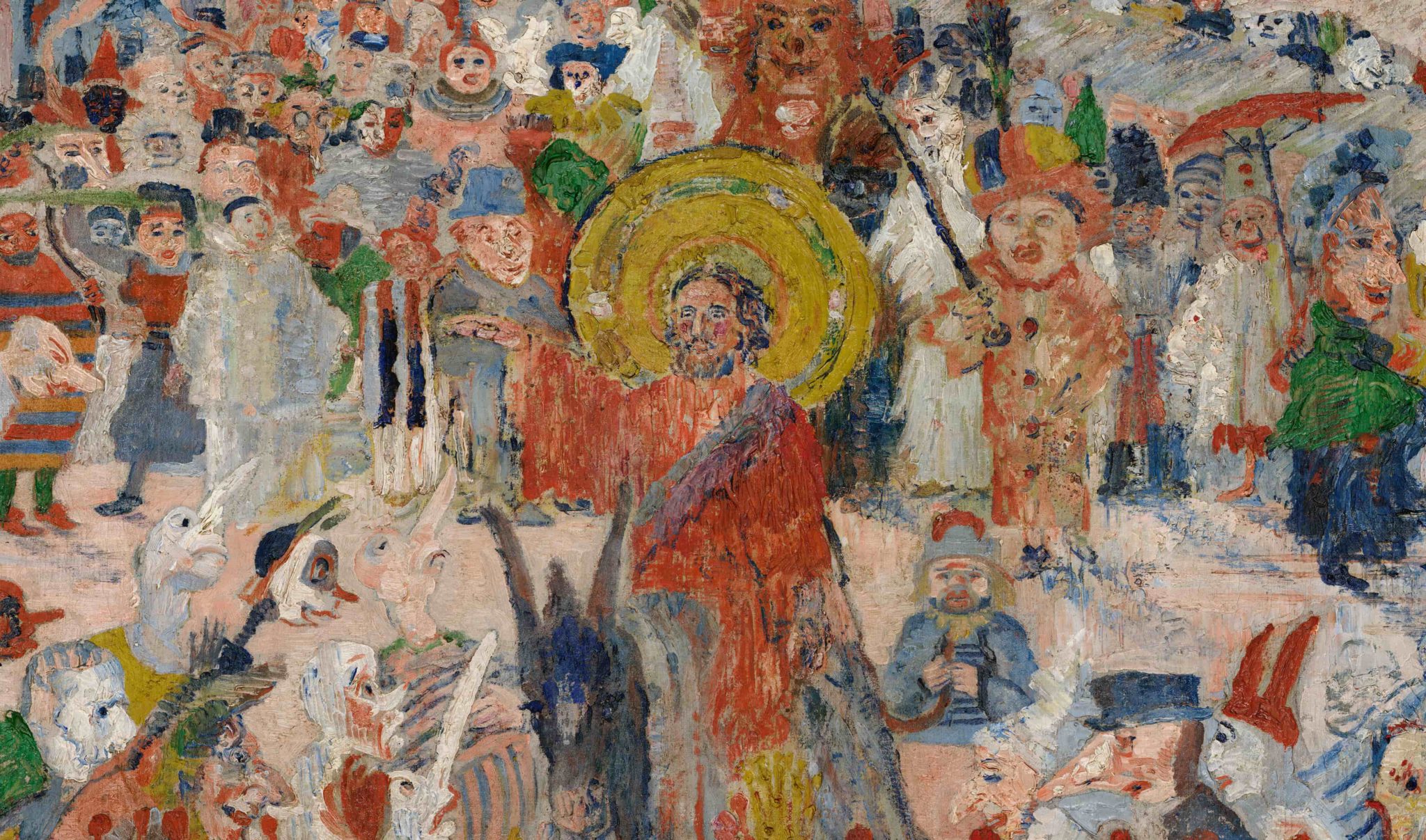
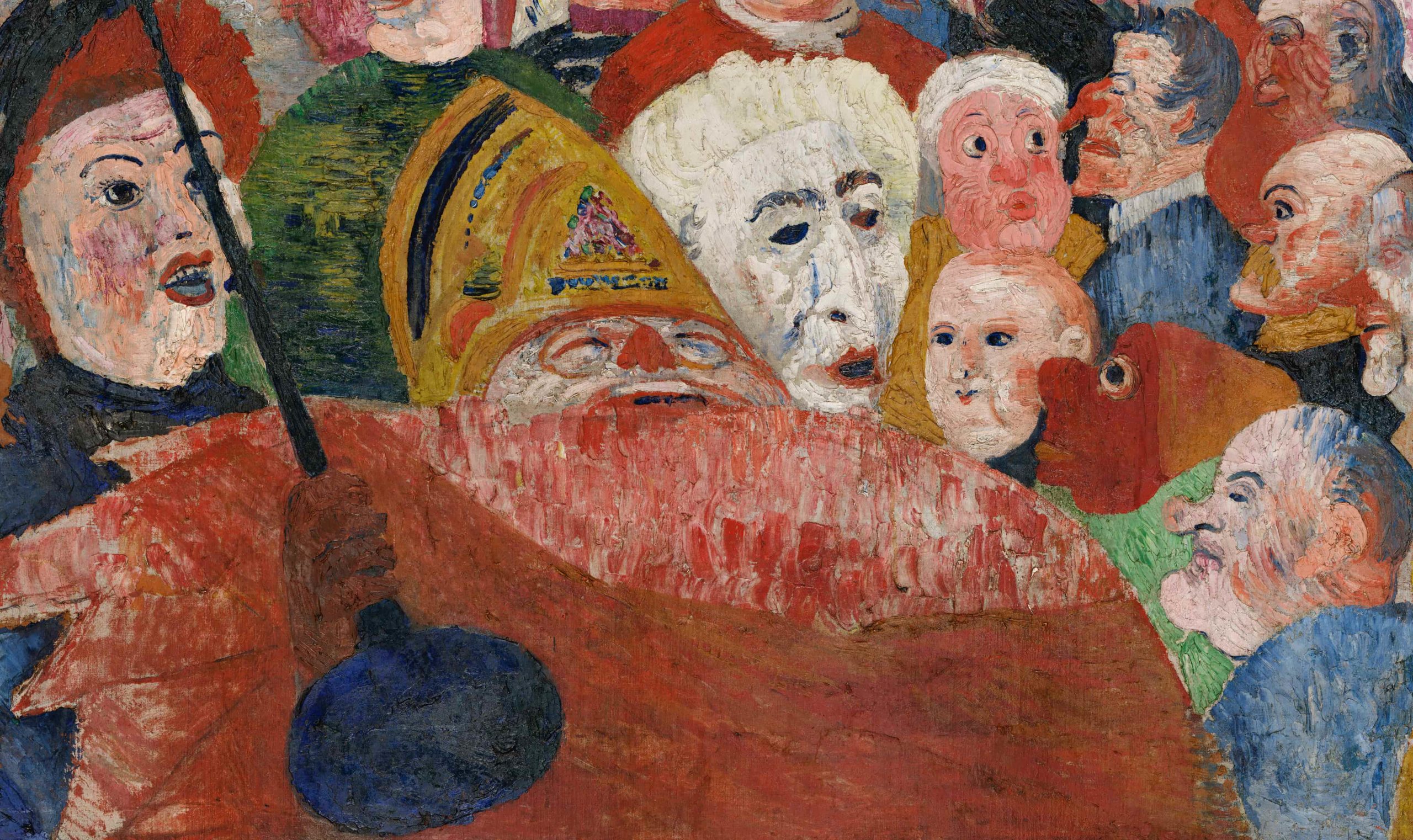
Ensor’s large painting is, among other things, a meditation on the paradoxes of the Triumphal Entry. His figure of Christ, positioned near the apex of a triangle created by the throng that surges toward us, is painted over a now faded smaller triangle of chromium yellow. The figure would have been luminous in color and central in position, a sort of proto-expressionist medieval icon, but Ensor’s Christ figure is placed in the distant middle-ground and is accordingly small. He is both the Grand Marshall of this turbulent parade and is carried along with the inexorable march toward the foreground. Surrounding the Christ figure, Ensor painted a sea of caricatured portraits and allegorical figures forming a bizarre, exuberant cavalcade. In the lower left of the picture, wearing a top hat, is a figure of death, reminding us that even as Jesus displays his authority in the Triumphal Entry, He is also willingly, sovereignly marching toward His own death. Soon another crowd will accompany Him on that journey.
Prayer
Adapted from Matthew 20:28
The Son of Man did not come to be served
But to serve,
And to give His life as a ransom for many
Jesus, somehow you are king and servant.
You came in peace and you conquered death.
You hold all things together.
Amen.
Jonathan Puls, M.F.A., M.A.
Chair, Department of Art
Professor of Art and Art History
Biola University
For more information about the artwork, music, and poetry selected for this day, we have provided resources under the “About” tab located next to the “Devotional” tab near the top of the page.
About the Artwork
Christ’s Entry Into Brussels in 1889 (3 views)
James Ensor
1888
Oil on canvas
99.5 x 169.5 in.
J. Paul Getty Museum
Los Angeles, California
Public Domain
James Ensor’s Christ’s Entry into Brussels in 1889 is one of the largest and most ambitious modern paintings of the late nineteenth and early twentieth centuries. Over eight feet high and fourteen feet wide, it depicts a huge parade flooding down a wide street toward the viewer. The lurid colors used to paint people, signs, and banners clash, and dozens of grotesque theatrical faces in the crowd, many wearing masks, compete for our attention. The paint is applied in crude, heavy strokes to create a rough, heavily textured surface. There is no shading, and the overall effect is flat and poster-like. The colors are brighter and lighter in the background, which sparkles with patterns of dots representing the distant crowds and rays of light that crisscross the waving banners. The painting’s title refers to the traditional subject of Christ’s entry into Jerusalem on Palm Sunday, and here it has been transposed to contemporary Belgium. The painting is reminiscent of the carnival parades of Mardi Gras, the Christian festival that precedes Lent. The small, gold-haloed figure of Christ rides a donkey in the center of the painting’s upper portion behind the marching band. He is surrounded by a small group of masked figures whose long noses point up at Him, and He raises His arm in a gesture of blessing. Most of the crowd, however, pays no attention to Christ’s arrival. The painting mocks humanity, as well as human beliefs and institutions, both civic and religious. The grotesque parade is led by a bishop dressed in red with a gold miter who is marching out of the painting in the middle of the foreground.
About the Artist
James Ensor (1860–1949) was a Belgian painter and printmaker and an important influence on the twentieth-century art movements of expressionism and surrealism. During the late nineteenth century, much of Ensor's work was rejected as scandalous but gradually his paintings won acceptance and acclaim. By 1920 he was the subject of major exhibitions. In 1929 he was named a baron by King Albert, and was the subject of the Belgian composer Flor Alpaerts's James Ensor Suite. In the first decade of the twentieth century, however, Ensor's production of new works was diminishing, and he increasingly concentrated on music—although he had no musical training, he was a gifted improviser on the harmonium, and spent much time performing for visitors. Against the advice of friends, he remained in Ostend, Belgium, during World War II, despite the risk of bombardment. In his old age, he was an honored figure among Belgians, and his daily walk made him a familiar sight in Ostend.
About the Music
“Ride on to Die” from the album The Life
Seems the sorrow untold,
As you look down the road,
At the clamoring crowd drawing near.
Feel the heat of the day,
As you look down the way,
Hear the shouts of Hosanna the King.
Oh, daughter of Zion,
Your time's drawing near.
Don't forsake Him, oh, don't pass it by,
On the foal of a donkey,
As the prophets had said,
Passing by you, He rides on to die.
Come now, little foal,
Though you're not very old,
Come and bear your first burden bravely,
Walk so softly upon,
All the coats and the palms,
Bear the One on your back, oh, so gently.
Midst the shouting so loud,
And the joy of the crowd,
There is One who is riding in silence.
For He knows the ones here,
Will be fleeing in fear,
When their Shepherd is taken away.
Oh, daughter of Zion,
Your time's drawing near.
Don't forsake Him, oh, don't pass it by.
On the foal of a donkey,
As the prophets had said,
Passing by you, He rides on to die.
Soon the thorn cursed ground,
Will bring forth a crown.
And this Jesus will seem to be beaten,
But He'll conquer alone,
Both the shroud and the stone,
And the prophecies will be completed.
Oh, daughter of Zion,
Your time's drawing near.
Don't forsake Him, oh, don't pass it by.
On the foal of a donkey,
As the prophets had said,
Passing by you, He rides on to die.
On the foal of a donkey,
As the prophets had said.
Passing by you He rides on to die.
About the Composer/Performer
In a career that spans over thirty years, Michael Card (b. 1957) has recorded over thirty-one music albums, authored or co-authored over twenty-four books, hosted a radio program, and written for a wide range of magazines. He has penned such favorite songs as “El Shaddai,” “Love Crucified Arose,” and “Immanuel.” He has sold over four million albums and written over nineteen #1 hits. Card’s original goal in life was to simply and quietly teach the Bible and proclaim Christ. Although music provided him the opportunity to share insight gained through his extensive scholarly research, he felt limited by having to condense the vast depth and richness of Scripture into three-minute songs. This prompted him to begin to write articles and books on topics that captured his imagination through conversations with Bible teachers, friends, and contemporaries in both Christian music and the academic community, and Card has continued to write to this day. Card travels frequently each year, teaching and sharing his music at Biblical Imagination Conferences, and facilitating the annual Life of Christ Tours to Israel.
About the Poetry and Poet
John Greenleaf Whittier (1807–1892) was an American poet, abolitionist, and influential figure of the nineteenth century. Born in rural Massachusetts, he was deeply shaped by his Quaker faith, which informed both his poetry and his lifelong commitment to social justice, particularly the abolition of slavery. Whittier was a leading voice in the anti-slavery movement and served as an editor and contributor to several abolitionist publications. His poetry often combined moral conviction with accessible language, drawing on rural New England life, religious reflection, and historical themes. Among his most enduring works are Snow-Bound and numerous hymns, including “Dear Lord and Father of Mankind.” Whittier remains a significant figure in American literary and religious history for his fusion of poetic craft, ethical concern, and spiritual depth.
About the Devotion Writer
Jonathan Puls is a painter, teacher, and family man who resides in Southern California. He has taught full-time in Biola’s Department of Art since 2005. He can frequently be found hiking and painting in the foothills.