March 19: Christ Heals the Blind
♫ Music:
Mark 8:22-26 (NKJV)
Then He came to Bethsaida; and they brought a blind man to Him, and begged Him to touch him. So He took the blind man by the hand and led him out of the town. And when He had spit on his eyes and put His hands on him, He asked him if he saw anything.
And he looked up and said, “I see men like trees, walking.”
Then He put His hands on his eyes again and made him look up. And he was restored and saw everyone clearly. Then He sent him away to his house, saying, “Neither go into the town, nor tell anyone in the town.”
Mark 10:46-52 (NKJV)
Now they came to Jericho. As He went out of Jericho with His disciples and a great multitude, blind Bartimaeus, the son of Timaeus, sat by the road begging. And when he heard that it was Jesus of Nazareth, he began to cry out and say, “Jesus, Son of David, have mercy on me!”
Then many warned him to be quiet; but he cried out all the more, “Son of David, have mercy on me!”
So Jesus stood still and commanded him to be called.
Then they called the blind man, saying to him, “Be of good cheer. Rise, He is calling you.”
And throwing aside his garment, he rose and came to Jesus.
So Jesus answered and said to him, “What do you want Me to do for you?”
The blind man said to Him, “Rabboni, that I may receive my sight.”
Then Jesus said to him, “Go your way; your faith has made you well.” And immediately he received his sight and followed Jesus on the road.
Poetry
“The Blind Suppliant”
by Richard Crashaw
Silence, silence, O vile crowd;
Yea, I will now cry aloud:
He comes near, Who is to me
Light and life and liberty.
Silence seek ye? yes, I’ll be
Silent when He speaks to me,
He my Hope; ah, meek and still,
I shall ’bide His holy will.
O crowd, ye it may surprise,
But His voice holdeth my eyes:
O have pity on my night,
By the day that gives glad light;
O have pity on my night,
By the day would lose its light,
If it gat not of Thee sight;
O have pity on my night,
By day of faith upspringing bright;
That day within my soul that burns,
And for eyes’ day unto Thee turns.
Lord, O Lord, give me this day,
Nor do Thou take that away.
Christ Heals the Blind
What do you want? Deep down in the core and quiet part of your heart – do you know? We all probably have an immediate answer, but is it in fact the answer?
There’s a cacophony of voices telling us what we should want. Visuals grab us viscerally with a three second swipe, capturing our attention before our brain has a chance to determine the truth, before our spirit has an opportunity to discern. But to really know in the depth of our souls, we need time to pause and reflect, to examine the process of getting to the deepest want.
As an organizational communication professor, I often talk with my students about the hidden value of the process. We tend to focus on the start and the end, particularly prioritizing the outcome. But it’s the process that’s truly formative. The process reveals the role of relationships, impact of communication, and quality of the outcome.
These two accounts of the blind men in the Gospel of Mark brilliantly highlight the process. While there’s so much going on in these stories, I’m particularly struck by the relational dynamic between Jesus and the ones who need healing. Notice the masterful verbal and nonverbal moves Jesus makes.
For the first blind man, Jesus provides touch. Touch, being one of the eight types of nonverbal communication codes, is the primary nonverbal to convey value and connection. Jesus also recognizes the importance of environment and timing (two other types of nonverbal communication codes), as he takes the man outside of town and instructs him what to do (or not do) after he receives sight.
In the second story, Jesus offers close proximity and conversation. He invites response. He listens. Although Bartimaeus is shushed by others, Jesus gives him dignity through discourse. The blind man could have remained silent based on the pressure of the crowd. Instead, he made a bold move – standing up (nonverbal) and with soul clarity, daring to make a request (verbal). These two men, who have lived a lifetime of uncertainty risked even further ambiguity for the sake of potential clarity. Why? Because they recognized the one before them and they were clear on their longing. Richard Crashaw’s poem, “The Blind Suppliant,” offers a compelling take on this: Jesus is the “light and life and liberty.” The Messiah’s very “voice holdeth my eyes.” The person and presence of Jesus emboldens us to move into the light. Similarly, Fernando Ortega helps us feel this distinct longing as well, singing, “Oh pass me not my gentle Savior.” He identifies the longing to be seen and touched by Jesus.
So, what is it that you want? This question is easier to answer when we know who’s asking. But there’s a second element here. We need to have enough self-awareness to see the deeper longing in our own souls so we can come in full honesty to the feet of the Healer.
This requires courage.
Courage isn’t denial, it’s clarity. It’s not tripped up by an awareness of fear, rather it’s rooted in core values, deep convictions, and connection to a larger purpose.
Courage is a kind of seeing.
What kind of courage do you need right now? Courage to show up. Courage to hope. Courage in the waiting. Courage in the asking. Courage in the leaving behind. Courage in the getting up. Courage in the speaking up. Courage in the listening.
Whatever it is that you need, the Savior sees you. He offers you relationship with him and in this intimate knowing, we gain sight.
Prayer
Jesus, thank you for caring about the everyday moments. Thank you for knowing what we need, even when we don’t. In seasons where uncertainty and chaos seem normal, help us to keep our eyes fixed on you. Please have mercy on us, oh Lord! Give us your eyes to see others as you see them. Grant us courage and show us what to do with the gift of holy sight. Amen.
Dr. Arianna Molloy
Associate Professor of Organizational Communication
Division of Communication, School of Arts & Letters
Biola University
For more information about the artwork, music, and poetry selected for this day, we have provided resources under the “About” tab located next to the “Devotional” tab near the top of the page.
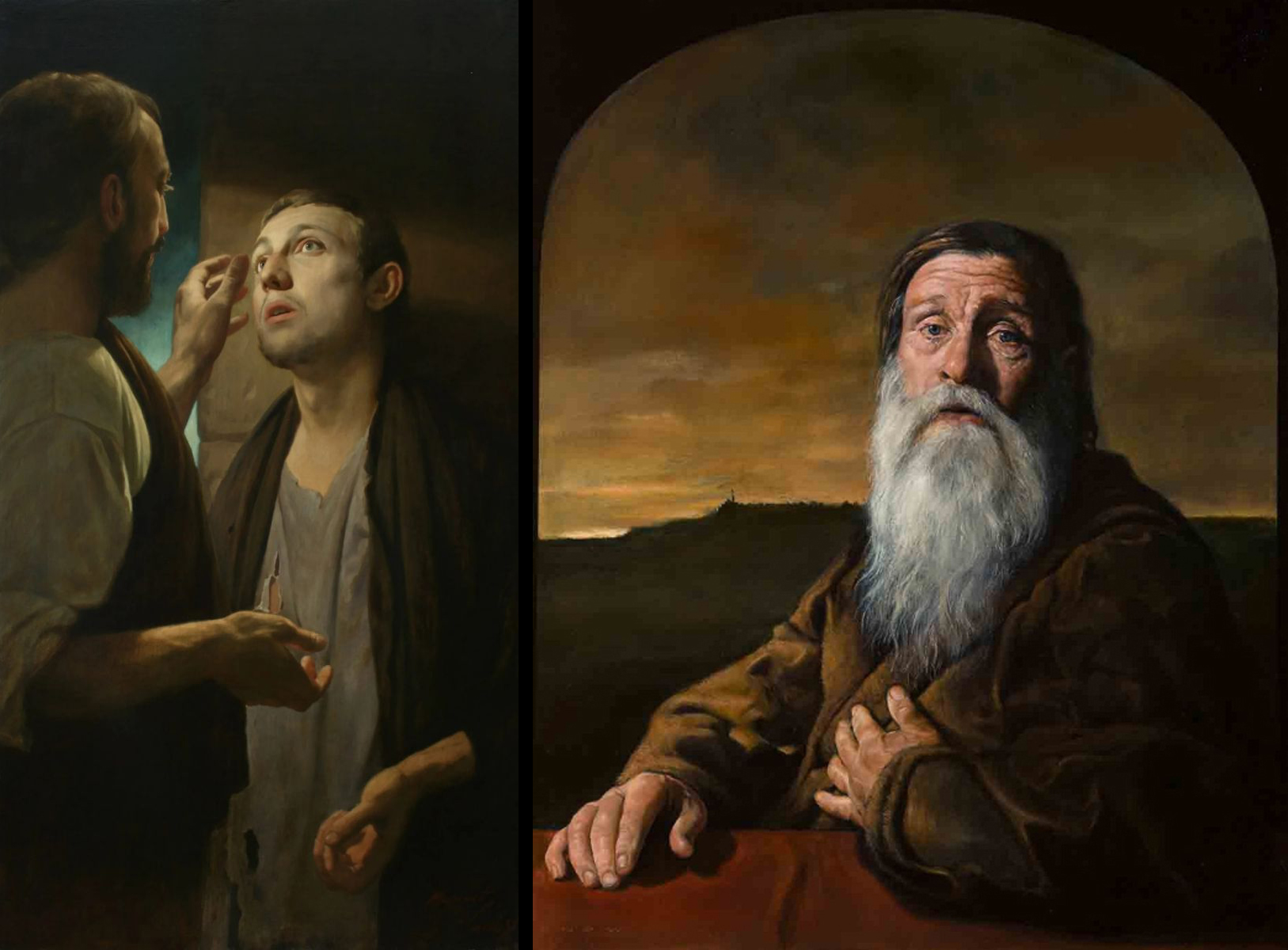
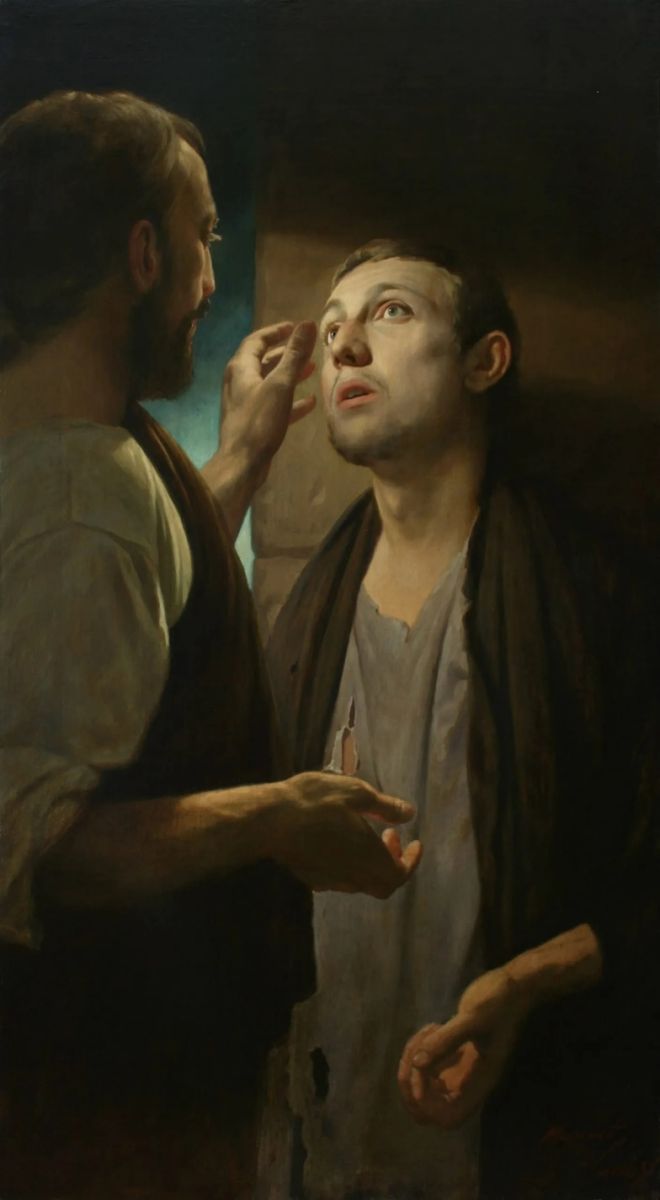
About the Artwork | 1 (L)
Healing of the Blind Man
A. N. Mironov
2019
Oil on canvas
23.6 x 11.8 cm
Used with permission from the artist
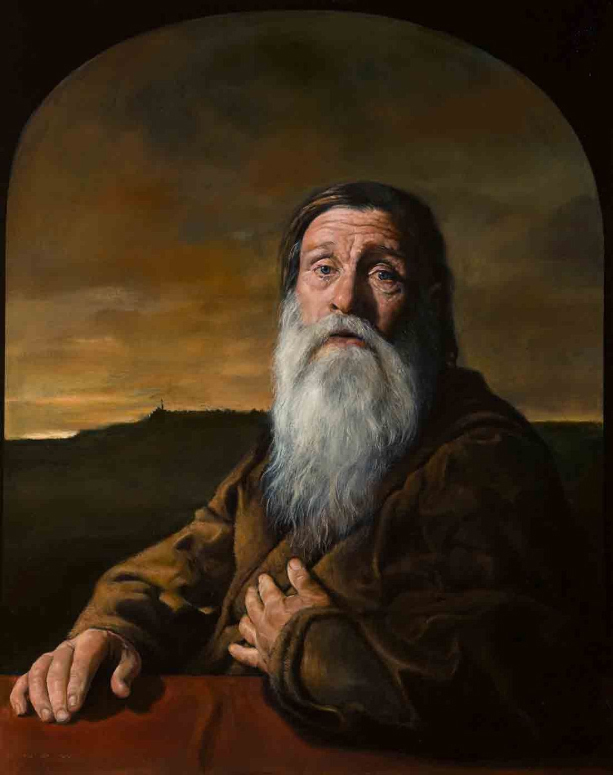
There are three distinct biblical accounts of Jesus healing blind men in the Gospels. These narratives challenged religious traditions of the day and powerfully showcased Jesus’s divine authority and compassion. In both of the paintings for today we see the contrast between physical sight and spiritual sight. In the Mironov painting entitled Healing of the Blind Man, Jesus heals a man who has been physically blind—unable to discern the physical world around him. In artist Tyson Snow’s painting entitled Whereas I Was Blind, Now I See, we see an old man, who has his physical sight intact, who has now gained spiritual insight—the ability to perceive spiritual realities and divine truth.
About the Artist
Andrei Mironov (b. 1975) was born in Russia. His paintings and prints focus on religious themes that portray his Christian beliefs and ideals. His oil paintings of biblical scenes are reminiscent of the artist Caravaggio with their dramatic lighting and detailed portraits. Self-educated in painting, Mironov has worked as a portraitist since 2005. In 2007, he won the title "Profi" at Russian Art Week in Moscow. His participation in the First Chechen War as well as his police work have had a considerable influence on his artistic development. The artist defined Christianity as "the main theme of his oeuvres.” Today his paintings are found in private collections, in the Kashira local museum, in the Monastery of Our Lady of Kazan, and in the St. Nicholas Church in Yamskaya Sloboda (Ryazan).
About the Artwork | 2 (R)
Whereas I Was Blind, Now I See
Tyson Snow
Oil on canvas
Used with permission from the artist
About the Artist
Tyson Snow is an American artist and sculptor. He had near instant success which brought a growing public interest in his work. He has been selected and featured as a finalist for the “Cover Art Competition” in the American Artist magazine. He was also featured in the American Art Collector magazine a number of times, as well as other publications and newspapers. Tyson’s work had previously consisted of black-and-white work: complex drawings created in reverse with white pencil over black substrate. Due to a compelling desire to create in different mediums, Snow began sculpting in clay/casting in bronze and painting in oils. His ability has allowed him to find early successes in both of those mediums. Tyson has been accepted into several museums and juried art exhibitions, where he has been the recipient of numerous awards for his paintings and sculpture.
About the Music | 1
“Then Jesus Came” from the album How Sweet the Sound
One sat alone beside the highway begging,
His eyes were blind, the light he could not see;
He clutched his rags and shivered in the shadows,
Then Jesus came and bade his darkness flee.
When Jesus comes the tempter's pow'r is broken;
When Jesus comes the tears are wiped away.
He takes the gloom and fills the life with glory,
For all is changed when Jesus comes to stay.
From home and friends the evil spirits drove him,
Among the tombs he dwelt in misery,
He cut himself as demon pow'rs possessed him,
Then Jesus came and set the captive free.
When Jesus comes the tempter's pow'r is broken;
When Jesus comes the tears are wiped away.
He takes the gloom and fills the life with glory,
For all is changed when Jesus comes to stay.
About the Composers
Oswald Jeffrey Smith (1889–1986) was a Canadian pastor, author, and missions advocate. He founded the Peoples Church in Toronto in 1928. Smith attended the Toronto Bible Training School; the Manitoba Presbyterian College in Winnipeg, Manitoba; and the McCormick Seminary in Chicago, Illinois. Smith was ordained as a minister of the Presbyterian Church of Canada in 1918. In 1928, he started an independent church in Toronto, the Peoples Church. Using his base in Toronto for fundraising, he traveled the world to recruit missionaries and preach. Over the course of eighty years he preached more than twelve thousand sermons in eighty countries, wrote thirty-five books, as well as 1,200 poems, of which one hundred have been set to music.
Homer Alvan Rodeheaver (1880–1955) was an American evangelist, music director, music publisher, composer of gospel songs, and pioneer in the recording of sacred music.
About the Performer
George Beverly Shea (1909–2013) was a Canadian-born American gospel singer and hymn composer. Shea was often described as "America's beloved gospel singer" and was considered "the first international singing star of the gospel world" as a consequence of his solos at Billy Graham Crusades and his exposure on radio, records, and television. Because of the large attendance at Graham's Crusades, it is estimated that Shea sang live before more people than anyone else in history.
About the Music | 2
“Pass Me Not” from the album Fernando Ortega Home
Pass me not, O gentle Savior,
Hear my humble cry;
While on others Thou art smiling,
Do not pass me by.
Let me at a throne of mercy
Find a sweet relief;
Kneeling there in deep contrition,
Help my unbelief.
Saviour, Saviour,
Hear my humble cry;
While on others Thou art calling,
Do not pass me by.
About the Composers
Lyrics by Fanny Crosby, Music by William H. Doane
Fanny Crosby (1820–1915) was an American missionary, poet, lyricist, and composer. She was a prolific hymnist, writing more than eight thousand hymns and gospel songs, with more than 100 million copies printed. She is also known for her teaching and her rescue mission work. Crosby became blind at the age of six weeks from maltreatment of her eyes during a spell of sickness. At the age of fifteen she entered the New York Institution for the Blind, where she received an excellent education. She became a teacher in the institution in 1847 and continued her work there until 1858. During the vacations of 1852 and 1853, spent at North Reading, Massachusetts, she wrote the words to many songs for Dr. Geo. F. Root, the teacher of music at the blind institution. In addition to the thousands of hymns that she wrote, many of which have not been set to music, she published four volumes of poetry.
Dr. William Howard Doane (1831–1915) was an American musical composer. At thirteen, he could play the double bass viol, and at fifteen, with equal skill, he could play on the cabinet organ. About this time, he began education in musical composition. During 1852–1854, he was conductor of the Norwich Harmonic Society. In 1868, Dr. Doane devoted himself to musical composition, and he is known to have composed more than six hundred Sunday-school songs, at least one hundred fifty church and prayer-meeting hymns, and two hundred fifty other songs and ballads.
About the Performer
Fernando Ortega (b. 1957) is an evangelical Christian singer-songwriter and worship leader, heavily influenced by traditional hymns, as well as his family’s New Mexico heritage. He is noted for his interpretations of many traditional hymns and songs, such as “Give Me Jesus,” “Be Thou My Vision,” and “Praise to the Lord, the Almighty.” Much of his current inspiration comes from the North American Anglican liturgy. It is from his heritage and classical training at the University of New Mexico that Ortega derives his sound, embracing country, classical, Celtic, Latin American, world, modern folk, and rustic hymnody. From the late 1970s to the mid-1990s, he served in music ministry at a number of churches in New Mexico and Southern California.
About the Poetry and Poet
Richard Crashaw (1612–1649) was an English poet and teacher, an Anglican cleric, and a Roman Catholic convert, and he was one of the major metaphysical poets in seventeenth-century English literature. Crashaw was educated at Pembroke College, Cambridge. After taking a degree, Crashaw taught as a fellow at Peterhouse, Cambridge, and began to publish religious poetry that expressed a distinct mystical nature and an ardent Christian faith. Crashaw's poetry, although often categorized with those of the contemporary English metaphysical poets, exhibits similarities with the baroque poets and was influenced in part by the works of Italian and Spanish mystics.
About the Devotion Writer
Dr. Arianna Molloy (Ph.D., University of Denver) is an Associate Professor of Organizational Communication at Biola University. Her research explores meaningful work, work as a calling, and the relationship between humility and burnout in the workplace; she is an award-winning teacher and scholar published in premier academic journals. She is the author of Healthy Calling: From Toxic Burnout to Sustainable Work, available in paperback, Kindle, and audio formats. Dr. Molloy is married to Dr. Allen Yeh, a professor of Intercultural Studies, and they have one young son. For more information on Dr. Molloy’s research on work calling, burnout, and organizational communication, visit ariannamolloy.com.