March 16: Christ's Teaching on Wealth
♫ Music:
Mark 10:17–31 (NKJV)
Now as He was going out on the road, one came running, knelt before Him, and asked Him, “Good Teacher, what shall I do that I may inherit eternal life?”
So Jesus said to him, “Why do you call Me good? No one is good but One, that is, God. You know the commandments: ‘Do not commit adultery,’ ‘Do not murder,’ ‘Do not steal,’ ‘Do not bear false witness,’ ‘Do not defraud,’ ‘Honor your father and your mother.’ ”
And he answered and said to Him, “Teacher, all these things I have kept from my youth.”
Then Jesus, looking at him, loved him, and said to him, “One thing you lack: Go your way, sell whatever you have and give to the poor, and you will have treasure in heaven; and come, take up the cross, and follow Me.”
But he was sad at this word, and went away sorrowful, for he had great possessions.
Then Jesus looked around and said to His disciples, “How hard it is for those who have riches to enter the kingdom of God!” And the disciples were astonished at His words. But Jesus answered again and said to them, “Children, how hard it is for those who trust in riches to enter the kingdom of God! It is easier for a camel to go through the eye of a needle than for a rich man to enter the kingdom of God.”
And they were greatly astonished, saying among themselves, “Who then can be saved?”
But Jesus looked at them and said, “With men it is impossible, but not with God; for with God all things are possible.”
Then Peter began to say to Him, “See, we have left all and followed You.”
So Jesus answered and said, “Assuredly, I say to you, there is no one who has left house or brothers or sisters or father or mother or wife or children or lands, for My sake and the gospel’s, who shall not receive a hundredfold now in this time—houses and brothers and sisters and mothers and children and lands, with persecutions—and in the age to come, eternal life. But many who are first will be last, and the last first.”
Poetry
“Advent”
by Suzanne Underwood Rhodes
Through the needle’s eye
the rich man came
squeezing through stars
of razor light
that pared his body down to thread.
Gravity crushed his heart’s chime
and his breath that breathed out worlds
now flattened as fire between walls.
The impossible slit stripped him,
admitting him
to stitch the human breach.
Christ's Teaching on Wealth
Some time ago, while preaching on today’s Scripture, an elder at my church answered a question that had long bothered me. “I don’t think that Jesus’ command to the rich young man applies to everyone,” he said. “God’s claim on each person’s life is total, but not everyone is necessarily asked to sell all they have to follow him.” I was relieved. “But, if you’re relieved to hear that,” he continued, “you might be the very person he is asking it of.”
Ah.
I’m attached to my possessions. I like having a clean place to live, food security, and savings. I rely on convenient transportation, fashionable clothes, ready entertainment, and treats when I’m sad. The comfort of middle-class American life woos me.
God is not against us having money or stability: he frequently commands his people to provide for the poor and steward their wealth well. Wearing nice clothes or going out for a fancy coffee can glorify God.
However, sometimes what he asks of us does go against human wisdom. Following him often costs more than we want to give.
If you walk long enough with God, you will be given the painful grace of being “pared down” in some manner, revealing what is truly in your heart. If God asked me to choose generosity over convenience, status symbols, or pleasure, would I obey? If he asked me to let go of a dream, would I follow? If I had to leave behind a relationship that offered me security, would I go? If he offered weakness and grace instead of my self-powered religiosity, would I accept it?
The poverty Jesus offered the rich man was a gift. Mark offers an unexpected note midway through the scene—Jesus looked at the young man, and loved him. Then, only after this moment of love, he offered: Here is the thing you’re missing. This was a gift of seeing reality. I want you to be filled! But to be filled you need to know that the things you have are empty.
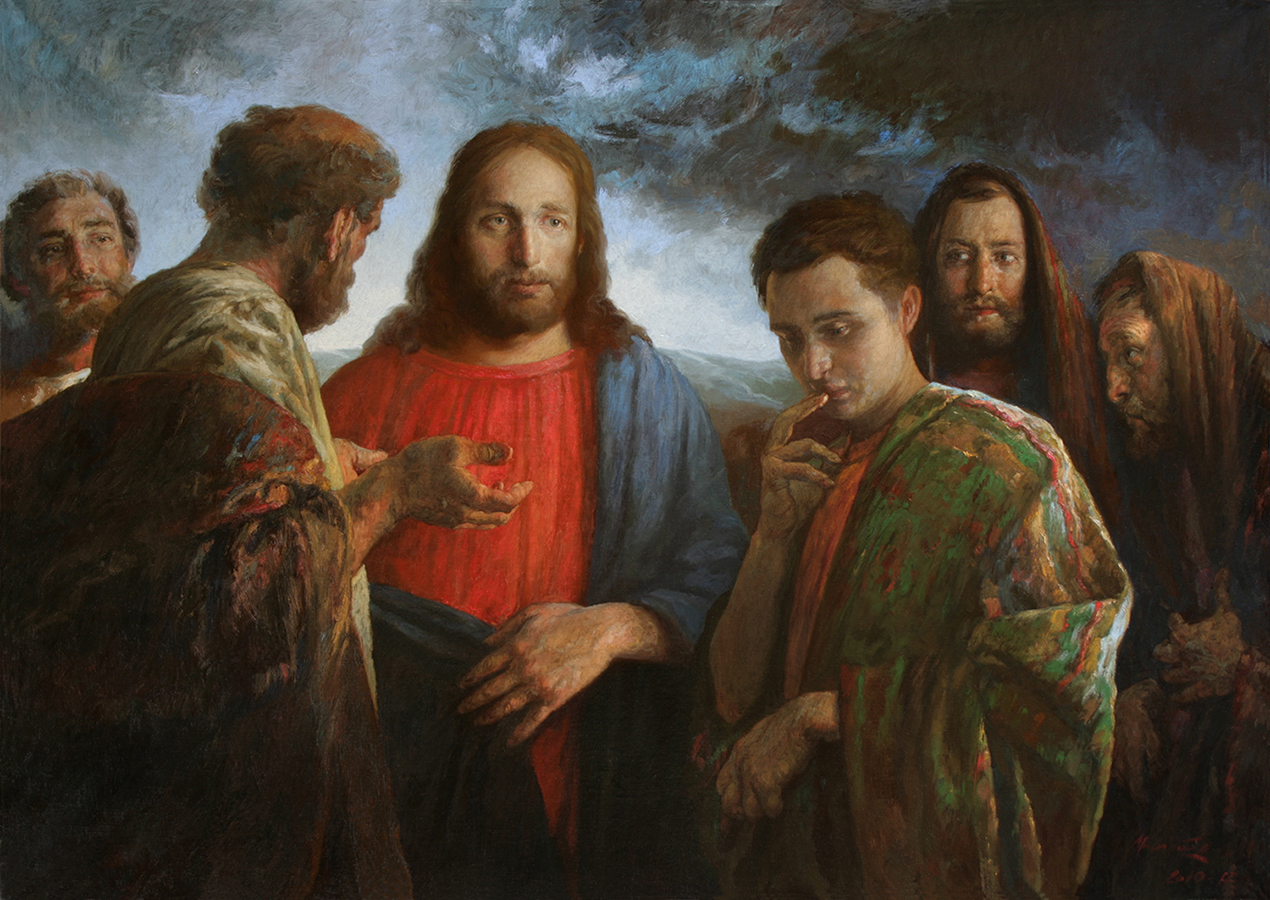
Maybe, like me, you find the young man’s demeanor in today’s painting relatable. The man is paralyzed, wishing to do what he ought, but perhaps already knowing what he will choose. He is grappling with the cost, seeking any other solution, fighting to let go of what his heart so tightly clutches. And he doesn’t. He can’t. He goes away, deeply grieved.
How is it possible for the rich man to enter the kingdom of God?
“With men it is impossible,” but “with God all things are possible,” Jesus answers (v. 27). Suzanne Underwood Rhodes’ poem “Advent” elucidates this solution. Jesus himself is the rich man who became poor, threaded through the needle to sew up our wounds. Because he took on human form, emptying himself to bear our sins in the flesh, we are able to enter the kingdom of God (Philippians 2:5-11).
I encourage you to consider: would I give up the things that make me feel safe and comfortable, believing there is a truer, better safety and comfort? What does my attitude towards my possessions tell me about my trust?
If accepting Christ’s call feels impossible, start here: ask the God who makes all things possible for the faith to see him as more beautiful than anything in this world. If we are emptied for him, we will be filled with eternal life.
Prayer:
Lord Jesus, who looks on me with love,
One thing I ask from you,
this only do I seek:
that I may dwell in the house of the Lord
all the days of my life,
to gaze on your beauty
and to seek you in your temple.
Give me only faith enough to be emptied,
So that I may be by your life filled.
—Adapted from Psalm 27:4
Grace Ducker
Alumna, Biola University & Torrey Honors College
Administrative Coordinator, Office of the President
Biola University
For more information about the artwork, music, and poetry selected for this day, we have provided resources under the “About” tab located next to the “Devotional” tab near the top of the page.
About the Artwork
Christ and the Rich Young Ruler
A. N. Mironov
2010
Oil on canvas
Used with permission from the artist
This painting entitled Christ and the Rich Young Ruler recounts the story of Jesus and the rich young ruler who asked what he could do to obtain eternal life. Jesus clearly sees into this privileged man’s heart and life, which have been predicated on self-reliance and lack of devotion to God. The one thing in his life preventing him from steadfast devotion to God is his possessions. So, Jesus tells the rich ruler to give all of his possessions and make a commitment to follow Him. In Mironov’s work one witnesses the internal struggle of the young ruler as he thoughtfully considers Jesus’s proposition. Jesus uses the man's inability to give up his riches to show that wealth can become an idol that hinders a person's ability to fully surrender to God. The story is a challenge to prioritize God above all else, including personal possessions and power.
About the Artist
Andrei Mironov (b. 1975) was born in Russia. His paintings and prints focus on religious themes that portray his Christian beliefs and ideals. His oil paintings of biblical scenes are reminiscent of the artist Caravaggio with their dramatic lighting and detailed portraits. Self-educated in painting, Mironov has worked as a portraitist since 2005. In 2007, he won the title "Profi" at Russian Art Week in Moscow. His participation in the First Chechen War as well as his police work have had a considerable influence on his artistic development. The artist defined Christianity as "the main theme of his oeuvres.” Today his paintings are found in private collections, in the Kashira local museum, in the Monastery of Our Lady of Kazan, and in the St. Nicholas Church in Yamskaya Sloboda (Ryazan).
About the Music
“I’d Rather Have Jesus” from the album Selah—You Amaze Me
I'd rather have Jesus than silver or gold
I'd rather be His than have riches untold
I'd rather have Jesus than houses or lands
I'd rather be led by His nail-pierced hand
Than to be the king of a vast domain
And be held in sin's dread sway
I'd rather have Jesus than anything
This world affords today
I'd rather have Jesus than men's applause
I'd rather be faithful to His dear cause
I'd rather have Jesus than worldwide fame
I'd rather be true to His holy name
Than to be the king of a vast domain
And be held in sin's dread sway
I'd rather have Jesus than anything
This world affords today
He’s fairer than lilies of rarest bloom
He’s sweeter than honey, from out the comb
He’s all that my hungering spirit needs
I'd rather have Jesus
And let Him lead
Than to be the king of a vast domain
And be held in sin's dread sway
I'd rather have Jesus than anything
This world affords today
Than to be the king of a vast domain
And be held in sin's dread sway
I'd rather have Jesus than anything
This world affords today
About the Composers
Lyrics by Rhea Miller, Music by George Beverly Shea
Rhea F. Miller (1894–1966) was the wife of Dr. H. V. Miller, one of the general superintendents of the Church of the Nazarene. After her husband’s death, Mrs. Miller taught piano and traveled all around her immediate area in her little grey Nash coupe. She had a special mission in life and that was to teach pastors’ children how to play the piano.
George Beverly Shea (1909–2013) was a Canadian-born American gospel singer and hymn composer. Shea was often described as "America's beloved gospel singer" and was considered "the first international singing star of the gospel world" as a consequence of his solos at Billy Graham Crusades and his exposure on radio, records, and television. Because of the large attendance at Graham's Crusades, it is estimated that Shea sang live before more people than anyone else in history.
About the Performers
From their inception, Selah has been synonymous with the singing of hymns. In fact, the understated beauty of the trio’s 1999 debut, Be Still My Soul, helped initiate a hymn revival in Christian music that continues today. Selah’s discography has significantly repopularized the church’s greatest songs while decorating the ensemble with numerous Dove Awards, number one singles, sold-out concert tours, and over two and half million albums sold.
About the Poetry and Poet
Suzanne Underwood Rhodes is the poet laureate of Arkansas and the author of six poetry collections, the most recent a chapbook, The Perfume of Pain. Her second full collection, Flying Yellow, was named a semifinalist in the North American Book Award. She has recent work in Dappled Things, Spiritus, Southern Voices: 50 Contemporary Poets, and Slant. Her book The Roar on the Other Side: A Guide for Student Poets is the text selected by Classical Conversations for teaching poetry at the high school level. She was awarded the 2025 Governor’s Individual Artist Award and was a recipient of the Artist 360 grant sponsored by the Walton Foundation. Suzanne brought “Poetry on Purpose” to dementia patients in a memory care center and taught poetry to formerly incarcerated women at Magdalene Serenity House in Fayetteville. She teaches virtual poetry workshops at the Muse Writers Center in Norfolk, Virginia, and is an adjunct instructor of English at John Brown University.
About the Devotion Writer
Grace Ducker is an alumna of Biola University and the Torrey Honors College, and currently works as an administrative coordinator in the office of the university president. She loves to think about how faith interacts with social issues, suffering, and loss. She cares deeply about the ways the profundity of the Christian life plays out in the tangible experiences of making art, hiking, and living daily life with others, and takes joy in practicing this alongside her church, family, and friends.