March 26: Christ’s Teaching on the End of the Age
♫ Music:
Mark 13:3–23 (NKJV)
Now as He sat on the Mount of Olives opposite the temple, Peter, James, John, and Andrew asked Him privately, “Tell us, when will these things be? And what will be the sign when all these things will be fulfilled?”
And Jesus, answering them, began to say: “Take heed that no one deceives you. For many will come in My name, saying, ‘I am He,’ and will deceive many. But when you hear of wars and rumors of wars, do not be troubled; for such things must happen, but the end is not yet. For nation will rise against nation, and kingdom against kingdom. And there will be earthquakes in various places, and there will be famines and troubles. These are the beginnings of sorrows.
“But watch out for yourselves, for they will deliver you up to councils, and you will be beaten in the synagogues. You will be brought before rulers and kings for My sake, for a testimony to them. And the gospel must first be preached to all the nations. But when they arrest you and deliver you up, do not worry beforehand, or premeditate what you will speak. But whatever is given you in that hour, speak that; for it is not you who speak, but the Holy Spirit. Now brother will betray brother to death, and a father his child; and children will rise up against parents and cause them to be put to death. And you will be hated by all for My name’s sake. But he who endures to the end shall be saved.
“So when you see the ‘abomination of desolation,’ spoken of by Daniel the prophet, standing where it ought not” (let the reader understand), “then let those who are in Judea flee to the mountains. Let him who is on the housetop not go down into the house, nor enter to take anything out of his house. And let him who is in the field not go back to get his clothes. But woe to those who are pregnant and to those who are nursing babies in those days! And pray that your flight may not be in winter. For in those days there will be tribulation, such as has not been since the beginning of the creation which God created until this time, nor ever shall be. And unless the Lord had shortened those days, no flesh would be saved; but for the elect’s sake, whom He chose, He shortened the days.
“Then if anyone says to you, ‘Look, here is the Christ!’ or, ‘Look, He is there!’ do not believe it. For false christs and false prophets will rise and show signs and wonders to deceive, if possible, even the elect. But take heed; see, I have told you all things beforehand.
Poetry
“Try to Praise the Mutilated World”
by Adam Zagajewski, trans. by Clare Cavanagh
Try to praise the mutilated world.
Remember June's long days,
and wild strawberries, drops of rosé wine.
The nettles that methodically overgrow
the abandoned homesteads of exiles.
You must praise the mutilated world.
You watched the stylish yachts and ships;
one of them had a long trip ahead of it,
while salty oblivion awaited others.
You've seen the refugees going nowhere,
you've heard the executioners sing joyfully.
You should praise the mutilated world.
Remember the moments when we were together
in a white room and the curtain fluttered.
Return in thought to the concert where music flared.
You gathered acorns in the park in autumn
and leaves eddied over the earth's scars.
Praise the mutilated world
and the gray feather a thrush lost,
and the gentle light that strays and vanishes
and returns.
Christ’s Teaching on the End of the Age
Mark sets an ominous tone in the early stages of his Gospel. Beginning in Mark 2:1, Jesus engages in several challenging interactions with the Jewish religious leaders over his identity, authority, and mission. He shows them that he, the Son of Man, has authority on earth to forgive sins and to lay aside the Sabbath for his greater mission. When asked why he eats with tax collectors and sinners, he tells them that his mission is not to call the righteous but to call sinners back to God. As a result of these interactions, Jesus, in Mark 2:21-22, makes what amounts to a warning to the religious leaders. He tells them that as the Messiah, he has brought something new to God’s people, the new covenant that was promised in the Old Testament as a primary feature of his kingdom. And if they insist on trying to force what he’s bringing into the old, Mosaic covenant and its forms of piety, both he and the old way will be destroyed. And then in Mark 3:6, Mark tells us that the Pharisees and the Herodians immediately took counsel together as to how they might destroy him.
When we come to Mark 13, Jesus knows that his “destruction” at the hands of the Jewish authorities is at hand. Three times he has apprised his disciples of this fact (Mark 8:31; 9:31; 10:32-34), and now he stands at the threshold of its fulfillment. But this is also the threshold of the “destruction” of the old covenant, of relating to God in the forms first established with Israel through Moses. And that covenantal relationship was signified first and foremost by the temple in Jerusalem. So, when his disciples point out how impressive the Jerusalem temple is, Jesus tells them that its days are numbered, that the days are coming when not one stone will be left upon another. Concurrent with his own death will be the end of the Mosaic dispensation and the beginning of a new dispensation, a new covenantal relationship between God and those Israelites (and others!) who accept Jesus as their anointed King in the kingdom of God. In this new covenantal relationship, God’s standards will be written on people’s hearts by the power of the Holy Spirit (Jer 31:31-37; Ezek 36:25-27) and be lived out through the fundamental commands to love God with one’s whole heart and to love one’s neighbor as oneself (Mark 12:28-34), what the New Testament calls “the royal law” and “the law of Christ” (1 Cor 9:21; Jam 2:8; cf. Rom 13:8-10; Gal 5:13-18). In predicting the destruction of the temple, Jesus was also announcing the inauguration of God’s kingdom.
In this Jesus was following lines laid down by the prophet Daniel. In Daniel, God decreed that in the last days, before the Son of Man took up his throne and his people were vindicated and blessed in his kingdom, a pagan imperial figure would destroy the temple and persecute Israel. In Mark 13, Jesus says that the destruction of the temple concurrent with his death would be a foreshadowing of this greater, future destruction before his return and the full expression of the kingdom. The first destruction would launch an adumbrated (though nonetheless real) experience of the kingdom; the greater fulfillment would precede the fully tangible experience of the kingdom as predicted in the Old Testament.
So, as we prepare for the celebration of the atoning death and vindicating resurrection of our Lord, let us remember that with that death and resurrection, he brought us into the new covenant relationship with God promised by the prophets of old, granting us reconciliation and the gift of his Spirit. Our lives are now lived not by the Law of Moses but by the Law of Christ. But let us also remember that this is only the beginning. Let us fix our hope on the return of our Lord, when we will experience the fulness of his kingdom, living, reigning, and fellowshipping with him forever in a world at peace with God and with one another under his lordship!
Prayer
Our Father in heaven, we pray that your kingdom would come and your will would be done on earth as it is in heaven. We look forward to and pray for the fulness of that at the return of our Lord Jesus. But may we also live as a citizen of your kingdom today, in love of you and others by the power of your Spirit and for your glory, even as you have called us to do, in the name of your Son, Jesus Christ, our Lord. Amen.
Dr. Alan Hultberg
Director of the Master of Arts Program
Associate Professor of New Testament
For more information about the artwork, music, and poetry selected for this day, we have provided resources under the “About” tab located next to the “Devotional” tab near the top of the page.
About the Artwork | 1
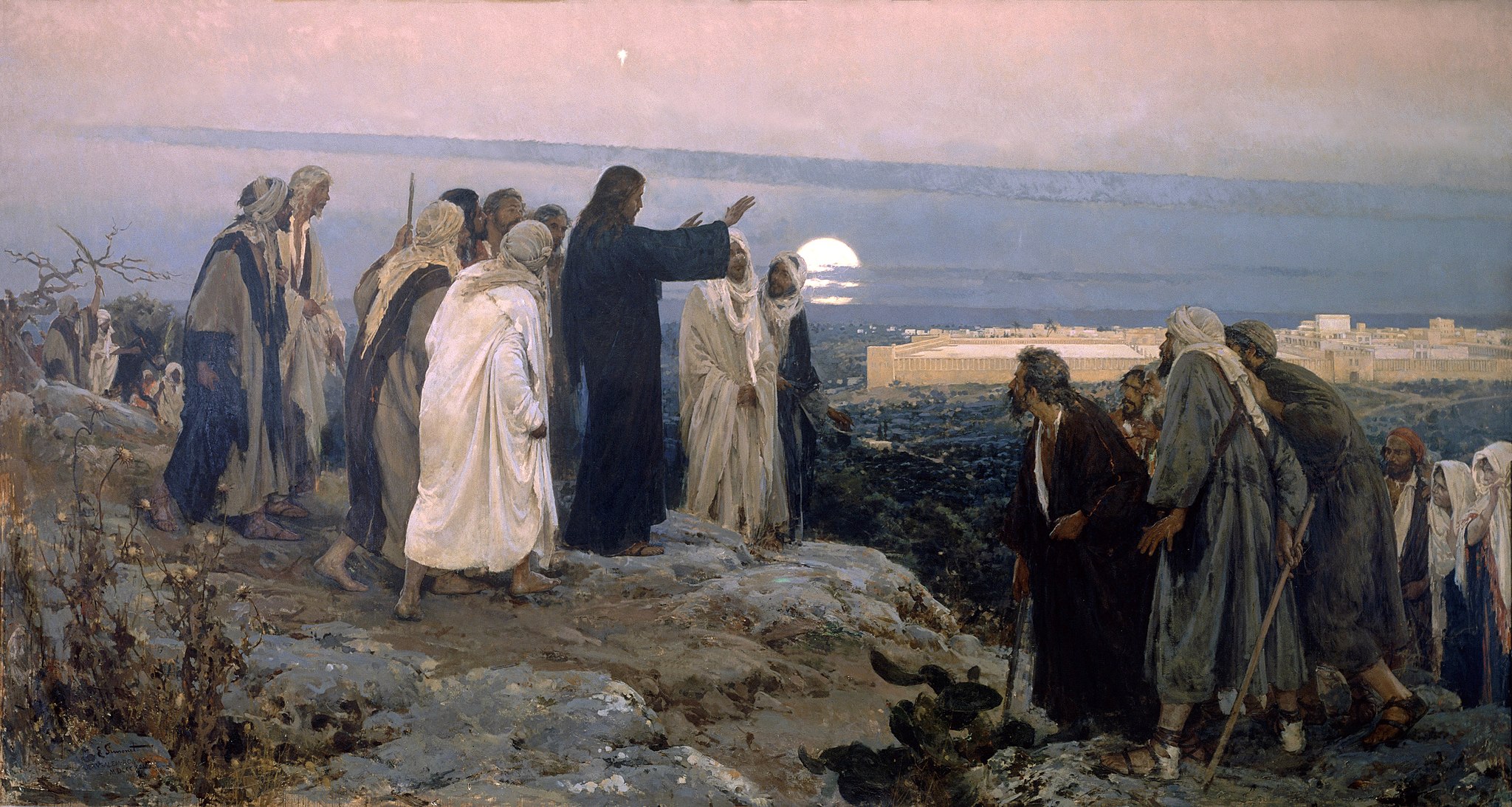
He Wept Over It (The Olivet Discourse)
Enrique Simonet
1892
Oil on canvas
304.5 x 555 cm
Museo Del Prado
Madrid, Spain
Public Domain
In artist Enrique Simonet’s large ten-by-eighteen-foot painting, we find Jesus weeping before He enters Jerusalem. Luke tells us Jesus’s tears are followed with His words about the impending destruction of Jerusalem and its people, a destruction that necessarily flowed from people forsaking God and the peace He offered. Jesus wept over the destruction of this city and her people, who could have experienced God’s peace and care. Instead, they turned away from God to pursue their own ends.
About the Artist
Enrique Simonet (1866–1927) was a Spanish painter whose childhood desire was to pursue a religious vocation. Although that did not happen, Simonet used his talents to reveal deep spiritual truths through his paintings of biblical narratives. Simonet’s monumental masterpiece He Wept Over It was completed during a trip to the Holy Land in 1890. In ensuing years, this work traveled to major cities in Europe and the United States, where Simonet received numerous medals and awards commending it. Simonet’s allegorical works can be found in the Palaces of Justice in both Barcelona and Madrid in Spain.
About the Artwork | 2
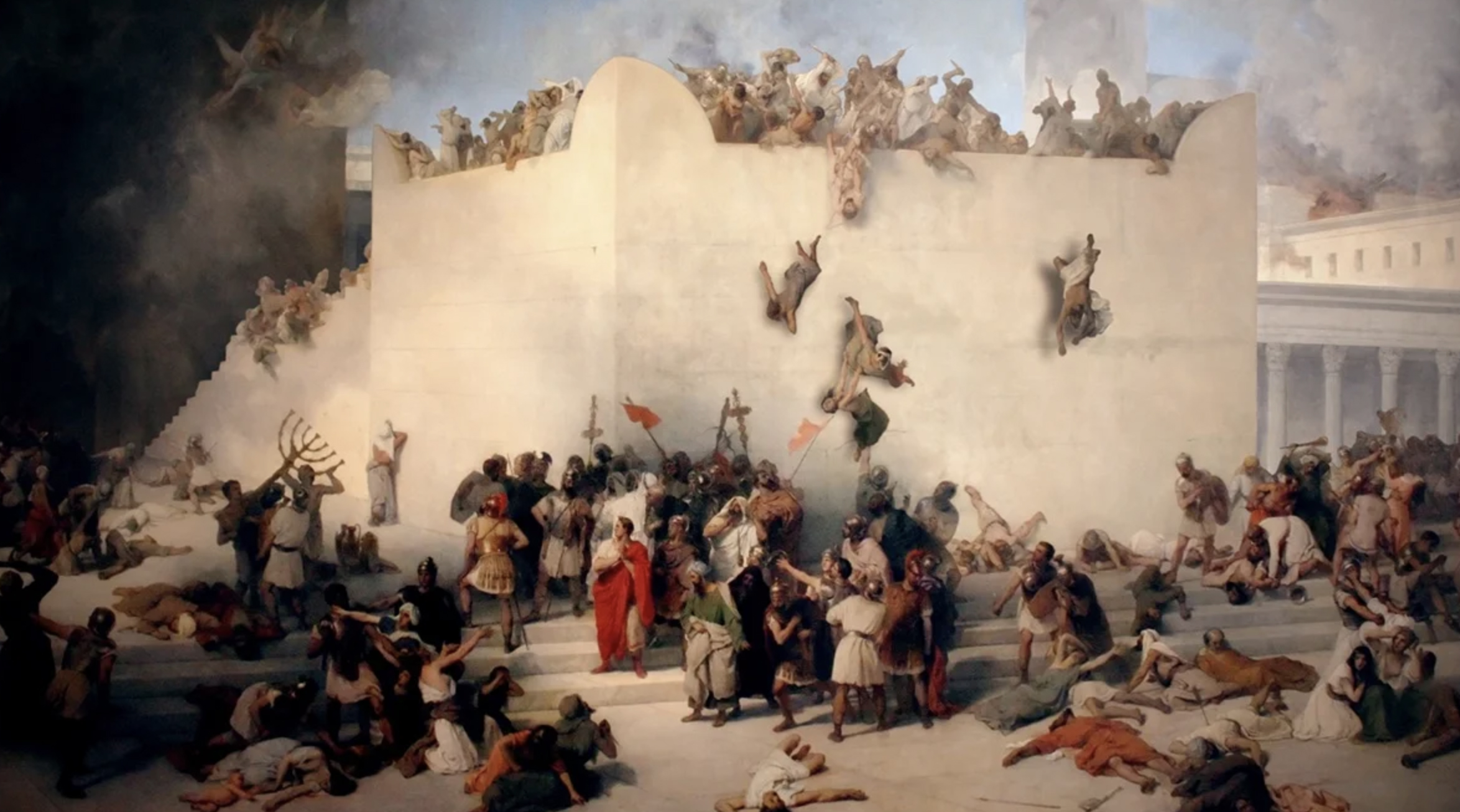
The Destruction of the Temple of Jerusalem
Francesco Hayez
1867
Oil on canvas
183 x 282 cm
Gallerie dell’Accademia
Venice, Italy
Public Domain
This visually striking composition by Italian artist Francesco Hayez depicts the destruction of the temple in Jerusalem at the very moment the carnage is at its height—the building is already engulfed in flames and the destructive fury of conflict is at its climax. The scene tells the story of the dramatic plight of the Jewish people and the destruction of the temple, a central symbol of Jewish worship and identity. Following the fall of the city, widespread slaughter ensued, and the aftermath solidified the Roman victory, leading to the dispersion of many Jewish communities. This event not only altered the religious landscape but also had profound implications for Jewish identity and national aspirations in the centuries to follow.
About the Artist
Francesco Hayez (1791–1882) was an Italian painter. He is considered one of the leading artists of Romanticism in mid-nineteenth-century Milan, and is renowned for his grand historical paintings, political allegories, and portraiture. Over the course of a long career, Hayez proved to be particularly prolific. His output included historical paintings designed to appeal to the patriotic sensibility of his patrons as well as works reflecting the desire to accompany a neoclassic style with grand themes from biblical or classical literature. His portraits have the intensity of painter Jean-Auguste Ingres and the Nazarene movement. While Hayez made portraits for the nobility, he also explored other subjects, like fellow artists and musicians.
About the Music
“Persecutions” from the album The Gospel of Mark: An Oratorio
And as he sat upon the mount of Olives over against the temple,
Peter and James and John and Andrew asked him privately,
Tell us, when shall these things be?
and what shall be the sign when all these things shall be fulfilled?
And Jesus answering them began to say, Take heed lest any man deceive you:
For many shall come in my name, saying, I am Christ; and shall deceive many.
And when ye shall hear of wars and rumours of wars,
be ye not troubled: for such things must needs be; but the end shall not be yet.
For nation shall rise against nation, and kingdom against kingdom:
and there shall be earthquakes in divers places, and there shall be famines and troubles:
these are the beginnings of sorrows.
But take heed to yourselves: for they shall deliver you up to councils;
and in the synagogues ye shall be beaten: and ye shall be brought
before rulers and kings for my sake, for a testimony against them.
And the gospel must first be published among all nations.
But when they shall lead you, and deliver you up,
take no thought beforehand what ye shall speak,
neither do ye premeditate: but whatsoever shall be given you in that hour,
that speak ye: for it is not ye that speak, but the Holy Ghost.
Now the brother shall betray the brother to death,
and the father the son; and children shall rise up against their parents,
and shall cause them to be put to death.
And ye shall be hated of all men for my name's sake:
but he that shall endure unto the end, the same shall be saved.
About the Composer
A graduate of the University of British Columbia School of Music with a degree in composition, Christopher Tyler Nickel studied with renowned Canadian composer Stephen Chatman. Upon graduation, he continued his studies in New York and Los Angeles. Christopher is the composer-in-residence of the Lionsgate Sinfonia and the author of numerous concert works which have been performed by orchestras and chamber ensembles in Canada, the United States, and Europe. Works include a concerto for piccolo/flute/alto flute; Tranquility for solo English horn and orchestra, which was premiered by the Vancouver Symphony’s English hornist, Beth Orson; and in 2015 the premiere of his Oboe Concerto written for Roger Cole, principal oboe of the Vancouver Symphony. Other major works include a Requiem, his hour-long, one-movement Symphony No.2, and a seven-hour oratorio setting the Gospel According to Mark to music.
About the Performers
Carman J. Price, Steven Bélanger, and the Vancouver Contemporary Orchestra conducted by Clyde Mitchell
Carman J. Price has a warm tenor sound and stylistic adaptability that have made him one of Vancouver’s most sought-after singers. His working trio with Canadian jazz legends Bill Coon (guitar) and Rene Worst (bass) has been delighting audiences for more than a decade, and they have appeared at venues throughout the Vancouver area. In addition to his work in the jazz and choral world, Carman is an experienced studio singer, recording jingles and vocals for pop recordings. His recent thrill has been being a guest on backing and lead vocals for the Steely Dan tribute band Steelin’ in the Years.
Steven Bélanger is an accomplished clarinetist and singer and a graduate of Queen’s University (B.Mus., B.A.) and McGill University (M.Mus.). He has performed with ensembles of all sizes and genres across Canada, including the Opéra de Montréal, VivaVoce, the Elmer Iseler Singers, the Canadian Chamber Choir, and the Arion Baroque Orchestra. He has appeared as soloist with the McGill Baroque Orchestra, Voix Libres, the Kingston Symphony Orchestra, the Queen’s University Symphony Orchestra, the Quinte Symphony, and the Prince George Symphony Orchestra. He has participated in over a dozen recordings for such labels as Decca, ATMA, Naxos, Centrediscs, and Grouse Records, and has recorded music for radio, television, and Cirque du Soleil. Steven is currently the general manager of the Vancouver Chamber Choir and is a featured artist on their newest recording of the music of Canadian composer R. Murray Schafer, entitled The Love that Moves the Universe.
Vancouver Contemporary Orchestra (VCO), founded in 1919, is a Grammy and Juno–award winning Canadian orchestra. VCO performs more than one hundred fifty concerts each year, throughout Vancouver and the province of British Columbia, reaching over 270,000 people annually. On tour the VCO has performed in the United States, China, Korea, and across Canada. The orchestra presents passionate, high-quality performances of classical, popular, and culturally diverse music, creating meaningful engagement with audiences of all ages and backgrounds.
Canadian-American conductor Clyde Mitchell studied piano, organ, and French horn before deciding to pursue a career in music. Music performance degrees from Louisiana State University (B. Mus.) and California State University-Northridge (M.A.in Music) led to a performing career in Bogotá, Colombia; Tucson, Arizona; and Montreal, Quebec. In Montreal, he was associate principal l horn in the prestigious Montreal Symphony Orchestra under Charles Dutoit, and was professor of horn and chamber music studies and conductor of the brass choir at McGill University. Mitchell is an outspoken advocate for music education, and regularly conducts and holds workshops for honor bands and orchestras across North America. He is the founding conductor and music director of Lions Gate Sinfonia and the new Lions Gate Youth Orchestra. He recently moved to Los Angeles, where his wife, Sarah Jackson, plays solo piccolo with the world-famous Los Angeles Philharmonic.
About the Poetry and Poet
Written by Adam Zagajewski, trans. by Clare Cavanagh
Adam Zagajewski (1945–2021) was a Polish poet, novelist, and essayist renowned as one of the leading voices of contemporary Polish literature. Born in Lwów (now Lviv, Ukraine), his family was relocated to Poland after World War II, and he later studied psychology and philosophy at the Jagiellonian University in Kraków. Zagajewski emerged as a central figure in the Polish New Wave (Generation of ’68), a literary movement that challenged official communist language and ideology. His work blends personal reflection with history, memory, and existential insight, and he gained international recognition when his poem “Try to Praise the Mutilated World” was published in The New Yorker. Zagajewski also taught poetry and creative writing at institutions including the University of Houston and the University of Chicago, and his poetry has been translated into numerous languages. He received many awards, including the Neustadt International Prize for Literature.
About the Devotion Writer
Alan Hultberg combines academic research in the Apocalypse, the use of the Old Testament in the New Testament and New Testament theology with a strong desire to see students become biblically oriented disciples of Jesus Christ. He comes to Talbot with formal classroom experience at the elementary, college, and seminary levels and has served in pastoral and lay leadership roles in churches in California and Illinois. Hultberg has published several critical book reviews in New Testament studies and presented papers at the annual conference of the Evangelical Theological Society.