March 30: Christ’s Agony in the Garden
♫ Music:
Mark 14:32–42 (NKJV)
Then they came to a place which was named Gethsemane; and He said to His disciples, “Sit here while I pray.” And He took Peter, James, and John with Him, and He began to be troubled and deeply distressed. Then He said to them, “My soul is exceedingly sorrowful, even to death. Stay here and watch.”
He went a little farther, and fell on the ground, and prayed that if it were possible, the hour might pass from Him. And He said, “Abba, Father, all things are possible for You. Take this cup away from Me; nevertheless, not what I will, but what You will.”
Then He came and found them sleeping, and said to Peter, “Simon, are you sleeping? Could you not watch one hour? Watch and pray, lest you enter into temptation. The spirit indeed is willing, but the flesh is weak.”
Again He went away and prayed, and spoke the same words. And when He returned, He found them asleep again, for their eyes were heavy; and they did not know what to answer Him.
Then He came the third time and said to them, “Are you still sleeping and resting? It is enough! The hour has come; behold, the Son of Man is being betrayed into the hands of sinners. Rise, let us be going. See, My betrayer is at hand.”
Poetry
“Gethsemane”
by Mary Oliver
The grass never sleeps.
Or the roses.
Nor does the lily have a secret eye that shuts until morning.
Jesus said, wait with me. But the disciples slept.
The cricket has such splendid fringe on its feet,
and it sings, have you noticed, with its whole body,
and heaven knows if it ever sleeps.
Jesus said, wait with me. And maybe the stars did,
maybe the wind wound itself into a silver tree, and didn’t move, maybe
the lake far away, where once he walked as on a
blue pavement,
lay still and waited, wild awake.
Oh the dear bodies, slumped and eye-shut, that could not
keep that vigil, how they must have wept,
so utterly human, knowing this too
must be a part of the story.
Christ’s Agony in the Garden
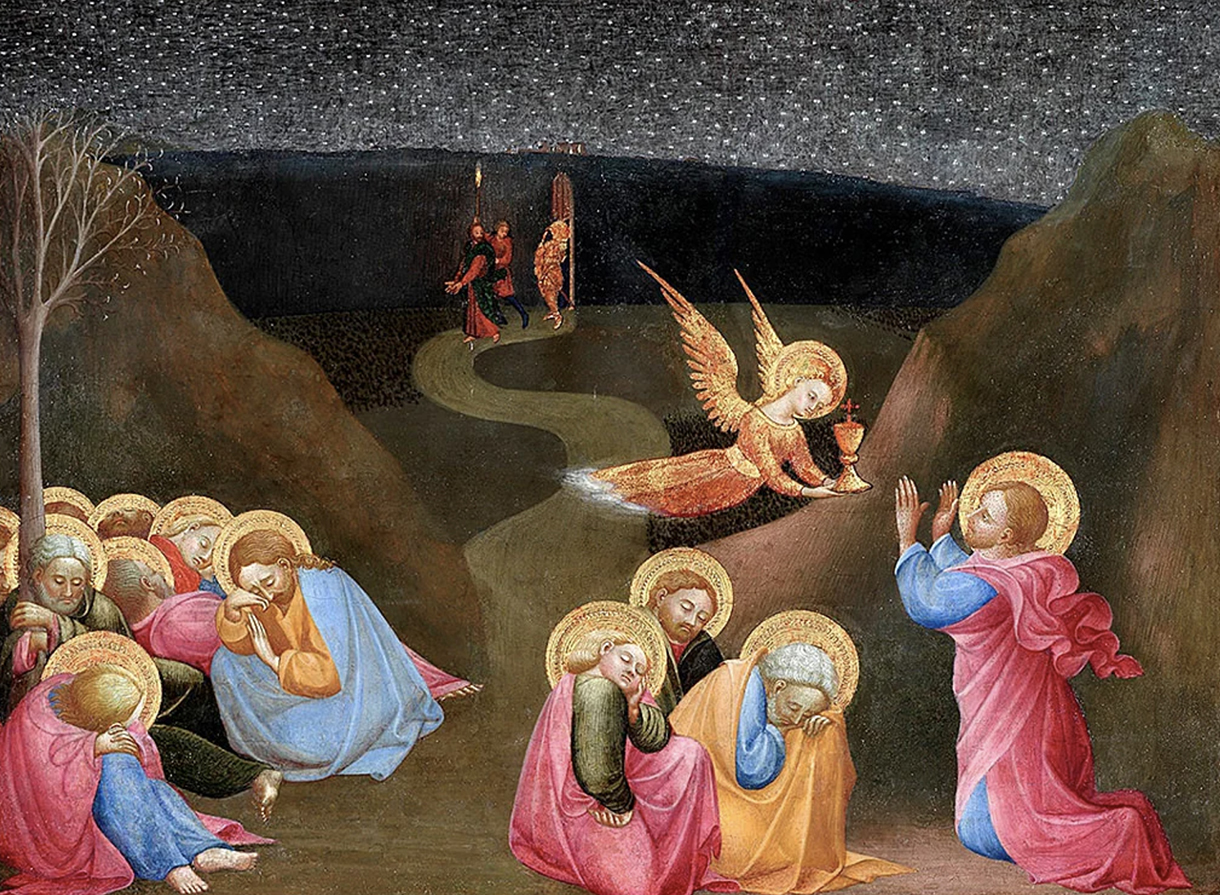
When I first saw a picture of “Christ’s Agony in the Garden” my eyes were immediately drawn to the starry sky. It reminded me of a time I took my daughter camping in Death Valley to see the stars on the longest, darkest night of the year. The sky on that night appeared as vibrant as the sky in this painting. We positioned our heads under the window of our tent so that we could wake in the middle of the night to watch a meteor shower, a meteor shower my daughter ultimately slept through despite my prodding. In the painting, the disciples sleep in childlike slumps, seemingly using their halos as pillows. I learned recently that those halos were once called glories. Here they appear incongruent on the figures of the sleeping disciples. Glory should be for the watchful ones, those who stay awake as directed.
But perhaps, even if the disciples did not keep watch, as Mary Oliver writes, then “maybe the stars did.” This observation echoes the triumphal entry in which Jesus remarks that if the crowds did not cry out, then the stones would! His purposes – and his glory – would not and will not be thwarted. The people are quick to see his entry into Jerusalem as the answer to their prayers. God has heard! The glory has returned! (Ezekiel 43). They celebrate, and rightfully so. They do not recognize that here in the agony of the garden, God has also heard. They do not see glory here. Yet it is in Christ’s passion that John will write about the Son of Man coming into glory (John 17:1-5).
How do we live and see God’s glory in a world that is in need of remaking, in which death is unavoidable and suffering surrounds us? Which is the greater temptation for me: that I am only able to see God’s glory in ease and in health, or that I compartmentalize an awareness of God’s glory to a future, heavenly state? Or do I simply fall asleep, content to not face the brokenness and suffering around me? What would it be like to somehow become awake to God’s glorious presence even in the midst of suffering?
While the disciples did fall asleep in the garden, they did not ultimately lose sight of God’s glory, even as they walked through their own suffering. Out of the twelve, ten of these disciples went on to die for their faith, and one had to bear the grief of living through these losses. Yet here in the garden, they each sleep on an undeserved halo of glory. The only disciple who did not fall asleep was incredulous of this type of glory, betrayed Christ, and died in despair.
As I have read this gospel scene over the years, I have often heard different tones in Christ’s voice when he spoke to the sleepy disciples. Sometimes I have heard his voice filled with anger when he tells them “enough!” Sometimes I have heard this “enough” as spoken with exhaustion and sorrow. Yet, it was only when trying to show my daughter the glory of tiny lights in the sky in the midst of darkness in a valley literally named Death that I heard Christ’s “enough” spoken in love. In looking upon her, it opened up my heart to a new possibility of how Christ looked upon the disciples and how he looks upon us in our own dark nights. He understands how we are totally overwhelmed and exhausted by it all, the call to lament and the call to celebrate, the fear of death and the fear of hope. We are, as Mary Oliver puts it, “so utterly human.”
“Not what I will, but what You will…let us be going.”
Prayer
Guide us waking, O Lord, and guard us sleeping; that awake we may watch with Christ, and asleep we may rest in peace.
— From the Book of Common Prayer
Stacie Poston
Adjunct, Torrey Honors
For more information about the artwork, music, and poetry selected for this day, we have provided resources under the “About” tab located next to the “Devotional” tab near the top of the page.
About the Artwork
Agony in the Garden
Il Sassetta
1437–1444
Tempera, silver, and gold leaf on poplar panel
Detroit Institute of Art
Detroit, Michigan
Public Domain
The garden of Gethsemane is where Jesus prayed the night before He was taken into custody. In his painting Agony in the Garden, Italian Renaissance artist il Sassetta depicts Christ as He wrestles with His impending suffering and death before ultimately submitting to God's will. The barren, dark landscape illuminated by a star-studded sky is sharply contrasted by the use of bright, saturated colors found in the apostles’ garments. Jesus is completely alone in His suffering, as His disciples have mostly fallen asleep and are scattered about despite Jesus’s admonition for them to stay awake and watch. In the far distance one sees His betrayer, Judas, leading Roman soldiers and officials from the chief priests who are intent upon arresting Jesus. Shown praying to the Father in the lower right corner, Jesus is visited by an angel from heaven offering Him a chalice, representing God's will and His impending crucifixion. The artist sought to show not only Jesus’s divinity, but also the human nature of Christ, who is feeling the weight of His imminent death.
About the Artist
Stefano di Giovanni di Consolo, known as il Sassetta (c. 1392–1450) was a Tuscan painter of the Renaissance, and a significant figure of the Sienese school of painting. While working within the Sienese tradition, he innovated the style by introducing elements derived from the decorative Gothic style and the realism of contemporary Florentine innovators such as artist Masaccio. Not only does he excel at infusing his figures with a natural light that convincingly molds their shape, he also has an amazing understanding of spatial relationships, thereby creating a cohesive and impressive work.
About the Music
“Gethsemane Prayer” from the album Pange Lingua Gloriosi: Choral Music for Holy Week
Abba, Abba, Abba!
Father, who art in heaven,
Hallowed be your name.
Abba, Abba, Abba!
Your kingdom come,
Your will be done.
Abba, your will be done.
Your will be done,.
Your will be done.
My Father, My Father,
Take this cup of suffering,
Of suffering away from me.
If it is possible take it away from me.
Yet not my will,
But yours alone.
Yet not my will,
But yours alone.
Your will be done.
Your will be done.
Abba, Abba!
Your will be done!
About the Composer
Known for his collaborative works Three Days and Agnus Dei, Jeffrey Honoré is a distinguished composer, organist, trombonist, and voice teacher. Honoré has served as a choir director in churches of many different denominations and has worked as an organist, trombonist, and voice teacher. He received the Vatican II Award for Distinguished Service in 1999. He is known for his collaborative works created with composers Gustav T. Holst and M. D. Ridge. Honoré is the liturgical music director of St. Matthias Parish in Milwaukee, Wisconsin, where he directs the archdiocesan choir.
About the Performers
Catherine van der Salm, Jeffrey Honoré, and Angela Westhoff-Johnson
Catherine van der Salm is a versatile musician praised for her “agile, supple and richly expressive” voice (The Oregonian). She is a collaborative artist singing with the ensemble Cappella Romana. She has appeared as a guest artist with 45th Parallel, Willamette Valley Chamber Music Festival, Newport Symphony Orchestra, Third Angle, Willamette Master Chorus, Musica Maestrale, Bach Cantata Choir, and Bach Cantata Vespers at St. James Lutheran Church. Catherine makes her home in Vancouver, Washington, with her husband, Ruud, and their daughters Juliana and Annelies.
Angela Westhoff-Johnson, the director of product development at Oregon Catholic Press (OCP), is a choral conductor and workshop presenter in the Portland, Oregon, area. After receiving a bachelor’s degree in music from Simpson College in Indianola, Iowa, she continued her studies at the University of Oregon. There she received a master’s degree in vocal music performance, a master’s degree in choral conducting, and completed the coursework for a doctorate of musical arts in vocal music performance and choral conducting. While studying at the University of Oregon, Angela had the wonderful opportunity to work with the Oregon Bach Festival, participating in seminars with Helmuth Rilling. Westhoff-Johnson has been the director of music at St. Mary's Cathedral of the Immaculate Conception in Portland for more than thirty years. There she conducts the cathedral choir, cathedral contemporary ensemble, and the cathedral children's choir, all of which provide music for weekly Sunday Eucharist as well as archdiocesan liturgies.
About the Poetry and Poet
Mary Oliver (1935–2019) was an American poet known for her vivid, accessible verse rooted in the natural world and attentive observation of the environment. Born in Maple Heights, Ohio, she published her first collection No Voyage, and Other Poems in 1963 and went on to win the Pulitzer Prize for American Primitive in 1984 and the National Book Award for New and Selected Poems in 1992. Her writing, often inspired by solitary walks and deep communion with nature, made her one of the most widely read poets in the United States. Over her career she published more than fifteen collections of poetry and taught at institutions including Case Western Reserve University and Bennington College.
About the Devotion Writer
Stacie Poston completed her graduate studies in biology, focusing on cell and molecular biology and immunology, before taking time to raise her family of four kids with her husband. As an adjunct instructor with Torrey Honors College, she enjoys stepping onto Biola's campus to discuss great books and loves to see how God's hand is evident in all the big and small parts of life.