April 10: Signs and Wonders Will Follow Those Who Believe
♫ Music:
Mark 16:17-18 (NKJV)
And these signs will follow those who believe: In My name they will cast out demons; they will speak with new tongues; they will take up serpents; and if they drink anything deadly, it will by no means hurt them; they will lay hands on the sick, and they will recover.”
Poetry:
“Signs and Wonders”
by Brian Kates
The rotting beech, rooted just a few yards from my house,
rose like a six-story steeple in the cathedral of trees
at the edge of our woods.
She’d stood a hundred years or more through sun and snow
drought and flood, housed crows and doves, was a ladder
to the sky for countless kids.
But now she was like a much-loved dog you take to
the vet for a merciful end. I watched and wept as
men with ladders, ropes, and saws took her down.
I’ve read that beech trees form families root to root,
warn each other of danger, share food with sick brethren,
make sacrifices to encourage new life.
That spring, the mother stump birthed a half dozen shoots.
Nourished, I like to think, by arboreal aunts and uncles,
they stretch for the blessing of rain and the succor of sun.
It seems to me they are in constant conversation
with each other and with God. When the wind rises,
I think I hear their prayers.
Signs That Accompany
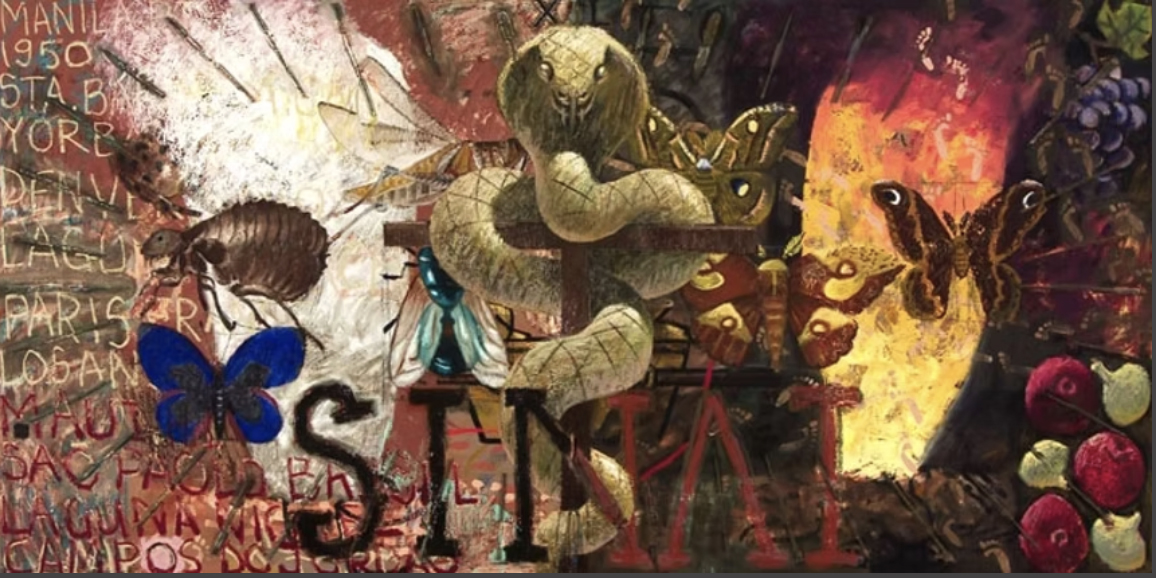
Have you ever looked into the eyes of a deeply troubled person, wishing you had an answer—something more than sympathy or advice? If you look closely rather than turning away, you may see something resembling our painting for today. Chaos. Fear. Something predatory beneath the surface. A serpent awaiting any opportunity to strike. Sadly, many Christians turn away at that moment, feeling helpless and defeated.
Here’s the good news: if you are a believer in Jesus, you have not been left without resources. Signs and wonders are already following—or accompanying—you. Close at hand, ready to be exercised. They characterize you. Too often we miss this because despair feels more real than faith.
Mark 16:17–18 is one of the more challenging passages in the New Testament. In the western church, it is often ignored or discounted because these verses are missing from two early manuscripts. But rather than dismiss the passage, we should wrestle with it. The real discomfort usually comes from verse 18. Casting out demons, speaking in tongues, and healing the sick feel at least somewhat familiar. But serpents? Poison? These collide head-on with contemporary sensibilities, especially because fringe groups have treated them as invitations to test God, often in theatrical ways.
Let’s divide the verses into two sections: the “familiar” and the “unfamiliar.” The “familiar” signs—deliverance, tongues, and healing—are repeated throughout the New Testament. Jesus explicitly commissioned His followers to heal the sick and cast out demons (Matt. 10:1; Luke 9:2, 10:9). The book of Acts is filled with such works, and church history affirms they did not end with the apostles. For example, around AD 180, Irenaeus testified that believers in his own day regularly drove out demons, healed the sick, and saw lives transformed through the power of Christ.
What, then, of serpents and poison? The “unfamiliar”—or just plain weird—signs? The key is understanding that these signs are protective, not prescriptive. Scripture and history show God protecting believers from both—not because they sought danger, but because danger found them. Paul survived an accidental viper’s bite in Acts 28. Church tradition suggests that multiple early Christians including John the Evangelist and Benedict of Nursia escaped death from poison during persecution. The promise is not that believers should pursue harm, but that harm will not ultimately prevail.
There is also a deeper picture. Serpents frequently symbolize the enemy—deception, accusation, and fear. Too many Christians live as if the devil is invincible. They retreat rather than resist. Yet Scripture and our song today declare that believers walk in the same power (dunamis) that raised Jesus from the dead (Eph. 1:19–20)!
If that power is already at work in us, what prevents us from confronting darkness, even when it looks dangerous or messy? If miraculous signs truly accompany us, what prevents us from walking in them?
While the Western Church has been slow to appropriate signs and wonders, other parts of the world appear to be living out Mark 16. For example, Biola’s Sean McDowell recently interviewed Hormoz Shariat, the “Billy Graham” of Iran, on his YouTube channel. Shariat reported: “There are so many signs, wonders, miracles, visions, and dreams happening in Iran right now. The #1 miracle is overnight, instant freedom from addiction. . . . There are many dreams and visions of Jesus. These happen every day in different ways. Many have seen him personally. [Iranian believers] receive miracles and healings all the time. Whole villages are coming to Christ.” Persecuted followers of Christ around the world are truly living these verses.
The promise of Mark 16 is not spectacle. It’s confidence and practice. And today we need to exercise this promise more than ever. As we step forward in faith and obedience, signs accompany us. They are readily available to us. Not because we chase miracles—but because the power (dunamis) of the risen Christ lives in us.
Prayer
Lord, I say I believe the Bible. I say I believe Jesus is who He says He is and I am who He says I am. Yet all too often I cower when pushed out of my comfort zone. Forgive me for denying the aspects of You I don’t understand. Draw me out of my fear and inhibitions. Show me how to live as if I truly believe that I have access to the same power that raised Jesus from the dead. Fill me with the courage to lay hands on the sick, the powerless, and the demonized, and speak the life of Jesus into them. Protect me from any dangerous or toxic situations I find myself in. I ask this in the powerful name of Jesus. Amen.
Pat J. Sikora, MPH, MAT
Author
For more information about the artwork, music, and poetry selected for this day, we have provided resources under the “About” tab located next to the “Devotional” tab near the top of the page.
About the Artwork
A Wreath for the Sinai Generation
Wayne Forte
2001
Oil on canvas
60 x 120 in.
Used with permission from the artist
A Wreath for the Sinai Generation, is a large painting by Wayne Forte. In it he conflates his own wanderings with the Children of Israel's Exodus from Egypt. There are references to the plagues, the "pillar of cloud" by day and the "pillar of fire" by night. In the center of the painting is the serpent which references the disobedience of the Jews and the bronze replica lifted up as a remedy for their sinfulness.
Striking similarities exist between this wilderness experience of the Chosen People and Christ's disciples as they go out into the "wilderness" of the known world equipped with signs and wonders to spread the Gospel, but totally dependent on the Lord for their daily needs.
Christ was lifted up on the cross like the bronze serpent on the pole. At the cross we see a Christ who took on or became sin for us so that we might be healed. Christ's great defeat of sin and death, enabled his evangelists to deal with a wide variety of sin (symbolized by the serpent) in their missionary journeys. God's protective "Pillar of Fire", became flaming tongues of fire at Pentecost, when the gift of the Holy Spirit was given. The moths in Forte's painting symbolize the renunciation of worldly possessions. The overall composition gives viewers the sense that something "new" is happening, something profound that will forever change mankind.
About the Artist
Wayne Forte (b. 1950) was born in Manila, Philippines, in 1950, married in Brazil in 1981, and studied at the University of California at Santa Barbara and Irvine (B.A. 1973; M.F.A. 1976). Wayne lives with his wife and four children in Laguna Niguel, CA, and attends Coast Hills Community Church in Aliso Viejo, California. He has been a member of CIVA (Christians in the Visual Arts) for fifteen years and participated in the Florence Portfolio Project in 1993. He has also taught courses at Biola University and Gordon College, Orvieto Campus, Italy. Wayne was educated to paint in the self-referential modernist tradition but longed for that passion of an earlier age, a passion for the spiritual and the transcendent found in the biblical narrative paintings of Gruenwald, Rubens, Rembrandt, and Caravaggio. His goal is to create paintings with powerful messages about faith that can resonate with contemporary viewers. From an early age, Forte saw art-making as a religious activity. He remembers attending Mass in old Spanish mission churches when he was a child and creating decorative, small-scale altars, hidden away in his bedroom closet. A conversion experience on the island of Hawaii led Forte to look at art once again in sacred terms, this time as a tool for evangelizing the world. Forte saw his true calling was to bring art back into the church after centuries of neglect and sometimes open hostility to religious imagery. Forte found a community of like-minded art-makers in Christians in the Visual Arts (CIVA) and joined an arts ministry in a nondenominational church near his home in Southern California. After nearly four decades of what he terms “persistence and humility,” he remains true to his mission.
About the Music
“The Same Power” from the album I Still Believe: The Greatest Hits
I can see waters raging at my feet,
I can feel the breath of those surrounding me,
I can hear the sound of nations rising up,
We will not be overtaken.
We will not be overcome.
I can walk down this dark and painful road,
I can face every fear of the unknown,
I can hear all God’s children singing out,
We will not be overtaken.
We will not be overcome.
The same power that rose Jesus from the grave,
The same power that commands the dead to wake,
Lives in us, lives in us.
The same power that moves mountains when He speaks,
The same power that can calm a raging sea.
Lives in us, lives in us.
He lives in us, lives in us.
We have hope that His promises are true.
In His strength there is nothing we can’t do.
Yes, we know there are greater things in store.
We will not be overtaken.
We will not be overcome.
The same power that rose Jesus from the grave,
The same power that commands the dead to wake,
Lives in us, lives in us.
The same power that moves mountains when He speaks,
The same power that can calm a raging sea.
Lives in us, lives in us.
He lives in us, lives in us.
Greater is He that is living in me.
He’s conquered our enemy.
No power of darkness, no weapon prevails.
We stand here in victory.
Greater is He that is living in me.
He’s conquered our enemy.
No power of darkness, no weapon prevails.
We stand here in victory.
In victory.
The same power that rose Jesus from the grave,
The same power that commands the dead to wake,
Lives in us, lives in us.
The same power that moves mountains when He speaks,
The same power that can calm a raging sea.
Lives in us, lives in us.
He lives in us, lives in us.
He lives in us.
About the Composer/Performer
Jeremy Thomas Camp (b. 1978) is an American contemporary Christian singer and songwriter from Lafayette, Indiana. He has released eleven albums, four of them RIAA-certified as Gold, and two live albums. Camp's original music is a mixture of ballads and up-tempo songs with rock influence. He has won five GMA Dove Awards, has been nominated for three American Music Awards, and was nominated for a Grammy Award for best pop/contemporary gospel album in 2010 for his album, Speaking Louder Than Before. In 2011, Camp released his first book, I Still Believe. The book is about Camp's life, illuminating his childhood, the death of his first wife, and where he believes God has brought him.
About the Poetry and Poet
Brian Kates (b. 1946) is an American poet. A longtime journalist, he holds the Pulitzer Prize and George Polk Award for editorial writing and a Daniel Pearl Award for investigative reporting, among other honors. His nonfiction book, The Murder of a Shopping Bag Lady, a saga of modern American homelessness, received a Special Edgar Allan Poe Award from Mystery Writers of America. He has taught at Columbia Graduate School of Journalism, New York University, Craig Newmark Graduate School of Journalism (CUNY), and SUNY Purchase College. His poetry has appeared in Paterson Literary Review, Gyroscope Review, Third Wednesday, Spirit Fire Review, Common Ground Review, Banyan Review, and elsewhere.
About the Devotion Writer
Pat J. Sikora, MPH, MAT, has authored eight books, including Conquering Your Giants: Biblical Strategies to Conquer What's Been Conquering You and Kingdom Now: Pursuing Unity in the Body of Christ to Change the World. Her passion is equipping and empowering believers for victorious Kingdom living. Pat was a Biola mom for four years and chaired the Parents’ Task Force for the Radio-TV-Film Department from 2003 to 2006. You can find her at PatSikora.com.