April 11: Christ Ascends to God’s Right Hand
♫ Music:
Mark 16:19-20 (NKJV)
So then, after the Lord had spoken to them, He was received up into heaven, and sat down at the right hand of God. And they went out and preached everywhere, the Lord working with them and confirming the word through the accompanying signs. Amen.
Poetry
“Ascension”
by Kathleen Norris
Why do you stand looking up at the skies?
Acts I:II
It wasn’t just wind, chasing
thin gunmetal clouds
across the loud sky;
it wasn’t the feeling that one might ascend
on that excited air,
rising like a trumpet note.
And it wasn’t just my sister’s water breaking,
her crying out,
the downward draw of blood and bone…
It was all of that,
the mud and new grass
pushing up through melting snow,
the lilac in bud
by my front door, bent low
by last week’s ice storm.
Now the new mother, that leaky vessel,
begins to nurse her child,
beginning the long good-bye.
Christ Ascends to the Right Hand of God
I’ve always been frustrated by what feels like Christ’s departure from me in his return to the Father. There have been so many times when I felt sad and all I wanted was a hug from Christ or a clear word from him about how to move forward. If Christ is still embodied, why is it better for him to be at the Father’s right hand than mine? How different is Christ enthroned from Christ entombed, if his presence is hidden from us either way?
Rising to new life on earth does not seem to be enough. It seems Christ must be raised and taken up—rise again…and again.
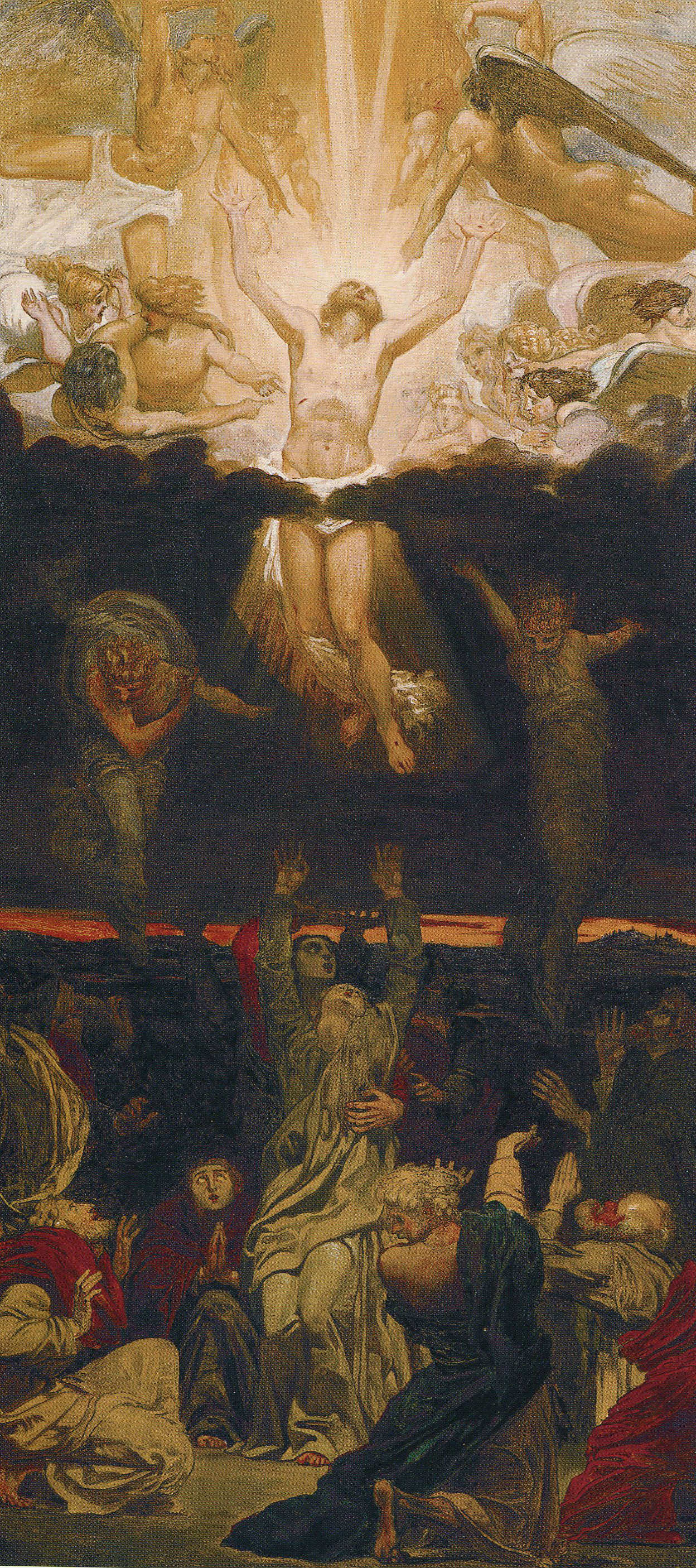
Mary’s body in Ford Madox Brown’s Ascension considers this double rising as she imitates Christ’s ascending body. But she cannot go where he is going. Her upward motion reaches toward the light. Perhaps like a blade of grass pushing through the melting snow, she hopes to shed her earthboundedness and stretch through a breakage where the light will surround her. But she is held down by a hand around her waist. All she can do is grasp after Christ as she herself is grasped. I can feel the strain in her neck as she looks up to watch her Savior go. I find myself similarly strained from the energy I spend trying to keep my eyes on Christ, while being pulled in what feels like opposite directions.
When I look at Christ, though, he does not grasp or strain. He receives heaven as heaven receives him, with wounded hands stretched out in offering and praise. He is going home, to the right hand of the One who sent him.
Kathleen Norris begins her poem with an epitaph from Acts 1: “Why do you stand looking up at the skies?” I don’t have an answer, except that maybe I think I’m more likely to see God there than at eye level. But the second half of today’s scripture gives me great hope. Even after Christ ascended, “they went out” and the Lord worked with them, confirming things spoken with things seen. The upward return of Christ is the downward sending of the Holy Spirit, and a new direction opens as God goes out with His people across the earth. God is with me, here, now, active on the ground and in my heart.
Though Mary’s body in the painting seems despairing, there is something to her simultaneous stretching and bending at the knee that resonates with the multi-directional life with God. As I both see Christ and remain blind to him, seek and reject his ways, praise and lament, God constantly brings me to my knees and raises me up again and again. Exactly when I am brought low, He brings me without distraction into the heights of His mercy and glory.
Prayer
O God, grant that we may desire you, and in desiring you seek you, and seeking you find you, and finding you be satisfied in you forever. Amen.
—Francis Xavier, Prayer for Desiring God
Ella Buell
Artist
Alumna, Torrey Honors College
Biola University
For more information about the artwork, music, and poetry selected for this day, we have provided resources under the “About” tab located next to the “Devotional” tab near the top of the page.
About the Artwork
The Ascension
Ford Madox Brown
1844
Forbes Magazine Collection
New York, New York
Public Domain
The Ascension by Ford Madox Brown is a nineteenth-century painting that captures the spiritual and dramatic moment of Christ's ascension to heaven. The oil painting features a rich, detailed style typical of the Pre-Raphaelite movement, with a focus on intense emotion and vivid imagery. Brown emphasizes the divide between the glory of heaven and the world below by casting the earthly world in deep shadow and Christ and the heavens in brilliant light. The divide between the two realms is further demarcated by a ring of dark clouds surrounding Christ’s legs while His upper torso breaks through the clouds into the heavens, where He is welcomed by a host of angels. All of the angelic figures around Christ are lit by the light emanating from the ascending Christ. Brown uses the lighting to powerfully establish the distinction between Christ’s heavenly glory and the terrestrial world below.
About the Artist
Ford Madox Brown (1821–1893) was a British painter of moral and historical subjects, notable for his distinctively graphic and often Hogarthian version of the Pre-Raphaelite style. Arguably, his most notable painting was Work (1852–1865). Brown spent the latter years of his life painting the twelve works known as The Manchester Murals, depicting Mancunian history, for Manchester Town Hall. Brown struggled to make his mark in the 1850s, with his paintings failing to find buyers. In 1852 he started work on two of his most significant works, The Last of England and Work. From the 1860s, Brown also designed furniture and stained glass. He was a founding partner of William Morris's design company, Morris, Marshall, Faulkner and Co., in 1861; the company dissolved in 1874, with Morris continuing on his own.
About the Music | 1
“God Is Gone Up with a Shout”
God is gone up, gone up, with a shout.
The Lord with the sound of a trumpet.
God is gone up, gone up, with a shout.
Let all the nations sing praise.
God is gone up, gone up, with a shout.
The Lord with the sound of a trumpet.
God is gone up, gone up, with a shout.
Let all the nations sing praise.
For God is a great king over the earth.
Sing him a new psalm.
Sing him a new psalm.
For God is the ruler over the nations.
For he is holy.
For he is holy.
All ye people clap your hands.
All ye people clap your hands.
All ye people clap your hands.
All ye people clap your hands.
All ye people clap your hands.
God is gone up with a shout.
God is gone up with a shout.
God is gone up with a shout, up with a shout.
God is gone up, gone up, with a shout.
The Lord with the sound of a trumpet.
God is gone up, gone up, with a shout.
Let all the nations sing praise.
With the sound of a trumpet.
Sound of a trumpet.
God is gone up with a shout.
With the sound of a trumpet
With the sound of a trumpet.
About the Composers
Joseph M. Martin (b. 1959 ), a native of North Carolina, earned his Bachelor of Music degree in piano performance at Furman University in Greenville, South Carolina. Subsequently he earned a Master of Music degree in piano performance at the University of Texas, Austin. While at Furman University, he was accompanist for choral director and composer Milburn Price, and, inspired by his teaching, Martin began to compose. He is a member of the staff of Shawnee Press as director of sacred publications, with responsibilities for overseeing the editorial and creative direction of the company’s sacred publications and also coordinating the recording and production aspects of future sacred publishing efforts. Though he continues to perform in concert, he now devotes his efforts to playing in churches and for conferences of church musicians. His first solo piano recording, American Tapestry, was nominated for a Dove Award. He is recognized throughout the United States for his many choral compositions, over 1,200 compositions are currently in print. Along with Mark Hayes and David Angerman, Joseph has coauthored a fully graded, progressive piano method for the Christian student called Keys for the Kingdom. His major works include nearly forty choral cantatas and extended works and Song of Wisdom, a choral tone poem based on the best-selling children's book Old Turtle. His music can be heard in such diverse locations as Carnegie Hall in New York City; the Lawrence Welk Theatre in Branson, Missouri; and in hundreds of worship services in churches across the United States and Canada. In addition, his works have been performed in cathedrals in Germany, England, Ireland, Scotland, and Austria.
David Angerman (b. 1955) is the director of choral arts at Regents School of Austin, Texas. Additionally, he has been the director of music and organist at Bethany Lutheran Church, Austin, since 1980. He holds a Bachelor of Music Education Degree and Master of Church Music Degree from Baylor University and a Master of Music Degree in Organ Performance from the University of Texas in Austin. As a composer, his published works include choral and handbell music as well as organ and piano solos. He has written the music for several youth and children's musicals, and coauthored, along with Joseph Martin and Mark Hayes, Keys For The Kingdom, a piano method for Christian students, published by Shawnee Press.
About the Performers
Hal Leonard Singers are associated with Hal Leonard, a company that is the world's largest sheet music and instructional music publisher.
About the Music | 2
“I Will Rise”
There's a peace I've come to know
Though my heart and flesh may fail
There's an anchor for my soul
I can say, "It is well".
Jesus has overcome
And the grave is overwhelmed
The victory is won
He is risen from the dead.
And I will rise, when He calls my name
No more sorrow, no more pain
I will rise on eagles' wings
Before my God, fall on my knees
And rise
I will rise.
There's a day that's drawing near
When this darkness breaks to light
And the shadows disappear
And my faith shall be my eyes.
Jesus has overcome
And the grave is overwhelmed
The victory is won
He is risen from the dead.
And I will rise when He calls my name
No more sorrow, no more pain
I will rise on eagles' wings
Before my God, fall on my knees
And rise
I will rise.
And I hear the voice of many angels sing,
"Worthy is the Lamb"
And I hear the cry of every longing heart,
"Worthy is the Lamb"
And I hear the voice of many angels sing,
"Worthy is the Lamb"
And I hear the cry of every longing heart,
"Worthy is the Lamb"
"Worthy is the Lamb"
And I will rise when He calls my name
No more sorrow, no more pain
I will rise on eagles' wings
Before my God fall on my knees
And rise
I will rise (repeats)
I will rise.
About the Composers
Chris Tomlin, Jesse Reeves, Louie Giglio, and Matt Maher, arranged for choir by Craig Courtney and Lynda Hasseler
Chris Tomlin (b. 1972) is an American contemporary Christian music singer, songwriter, and worship leader. Some of his most well-known songs are "How Great Is Our God," "Our God," "Whom Shall I Fear (God of Angel Armies)," and his cover of "Good Good Father." Tomlin has been awarded twenty-three GMA Dove Awards, and he won a Grammy Award for best contemporary Christian music album in 2012. Planning for a medical career, Tomlin enrolled in Texas A&M University to study medicine. However, Tomlin participated in a Bible study led by Choice Ministries founder Louie Giglio, and together they founded the Passion Conferences—conferences that seek to glorify God by uniting students in worship, prayer, and seeking justice for spiritual awakening. In 2000, Tomlin signed on to newly founded sixstepsrecords, a subsidiary of Passion Conferences, and has since then released nine full-length studio albums. Tomlin has toured with many contemporary Christian artists, such as Delirious?, Steven Curtis Chapman, Michael W. Smith, and MercyMe. Tomlin has headlined several tours, and has also joined Passion Conferences for national and global tours and events. In 2008, Tomlin started a new church with Giglio in Atlanta, Georgia: the Passion City Church. In 2019, Tomlin and his wife, Lauren, started Angel Armies, a nonprofit organization that works to bring people and ministry organizations together to attempt to solve issues related to vulnerable at-risk youth in the United States.
Jesse Reeves is a father, musician, songwriter, church planter, and pastor. As a musician, Jesse spent seventeen years leading worship, touring, and playing bass guitar in the Chris Tomlin Band. As a songwriter, he has co-written several songs that are sung in the church around the world today, including “How Great is Our God,” “Our God,” “I Will Rise,” “Indescribable,” and “Lord, I Need You.” As a church planter, Reeves has been a part of planting the Austin Stone Community Church in Austin, Texas, and Passion City Church in Atlanta, Georgia.
Louie Giglio is the pastor of Passion City Church, located in Atlanta, Georgia. He is also a public speaker, author, and the founder of the Passion Movement. "We don't know the expanse of the worship that's continually surrounding the throne of God," Giglio says. “But God isn't banking on our songs because He is surrounded by a symphony that's bigger than our wildest dreams."
Matt Maher (b. 1974) is a Canadian contemporary Christian music artist, songwriter, and worship leader who currently lives in the United States. He has written and produced nine solo albums to date. Three of his albums have reached the Top 25 Christian Albums Billboard chart and four of his singles have reached the Top 25 Christian Songs chart. Maher has been nominated for nine Grammy Awards in his career and was awarded the songwriter of the year award at the 2015 GMA Dove Awards. Maher was born and raised in Newfoundland, Canada. His parents recognized his musical talent, and he grew up taking piano lessons and immersing himself in a broad variety of music, including playing in concert and jazz ensembles, singing in a choir, and playing in a garage rock band. Maher started his postsecondary studies at Memorial University of Newfoundland and continued his studies in the Jazz Department at Arizona State University. Maher currently lives in Nashville, Tennessee.
Craig Courtney (b. 19454), a native of Indiana, began playing the piano at the age of three and the cello at the age of eleven. He received a B.A. and an M.A. in piano performance from the University of Cincinnati. Following a three-year stay in Milan, Italy, where Mr. Courtney studied and worked extensively as a vocal coach, he was invited to join the music faculty of the famed Mozarteum in Salzburg, Austria. During this period, while serving in the music ministry of the Salzburg International Baptist Church, Courtney began directing a church choir and composing sacred choral music. In 1985, his compositions came to the attention of John Ness Beck through the publication of his octavo Thy Will Be Done, initiating a close working relationship between the two men which continued until Beck's death in 1987. In making plans for the continuation of Beckenhorst Press, Beck appointed Courtney to assume his responsibilities as staff composer and editor. At this point in time, Mr. Courtney's published works include more than one hundred sixty choral octavos, eight vocal collections, a piano solo collection, and six extended works for choir and orchestra. In demand throughout the country as a choral clinician and featured composer, Courtney now resides in Columbus, Ohio.
Nurturing Capital University’s rich choral legacy, Lynda Hasseler, D.M.A., continues to program classic and contemporary a cappella sacred and secular choral literature. Reflecting her commitment to perform music from a global perspective, choirs under her direction have expanded their repertoire and developed a reputation for performances that feature diverse programming, staging, and a range of tone colors uniquely suited to each style of music. Dr. Hasseler travels widely as a clinician, singer, and guest conductor. Choirs under her direction have received numerous invitations to perform for multiple conferences and have toured nationally and internationally. In partnership with Craig Courtney, she was recently appointed co-editor of the new Capital University Choral Series published by Beckenhorst Press.
In addition to her work as a conductor, Professor Hasseler has maintained an active singing career. A mezzo-soprano, she has performed, toured, and recorded nationally and internationally with professional choral ensembles including the Robert Shaw Festival Chorus and the Oregon Bach Festival Chorus.
About the Performers
From chant, traditional hymns, Taizé, and SATB choral anthems to contemporary, praise and worship, gospel and spiritual songs, the Sunday 7PM Choir strives to sing beautiful, sacred Christian choral music from all genres, all for the glory of the Lord.
About the Poetry and Poet
Kathleen Norris (b. 1947) is an American poet and essayist whose literary career began with her first poetry collection, Falling Off, which won the Big Table Younger Poets Award in 1971. She has published several volumes of poetry, including The Middle of the World, The Year of Common Things, Little Girls in Church, and Journey: New and Selected Poems, 1969–1999. Her work often reflects a deep engagement with faith and the everyday world. Norris also gained wider recognition for her nonfiction writing, particularly Dakota: A Spiritual Geography, The Cloister Walk, and Amazing Grace: A Vocabulary of Faith. She lives in Hawaii and continues to be active in literary and faith communities.
About the Devotion Writer
Ella Buell is an alumna of Biola University’s Art Department and the Torrey Honors College. She currently lives in Vancouver, British Columbia where she is working toward a Masters in Theological Studies with a concentration in Christianity and the Arts. She finds herself relentlessly drawn to hard questions, sunlight, strong communities, her downtown studio and her favorite coffee shops. These days, most of her questions circle around the ground and what it means to be grounded.