February 17: Introduction to the 2026 Lent Project
A Lenten Meditation on the Gospel of Mark: The Servant King We Long to Know!
In 2023 the Lent Project featured meditations on the gospel of John. It was one of our most popular offerings. This year we turn to another gospel writer, Mark, and his intriguing account of Christ’s mission and ministry. The gospel of Mark is both fast-paced and jam-packed with lots of dramatic action. Events happen in quick succession with a powerful sense of import. Using language and details that heighten Christ’s mighty deeds and words, Mark is on a mission to convince his readers that Jesus is indeed the victorious Servant Messiah. Much less focused on dialogue than the other gospels, Mark is able to graphically detail a series of miraculous episodes that are transformational not only for the original New Testament recipients, but also for contemporary readers.
Most New Testament scholars agree that Mark was the first to write the good news of Christ (65–70 AD) and was heavily relied upon by both Matthew and Luke as they penned their own treatises. It is also the shortest of the four gospels. According to Christian tradition, Mark was written at the urgent request of persecuted Roman Christians, who wanted a hard copy of the apostle Peter’s teachings so that they could hear them again and again. New Testament theologian Dr. William L. Lane referred to Mark’s gospel as a “pamphlet for hard times.” In it, Jesus predicted His own suffering and death on three separate occasions. These prophecies culminate in Mark 10:45, which echoes Isaiah’s famous “Suffering Servant” passage (Isaiah 53). Mark’s healing gospel offered concrete examples of what it meant to be a follower of Christ, especially for those facing affliction, imprisonment, and martyrdom.
The evangelist Luke first mentioned the author, John Mark, in Acts 12. When Peter was miraculously rescued from a Jerusalem prison in the middle of the night, the startled apostle found his way to the home of Mary and her son John Mark; they were a prominent early Christian family. Mark (his Roman name) accompanied Paul and Barnabas on their first missionary journey, but ended up leaving early. His abandonment caused a major rift between Paul and Barnabas (Acts 15: 36–41). Mark eventually became a mentee of St. Peter, assisting him in Rome, where John Mark transcribed the apostle’s teachings and firsthand accounts of the time Peter had spent with Christ. Early church father Justin Martyr referred to the gospel of Mark as "the memoirs of Peter.” Second-century Christian theologian Irenaeus wrote, “And after their [Peter and Paul’s] deaths, Mark, the disciple and interpreter of Peter, himself also handed down to us in writing the things preached by Peter.”
Actor Max McLean gives a blockbuster dramatic interpretation of the entire gospel of Mark in one uninterrupted performance. He periodically brings his vivid account of Christ’s earthly sojourn to life on stages around the world. You can find a recording of it on a number of media outlets. This is what McLean says about the production: “Our familiarity with the story goes away and the gospel becomes something new, fresh, powerful, and different. It’s almost as if you find yourself hearing the story for the first time. The true heroic nature of Jesus becomes almost overwhelming. . . .When we look at our own conversion many of us first fell in love with Jesus because we discovered who he is through the Gospels and then we were motivated to follow him.” McLean is onto something profound. The genius of Mark’s writing style invites readers into the throes of the gospel as participants. Stepping into the story, we find ourselves walking with Christ and His disciples. The questions Christ’s followers have become ours: “Who is this man, Jesus, and what are we to do with him?” Join us over the next eight weeks as we meditate on and wonder at the one called Jesus Messiah—the Servant King!
Video Introduction by Dr. Barry H. Corey
Barry H. Corey is the eighth president of Biola University. Since assuming the role in 2007, Corey has led Biola into its second century with the launch of an ambitious ten‐year university plan, completing the largest fundraising campaign in Biola’s history by exceeding its $180-million goal, creating four new academic schools, and embarking on a major university transformation journey to position Biola to flourish for decades to come. He has done this while honoring the mission of the university and its unique contribution to the landscape of higher education. A native of New England, Corey previously served as dean of the faculty and vice president for education at Gordon‐Conwell Theological Seminary as well as its vice president for development. He received his B.A. in English and biblical studies from Evangel University and his M.A. in American studies and Ph.D. in education from Boston College. As a Fulbright scholar, Barry lived in Bangladesh, where he researched educational programs for children of the landless poor. Corey is the author of the books The Treasurer: A Biography of Herbert Stewart Gray (Westbow, 2025), Make the Most of It: A Guide to Loving Your College Years (Tyndale, 2020), and Love Kindness: Discover the Power of a Forgotten Christian Virtue (Tyndale, 2016), and his writing has been featured in publications like The Washington Post, The National Review, Relevant, and Converge, among others. He currently serves or has recently served on governing boards such as that of Gordon-Conwell Theological Seminary, the Museum of the Bible, the National Association of Independent Colleges and Universities, Christianbook International Outreach, and the Council for Christian Colleges and Universities. He and his wife, Paula, have three children: Anders—who is married to Ashley—Ella, and Samuel.
Image
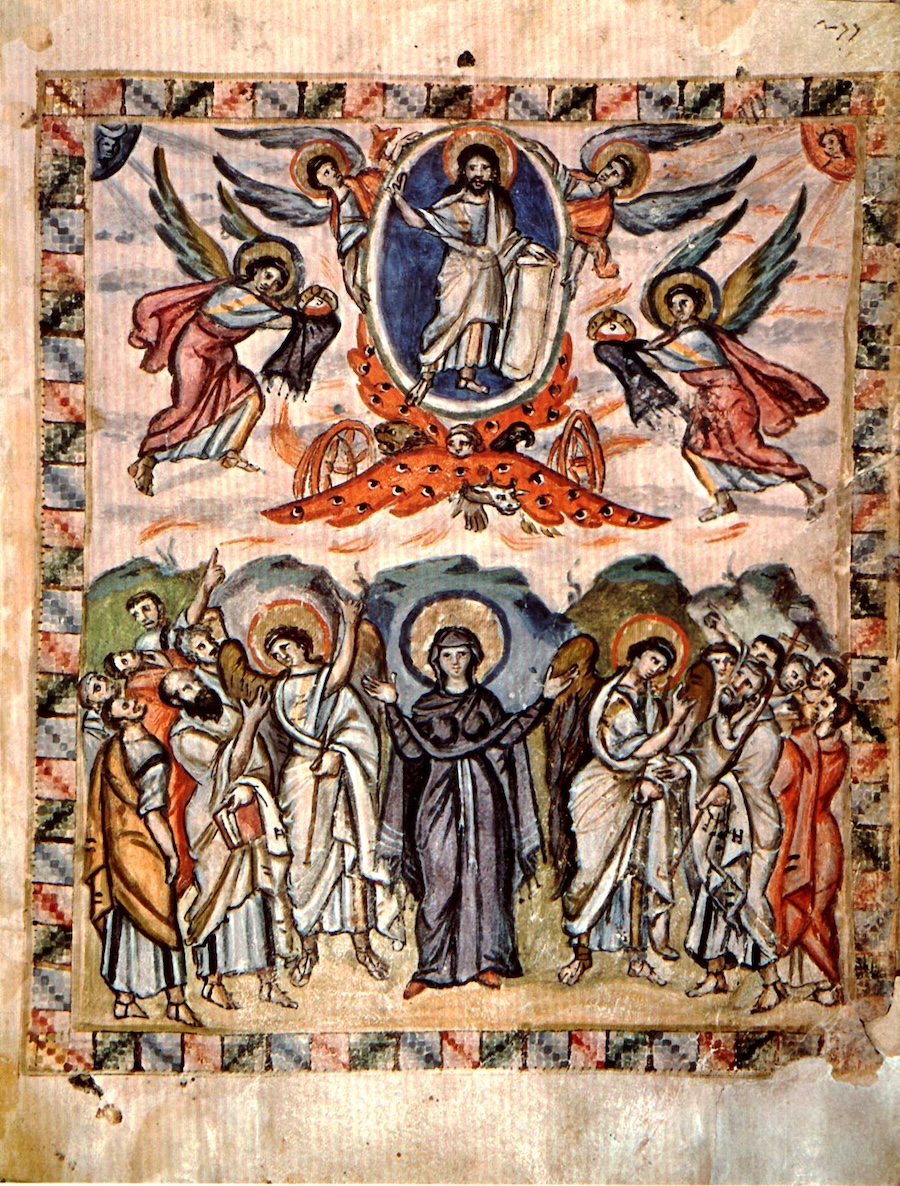
Ascension
fol. 13v from the Rabbula Gospels
(cod. Plut. I, 56), Syria, 586.
Tempera on parchment
33 × 25 cm
Biblioteca Mediceo Laurenziana
Florence, Italy