February 21: Christ's Ministry Quickly Intensifies
♫ Music:
Mark 1:29–45 (NKJV)
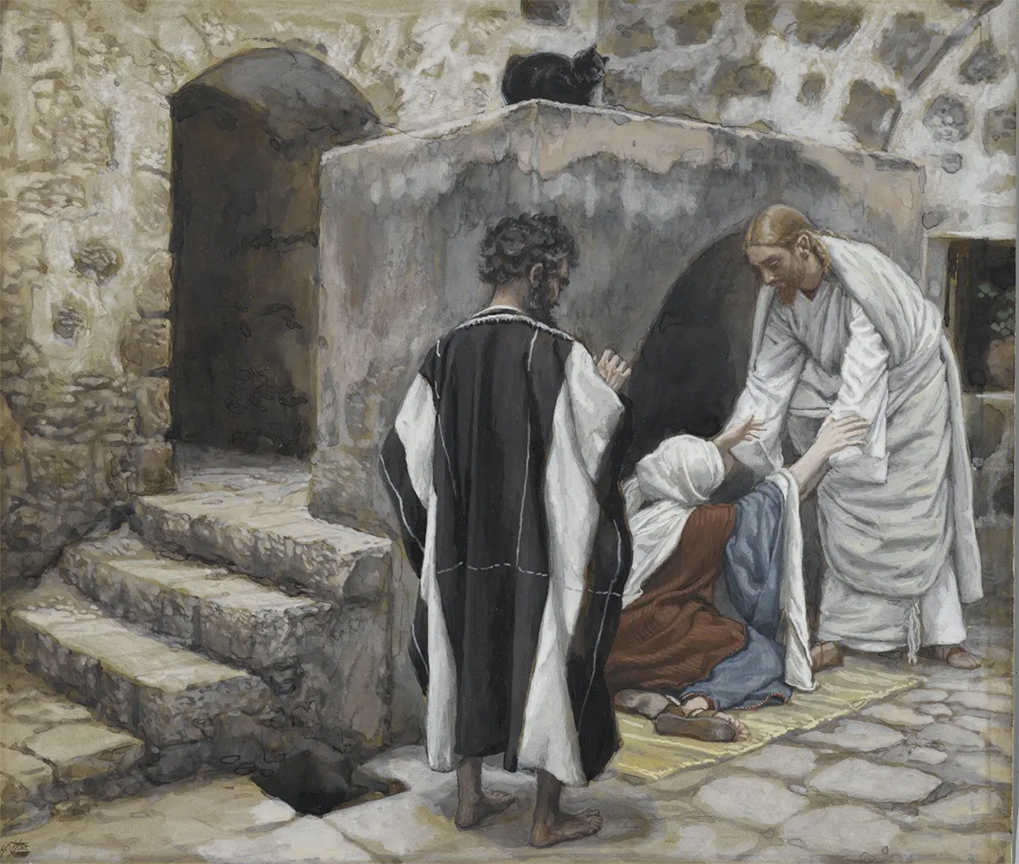
Now as soon as they had come out of the synagogue, they entered the house of Simon and Andrew, with James and John. But Simon’s wife’s mother lay sick with a fever, and they told Him about her at once. So He came and took her by the hand and lifted her up, and immediately the fever left her. And she served them.
At evening, when the sun had set, they brought to Him all who were sick and those who were demon-possessed. And the whole city was gathered together at the door. Then He healed many who were sick with various diseases, and cast out many demons; and He did not allow the demons to speak, because they knew Him.
Now in the morning, having risen a long while before daylight, He went out and departed to a solitary place; and there He prayed. And Simon and those who were with Him searched for Him. When they found Him, they said to Him, “Everyone is looking for You.”
But He said to them, “Let us go into the next towns, that I may preach there also, because for this purpose I have come forth.”
And He was preaching in their synagogues throughout all Galilee, and casting out demons.
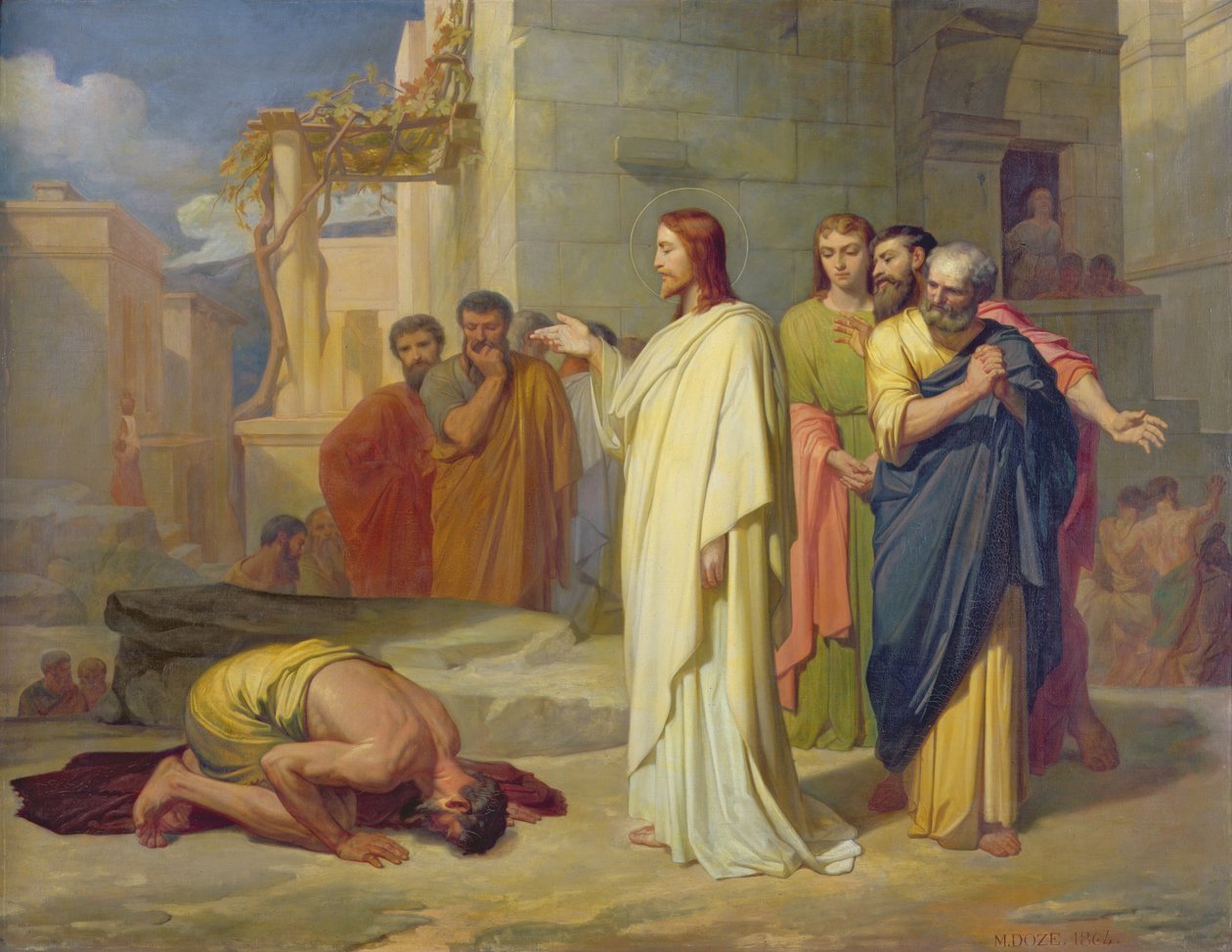
Now a leper came to Him, imploring Him, kneeling down to Him and saying to Him, “If You are willing, You can make me clean.”
Then Jesus, moved with compassion, stretched out His hand and touched him, and said to him, “I am willing; be cleansed.” As soon as He had spoken, immediately the leprosy left him, and he was cleansed. And He strictly warned him and sent him away at once, and said to him, “See that you say nothing to anyone; but go your way, show yourself to the priest, and offer for your cleansing those things which Moses commanded, as a testimony to them.”
However, he went out and began to proclaim it freely, and to spread the matter, so that Jesus could no longer openly enter the city, but was outside in deserted places; and they came to Him from every direction.
Poetry
“The Leper”
by John Newton
Oft as the leper's case I read,
My own described I feel;
Sin is a leprosy indeed,
Which none but Christ can heal.
Awhile I would have passed for well,
And strove my spots to hide;
Till it broke out incurable,
Too plain to be denied.
Then from the saints I sought to flee,
And dreaded to be seen;
I thought they all would point at me,
And cry, Unclean, unclean!
What anguish did my soul endure,
Till hope and patience ceased?
The more I strove myself to cure,
The more the plague increased.
While thus I lay distressed, I saw
The Savior passing by;
To him, though filled with shame and awe,
I raised my mournful cry.
Lord, thou canst heal me if thou wilt,
For thou canst all things do;
O cleanse my leprous soul from guilt,
My filthy heart renew!
He heard, and with a gracious look,
Pronounced the healing word;
I will, be clean - and while he spoke
I felt my health restored.
Come lepers, seize the present hour,
The Saviour's grace to prove;
He can relieve, for he is pow'r,
He will, for he is love.
Christ’s Ministry Quickly Intensifies
I’m not proud of what I’m about to share.
While in New Delhi, India, on a research project for my university we stopped at a local church in an extremely poor community. After the sermon, it was announced that communion would be taken. We all sat in rows with a common cup coming from left to right. This meant I would take a drink after a homeless woman. She was covered in filth and, to be honest, smelled horribly. When I had sat down next to her, she smiled at me with rotted teeth. Now, I would drink from the same cup. I was extremely uncomfortable. What diseases or germs might she carry? I honestly thought about excusing myself to fake going to the restroom to avoid the situation. Not my finest hour.
Then, the Spirit dramatically brought to mind the very passage we are focusing on today.
While Mark only tells us that a “leper came up” to Jesus, Luke provides graphic detail in describing him as “covered with leprosy” (Lk 5:12), a disease carrying the same social stigma often associated with AIDS. The man falls at Jesus’ feet and begs to be healed.
What would Jesus do?
His response becomes increasingly counter-cultural the more we learn about New Testament views of leprosy. Rabbis of the day viewed leprosy as one of the major sins of uncleanness. “Not merely actual contact with the leper, but even his entrance defiled a habitation, and everything in it, to the beams of the roof” notes historian Alfred Edersheim. The burdens of a leper were cruelly exacerbated by the reaction of those who came into contact with them. Edersheim continues: “No less a distance than four cubits [six feet] must be kept from a leper, or, if the wind came from that direction, a hundred were scarcely sufficient. Rabbi Meir would not eat an egg purchased in a street where there was a leper. Another Rabbi boasted that he always threw stones at them to keep them far off, while others hid themselves or ran away.”
Rather than running away—as surely as everyone else did—Jesus is moved by the leper cowering at His feet. Christ not only heals him but, to the astonishment of the crowd, touches him. This one particular act of charity deeply influenced another Christian advocate of social justice—Francis of Assisi. Upon seeing a leper on the street, his face disfigured and covered with open wounds, Francis felt compelled by Christ to kiss him. “We are told,” notes one biographer, “that Francis approached the leper, whose face was one vast sore, took his hand, and placed his mouth on the leper’s rotting flesh. An immense joy swept over the young man, and the kiss of peace was immediately returned.”
Joy.
That’s the emotion that was on the face of the woman as I took the cup from her and drank. In that moment, economic barriers disappeared and we wordlessly acknowledged our bond—brother and sister in Christ. Two individuals who had, in our own way, been touched by the Savior.
Prayer
“Lord, today let us look for the very people who often are shunned, or ignored. Let us see them as Jesus did—people in need of his loving and healing touch.”
Dr. Timothy Muehlhoff
Author, Speaker and Research Consultant
Director, Winsome Conviction Project
Biola University
For more information about the artwork, music, and poetry selected for this day, we have provided resources under the “About” tab located next to the “Devotional” tab near the top of the page.
About the Artwork | 1
The Healing of Peter’s Mother-in-Law
James Tissot
1886–1894
Opaque watercolor over graphite on gray wove paper
7 7/16 x 8 11/16 in.
Brooklyn Museum of Art
New York, New York
Public Domain
In this delicate gouache painting, the French artist James Tissot suggests that Peter’s mother-in-law had made a brave attempt to welcome Jesus into her house, but collapsed in the effort. The real tenderness we see here as Jesus helps the woman up is typical of His ministry. Just as Jesus breaks tradition by healing on the Sabbath, this faithful woman, now healed, instead of recuperating slowly, is already up and preparing a meal on the Sabbath. Since working on the Sabbath was forbidden, Jewish women would normally prepare the food on the previous day and stoke the fire before sunset to keep it warm. Jesus has saved her embarrassment as the hostess and so this woman’s first thought, once recovered, is to show her gratitude to the Lord by getting the food ready, to serve Jesus and others in their hunger.
About the Artist
James Tissot (1836–1902) was a French painter and illustrator. He was a successful painter of fashionable, modern scenes and society life in Paris before moving to London in 1871. A friend and mentor of the impressionist painter Edgar Degas, Tissot also painted scenes and figures from the Bible. In 1885, Tissot had a revival of his Catholic faith, which led him to spend the rest of his life making paintings about biblical events. Moving away from impressionism and postimpressionism, Tissot returned to traditional, representational styles and narratives in his watercolors. To assist in his completion of biblical illustrations, Tissot traveled to the Middle East to make studies of the landscape and people. His series of 365 gouache illustrations showing the life of Christ were shown to critical acclaim and enthusiastic audiences in Paris, London, and New York, before being bought by the Brooklyn Museum in 1900. Tissot spent the last years of his life working on paintings of subjects from the Old Testament, which he unfortunately never completed.
About the Artwork | 2
Jesus Heals the Leper
Jean-Marie Melchior Doze
1864
Oil on canvas
Musée des Beaux Arts de Nimes
Nimes, France
Public Domain
Jesus cleansing a leper is one of the healing miracles of Jesus. The story is found in all three of the Synoptic Gospels. Leprosy was considered a sort of curse from God. Infected individuals lived separated, outside the community. Ostracized from the community, they were left homeless, without the support structure of family and friends. The condition symbolized the defilement of sin, which results in separation from God and the community. Jesus touched the leper to not only show compassion and break societal and legalistic religious barriers, but He demonstrated His power to heal the "unclean" and His willingness to be intimate with those who were ostracized. By physically crossing the line into the leper's isolated world, Jesus showed that He was not afraid, and that His divine power, not a physical touch, was the source of healing.
About the Artist
Jean-Marie Melchior Doze (1827–1913) was a French painter. He devoted himself almost entirely to religious painting and decorated many churches. He also designed the cartoons for the first two mosaics in the Basilica of Our Lady of the Rosary in Lourdes, France. In 1875 he became the director of a drawing school and curator of the Nimes Museum. From 1861 to 1879 he exhibited his paintings at the Paris Salon.
About the Music | 1
“Healer” from the album Healer
It’s hard to see the storm blowing over anytime soon.
It’s hard to hear any hope in the headlines,
Or how to know what’s true.
We’ve been trusting in the broken to make us whole.
But there’s no new rescue coming.
It’s still the one we’ve always known.
We need the Healer.
We don’t need another hero.
We need the Healer.
Deep down every hurting heart knows.
We need the healer.
And only Jesus is the Healer.
The whole world is looking for something.
But what we need is someone.
And every road leads back to one name.
When all the searching is done.
‘Cause there's no world view, no religion.
That can make the blind eyes see.
Let the eyes of our heart be opened.
To the healing that we need.
We need the Healer.
We don’t need another hero.
We need the Healer.
Deep down every hurting heart knows.
We need the Healer.
And only Jesus is the Healer (the Healer).
More than comfort, we need the King.
More than gifts, we need the Giver.
More than blessings, we need your Presence.
More than the healing, we need the Healer.
More than comfort, we need the King.
More than gifts, we need the Giver.
More than blessings, we need your Presence.
More than the healing, we need the Healer.
More than comfort, we need the King.
More than gifts, we need the Giver.
More than blessings, we need your Presence.
More than the healing
We need the Healer.
We don’t need another hero.
We need the Healer.
Deep down every hurting heart knows.
We need the healer.
‘Cause only Jesus is the Healer.
Yes we need the, yes we need the Healer (Healer).
No other name but Jesus is the Healer (Yes, we need the).
Come now Jesus, be the Healer (the Healer).
About the Composers
Mark Hall, Seth Mosley, and Matthew West
John Mark Hall (b. 1969) is an American musician. He is the lead vocalist for the Georgia-based contemporary Christian music group Casting Crowns, a seven-member group composed of worship leaders. He is also youth pastor at Eagle's Landing First Baptist Church in McDonough. Casting Crowns began as the student worship band that Hall formed while he was serving at First Baptist Daytona Beach in 1999. Other members at that time included Juan DeVevo (guitar), Melodee DeVevo (vocals and violin), Hector Cervantes (guitar), and Darren Hughes (production manager). Mark Hall received several Dove Award nominations at the 36th GMA Dove Awards. In 2007, Hall was nominated for a Dove Award for Male Vocalist of the Year at the 38th GMA Dove Awards. The Casting Crowns song "Praise You in This Storm,” written by Hall, was also nominated for Song of the Year.
Matthew Joseph West (b. 1977) is an American contemporary Christian singer-songwriter. He has released five studio albums and is known for his songs "More," "You Are Everything," and "The Motions." He was nominated for five Dove Awards in 2005, two of which were for his major-label debut album, Happy. West won the 2013 American Music Award for Best Contemporary Inspirational Artist. In addition to his main solo career, West has worked as a songwriter for many Christian musicians and groups, such as Point of Grace, Mandisa, Natalie Grant, and Casting Crowns, as well as mainstream country acts including Rascal Flatts, Billy Ray Cyrus, and Vince Gill.
Seth David Mosley (b. 1987) is an American Christian musician and record producer, who plays Christian pop and Christian rock. He was the front man for the Christian alternative rock band Me in Motion. His music recording career began in 2006 with the band Me in Motion. This would lead him to launch his own music production career, eventually starting up Full Circle Music in Franklin, Tennessee. He achieved recognition for a Grammy Award during the 57th Annual Grammy Awards in the Best Contemporary Christian Music Album category, for his production of Run Wild. Live Free. Love Strong. for King & Country. Full Circle Music is a group of music producers, engineers, songwriters, editors, studios and creators focused on delivering the highest quality music in a timely fashion, both to the label and to the independent artist.
About the Performers
Casting Crowns is a contemporary Christian and Christian rock band started in 1999 by youth pastor Mark Hall, the band's lead vocalist, as part of a youth group at First Baptist Church in downtown Daytona Beach, Florida. They later moved to Stockbridge, Georgia, where more band members joined. Some members of the band currently work as ministers for Eagle's Landing First Baptist Church in McDonough, Georgia. The band has won a Grammy and a Dove Award. In 2023, the band announced their The Healer Tour, which included artists Ben Fuller and We Are Messengers.
About the Music | 2
“Heal” from the album The Healing
Heal, heal me from my sin
Heal me from my shame. Oh, Lord.
Feel, feel you changin’ me.
Feel you making me your own. Oh, Lord.
About the Composers/Performers
Caleb and Sol Rexius are identical twins and American singer-songwriters from Eugene, Oregon. Their debut album, titled Afloat, was released in 2009. Both graduated from the University of Oregon's Lundquist College of Business before pursuing a music career together. On a road trip down through California after college graduation, they decided to throw their guitars in the back and maybe make a few bucks to cover gas by singing on street corners. After making $84 in one hour, they realized that they might be on to something. They finished the week by writing a few songs that are included on their debut album. After a hiatus from the music scene, and an ever-growing desire to spread the gospel through their music, Caleb and Sol decided in 2008 to record and launch their debut album, titled Afloat. Caleb penned the words and music for the title song and they split lyric-writing responsibilities for the rest, each writing separately, then coming together to edit one another's work. Their fan base on the internet has grown exponentially; churches, camps, youth groups, and schools continue to call. After just nine months, and twenty thousand CDs, Caleb and Sol are staying afloat and excited about what's to come.
About the Poetry and Poet
John Newton (1725–1807) was an English Anglican clergyman, hymn writer, and former slave-ship captain whose dramatic life conversion shaped one of the most enduring Christian testimonies in history. After years spent at sea in the transatlantic slave trade, Newton experienced a profound spiritual awakening during a storm in 1748. Over time he left seafaring entirely, eventually becoming an Anglican priest in 1764.
Newton is best known as the author of the hymn Amazing Grace, written in 1772, which reflects his deep sense of repentance and gratitude for God’s mercy. Later in life, he became an influential voice in the abolition movement, mentoring figures such as William Wilberforce and publicly condemning the slave trade he once participated in. Newton’s life and writings continue to be remembered for their honesty, humility, and powerful testimony of redemption.
About the Devotion Writer
Tim Muehlhoff (Ph.D., University of North Carolina at Chapel Hill) is the Senior Director of Biola’s Winsome Conviction Academy which seeks to restore civility back into a warring public square. His latest book is End the Stalemate: Moving Past Cancel Culture to Meaningful Conversations (with Sean McDowell).