December 7: Names Associated with the Various Roles of Christ
♫ Music:
Week Two Introduction
December 07–13
Title: Names Associated with the Various Roles of Christ
“The Son of man came not to be ministered unto, but to minister, and to give his life a ransom for many” (Matthew 20:28, KJV). Jesus’ three years of public ministry were characterized by tireless service to others. Wherever He went, this great “Lover of Souls” was mobbed by people with multiple needs and special requests. Some of the people in the crowds came because they were suffering from physical maladies, some from demon possession. Others were curious and wanted to see Him perform miracles or learn from His parabolic stories and authoritative teaching. Everyone was hungry, either for physical food or for spiritual nourishment. Jesus was and still is truly the “Servant of All.”
We are only able to discuss a few of the many roles Christ shouldered on earth and continues to carry out through the agency of the Holy Spirit in our own time. The breadth of His duties is wide-ranging. It is reassuring to know that in heaven Christ continues to minister to all who call upon His name. Since Scripture has given us such a rich panoply of roles and functions Christ assumes, perhaps praying by using a specific title that meets the greatest need for you at the moment is appropriate. Christ is our “Shepherd,” “High Priest,” “Friend,” “Teacher,” “Physician,” “Counselor,” and “Servant.” These titles remind us that He is actively leading, protecting, interceding, nurturing, instructing, healing, guiding, and showing us by example how to live in this world as we prepare for the next. May we follow in His footsteps as we in turn minister to others.
Day 8 - Sunday, December 07
Title: Good Shepherd | Shepherd & Overseer of Souls
Scripture #1: Hebrews 13:20–21 (NKJV)
Now may the God of peace who brought up our Lord Jesus from the dead, that great Shepherd of the sheep, through the blood of the everlasting covenant, make you complete in every good work to do His will, working in you what is well pleasing in His sight, through Jesus Christ, to whom be glory forever and ever. Amen.
Scripture #2: John 10:11–16 (NKJV)
“I am the good shepherd. The good shepherd gives His life for the sheep. But a hireling, he who is not the shepherd, one who does not own the sheep, sees the wolf coming and leaves the sheep and flees; and the wolf catches the sheep and scatters them. The hireling flees because he is a hireling and does not care about the sheep. I am the good shepherd; and I know My sheep, and am known by My own. As the Father knows Me, even so I know the Father; and I lay down My life for the sheep. And other sheep I have which are not of this fold; them also I must bring, and they will hear My voice; and there will be one flock and one shepherd.”
Scripture #3: 1 Peter 2:25 (NKJV)
For you were like sheep going astray, but have now returned to the Shepherd and Overseer of your souls.
Poetry & Poet:
“Ewe to Shepherd”
by Laura Wang
And won’t you slow your pace, and let us look
at least upon your shadow as you move?
Your darkened form walks all too swiftly through
these thickets, and some rams among our flock
command me stay behind. They say my words
disrupt their meditations, and my feet
usurp the path that theirs would take. You need
me, so they say, to be unseen, unheard,
and let my sheepish silence be the sign
of my devotion. Bleating arguments,
we wait for you to turn; but until then
we trot as troubled stragglers in your line,
not knowing how to reconcile our aims,
or even if our shepherd is the same.
The Good Shepherd
Father God, thank you for Your holy and perfect Word, and how the creativity of the people You made help us to see You. Spirit I pray You will move in us as we reflect on these things. Make us more like Jesus, I pray.
Amen.
I so much appreciate the way Scripture honors the humble, earthy occupation of shepherd. Starting with Abel, and later with Moses and David, there are many heroes in God’s story who spent time in this work. Of course we must remember in this Advent season that God greatly honored the shepherds around Bethlehem with being the first to hear the “good news of great joy for all the people.”
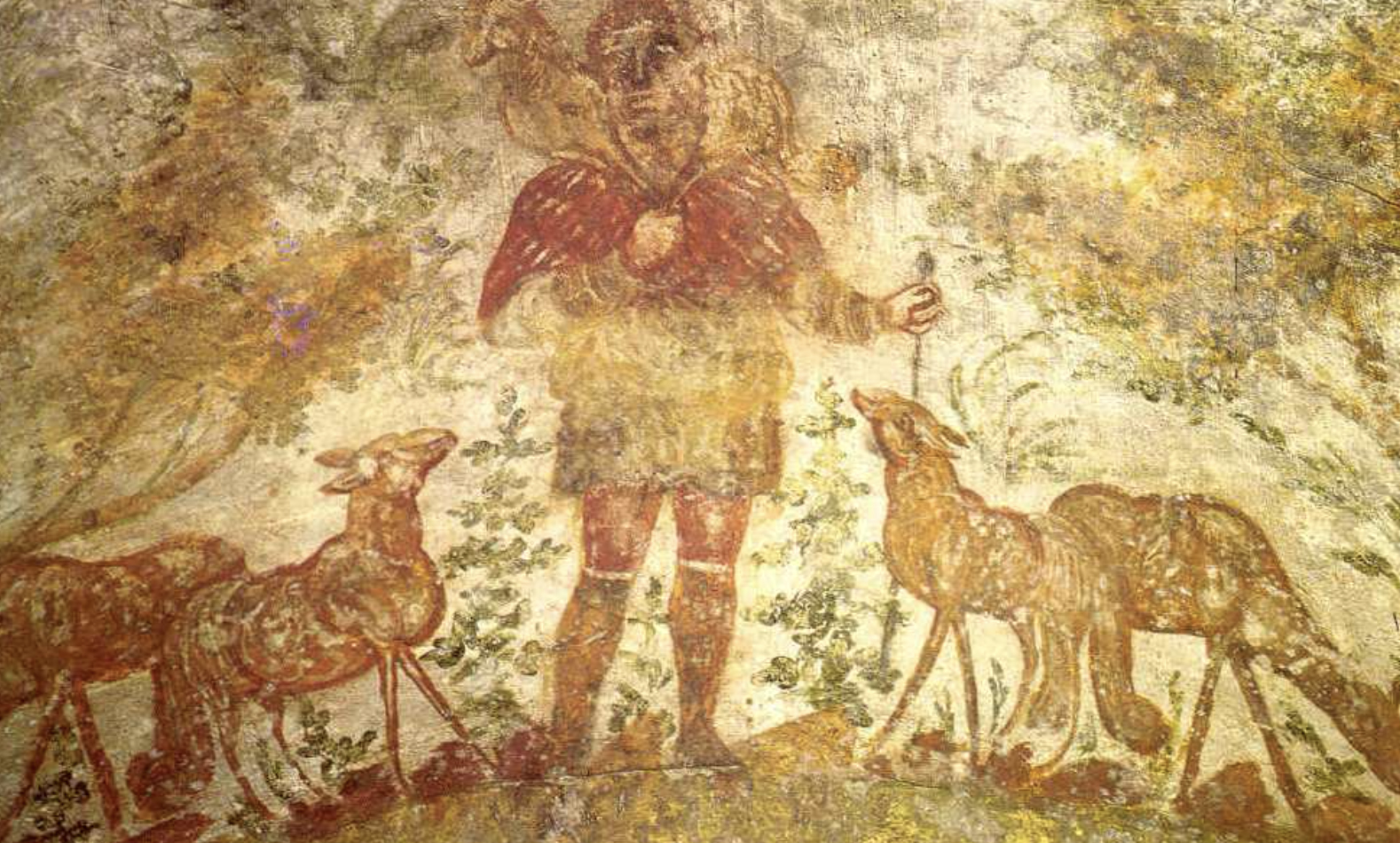
I’ve never been a shepherd, but I am a proud father to three sons, who now age 16 to 22. I am continually thankful to God for the ways He shows me His love through the experience of parenting. When our boys were young, my wife and I were often challenged in herding our little flock. I would often have a boy on my shoulders for the joy of it, so they could see the world from a different place and so we could have a different kind of connection. But there were definitely times when a strategy for managing them and to keep them from scattering was to put the one most likely to wander on my shoulders. Each of them had ages when their legs were the right length so I could hold both their feet in one hand, similar to how we see our shepherd from ages past holding the feet of his wayward sheep.
Yes, I feel certain that in our image for today, this particular sheep is wayward and not hurt. It looks far too alert - I imagine it's craning its neck to look off in the distance at the place it had wandered. I remember the feeling of my sons sitting up as high as they could on my shoulders and craning their necks to see interesting things from their higher vantage point, maybe leaning toward the place where they’d really like to wander.
Jesus is my Good Shepherd, coming to collect me because I am prone to wander.
Lord, I feel it.
Thank you, Jesus, for carrying me back to the fold.
Laura Wang's poem shares a particular angle on that wandering, how we sheep are prone to argue, complain, and insist that we relate to the Shepherd on our own terms. We “troubled stragglers” want our Shepherd to hear us and solve our immediate problems. I was convicted that the poem starts with “And…” Do we ever stop our self-centered complaints?
The answer from the Shepherd is clear, though non-verbal:
I hear you. What you really need is to just follow. Trust Me.
Our Scripture passage in John is rich in descriptions of our Good Shepherd, showing us why we can trust Him. He owns us, He cares for us, and He knows us with a depth we can’t comprehend, even as He and the Father know each other. He is welcoming, unifying, and His plan is bigger than we can understand. And because of how much He loves us, He lays down his life for us, His beloved flock.
I’m so thankful that we get to think about these truths in connection to Psalm 23, beautifully set for choir and orchestra by John Rutter. What peace and heavenly glory we can hear in this music! Our Shepherd leads us to green pastures, beside still waters, and He is with us as we walk through the valley of the shadow of death to dwell in the house of the Lord forever.
Prayer:
We praise You, Father, for loving us and sending us Your Son, our Good Shepherd. Jesus, help us to hear Your voice. Protect us from all that would cause us to wander. We are so distracted. Spirit, help us to listen and follow. Thank You for Your continued work in us.
Amen.
Chuck Koontz, MLIS
Librarian for Systems and Special Collections
Adjunct faculty for School of Fine Arts & Communications
Biola University
About the Artwork:
The Good Shepherd
Unknown Artist
Early Christian fresco
c. 350 A.D.
Catacombs of Domitilla
Rome, Italy
Public Domain
The Good Shepherd image is the most common of the symbolic representations of Christ found in early Christian art in the catacombs of Rome. Jesus’ role as compassionate Savior, devoted to protecting and saving the flock of God, is commonly conveyed through shepherd symbolism. The Catacombs of Domitilla are an underground Christian cemetery named after the Domitilla family that initially ordered them to be dug. They are among the largest catacombs in Rome, spreading out seventeen km, largely along the ancient Via Ardeatine, laid out on four levels, and housing approximately fifteen thousand bodies underground. The Catacombs of Domitilla are the only catacombs in Rome that have an underground basilica and are one of only five Roman catacombs open to the public. Constructed during the second and third centuries, this labyrinth of underground passages contains frescoes and a wealth of Christian iconography while also presenting masterful engineering skills and innovative architectural techniques.
https://en.wikipedia.org/wiki/Catacombs_of_Domitilla#:~:text=Constructed%20during%20the%20second%20and,skills%20and%20innovative%20architectural%20techniques.
https://en.wikipedia.org/wiki/Good_Shepherd#:~:text=11%20External%20links-,Biblical%20references,:11%20and%2010:14.&text=This%20passage%20is%20one%20of,%2C%20and%20Revelation%207:17.
About the Music: “The Lord is My Shepherd” from the album Gloria - The Sacred Music of John Rutter
Lyrics:
The Lord is my shepherd.
Therefore can I lack nothing.
He shall feed me in a green pasture,
And lead me forth beside the waters of comfort.
He shall convert my soul,
And bring me forth in the paths of righteousness.
For His name's sake,
For His name's sake,
For His name's sake.
Even though I walk through the valley,
Of the shadow of death,
I will fear no evil.
For Thou art with me,
Thy rod and Thy staff comfort me.
Thou shalt prepare a table before me,
Against them that trouble me.
Thou hast anointed my head with oil,
And my cup shall be full.
But Thy loving kindness and mercy,
Shall follow me all the days of my life.
And I will dwell in the house of the Lord,
In the house,
In the house of the Lord forever.
About the Composer:
John Rutter (b. 1945) is an English composer, conductor, editor, arranger, and record producer, mainly of choral music. He studied music at Clare College, Cambridge. He first came to notice as a composer during his student years, with much of his early work consisting of church music and other choral pieces, including Christmas carols. In 1981, Rutter founded his own choir, the Cambridge Singers, which he conducts and with which he has made many recordings of sacred choral repertoire, particularly under his own label, Collegium Records. From 1975 to 1979, he was the director of music at his alma mater, Clare College, and has directed the college chapel choir in various recordings and broadcasts. Since 1979, he has divided his time between composition and conducting. Today his compositions, including such concert-length works as Requiem, Magnificat, Mass of the Children, The Gift of Life, and Visions, are performed around the world. His music has been featured in a number of British royal occasions, including the two most recent royal weddings. Rutter's music is very popular, particularly in the US. In the UK, many hold him in high regard, as illustrated by the following quotation from a review in the London Evening Standard (2005): "For the infectiousness of his melodic invention and consummate craftsmanship, Rutter has few peers.” British broadcaster Sue Lawley referred to Rutter as "the most celebrated and successful composer of carols alive today" and Irish broadcaster Sean Rafferty heralded Rutter as "a creator of not just carols, but wonderfully great things for the human voice.”
https://johnrutter.com/
About the Performers:
City of London Sinfonia (CLS) is rooted in the belief that music and creativity are for anyone and everyone. CLS puts responsive, in-the-moment music-making with individuals and groups and musician development at the forefront of all their activities. In 2020, the Royal Philharmonic Society (RPS) Awards awarded the Impact Award to CLS for their Sound Young Minds Project, which provides opportunities to young people in psychiatric hospitals to work with each other and to express themselves. Other of their core projects include Room to Room Music with residents in care homes, Music for Children in London hospitals, and social prescribing with the new Tessa Jowell Health Centre. Over the last decade, they have established a “seriously informal” performance style, reaching new and diverse audiences by presenting live music in modern, exciting, and thought-provoking ways, often in open-spaced venues such as East London clubs, university halls, and cathedrals. The orchestra gives over seventy-five performances each year, performing regularly at the Albany (Deptford), Canada Water Theatre, Southbank Centre’s Queen Elizabeth Hall, Southwark Cathedral, and St Paul’s Cathedral.
https://cityoflondonsinfonia.co.uk/about-us/
https://en.wikipedia.org/wiki/City_of_London_Sinfonia
About the Poetry & Poet:
Laura Wang lives in Brooklyn, New York, where she writes stories and teaches about molecules. She is currently an M.F.A. candidate at Sarah Lawrence College in Bronxville, New York. Most notably, she is frequently found in close proximity to delicious snacks, and wasting time on Twitter (X).
About the Devotion Author:
Chuck Koontz, MLIS
Librarian for Systems and Special Collections
Adjunct faculty for School of Fine Arts & Communications
Biola University
Chuck Koontz is the Systems Librarian and Archivist at Biola University, having worked at Biola since 2001. He also works as a freelance musician playing tuba in various settings around Los Angeles. He has been happily married to Faith since 2001, and they have three sons. The Koontzes are members of Grace Evangelical Free Church in La Mirada, California.