December 8: High Priest | Prophet
♫ Music:
Day 9 - Monday, December 08
Title: High Priest | Prophet
Scripture #1: Hebrews 2:17–18 (NKJV)
Therefore, in all things He had to be made like His brethren, that He might be a merciful and faithful High Priest in things pertaining to God, to make propitiation for the sins of the people. For in that He Himself has suffered, being tempted, He is able to aid those who are tempted.
Scripture #2: Hebrews 4:14–16 (NKJV)
Seeing then that we have a great High Priest who has passed through the heavens, Jesus the Son of God, let us hold fast our confession. For we do not have a High Priest who cannot sympathize with our weaknesses, but was in all points tempted as we are, yet without sin. Let us therefore come boldly to the throne of grace, that we may obtain mercy and find grace to help in time of need.
Scripture #3: Hebrews 1:1–4 (NKJV)
God, who at various times and in various ways spoke in time past to the fathers by the prophets, has in these last days spoken to us by His Son, whom He has appointed heir of all things, through whom also He made the worlds; who being the brightness of His glory and the express image of His person, and upholding all things by the word of His power, when He had by Himself purged our sins, sat down at the right hand of the Majesty on high, having become so much better than the angels, as He has by inheritance obtained a more excellent name than they.
Poetry & Poet:
“Tempted”
by Eugene Peterson
Still wet behind the ears, he’s Spirit-pushed
up Jordan’s banks into the wilderness.
Angels hover praying ’round his head.
Animals couch against his knees and ankles
intuiting a better master. The Man
in the middle—new Adam in old Eden—
is up against it, matched with the ancient
Adversary. For forty days and nights
he tests the baptismal blessing and proves to his dismay
the Man is made of sterner stuff than Adam:
the Man will choose to be the Son God made him.
Our High Priest
One of the great comforts of our faith is knowing we have a High Priest—Jesus—who feels what we do in today’s turbulent times. The writer of Hebrews states our High Priest is intimately aware of our weaknesses. While some translations use the word “sympathize” (NKJV) or “empathize” (NIV) the message is clear—God enters our pain. Today, we’ll consider the value of human empathy and think about how divine empathy is unique.
Empathy: The Pinnacle of Listening
Emotions are a powerful indicator of how we view the world. The more powerful the emotion the more strongly we feel that something isn’t right or that an injustice has been committed. If our emotions are ignored, resolving differences with a person becomes increasingly unlikely. In light of this, scholars regard empathy as the “pinnacle of listening.” The word empathy comes from two Greek words that mean feeling inside and is defined as the ability to project into a person’s point of view in an attempt to experience that person’s thoughts, feelings, and perspective. Perhaps the most vivid call to empathy is when the writer of Hebrews not only asks us to remember those in prison, but to feel their pain.
Imagine being a persecuted New Testament believer. Upon arriving at a crude jail, you are stripped and whipped. The wounds are left untreated and once put back on, your shirt is soon soaked in blood. Wrists or legs are placed in irons that are only periodically taken off. Meals are unpredictable and when provided often cause dysentery. The problem is, there is nowhere to go to the bathroom. The stench in your cell increases each day. What is most distressing is the cold—especially at night.
In light of these deplorable conditions, it makes sense the writer of Hebrews implores his readers to “remember those in prison” (Heb. 13:3a). This especially takes on significance if the letter was written by Paul who spent 25% of his missionary career in prisons. It’s what the passage says next that relates to our focus on empathy. Think of others “as if you were there yourself. Remember also those being mistreated, as if you felt their pain in your own bodies” (Heb. 13:3b, emphasis mine). Put yourself in their position and then take a close look around. Imagine it’s your pain. How would it affect your emotions and body? How would it increase an urgency to pray?
While empathy may be the pinnacle of listening, is it slowly becoming a lost skill?
Researchers from the University of Michigan at Ann Arbor report that as early as 1980 college students started to show evidence of a dramatic decline in the ability to empathize. Utilizing the Interpersonal Reactivity Index—a questionnaire that asks individuals to respond to empathetic statements—participants rate themselves seventy-five percent less empathetic than students thirty years ago. Why such a decline? While many factors are at play, some researchers suggest our lack of empathy, oddly, may be related to our reading habits. Psychologist Raymond Mar, from York University in Toronto, notes that adults who read less fiction report being less empathetic. Is it possible that fiction encourages us to understand and identify with diverse characters and the emotions they exhibit? Empathy is fostered when we enter another person’s perspective—real or fictional—and ask, “What if?”
When seeking to foster empathy we must be careful not to question the validity of a person’s emotions even if they seem irrational or misguided. Taking a person’s feelings seriously or trying to acknowledge powerful emotions is not the same as condoning the perspective that produced the emotions. Empathy communicates to another person that his or her feelings, beliefs, and perspective matter and you are working to understand them.
When engaging in a conversation with someone who holds a different opinion, it’s beneficial to ask ourselves: Why does this person hold this belief? Such a question helps us not only trace a person’s beliefs to its roots by understanding influential factors such as significant others, experiences, or family, but also to surface and acknowledge the powerful emotions associated with these influencers. Not only will this question yield valuable information about the person you are trying to engage, but it may also dramatically change the communication climate. While still disagreeing, it may foster sympathy. The poet Longfellow writes: “If we could read the secret history of our enemies, we should find in each person’s life sorrow and suffering enough to disarm all hostility.”
Divine Empathy
One of the key doctrines of our faith is that God is omniscient—nothing is beyond his knowledge. To the church in Rome, Paul boldly exclaims, “Oh, how great are God’s riches and wisdom and knowledge!” (11:33). As the passage from Hebrews that started this devotional suggests, this knowledge includes a deep relational understanding of what it means to be human. In referring to Jesus our High Priest, the writer says, he sympathizes with us (Heb. 4:15). New Testament scholar Kenneth Wuest notes the word sympathy “points to a knowledge that has in it a feeling for the other person by reason of a common experience with that person.” Thus, “our Lord’s appreciation of our infirmities is an experiential one [emphasis mine].” This is where Jesus differs from us. To us, empathy is an important moment in the conversation where I attempt to project myself into your situation. You come from a family where your parents divorced when you were young. While mine didn’t, I still try to imagine how that would feel. Even if we both came from homes where parents divorced when we were young, we no doubt didn’t experience it exactly the same.
Here is where Jesus’s brand of empathy is uniquely different. Jesus didn’t have to project himself into or imagine what it’s like to be human. He was human and experienced the full scope of humanity—born to poor parents, being tired, feelings of betrayal by closest friends, unjustly judged, crucified, and dying to name a few. In a shocking passage, Jesus even knows what it’s like to feel God as distant or non-responsive. “My God, my God,” he exclaims from the cross, “why have you forsaken me? (Mt. 27:46). No, Jesus doesn’t have to imagine our pain, he felt it himself.
No doubt we’ve all felt comfort when a friend or family member takes time to empathize with us. The mere fact that they attempt to imagine our pain helps us in our pain. However, such comfort pales in comparison to our High Priest who steps into our hurt and takes it upon himself.
Prayer:
Lord, today let us be quick to enter into the pain of those around us and see life from their perspective. To imagine their pain is ours. Jesus, thank you that you don’t imagine our pain, but feel it in the mystery of your humanity. May it give us confidence to boldly approach your throne of grace as we offer comfort to others and seek it for ourselves.
Amen
Dr. Tim Muehlhoff
Professor of Communication
Co-director of the Winsome Conviction Project
Biola University
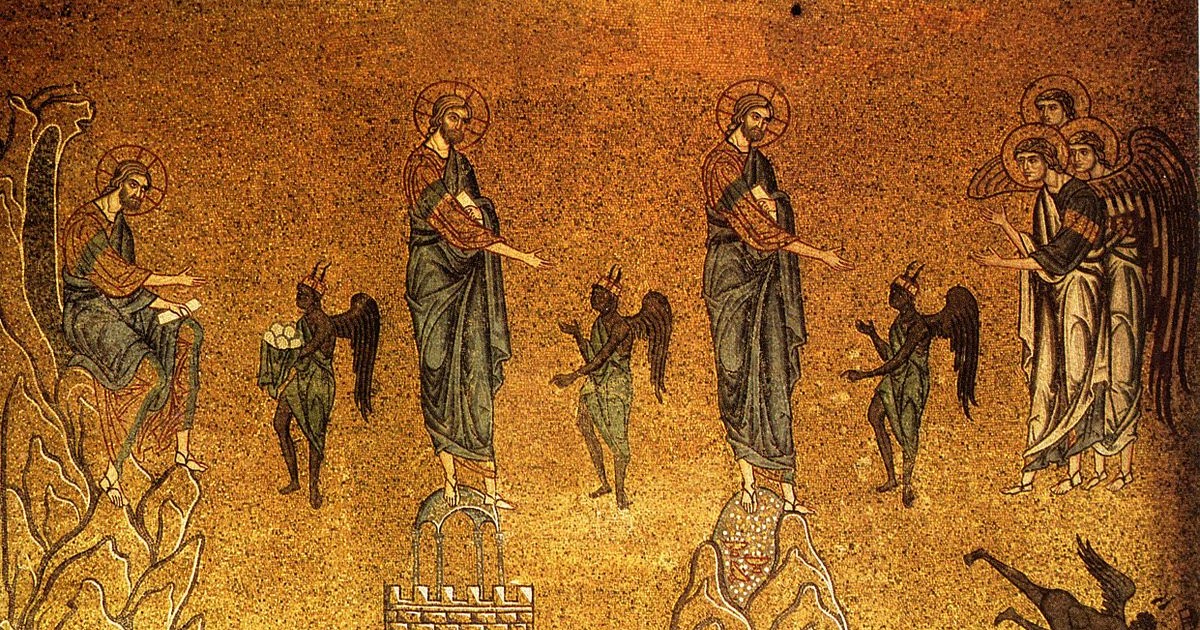
About the Artwork #1:
Temptations of Christ
Unknown Artisans
Twelfth Century
Mosaic
Basilica di San Marco
Venice, Italy
Public Domain
This mosaic created in the early twelfth century shows the temptations of Christ during His forty days and nights in the Judean desert as He fasted in preparation for the beginning of His public ministry. The devil challenges Jesus on three separate occasions—urging Him to use His divine power to satisfy His hunger, suggesting He rely on heavenly intervention if He throws Himself from the top of the temple, and offering Him every earthly kingdom in exchange for worship and submission. In each case, Jesus refuses the temptation, giving us a model of how to resist temptation and remain faithful to God’s will and commandments.
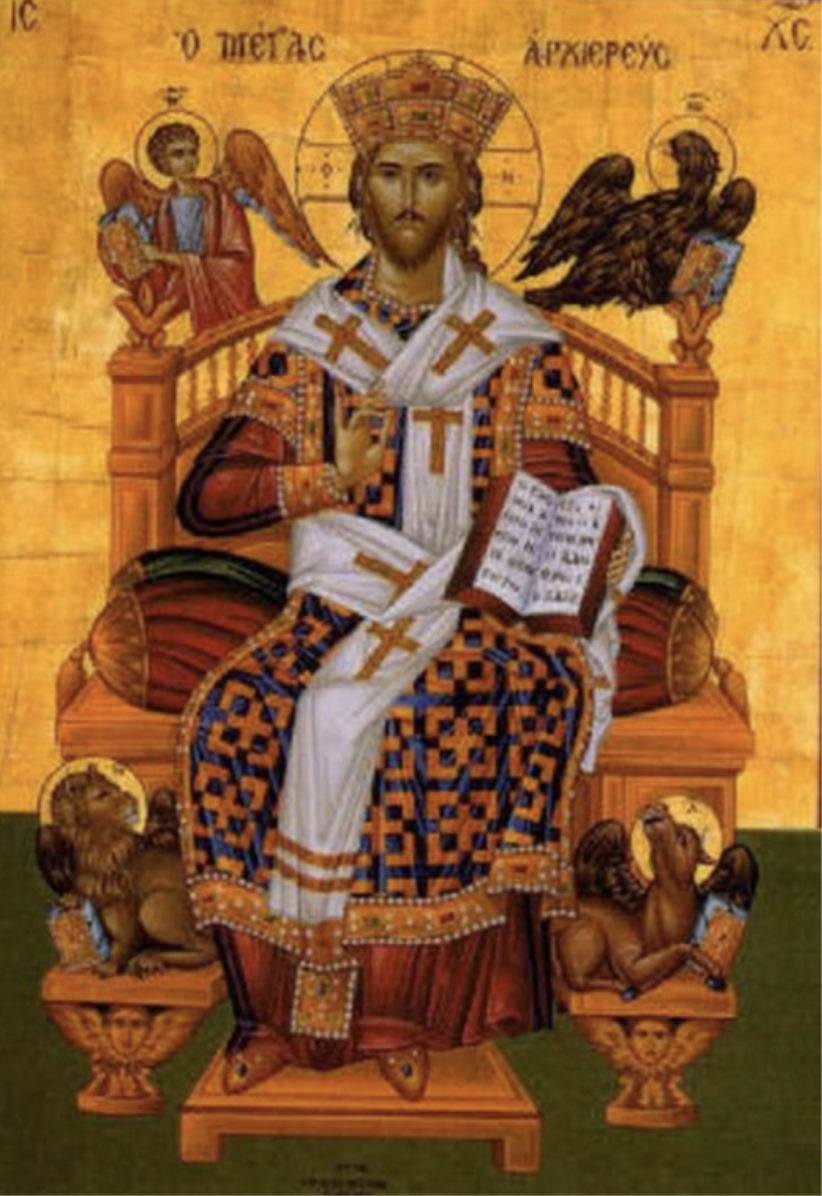
About the Artwork #2:
The Great High Priest Enthroned
Anonymous Iconographer
Holy Monastery Dormition of Theotokos
Parnitha Mount, Greece
Public Domain
This is a Greek Orthodox icon painting of Jesus Christ, the great high priest. The Lord sits on a throne as the ruler of the universe, and in His left hand He holds an opened gospel. With His right hand He blesses, the fingers of His hand forming the Greek letters IC XC, which is the abbreviation for Jesus Christ. On the four corners of His throne the four evangelists are symbolically represented: Matthew as a young man, Mark as a lion, Luke as an ox, and John as an eagle. All four have wings to portray their holy nature and all carry gospel books.
About the Music: “Before the Throne of God Above” from the album Pages
Lyrics:
Before the throne of God above
I have a strong and perfect plea:
A great High Priest whose name is Love,
Whoever lives and pleads for me.
My name is graven on his hands,
My name is written on his heart.
I know that while in Heav'n he stands
No tongue can bid me thence depart,
No tongue can bid me thence depart.
When Satan tempts me to despair
And tells me of the guilt within,
Upward I look and see him there,
Who made an end of all my sin.
Because the sinless Savior died,
My sinful soul is counted free,
For God the just is satisfied
To look on him and pardon me,
To look on him and pardon me.
Hallelujah, Hallelujah
Praise the one risen Son of God
Hallelujah, Hallelujah
Behold him there, the risen Lamb,
My perfect, spotless righteousness,
The great unchangeable I AM,
The King of glory and of grace.
One with himself I cannot die;
My soul is purchased by his blood.
My life is hid with Christ on high,
With Christ, my Savior and my God,
With Christ, my Savior and my God.
Hallelujah, Hallelujah
Praise the one risen Son of God
Hallelujah, Hallelujah (x3)
About the Composer:
Charitie Lees Smith (1841–1923) was an Anglican Irish-American hymn writer. Her hymns, well known in England and Ireland, were included in hymn books including Lyra Sacra Hibernica, Ryle's Spiritual Songs, Lyra Britannica, and Times of Refreshing. In 1863, she wrote perhaps her best-known hymn, "Before the Throne of God Above," which she entitled “The Advocate,” a hymn which was revived in evangelical circles in the late twentieth century.
https://en.wikipedia.org/wiki/Charitie_Lees_Smith
About the Performers:
Shane & Shane is the combination of solo artists Shane Barnard and Shane Everett. After meeting in college, Shane & Shane began writing songs and touring the country leading worship. Over fifteen years later, they’re writing more music than ever, with no intention of slowing down. Their desire has always been to glorify the Lord instead of themselves, and they do so by writing music that is biblically based, lyrically rich, and sonically engaging. Over the past few years, Shane & Shane have dedicated their lives to encouraging and equipping worship leaders and their teams through an online resource called the Worship Initiative, an equipping ministry and collective of worship leaders that has grown into a thriving community.
https://www.shaneandshane.com/about
About the Poetry & Poet:
Eugene H. Peterson (1932–2018) was an American-born clergyman, scholar, author, and poet. He wrote over thirty books, including Gold Medallion Book Award winner The Message: The Bible in Contemporary Language (2002), a modern-day paraphrase of the Bible. He earned his B.A. in philosophy from Seattle Pacific University, his S.T.B. from New York Theological Seminary, and his M.A. in Semitic languages from Johns Hopkins University. He also held several honorary doctoral degrees. In 1962, Peterson became a founding pastor of Christ Our King Presbyterian Church in Bel Air, Maryland, where he served for twenty-nine years before retiring in 1991. He was Professor of Spiritual Theology at Regent College in Vancouver, British Columbia, until retiring in 2006.
https://en.wikipedia.org/wiki/Eugene_H._Peterson
About the Devotion Author:
Dr. Tim Muehlhoff
Professor of Communication
Co-director of the Winsome Conviction Project
Biola University
Tim Muehlhoff is a professor of communication at Biola University and senior director of the Winsome Conviction Podcast, designed to reintroduce civility into our private and public disagreements. Tim is also a co-author (with Sean McDowell) whose latest book is End the Stalemate: Moving from Cancel Culture to Meaningful Conversations (Tyndale House).