December 15: Light of the World
♫ Music:
Day 16 - Monday, December 15
Title: Light of the World | Bright Morning Star | Dayspring from on High | Sun of Righteousness
Scripture #1: Revelation 22:16–17 (NKJV)
“I, Jesus, have sent My angel to testify to you these things in the churches. I am the Root and the Offspring of David, the Bright and Morning Star.” And the Spirit and the bride say, “Come!” And let him who hears say, “Come!” And let him who thirsts come. Whoever desires, let him take the water of life freely.
Scripture #2: John 8:12 (NKJV)
Then Jesus spoke to them again, saying, “I am the light of the world. He who follows Me shall not walk in darkness, but have the light of life.”
Scripture #3: Isaiah 60:19–20 (NKJV)
“The sun shall no longer be your light by day, nor for brightness shall the moon give light to you; but the Lord will be to you an everlasting light, and your God your glory. your sun shall no longer go down, nor shall your moon withdraw itself; for the Lord will be your everlasting light, and the days of your mourning shall be ended.”
Scripture #4: Malachi 4:2 (NKJV)
“But to you who fear My name the Sun of Righteousness shall arise with healing in His wings.”
Scripture #5: Luke 1:78–79 (NKJV)
“Through the tender mercy of our God, with which the Dayspring from on high has visited us; to give light to those who sit in darkness and the shadow of death, to guide our feet into the way of peace.”
Poetry & Poet:
“Morning Star”
by C. D. Wright
This isn’t the end. It simply
cannot be the end. It is a road.
You go ahead coatless, light-
soaked, more rutilant than
the road. The soles of your shoes
sparkle. You walk softly
as you move further inside
your subject. It is a living
season. The trees are anxious
to be included. The car with fins
beams through countless
oncoming points of rage and need.
The sloughed-off cells
under our bed form little hills
of dead matter. If the most sidereal
drink is pain, the most soothing
clock is music. A poetry
of shine could come of this.
It will be predominately
green. You will be allowed
to color in as much as you want
for green is good
for the teeth and the eyes.
The Light of the World
In the beginning, God spoke “Light!” bringing order to a formless, empty, chaotic void. In the beginning, also, was the Word, who, when the time was right, entered into the formless, empty, chaotic void of our sin and brokenness, bringing Light to our World.
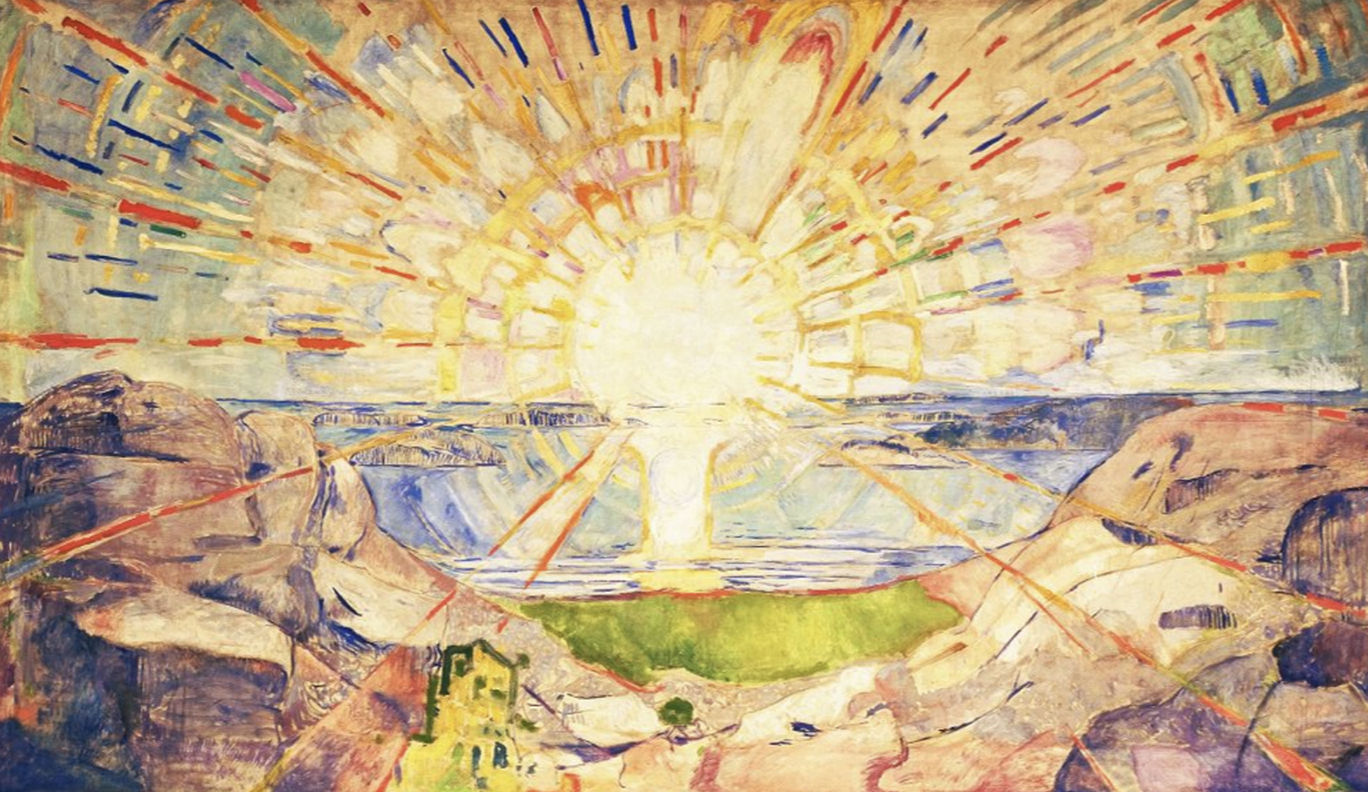
Edvard Munch captures the breath-taking awe of the rising sun over a rocky Norwegian coastline in his most famous work, The Sun. Vitality, energy, and life radiate from his mural, which serves as a centerpiece at an assembly hall in the University of Oslo. His painting is bright, vibrant, “a poetry of shine” (to borrow Wright’s words) over a fresh, beauty-soaked world. This could be a rendering of that very first sunrise flowing from our God’s creative Word.
As I reflect on the vibrant colors and radiating brushstrokes of Munch’s painting, I find myself more and more longing for the awe and beauty of God’s ordering Word to break into what feels like a particularly chaotic and confusing time. Perhaps it’s our 24-hour access to national and global headlines and images, with that accompanying sense of powerlessness and even despair over the ways people treat each other and the ways systems dehumanize. Or perhaps we really are living in a time of upheaval, where what is True and Real seems especially obscured by competing truth-claims and power structures.
Wright’s “Morning Star” gazes unflinchingly at what could be this despairing moment--the end of our own lives or our lives as we know them, where “sloughed-off cells / under our bed form little hills / of dead matter”––and, miraculously, finds hope, where we become rutilant (glowing), painting with a green that marks the vibrancy of life.
Our hope, Scripture reminds us, sometimes comes at the darkest hour, just before dawn. Into the disorder, chaos, and despair, when things seem to be at their worst, Jesus comes: our Bright and Morning Star appears to end the night (Revelation 22:16-17); our Dayspring, our Dawn from on high brings light that guides us into peace (Luke 1:78-79); our Sun of Righteousness brings healing in His wings (Malachi 4:2).
During Advent, our longing for Jesus’ return amplifies as we look toward our Christmas celebration, where Jesus, the Light of this World, first broke in. We sing “Glory!” with the heralding angels and find healing in His wings, even as we long for His bright, orienting light to dawn once more and vanquish our world’s confusion and disorder, to “flood the nations with grace and mercy.” Advent invites us to sit for a while in our longing and our joy, allowing the Light to overcome our darkness, bring order to our chaos, and envelope our world in His peace.
Prayer:
Light of the World, who spoke “Light” and vanquished darkness, we sit for a moment in this Advent season with both longing and joy. With great joy we praise you for coming to us as Jesus, enfleshed as our Immanuel, bringing light and life to all who seek you. And we long for you, Sun of Righteousness, to flood our world with grace, mercy, and everlasting peace. As we sit in the “already and not yet” of your life-giving Light, bathe our hearts and minds in the steadfast hope of your everlasting love.
Amen.
Dr. Lisa Igram
Assistant Professor of Theology
Rosemead School of Psychology
Office of Student Wellness
Biola University
About the Artwork:
The Sun
Edvard Munch
1910–1911
Oil on canvas
14.9 x 25.5 ft.
University of Oslo
Oslo, Norway
Public Domain
This image by artist Edvard Munch was created for the University of Oslo’s ceremonial hall (Aula), which had been built in connection with the university’s centenary celebrations in 1911. This was Munch’s first major commission for a public institution, and he worked on the prestigious project for many years, during which he made several hundred preparatory drawings and paintings. The Sun is one of eleven large paintings created for the walls of the Aula Hall. Located on the end wall, it depicts sunbeams radiating out towards the panels on either side, where men and women reach up towards the light. These images reflect Munch’s interest in nature and Vitalism, a school of scientific thought that promoted health, hygiene, and physical education, and that emphasized the sun as an energy-giving force.
https://commons.wikimedia.org/wiki/File:Edvard_Munch_-_The_Sun_(1911).jpg
https://www.munchmuseet.no/en/our-collection/between-us-and-the-sun/
About the Artist:
Edvard Munch (1863–1944) was a Norwegian painter whose best-known work, The Scream, has become one of the most iconic paintings of our time. Munch’s childhood was overshadowed by illness, bereavement, and the dread of inheriting the mental illness that ran in his family. Studying at the Royal School of Art and Design in Oslo, Norway, Munch began to live a bohemian lifestyle under the influence of nihilist writer Hans Jaeger, who urged him to paint his personal, emotional, and psychological states. Travel took him to Paris, where he learned about the power of color from fellow artists Paul Gauguin, Vincent van Gogh, and Henri de Toulouse-Lautrec. As Munch’s fame and wealth grew, his emotional state remained as tenuous as ever. After a breakdown in 1908, he became encouraged by the increasing acceptance of the people and museums of Oslo. His later years were spent working in peace and privacy. During his lifetime of work, he made one of the most significant and enduring contributions to the development of modernism in the twentieth century. He is one of the handfuls of artists who have shaped our understanding of the human experience and transformed the ways in which it might be visually expressed.
https://www.edvardmunch.org/biography.jsp
About the Music #1: “Hark! The Herald Angels Sing” from the album Christmas with the Chosen
Lyrics #1:
Hark the herald, angels sing,
Glory to the newborn king.
Peace on earth and mercy mild,
God and sinners reconciled.
.jpg)
Joyful all ye nations rise,
Join the triumph of the skies,
With angelic host proclaim,
Christ is born in Bethlehem.
Hark the herald angels sing,
Glory to the newborn king.
Christ by highest Heaven adored,
Christ the everlasting Lord,
Laid in time behold him come,
Offspring of the virgin’s womb.
Veiled in flesh the godhead see,
Held incarnate deity,
Pleases him with man to dwell,
Jesus our Emmanuel.
Hark the herald angels sing,
Glory to the newborn king.
And the angels they sing,
And the Heavens they ring,
Won’t you raise up your voice.
Join the song of the king.
Singing glory to God and peace on the earth,
Sing it out now the song of the king.
Heaven-born prince of peace,
Hail the song of righteousness.
Life and light to all he brings,
With healing in his wings.
Mild He lays His glory by,
Born that men no more may die.
Born to raise the sons of earth,
Born to give us second birth
Hark! The herald angels sing,
Glory to the newborn King!
And the angels they sing,
And the Heavens they ring,
Won’t you raise up your voice.
Join the song of the king.
Singing glory to God and peace on the earth,
Sing it out now the song of the king.
About the Composers #1: Lyrics by Charles Wesley and George Whitefield with additional lyrics by Matt Maher, music by Felix Mendelssohn
Charles Wesley (1707–1788) was an English leader of the Methodist movement and is most widely known for writing the words for over 6,500 hymns. His most famous works include "And Can It Be,” "Christ the Lord is Risen Today," "Hark! The Herald Angels Sing,” and "Lo! He Comes with Clouds Descending.” He was a younger brother of Methodist founder John Wesley and Anglican cleric Samuel Wesley the Younger. Educated at Oxford University, where his brothers had also studied, Charles followed his father into the church in 1735. Following their evangelical conversions in 1738, the Wesley brothers traveled throughout Britain, converting followers to the Methodist Revival through preaching and hymn-singing. It has been said that Charles Wesley usually celebrated each anniversary of his birthday by writing a hymn of praise to God. On his spiritual birthday—the first anniversary of his conversion—he celebrated by writing one of the most beloved hymns still in use today among Methodists—“O For a Thousand Tongues to Sing.” The hymn was placed first in John Wesley's A Collection of Hymns for the People Called Methodists, published in 1780.
https://en.wikipedia.org/wiki/Charles_Wesley
George Whitefield (1714–1770) was an English Anglican minister and preacher who was one of the founders of Methodism and the evangelical movement. Born in Gloucester, he matriculated at Pembroke College, Oxford in 1732. There, he joined the "Holy Club" and was introduced to John and Charles Wesley, with whom he would work closely in his later ministry. Whitefield was ordained after receiving his B.A. degree. He immediately began preaching, but he did not settle as the minister of any Church of England parish; rather, he became an itinerant preacher and evangelist. In 1740, Whitefield traveled to British North America, where he preached a series of Christian revivals that became part of the First Great Awakening. His methods were controversial, and he engaged in numerous debates and disputes with other clergymen. Whitefield received widespread recognition during his ministry; he preached at least eighteen thousand times to perhaps ten million listeners in the British Empire. Whitefield could enthrall large audiences through a potent combination of drama, religious eloquence, and patriotism.
https://en.wikipedia.org/wiki/George_Whitefield
Jakob Ludwig Felix Mendelssohn Bartholdy (1809–1847), widely known as Felix Mendelssohn, was a German composer, pianist, organist, and conductor of the early Romantic period. Mendelssohn was born into a prominent Jewish family and although initially raised without religion, he was later baptized as a Reformed Christian. Mendelssohn was recognized early as a musical prodigy and enjoyed early success in Germany and in his travels throughout Europe. He was particularly well received in Britain as a composer, conductor, and soloist. His ten visits to England—during which many of his major works were premiered—form an important part of his adult career. Mendelssohn wrote symphonies, concerti, oratorios, piano music, and chamber music. His best-known works include his Overture and incidental music for A Midsummer Night's Dream, the Italian Symphony, the Scottish Symphony, the overture The Hebrides, his mature Violin Concerto, and his String Octet.
https://en.wikipedia.org/wiki/Felix_Mendelssohn
https://pragueclassicalconcerts.com/en/composers/mendelssohn
About the Performer/Lyricist/Arranger #1:
Matt Maher (b. 1974) is a contemporary Canadian Christian music artist, songwriter, and worship leader who currently lives in the United States. He has written and produced nine solo albums to date. Three of his albums have reached the Top 25 Christian Albums Billboard chart and four of his singles have reached the Top 25 Christian Songs chart. Maher has been nominated for nine Grammy Awards in his career and was awarded the Songwriter of the Year at the 2015 GMA Dove Awards. Maher was born and raised in Newfoundland, Canada. His parents recognized his musical talent, and he grew up taking piano lessons and immersing himself in a broad variety of music, including playing in concert and jazz ensembles, singing in a choir, and playing in a garage rock band. Maher started his post-secondary studies at Memorial University of Newfoundland and continued his studies in the Jazz Department at Arizona State University. Maher currently lives in Nashville, Tennessee.
www.mattmahermusic.com
About the Music #2: “Shine Jesus Shine” from the album The Very Best of Graham Kendrick
Lyrics #2:
Lord, the light of your love is shining,
In the midst of the darkness, shining,
Jesus, Light of the world, shine upon us.
Set us free by the truth you now bring us,
Shine on me, shine on me.
Shine, Jesus, shine,
Fill this land with the Father’s glory.
Blaze, Spirit, blaze,
Set our hearts on fire.
Flow, river, flow
Flood the nations with grace and mercy.
Send forth your word,
Lord, and let there be light.
Lord, I come to your awesome presence,
From the shadows into your radiance,
By the blood I may enter your brightness
Search me, try me, consume all my darkness,
Shine on me, shine on me.
Shine, Jesus, shine,
Fill this land with the Father’s glory.
Blaze, Spirit, blaze,
Set our hearts on fire.
Flow, river, flow
Flood the nations with grace and mercy.
Send forth your word,
Lord, and let there be light.
As we gaze on your kingly brightness
So our faces display your likeness
Ever changing from glory to glory
Mirrored here may our lives tell your story
Shine on me, shine on me.
Shine, Jesus, shine,
Fill this land with the Father’s glory.
Blaze, Spirit, blaze,
Set our hearts on fire.
Flow, river, flow
Flood the nations with grace and mercy.
Send forth your word,
Lord, and let there be light.
Shine, Jesus, shine,
Fill this land with the Father’s glory.
Blaze, Spirit, blaze,
Set our hearts on fire.
Flow, river, flow
Flood the nations with grace and mercy.
Send forth your word,
Lord, and let there be light.
Lord, and let there be light.
Lord, and let there be light.
About the Composer/Performer #2:
Graham Kendrick (b. 1950) is an English Christian singer, songwriter, and worship leader. Together with Roger Forster, Gerald Coates, and Lynn Green, he was a founder of March for Jesus, a processional event of praise through the streets of a city to celebrate the lordship of Jesus Christ that culminates in a worship event. Kendrick began his songwriting career in the late 1960s. His most successful accomplishment is his authorship of the lyrics and music for the song "Shine, Jesus, Shine," which is among the most widely heard songs in contemporary Christian worship worldwide. He received a Dove Award in 1995 for his international work. In 2000, London School of Theology and Brunel University awarded Kendrick an honorary doctorate in "recognition of his contribution to the worship life of the Church.” He is a member of Compassionart, a charity founded by Martin Smith of Delirious?.
https://en.wikipedia.org/wiki/Graham_Kendrick
About the Poetry & Poet:
Carolyn D. Wright (1949–2016) was an American poet. She was a MacArthur Fellow, a Guggenheim Fellow, and the poet laureate of Rhode Island. She earned a B.A. in French from the University of Memphis (1971) and briefly attended law school before leaving to pursue an M.F.A. from the University of Arkansas. Wright's poetry is rooted in a sense of place and time and often employs distinct voices in dialogue, particularly those of the American South. Her work is formally inventive and often documentary in spirit, in the sense that it honors those whose stories or voices might be lost were it not for her own writing. Her diction mixes high and low to surprising effect, and her range of reference is both broad and deep, including phrases from other languages, allusions to other poems, and pieces of conversation.
https://en.wikipedia.org/wiki/Carolyn_D._Wright
About the Devotion Author:
Dr. Lisa Igram
Assistant Professor of Theology
Rosemead School of Psychology
Office of Student Wellness
Biola University
Lisa Igram’s twenty-plus years in higher education includes a variety of teaching and co-curricular leadership experiences. She is a trained spiritual director and holds an M.Div. in Spiritual Formation and a Ph.D. in New Testament Studies. She currently serves as an Assistant Professor of Theology at Rosemead School of Psychology, and her research focuses broadly on the value of embodiment for spiritual growth. When she's not reading up on the apostle Paul's theology or spiritual formation, you'll find her taking her niece to try a new ice-cream shop, finding good food with friends, or walking her dog on local trails.