December 14: The Figurative Names of Christ
♫ Music:
Week Three Introduction
December 14–20
Title: The Figurative Names of Christ
In addition to being a volume of concrete theological ideas and beliefs, the Bible is also a text filled with creative imagery and imagination. Scripture is a rich depository of poetic word pictures: symbols, motifs, metaphors, similes, parables, and similitudes. This imagery is used when familiar language does not adequately express what the author wishes to convey. Figurative language has the ability to speak passionately about abstract truth using concrete images from everyday life with attached emotional/spiritual associations. It appeals to our sensory perceptions of sight, hearing, smell, taste, and touch—ways we understand the world around us.
This evocative language tends to elicit stronger feelings and deeper insights than hard, cold facts. We are able to more fully understand the complex character and diverse attributes of Christ because of the abundant symbolism concerning Him found in Scripture. In fact, the Bible offers such a vivid tapestry of Christological images that it is impossible to stereotype Christ or consider only one aspect of His being. This week, we’ll delve into a few of the many figurative names used to describe our Lord. In his “25 Metaphors for Christ” guide, Chris Drew writes, “Each metaphor offers a unique perspective on who Jesus is and what he means to those who follow him. As we contemplate these metaphors, may we draw closer to the multifaceted, awe-inspiring reality of Jesus Christ.” That is our prayer for you this week as well.
Day 15 - Sunday, December 14
Title: Branch | Rod Out of the Stem of Jesse
Scripture #1: Isaiah 11:1–2 (NKJV)
There shall come forth a Rod from the stem of Jesse, and a Branch shall grow out of his roots. The Spirit of the Lord shall rest upon Him, the Spirit of wisdom and understanding, the Spirit of counsel and might, the Spirit of knowledge and of the fear of the Lord.
Scripture #2: Jeremiah 23:5 (NKJV)
“Behold, the days are coming,” says the Lord, “That I will raise to David a Branch of righteousness; a King shall reign and prosper, and execute judgment and righteousness in the earth.”
Scripture #3: Zechariah 3:8 (NKJV)
“‘Hear, O Joshua, the high priest, you and your companions who sit before you, for they are a wondrous sign; for behold, I am bringing forth My Servant the BRANCH.’”
Poetry & Poet:
“Salvage”
by Ada Limón
On the top of Mount Pisgah, on the western
slope of the Mayacamas, there’s a madrone
tree that’s half-burned from the fires, half-alive
from nature’s need to propagate. One side
of her is black ash and at her root is what
looks like a cavity that was hollowed out
by flame. On the other side, silvery green
broadleaf shoots ascend toward the winter
light and her bark is a cross between a bay
horse and a chestnut horse, red and velvety
like the animal’s neck she resembles. I have
been staring at the tree for a long time now.
I am reminded of the righteousness I had
before the scorch of time. I miss who I was.
I miss who we all were, before we were this: half
alive to the brightening sky, half dead already.
I place my hand on the unscarred bark that is cool
and unsullied, and because I cannot apologize
to the tree, to my own self I say, I am sorry.
I am sorry I have been so reckless with your life.
Rod Out of the Stem of Jesse
Jesus entered a messy family tree.
When you’re familiar with the convoluted and offensive stories behind the names, the genealogy of Jesus is anything but boring. A father sleeping with his daughter-in-law. The king abusing power to commit adultery at best and sexual assault at worst. An oppressed man turned prince-of-oppressors committing murder. A schemer lying his way into blessing over and over. Everywhere you turn, something is breaking, and someone is hurting.
Before he ever heard the whispers about his mother’s unchaste pregnancy or suffered his father’s untimely death, Jesus inherited the pain of a family acquainted with agony, a family with things to hide. He stepped into a lineage littered with shame, blame, and a long list of unresolved traumas.
Do you know anything about that?
Anything about coming awake to generational cycles of sin and all they’ve cost you? Anything about whispers of indecent family histories—or silences that leave you uneasy? Anything about receiving a family mythology where we’re heroes, martyrs, and underdogs (our actions excusable), while those other people are unwelcome, unclean, unforgivable, or expendable?
In short: do you know anything about living within a messy family tree? Because I do. And I suppose anyone taking seriously God’s redefinition of the church as “family” must, too.
Of course, I don’t just come from a half-burned family. I lead a half-burned life. The only thing more painful than vulnerably facing the harm I’ve suffered is unflinchingly confronting the harm I inflict. My hands and lips are unclean. Called to be God’s adoring, committed partner in putting the world back together, I instead chase security, affection, and control. I use people. I quietly condemn. I look away. I self-justify. I fail to practice long-suffering love.
How does God respond to such a mess? What does he do when we, in our fear and pain, torch our churches, families, and lives?
He comes near. He sees a “tree that’s half-burned from the fires” and calls it home. He abides. He commits himself to salvaging. To redemption. Before he ever asks us to enter the mess and practice costly healing and costlier love, to face reality honestly and still return good for evil, to speak the truth in love—before he asks us to become cycle-breakers—he goes first. Before he asks us to descend into the anguish of grappling with our hearts, he commits to remaining with us on the journey.
The Rod of Jesse arrives as the infant Emmanuel, “red and velvety,” a green shoot emerging from a “cavity…hollowed out / by flame.” A child born to change the trajectory of the story. To live humbly, justly, and righteously before the Lord.
A symbol of hope for anyone who has ever writhed in the flames or been the one to light the match. A challenge to trust that in the very middle of our mess, he is recreating. And an open invitation to join in the new thing he’s already doing. Nothing is ruined. Because we are not alone.
Thanks be to God.
Prayer:
Rod of Jesse,
Root us in the security of your unrelenting love for us. Turn us toward sacrificial love for our families, neighbors, and enemies. Lead us, again, out of our slavery to fear. And give us the humility and courage to live into your better story for our world.
Amen.
Hannah Williamson
Content Architect - Writer | Full Focus
Alumna of Biola University
Torrey Honors College (‘18)
About the Artwork #1:
Corpus
Tony Caltabiano
2009
Inkjet and acrylic on panel
80 x 120 in.
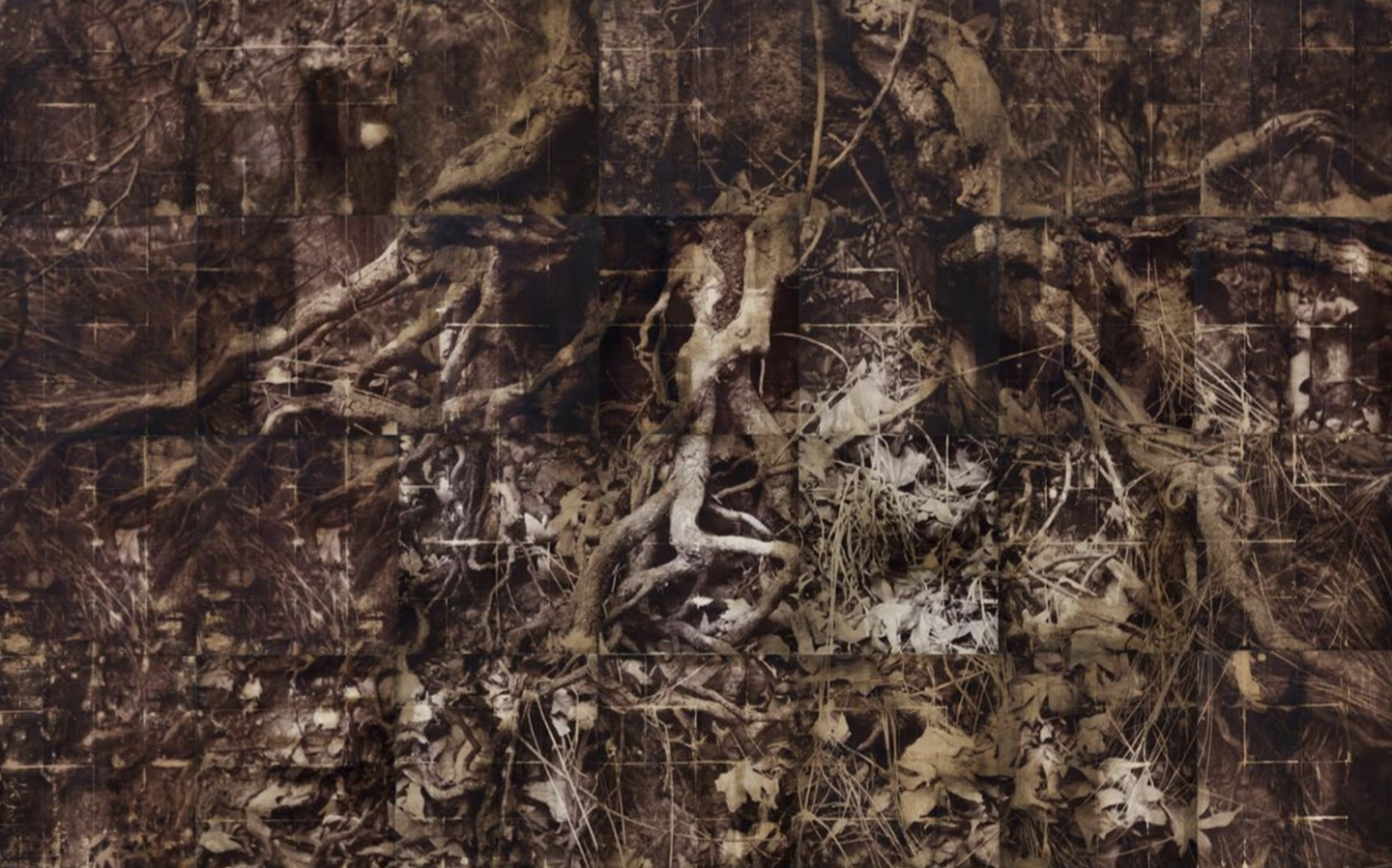
In his large work Corpus, artist Tony Caltabiano creates a multipaneled painted photograph of an old sycamore tree growing in the hills near his home in Riverside, California. The Latin word “corpus” translates into English as “body.” One may see this image as a metaphor for Jesse’s lineage and Christ’s family tree. Another reading of the work suggests the far-flung root system of the Christian church over the centuries. The tree is also a reminder of the wood that bore the suffering Savior. However, the artist’s favorite association is the humble sycamore tree mentioned in Luke 19:1–10 that held Zacchaeus the tax collector, as he strained to see Christ pass by.
About the Artist #1:
Tony Caltabiano is a graduate of the Biola University Art Department and an active educator, photographer, graphic designer, and mosaic artist.
https://anthonycaltabiano.com/mixed-media-2004-2009
About the Artwork #2:
The Tree of Jesse
Victor
1674
Tempera and gold leaf on panel
20.4 x 16.0 in.
Hellenic Institute of Byzantine and Post-Byzantine Studies
Venice, Italy
Public Domain
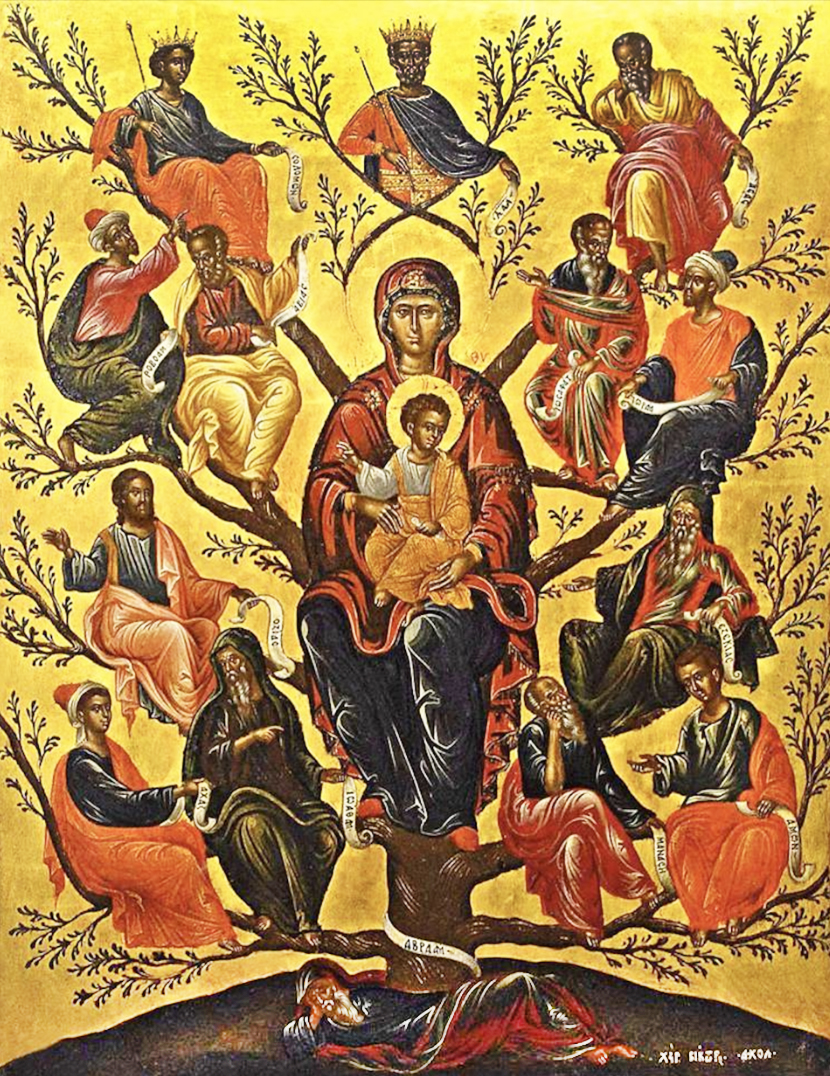
The Tree of Jesse is a depiction in art of the ancestors of Jesus, usually shown as a branching tree which rises from Jesse of Bethlehem, the father of King David. It is the original use of a family tree as a schematic representation of a family genealogy. The various figures depicted in the lineage of Jesus are drawn from those names listed in the gospel of Matthew and the gospel of Luke.
About the Artist #2:
Victor (1630/1635–1697) was a Greek iconographer active during the seventeenth century. He kept his style simple and was heavily influenced by the Venetian school. He was a priest at the Church of Agios Ioannis church of Mertzeroi Fraternity in Candia, Crete, Greece. Not much is known about the artist aside from records and historical research dealing primarily with his signature. He has a huge catalog of work attributed to him. According to the Neo-Hellenic Institute, ninety-five of his paintings and one fresco have survived. There are a large number of icons attributed to this artist. His workshop was extremely popular.
https://en.wikipedia.org/wiki/Victor_(iconographer)
https://commons.wikimedia.org/wiki/File:Victor_(iconographer)_Tree_of_Jesse.png
_Tree_of_Jesse.png)
About the Music #1: “O Root of Jesse”
Lyrics #1:
There shall come forth a rod out of the stem of Jesse,
And a Branch shall grow out of his roots:
The Spirit of the Lord shall rest upon Him,
The Spirit of wisdom and understanding,
The Spirit of counsel and might,
The Spirit of knowledge and of the fear of the Lord.
O Root of Jesse, Hope of the nations,
Come and lead us forth from the shadows of death!
There shall come forth a rod out of the stem of Jesse,
And a Branch shall grow out of his roots:
The Spirit of the Lord shall rest upon Him,
The Spirit of wisdom and understanding,
The Spirit of counsel and might,
The Spirit of knowledge and of the fear of the Lord.
O Root of Jesse, Hope of the nations,
Come and lead us forth from the shadows of death!
The Spirit of knowledge and of the fear of the Lord.
O Root of Jesse, Hope of the nations,
Come and lead us forth from the shadows of death!
O Root of Jesse, Hope of the nations,
Come and lead us forth from the shadows of death!
About the Performers #1: Et Incarnatus Chamber Orchestra
During the many concerts commemorating the hundredth anniversary of the death of the composer Felipe Gorriti, a small band of young musicians formed in Donostia (San Sebastian), Spain, in 1996. Their name was derived from the Latin phrase "Et incarnatus est," meaning "and was made flesh." The phrase represents a tenet of the Nicene Creed which specifically refers to the belief that Jesus Christ became incarnate, taking on human form. Since those humble beginnings, the orchestra’s continuous collaboration with varied musicians and composers has forged opportunities for them to work in the broad field of music—from jazz, pop, and cinema, to contemporary music. To date, the orchestra has recorded more than forty albums.
https://etincarnatus.eus/en/
About the Music #2: “The Rod of Jesse’s Root Has Bloomed” from the album Kontakion on the Nativity of Christ
Lyrics #2:
The rod of Jesse’s root has bloomed,
Has budded from a Virgin’s womb;
For you have come,
O Christ our Lord,
All-praised and blest and all-adored.
For from the mount of shadow dark,
You come as from a holy ark,
Incarnate of a Virgin Maid
O Lord of glory, human made.
O immaterial, spiritual One,
The One-begotten God the Son,
All glory to your might, O Lord,
All glory, Christ, the all-adored.
About the Composer #2:
Richard Toensing (1940–2014) was an American composer and music educator. He studied composition at St. Olaf College and the University of Michigan, Ann Arbor, where he earned a Doctor of Musical Arts degree (1967). Toensing joined the faculty of the University of Colorado at Boulder College of Music in 1972. Toensing retired in 2005 from the College of Music, where he served as professor of composition and as the former director of the University's Electronic Music Studio. Raised a Lutheran, Toensing joined the Eastern Orthodox Church in the 1990s. He later wrote Christmas carols and Kontakion on the Nativity of Christ, a setting of a sixth-century poem by St. Romanos, a Byzantine hymnographer and composer. Toensing received numerous awards for his compositions, most notably from Columbia University, the John Simon Guggenheim Memorial Foundation, the National Endowment for the Arts, and BMI.
https://en.wikipedia.org/wiki/Richard_Toensing
About the Performers #2: Cappella Romana directed by Alexander Lingas
Founded in 1991, Cappella Romana is a vocal chamber ensemble dedicated to combining passion with scholarship in its continuing exploration of the musical traditions of the Christian East and West traditions, with an emphasis on early and contemporary music. It is conducted by its founder and artistic director, Alexander Lingas. Flexible in size according to the demands of the repertoires, Cappella Romana is one of the Pacific Northwest’s few professional chamber vocal ensembles. It has a special commitment to mastering the Slavic and Byzantine repertories in their original languages, thereby making accessible to the general public two great musical traditions that are little known in the West. Leading scholars have supplied the group with their latest discoveries, while its music director has prepared a number of the ensemble performing editions from original sources. In the field of contemporary music, Cappella Romana has taken a leading role in bringing to West Coast audiences the works of such European composers as Michael Adamis, Ivan Moody, Arvo Pärt, and John Tavener, as well as promoting the sacred work of North American composers.
https://cappellaromana.org/
Alexander Linga is the music director and founder of Cappella Romana, and formed and directed the Byzantine Chant Ensemble for the coronation of their majesties King Charles III and Queen Camilla in 2023. He is a professor emeritus of music at City St. George’s, University of London, and a research fellow of the Institute for Orthodox Christian Studies (Cambridge, UK). From 1997 to 2021 he was a fellow of the University of Oxford’s European Humanities Research Centre. His present work embraces not only historical study but also ethnography and performance. Having been Spring 2023 Artist-in-Residence at St. Vladimir’s Orthodox Theological Seminary in Yonkers, New York, he returned there in 2023–24 as professor of music and associate director of its Institute of Sacred Arts.
https://cappellaromana.org/leadership-staff-and-board/
About the Poetry & Poet:
Ada Limón (b.1976) is an American poet. In 2022, she was named the twenty-fourth poet laureate of the United States by the Library of Congress. Limón is the author of seven books of poetry, including Startlement: New & Selected Poems; The Hurting Kind, which was a finalist for the Griffin Prize; The Carrying, which won the National Books Critics Circle Award and was a finalist for the PEN/Jean Stein Book Award; and Bright Dead Things, which was named a finalist for the National Book Award, the National Book Critics Circle Award, and the Kingsley Tufts Award. Limón is the recipient of a MacArthur Fellowship, a Guggenheim Fellowship, and was named a 2024 Time Magazine Woman of the Year. She is the author of two picture books, In Praise of Mystery as well as And, Too, The Fox, and was the editor of the anthology You Are Here: Poetry in the Natural World.
https://adalimon.com/about
https://en.wikipedia.org/wiki/Ada_Lim%C3%B3n
About the Devotion Author:
Hannah Williamson
Content Architect - Writer | Full Focus
Alumna of Biola University
Torrey Honors College (‘18)
Hannah Williamson is an anchored companion, life-speaking wordsmith, and Velveteen Rabbit. She seeks to foster sanctuaries of communion, romp amid ordinary wonders, and bear witness with gritty hope. She is grateful to the brothers and sisters who have modeled sturdy, tender love and joined her in engaging the world with holy mischief.
Read more: hannahewilliamson.substack.com