December 16: Bread of Life | Living Bread
♫ Music:
Day 17 - Tuesday, December 16
Title: Bread of Life | Living Bread
Scripture #1: John 6:32–35, 51 (NKJV)
Then Jesus said to them, “Most assuredly, I say to you, Moses did not give you the bread from heaven, but My Father gives you the true bread from heaven. For the bread of God is He who comes down from heaven and gives life to the world.” Then they said to Him, “Lord, give us this bread always.” And Jesus said to them, “I am the bread of life. He who comes to Me shall never hunger, and he who believes in Me shall never thirst.” . . . “I am the living bread which came down from heaven. If anyone eats of this bread, he will live forever; and the bread that I shall give is My flesh, which I shall give for the life of the world.”
Poetry & Poet:
“Shortnin’ Bread”
by Dick Allen
The lyrics were appalling. Three little children lying in bed,
two were sick an’ the other most dead
and how the song, written by James Whitcomb Riley
in racist dialect, became a minstrel song.
Yet the bread itself was wonderful: cornmeal,
flour, hot water, eggs, baking powder, milk,
a good deal of shortening. My mother used to sing
Momma’s little baby loves shortnin’, shortnin’
Momma’s little baby loves shortnin’ bread
all morning while she whipped up some,
wearing her white apron with the red stitching,
and I never tired of hearing about how
when those children, sick in bed
heard the talk about shortnin’ bread
they popped up well to dance and sing
for I believed, then, like other children from our small church village,
in miraculous cures. I believed in the luck brought by four-leaf clovers,
that men actually beat their swords into ploughshares,
and in the resurrection and the life.
Didn’t seasons change, weren’t prayers always answered?
One day it was snowing like the devil, the next,
robins came to our upstairs bedroom windows,
sheep gamboled, the lilac bush blossomed.
Behind us, trailing back through our lives like drunkards’ footsteps
there are thousands upon thousands of small escapes
from horrible outcomes. Be thankful for each reprieve
with which you’ve been blessed.
My brother who’d stepped on glass and got himself infected
didn’t die in his trundle bed beneath the stairs.
The nurse who’d stayed all night awake by his bedside
had left quickly in the morning, smiling, reassuring us,
while downstairs my mother had started singing,
hat ain’t all she’s gonna do
the house on Janes Avenue filling with the smells
of coffee and lilacs and delicious shortnin’ bread.
Sustenance
In our Scripture today, Jesus just fed five thousand men (and their families) by multiplying five little barley loaves and two small fish. Amazed, the crowd wanted more because they sensed that there was something extraordinary about this man. Then he said something audacious: I am the bread of life. He explained that Moses provided manna that would temporarily provide sustenance, but he was the true, living bread from heaven.
Notice the crowd’s response: Lord, give us this bread always. They’re thinking of physical provision to satisfy their hunger. Jesus explains that it is not only what he gives, but who he is that is deep, spiritual sustenance. He’s not just a rabbi pointing to bread, but the Bread himself. God is making himself consumable, absorbable, tangible – the very nourishment that satisfies the deepest parts of who we are and what we ache for.
What does it mean for us to never hunger? Jesus promises complete satisfaction, not temporary relief that rots overnight like manna. He explains: If anyone eats of this bread, he will live forever. This isn’t simply about physical immortality or even that we will join him in heaven one day, but about how our quality of life changes the moment we begin to realize that he is our eternal, everyday sustenance. We live forever because we consume the Eternal, and his eternal life infuses our everyday being.
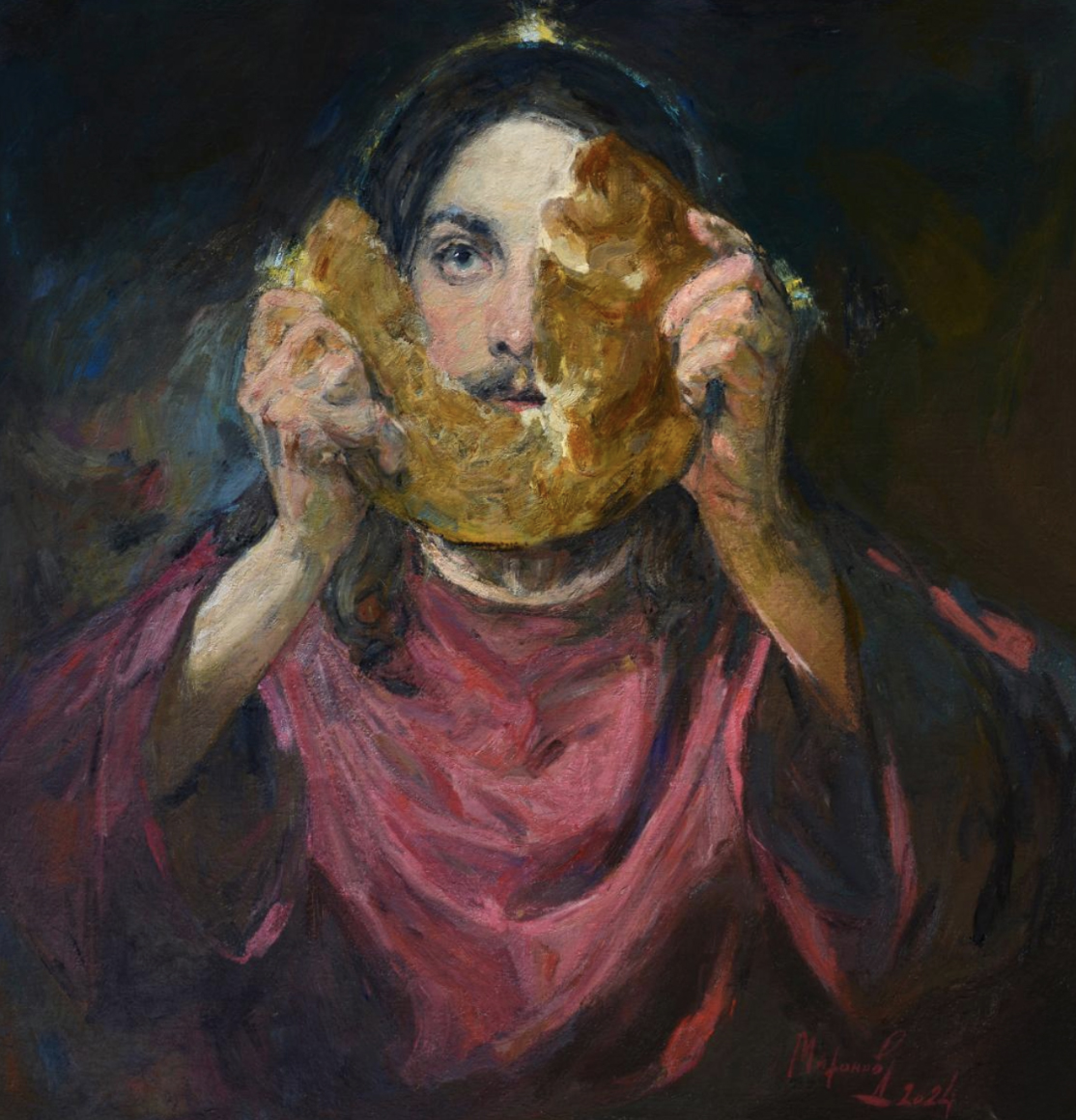
In Mironov Andrey’s Meal at Emmaus, we see this audacious claim unveiled. The oil painting captures the sacred instant of recognition, when ordinary bread becomes extraordinary revelation. The disciples’ eyes were not opened through spectacle, but through the intimate act of sharing bread (Luke 24:31). Sometimes we only want to see Jesus show up in spectacular ways, but he usually comes to us in a basic meal. How often do we miss him in the simple sustenance he provides?
Dick Allen’s Shortnin’ Bread reminds us of bread’s power to heal and comfort. His mother’s ritual of singing while baking and filling their home with delicious aromas transforms their ordinary moments into an extraordinary environment. Allen reflects on thousands upon thousands of small escapes from horrible outcomes alongside his brother’s healing, the nurse’s gentle care, and the smells of coffee and lilacs and delicious shortnin’ bread. These images remind us that God sustains us through dramatic interventions, but also in the quiet, daily provisions.
Take a few moments today to reflect on our Scripture, artwork, and poem. Do this while listening to Pastor Shirley Caesar’s Bread of Heaven and prayerfully consider how you might see Jesus’ extraordinary sustenance throughout what is likely to be an ordinary day. In every meal, in every moment of nourishment, in every small escape from harm, in every provision, may we taste and see that he is good.
Prayer:
Lord, Give us this day our daily bread. And remind us that, in all the big and small ways that we might miss, you are our Living Bread. We confess that there are so many things we take for granted, and so many ways we don’t see how you sustain us. Give us eyes to see how your goodness has always been running after us. We are grateful for every way you bring the eternal into our everyday moments.
Amen.
Dr. Mike Ahn, Ph.D., M.Div.
Dean of Spiritual Development
Biola University
About the Artwork:
Meal at Emmaus
Andrei Mironov
2024
Oil on canvas
70 x 70 cm
Used with permission from the artist
On the third day after the crucifixion, two of Jesus’s disciples were walking to Emmaus when they met the resurrected Christ, whom they failed to recognize. The two subsequently invited their companion into their home for supper. Most artists who have painted the scene of the supper at Emmaus re-create this event by depicting the moment when the resurrected, but incognito, Jesus reveals Himself as He breaks bread over dinner. Usually the unsuspecting disciples are captured with astonished reactions at the moment of their recognition. But in this composition, Russian artist Mironov gives us a different point of view—that of a disciple who witnesses firsthand the moment of recognition of the risen Christ who breaks the bread before him. Just as bread sustains physical life, Jesus, as the bread of life, provides spiritual nourishment and eternal life for those who believe in Him.
About the Artist:
Andrei Mironov (b. 1975) is a Russian artist. His paintings and prints focus on religious themes that portray his Christian beliefs and ideals. His oil paintings of biblical scenes are reminiscent of the baroque artist Caravaggio with their dramatic lighting and detailed portraits. Self-educated in painting, Mironov has worked as a portraitist since 2005. His participation in the First Chechen War as well as his police work has had a considerable influence on his artistic development. The artist defined Christianity as "the main theme of his oeuvres.” Today his paintings are found in private collections, in the Kashira local museum, in the Monastery of Our Lady of Kazan, and in the St. Nicholas Church in Yamskaya Sloboda (Ryazan).
https://en.wikipedia.org/wiki/Andrei_Mironov_(painter)
http://artmiro.ru/
http://artmiro.ru/blog/creative_commons/2015-07-04-244
About the Music: “Bread of Heaven” from the album Golden Gospel Classics
Lyrics:
Guide me over
Great Jehovah, Jehovah.
Feel right through,
This old bad rain.
Thank you Lord.
I am weak, Oh, yes I am.
But Thou art mighty.
Oh, You’re so mighty.
Hold me with Thy pow'rful hand.
Thy pow'rful hand.
Bread of heaven, Bread of heaven,
Feed me till I want no more,
I want no more, Oh yea.
I said Bread of Heaven
Bread of Heaven. (4x)
Rather than every tear,
I, I want no more.
I want, I want no more.
Listen, Strong Deliv'rer,
Hallelujah
Be Thy still my soul.
Please Jesus,
I want You to be my hiding place.
Yeah, oh yeah.
I said strong Deliv'rer.
Strong Deliv'rer.
Can I hear the touch of a strong Deliv'rer.
Strong Deliv'rer.
Clap your hands and say strong Deliv'rer.
Strong Deliv'rer.
Strong Deliv'rer
Strong Deliv'rer
Strong Deliv'rer
Never need your tear
Until I want
No
Until I want
No
I, I want no more.
Let me say it one more time
I said one more time.
Strong Deliv'rer
I know he is tonight
Strong Deliv'rer
Feed me Jesus
Until I want (x4)
I, I want no more.
Bread of heaven,
My soul is hungry tonight
Why don't you lift body up tonight
To the bread of heaven
Can do something for you right now.
If you just said bread of heaven.
Oh, bread of heaven.
Bread of heaven
Bread of heaven
My soul is hungry tonight.
Bread of heaven.
Beat me til I want no
I want, I want, I want, I want, want, no more
Yeah, yeah
About the Composers: William Williams Pantycelyn and John Hughes
William Williams Pantycelyn (1717–1791), also known as William Williams, is generally seen as Wales' premier hymnist. He is also rated among the great literary figures of Wales as a writer of poetry and prose. He was among the leaders of the eighteenth-century Welsh Methodist Revival, along with the evangelists Howell Harris and Daniel Rowland. Pantycelyn was not merely an important figure in the religious life in Wales, he was also one of the most important influences on Welsh language culture, not just in his own lifetime, but on into the nineteenth and twentieth centuries. His most famous hymn, written in 1745, was “Guide Me, O Thou Great Redeemer," but when translated into English, the hymn became known as "Bread of Heaven." The hymn tune was written by John Hughes in 1907.
https://en.wikipedia.org/wiki/William_Williams_Pantycelyn
https://www.classical-music.com/articles/what-are-the-lyrics-to-guide-me-o-thou-great-redeemer-bread-of-heaven
https://www.crichbaptist.org/articles/william-williams/
https://en.wikipedia.org/wiki/Cwm_Rhondda
John Hughes (1873–1932) was a Welsh composer of hymn tunes. He is most widely known for the tune “Cwm Rhondda” which was written in 1905 for the Cymanfa Ganu (hymn festival). The music’s present form was developed for the inauguration of the organ at Capel Rhondda, in Hopkinstown in 1907. Hughes himself played the organ at this performance, using the English translation of William Williams' words, which translated into English as “Guide Me, O Thou Great Redeemer.” This most celebrated of Welsh hymns continues to refer to the plight of the children of Israel condemned to wander in the desert wilderness. Popular in Welsh chapels, it became widely used in English services, and is still believed to be one of the best-loved church anthems.
https://en.wikipedia.org/wiki/John_Hughes_(1873%E2%80%931932)
About the Performer:
Shirley Ann Caesar-Williams (b.1938), known professionally as Shirley Caesar, is an American gospel singer. Her career began in 1951, when she signed to Federal Records at the young age of twelve. Throughout her seven-decade career, Caesar has often been referred to as the "First Lady of Gospel Music” and "The Queen of Gospel Music.” She has won eleven Grammy Awards, fifteen Dove Awards, and fourteen Stellar Awards. Caesar has released over forty albums. She has also participated in over sixteen compilation albums and three gospel musicals, including Mama I Want to Sing, Sing: Mama 2, and Born to Sing: Mama 3. Caesar is a recipient of a 1999 National Heritage Fellowship from the National Endowment for the Arts, which is the United States' highest honor in the folk and traditional arts. She was inducted into the Gospel Music Hall of Fame in 2000.
https://en.wikipedia.org/wiki/Shirley_Caesar
About the Poetry & Poet:
Richard Stanley Allen (1939–2017) was an American poet, literary critic, and academic. Allen was educated at the College of Liberal Arts at Syracuse University (A.B. 1961), then at the Brown University graduate school (M.A. 1964). He went on to teach creative writing and English literature at Wright State University from 1964 to 1968 and then at the University of Bridgeport. When he retired, he was the Charles A. Dana Endowed Chair Professor at the University of Bridgeport. From 2010 through 2015, he served as Connecticut's poet laureate. During this time he wrote the poem "Solace" in remembrance of the victims of the shootings at the Sandy Hook Elementary School in Newton, Connecticut. Allen was co-editor of several anthologies of science fiction and science fiction criticism, and his book, Overnight in the Guest House of the Mystic, was a finalist for the 1984 National Book Critics Circle Award for Poetry. His poems appeared in many journals, including Poetry, The Atlantic Monthly, The New Republic, The New Yorker, The American Poetry Review, Ploughshares, The Gettysburg Review, and The New Criterion.
https://en.wikipedia.org/wiki/Dick_Allen_(poet)
https://www.poetryfoundation.org/poets/dick-allen
About the Devotion Author:
Dr. Mike Ahn, Ph.D., M.Div.
Dean of Spiritual Development
Biola University
Mike Ahn oversees the various departments in spiritual development: chapel programs, worship teams, Torrey Memorial Bible Conference, student-led ministries, and pastoral care. He is a graduate of Haverford College (B.A., History, ’01) and Talbot School of Theology (M.Div., Spiritual Formation, ’09; Ph.D., Educational Studies, ’22). If he could, he would have two In-N-Out cheeseburgers with chopped chilis, animal-style fries, and a Pamplemousse LaCroix for every meal.