December 27: Consolation of Israel | Desire of the Nations
♫ Music:
Day 28 - Saturday, December 27
Title: Consolation of Israel | Desire of the Nations
Scripture #1: Luke 2:25 (NKJV)
And behold, there was a man in Jerusalem whose name was Simeon, and this man was just and devout, waiting for the Consolation of Israel, and the Holy Spirit was upon him.
Scripture #2: Haggai 2:6–7 (NKJV)
“For thus says the Lord of hosts: ‘Once more (it is a little while) I will shake heaven and earth, the sea and dry land; and I will shake all nations, and they shall come to the Desire of All Nations, and I will fill this temple with glory,’ says the Lord of hosts.”
Scripture #3: Psalm 86:9 (NKJV)
All nations whom You have made Shall come and worship before You, O Lord, And shall glorify Your name.
Poetry & Poet:
“Wait and See (Simeon and Anna)”
by Richard Bauckham
In the drab waiting-room
the failed travellers, resigned, sleep
on the hard benches, inured
to postponement and foul coffee.
Hope has given up on them.
There are also the impatient,
pacing platforms, and the driven,
purple with frustration, abusing
their mobiles, for the hardest part
of waiting is the not doing.
Truly to wait is pure dependence.
But waiting too long the heart
grows sclerotic. Will it still
be fit to leap when the time comes?
Prayer is waiting with desire.
Two aged lives incarnate
century on century
of waiting for God, their waiting-room
his temple, waiting on his presence,
marking time by practicing
the cycle of the sacrifices,
ferial and festival,
circling onward, spiralling
towards a centre out ahead,
seasons of revolving hope.
Holding out for God who cannot
be given up for dead, holding
him to his promises – not now,
not just yet, but soon, surely,
eyes will see what hearts await.
Waiting with Desire for the Consolation of Israel
In the morning when I sat down to write this devotional, I had set aside specific time to complete the task. And wouldn’t you know it, I had to restart my computer, and in doing so I was confronted with that spinning wheel-icon that turned over…and over…and over—endlessly processing something, and preventing me from adhering to my (self-imposed) schedule. Quickly I felt my gut tighten with impatience: How long is this going to take? I don’t have time for this. Of course, the restart only took several extra minutes, but it reminded me how often I—how often we—can struggle with waiting. Whether we wait on a delayed flight, for a text reply from a loved one, for news about medical results, or for the respite of the weekend: Waiting can feel interminable, even when there is an end in sight.
For today’s entry I encourage you to slowly absorb Bauckham’s poem, which captures so well the varied human experience of waiting. From the impatient, pacing platforms, to the hardest part…the not doing. From waiting as pure dependence, to the failed travelers sleeping on hard benches, feeling that hope has given up on them. His reverie lands on the especially long wait embodied by Simeon and Anna, the two aged lives incarnate, century upon century of waiting for God. This wait extends back to a discouraged people featured in Haggai’s oracle, overwhelmed by the enormity of the temple rebuilding project: When will God come? “In a little while,” He promises: “I will shake heaven and earth…and I will fill this temple with glory” (Hag 2:6-7).
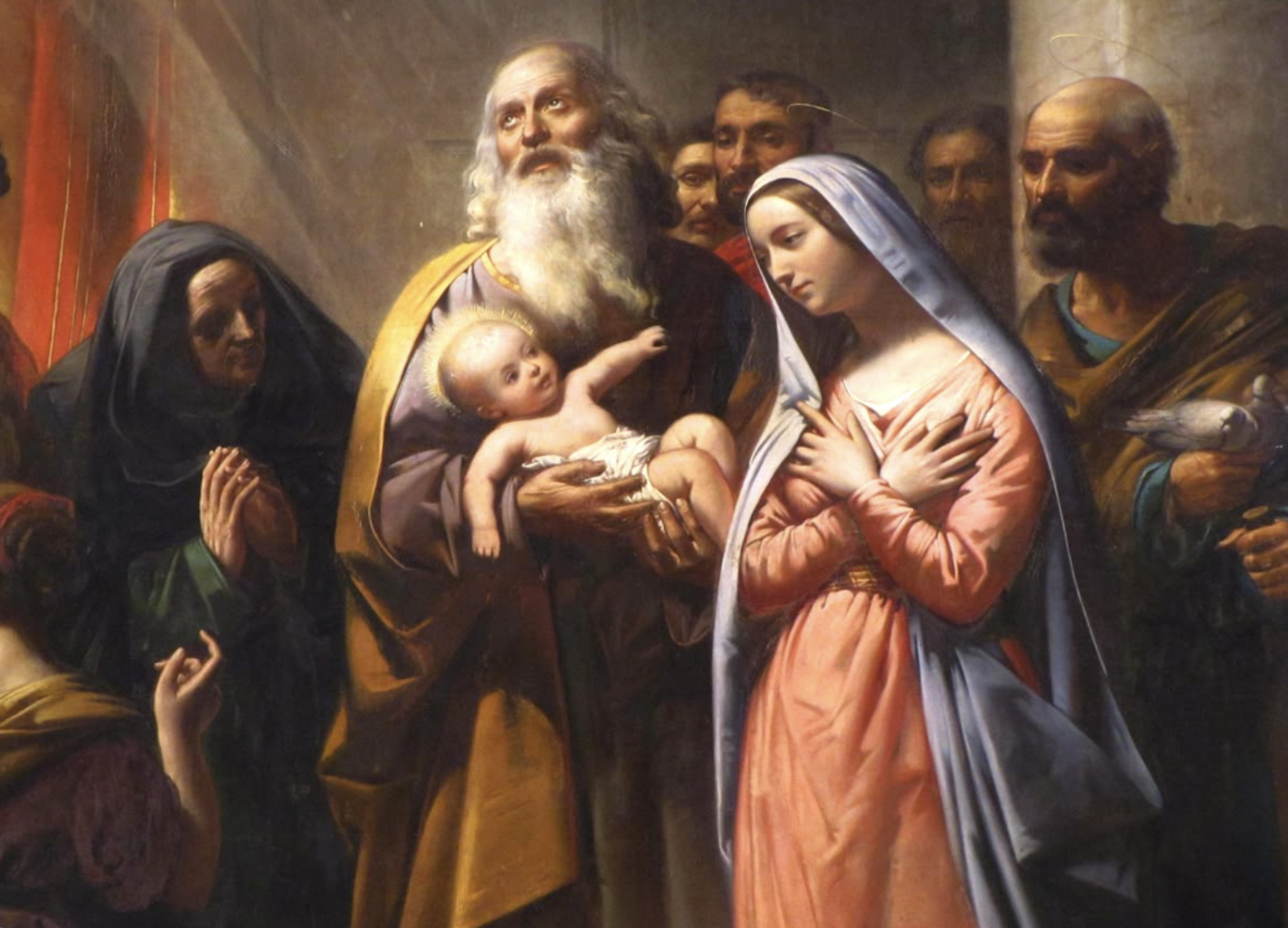
So, Simeon and Anna [held] out for God, Bauckham continues, holding him to his promises. And sure enough, one day a young new mom shows up at the temple, cradling her tiny baby boy, and Simeon knows—the Holy Spirit confirms—that the Consolation of Israel had finally arrived.
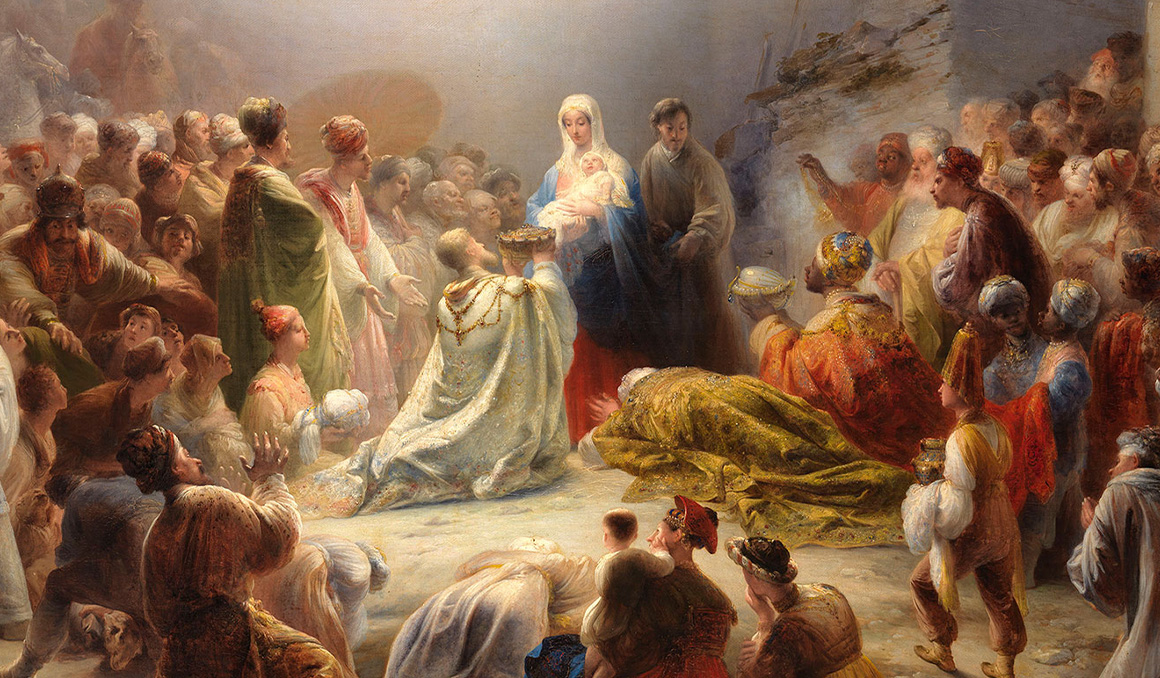
The Presentation in the Temple visually captures this moment in time, with the significance of the Savior’s arrival amplified by The Adoration of the Magi. How well it illustrates Psalm 86:9, the psalmist anticipating when “all nations whom You have made shall come and worship before You, O Lord, and shall glorify Your name.”
We rejoice in the advent of our Lord Jesus Christ. Jesus is Emmanuel, God with Us. And yet our lives are still riddled with all kinds of waiting. Not everything has been fully restored…yet. He has come and he is coming. In the meantime, Bauckham reminds us that prayer is waiting with desire. Sometimes, when we wait too long the heart can grow sclerotic, to the point where we wonder if it will still be fit to leap when the time comes. If your heart is there, or if you’re wondering if God has forgotten about you, don’t give him up for dead. Wait with desire. God will show up, in time.
Prayer:
I wait for you, LORD, my whole being waits,
and in your word I put my hope.
I wait for you, LORD,
more than watchmen wait for the morning,
more than watchmen wait for the morning.
We wait in hope for you, LORD; you are our help and our shield.
In you our hearts rejoice, for we trust in your holy name.
May your unfailing love be with us, LORD, even as we put our hope in you.
Psalms 130:5-6; 33:20-22
Dr. Jeannine Hanger
Assistant Professor
Talbot School of Theology
Biola University
About the Artwork #1:
Presentation in the Temple
Anonymous artist
Nineteenth century
Sts. Peter and Paul Cathedral
Hochfelden, Switzerland
Public Domain
The Presentation in the Temple is an event in the life of Jesus, describing His presentation by His parents at the temple in Jerusalem. According to the gospel of Luke, Mary and Joseph took the infant Jesus to the temple in Jerusalem forty days after His birth to complete Mary's ritual purification after childbirth and to perform the redemption of the firstborn son, done in accordance with the Torah. Upon bringing Jesus into the temple, Mary and Joseph encountered the "just and devout" Simeon, who had been promised that "he would not see death before he had seen the Lord's Christ" (Luke 2:26). Simeon then uttered the prayer that would become known as the Nunc Dimittis, or Canticle of Simeon, which prophesied the redemption of the world by Jesus. On the left side of the painting, the elderly prophetess Anna can be seen offering prayers and praise to God for Jesus.
https://en.wikipedia.org/wiki/Presentation_of_Jesus#:~:text=According%20to%20the%20gospel%2C%20Mary,%E2%80%9315%2C%20etc.
About the Artwork #2:
The Adoration of the Magi
Domingos António de Sequeira
1828
Oil on canvas
100 × 140 cm
National Museum of Ancient Art
Lisbon, Portugal
Public Domain
The Adoration of the Magi, a painting by Portuguese artist Domingos Sequeira, shows the visit by the three kings to the infant Jesus. Giving them a grand theatrical treatment by including their spectacular and exotic retinues, the painting is ethereally and dramatically illuminated by the star of Bethlehem. The star is depicted as a luminous white circle of light in the sky, from which a faint luminescence bathes the characters. A more distinct diagonal ray of light shines directly onto Jesus and Mary in the center of the composition. Joseph, not as brightly lit as the Virgin, stands beside her and holds her blue mantle. The magi are before the holy family—Melchior and Balthazar kneel, holding up the gifts of gold and myrrh in ornate bejewelled boxes, and Caspar falls prostrate in worship before the baby. The crowd of about one hundred fifty figures surrounding the holy family are dressed in elaborate and exotic clothing. Some of them bear prominent status symbols, such as richly decorated cloaks and headgear, processional canopies, horses with elaborate reins and harnesses, and one is carried inside an elaborate carriage on the back of an elephant. The scene is framed by the crowd, which guides the viewer towards the focal point of the composition—Jesus in Mary's arms.
https://en.wikipedia.org/wiki/Adoration_of_the_Magi_(Sequeira)
About the Artist #2:
Domingos António de Sequeira (1768–1837) was a famous Portuguese painter at the Royal Court of King John VI of Portugal. Sequeira resided in Rome from 1788 to 1794, when he was made honorary member of the prestigious Academy of St. Luke. After another two years and further study in Italy, he returned to his native country with such a great reputation that important commissions for churches and palaces were immediately entrusted to him. At the end of his life, Sequeira returned to Rome, where he devoted himself to a remarkable series of four religious paintings to which this Adoration of the Magi belongs.
https://en.wikipedia.org/wiki/Domingos_Sequeira
https://en.wikipedia.org/wiki/Adoration_of_the_Magi_(Sequeira)
About the Music: “O Come, Emmanuel” from the album Beckenhorst Choral Music Christmas 2023
Lyrics:
O come, O come,
O come, O come, Emmanuel,
And ransom captive Israel,
That mourns in lonely exile here.
Until the Son of God appear.
Rejoice! Rejoice! Emmanuel.
Shall come to you, O Israel.
Come, oh come, Thou dayspring
Come and cheer our spirits
By thine advent here.
And drive away the shades of night.
And pierce the clouds and bring us light.
Rejoice! Rejoice! Emmanuel.
Shall come to you, O Israel.
O come, O come desire of nations,
Bind all people in one heart and mind.
Bid envy, strife, and quarrels cease,
And fill the world with Heaven’s peace.
Oh, Rejoice! Rejoice! Emmanuel.
Shall come to you, O Israel.
Shall come to you, O Israel.
O come, O come.
About the Composers: Original fifteenth-century Advent hymn, arranged by Craig Courtney and Elaine Hagenberg
Elaine Hagenberg’s music “soars with eloquence and ingenuity” (ACDA Choral Journal). Her award-winning compositions are performed worldwide and frequently featured at American Choral Directors Association conferences, All-State festivals, Carnegie Hall, and other distinguished international concert halls from Australia to South America and throughout Europe. In addition to composing full-time, Elaine actively engages in bringing her music to life as the guest artist and featured clinician for professional conferences and festivals both in the United States and abroad as a composer, conductor, and accompanist of her work. With over fifty commissioned works, Hagenberg has composed new music for the American Choral Directors Association, professional choirs, colleges and universities, community choirs, high schools, and churches. Currently, she publishes her concert music independently through Elaine Hagenberg Music.
https://www.elainehagenberg.com/
Craig Courtney is an American composer and arranger of music. He received a bachelor’s and a master’s degree in piano performance at the University of Cincinnati. Following a three-year stay in Milan, Italy, where Courtney studied the piano, performed, and worked extensively as a vocal coach, he was invited to join the music faculty of the famed Mozarteum in Salzburg, Austria, serving as piano teacher and accompanist for the woodwind and brass department. It was during this six-year period, while serving in the music ministry of the Salzburg International Baptist Church, that Mr. Courtney began directing a church choir and composing sacred choral music. In 1985, his compositions came to the attention of John Ness Beck, initiating a close working relationship between the two men, which continued until Beck's death in 1987. In making plans for the ongoing work of Beckenhorst Press, Beck appointed Courtney to assume his responsibilities as staff composer and editor. At this point in time, Courtney's published works include more than one hundred sixty choral octavos, eight vocal collections, a piano solo collection and six extended works for choir and orchestra. In demand throughout the country as a choral clinician and featured composer, Courtney now resides in Columbus, Ohio.
https://www.ecspublishing.com/composers/c/craig-courtney.html
About the Performers: Beckenhorst Singers of Beckenhorst Press
Beckenhorst Press was founded by two talented composers, John Ness Beck and John Tatgenhorst. At the time, John Beck owned a retail sheet music establishment and was writing principally choral music while John Tatgenhorst was engaged in various musical pursuits. The initial intent was to publish choral, band, and orchestra music, with John Beck focusing on choral music and John Tatgenhorst directing his efforts toward instrumental works.
https://beckenhorstpress.com/our-history/
About the Poetry & Poet:
Richard John Bauckham (b.1946) is an English Anglican scholar in theology, historical theology, and New Testament studies, specializing in New Testament Christology and the gospel of John. He is a senior scholar at Ridley Hall, Cambridge. In 2006, Bauckham published his most widely read work, Jesus and the Eyewitnesses, a book that upholds the historical reliability of the Gospels. The book was well-received, earning the 2007 Christianity Today book award in biblical studies and the Michael Ramsey Prize in 2009.
https://en.wikipedia.org/wiki/Richard_Bauckham
About the Devotion Author:
Dr. Jeannine Hanger
Assistant Professor
Talbot School of Theology
Biola University
Jeannine teaches at Biola in the area of undergraduate Biblical Studies (NT). Her research and writing interests focus on John's Gospel, and more specifically on the sensory aspects of texts. She and her husband Garrick live in the South Bay, where Garrick pastors (Coastline Covenant), and where they love spending time with their kids, Bella, Emery, and Garrison. Jeannine also enjoys rainy days, good books, and strong coffee.